
Canto 10
Canto 10
Chapter 90: The Queens Play and Speak, and Lord Krishna's Glories Summarized
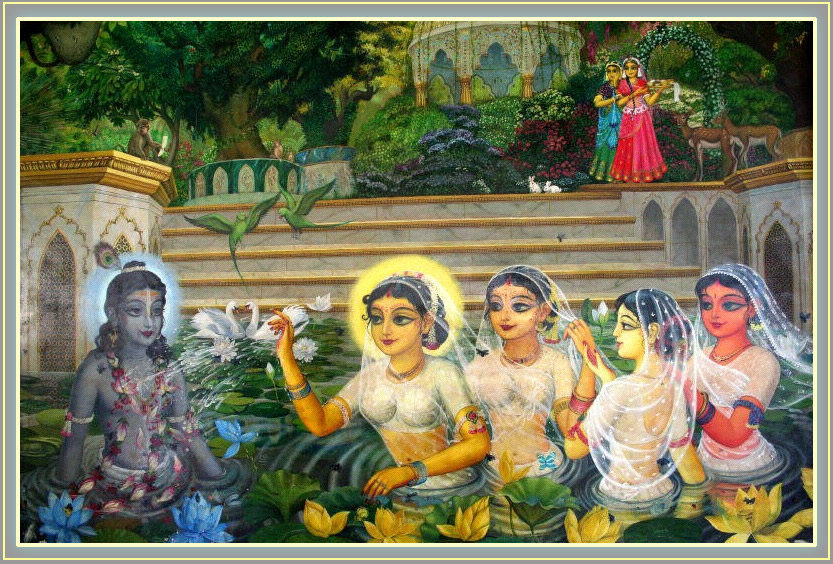
(1-7) S'rî S'uka said: 'The Master of the goddess of fortune resided happily in Dvârakâ. His city, opulent in every respect, was populated by the most prominent Vrishnis and their excellently, in new apparel dressed women, who in the beauty of their youth shone like lightening when they on the rooftops were playing with balls and other toys. Its roads were always crowded with well ornamented and honored elephants dripping with mada, with foot soldiers and horses and chariots shining with gold. The city was richly endowed with gardens and parks with rows of flowering trees, where from all sides the sounds of the bees and the birds were heard that frequented them. He [Krishna] enjoyed there with His sixteen thousand wives, for whom He, as their one and only love, had expanded Himself in their richly furnished residences in as many different forms [see also 10.69: 41]. There were crystal clear ponds filled with the cooing of flocks of birds and the aroma of the pollen of night and day blooming lotuses and water lilies. The Great Appearance sported there by diving into the water of the streams, whereby His body, being embraced by the women, was smeared with the kunkuma of their breasts. (8-9) Being glorified by the singers of heaven who played two-sided drums, kettledrums and tabors, as also by male and female reciters playing vînâs, His laughing wives squirted Him wet with syringes. Squirting them wet in His turn, He sported like the lord of the treasure keepers [Kuvera] with his nymphs. (10) With their clothes wet revealing their thighs and breasts, they looked resplendently as they, with the flowers of their large braids scattered all over the place and with blooming faces beaming wide smiles, tried to seize His syringe and under the spell of Cupid embraced their Spouse. (11) Like He was the king of the elephants surrounded by she-elephants, Krishna enjoyed the being sprayed by and spraying of the women, while the kunkuma from their breasts stuck to His garland and the arrangement of His wealth of hair was disheveled from being absorbed in the game. (12) Done playing Krishna gave the male and female performers, who earned their livelihood by singing and playing music, the ornaments and garments of Himself and His wives. (13) Krishna thus sporting, stole away the hearts of the wives with His movements, talks, glances and smiles, with His jokes, exchanges of love and embraces. (14) Having focussed their minds exclusively on Mukunda they, being entranced, spoke like they were mad. Now listen to me as I relate to you the words they spoke thinking about the Lotus-eyed One.
(15) The queens said [see also 10.47: 12-21, 10.83: 8-40]: 'Oh kurari, you are lamenting! Deprived of sleep you cannot rest, while the Controller tonight is sleeping somewhere in the world at an unknown place. Can it be that your heart, just like ours, oh friend, was deeply pierced by His smiling and the munificent, playful glance of His lotus eyes? (16) Oh cakravâkî, having closed your eyes for the night, you nevertheless are crying pitifully for your unseen friend. Or do you perhaps, after having attained the servitude, just like us desire to carry in your braided hair the garland that was honored by Acyuta's feet? (17) Oh dear, dear ocean, you are always making such a noise, never getting any sleep. Are you suffering from sleeplessness? Or were, maybe, your personal qualities stolen by Mukunda, so that you also ended up in this hard to cure [diseased] condition? (18) Oh moon, are you, in the grip of the fell disease of consumption, so emaciated that you cannot dispel the darkness with your rays? Or are you maybe dumbstruck, oh dearest, because you, just like us, cannot remember what Mukunda all said? (19) Oh wind from the Malaya mountains, what have we done that displeased you, so that our hearts are led by Cupid [Kâmadeva], hearts that are already torn apart by Govinda's sidelong glances? (20) Oh honorable cloud, you surely are a friend most dear to the Chief of the Yâdavas with the S'rîvatsa on His chest. We are, in our meditation on pure love, just as bound to Him as your good self is. Your most eager heart is just as distraught as ours. We, just like you, remember Him over and over. And that results in torrents of rain with you, just as it time and again makes us shed streams of tears. It can be so hurtful to associate with Him! (21) Oh sweet-throated cuckoo, please tell me what I should do to please you, who vibrate His so very dear sounds, in this voice that is capable of reviving the dead. (22) Oh mountain with your broad-minded intelligence, you do not move or speak. Are you preoccupied with great matters, or do you maybe, just like us, desire to hold on your breasts the feet of the darling son of Vasudeva? (23) Oh [rivers,] wives of the ocean, your lakes have alas lost their wealth of lotuses that shriveled away now that they dried up, just like us, who became very thin because of not obtaining the loving glance of our beloved husband, the Lord of Madhu, who so often stole our hearts [see also 10.47: 41 and 10.48: 11]? (24) Oh swan, be welcome and sit down, please drink some milk and tell us the news, oh dear one, for we know you to be a messenger of S'auri. Is the Unconquerable One all well? Does He, who is so fickle in His friendship, still remember that He talked to us a long time ago? Why should we [run after Him to] be of worship, oh servant of the campaka? Tell Him who raises the desire, to visit us without the goddess of fortune. Why should that woman have the exclusive right of devotion?'
(25) S'rî S'uka said: 'Speaking and acting with such ecstatic love for Krishna, the Master of Yoga masters, the wives of Lord Mâdhava attained the ultimate goal. (26) He, who in numerous songs is glorified in numerous ways, attracts with force the mind of any woman who but heard about Him. And how much more attractive would He then be to those who directly see Him? (27) How can we ever describe the austerities of the women who, with the idea of having as their husband the Spiritual Master of the Universe, with pure love served His feet perfectly with massages and so on? (28) Thus proceeding according to the dharma as defended by the Vedas, He, the Goal of all Saintly Souls, demonstrated how one at home may arrive at the regulation of one's religiosity, economic development and sense gratification [the purushârthas]. (29) With Krishna answering to the highest standard of a householder's life, there where over sixteen thousand and one hundred queens [see also 10.59** and 7.14]. (30) Among them there were eight gems of women, headed by Rukminî, who I, along with their sons, one after the other have described previously, oh King [see 10.83 & 10.61: 8-19]. (31) Krishna, the Supreme Lord Who Never Fails in His Purpose, begot in each of His many wives ten sons [and one daughter]. (32) Among these there were eighteen mahârathas of an unlimited prowess, whose fame spread wide. Hear now from me their names. (33-34) They were Pradyumna and [His son] Aniruddha; Dîptimân and Bhânu as also Sâmba, Madhu and Brihadbhânu; Citrabhânu, Vrika and Aruna; Pushkara and Vedabâhu, S'rutadeva and Sunandana; Citrabâhu and Virûpa, Kavi and Nyagrodha. (35) Oh best of kings, Pradyumna, the son of Rukminî, was the most prominent one of these sons of Krishna, the enemy of Madhu. He was just like His father. (36) He, the great chariot fighter, married the daughter of Rukmî [named Rukmavatî] from whom next Aniruddha was born who was endowed with the strength of a ten thousand elephants [see 10.61]. (37) He, as you know, married Rukmî's granddaughter [Rocana] from whom next His son Vajra was born, one of the few who survived the battle with the clubs [see 3.4: 1 & 2]. (38) Pratibâhu was his son, who next fathered Subâhu, whose son S'ântasena had S'atasena as his son. (39) No one born in this family was poor in wealth or had few children, was short-lived, small in prowess or neglecting the brahminical interest.
(40) The glorious deeds of the men born in the Yadu dynasty cannot be summed up, oh King, not even in a ten thousand years. (41) I heard that there were thirty-eight million eight-hundred thousand teachers for the children of the Yadu family. (42) Who can keep count of the Yâdavas when Ugrasena alone among its great personalities was assisted by ten thousand times ten thousand, hundreds of thousands of men [*]? (43) The most pitiless Daityas, who in [past ages in] wars between the gods and the demons had been killed, took their birth among the human beings and arrogantly troubled the populace. (44) In order to subdue them, the devas were by the Lord ordered to descend in the one hundred-and-one clans of the family, oh King [see 10.1: 62-63]. (45) Krishna, on account of His mastery, represented for all the Yâdavas who were His faithful followers, the authority of Lord Hari, and that is why they prospered. (46) Because the Vrishnis always thought of Krishna, they, in their activities of sleeping, sitting, walking, conversing, playing, bathing and so on, forgot the presence of their own bodies [and hence were fearless, see also 10.89: 14-17]. (47) Oh King, when Krishna took His birth among the Yadus, He outshone the pilgrimage site of the heavenly river [the Ganges] that washes from His feet. Because of His embodiment friends and foes attained their goal [7.1: 46-47]. The undefeated and supremely perfect goddess S'rî belongs to Him, she for whom others are struggling. His name, being heard or chanted, is what destroys the inauspiciousness. He settled the dharma for the lines of [disciplic] succession [the schools of the sages]. With Lord Krishna holding the weapon that is the wheel of Time [His cakra], it is no wonder that the burden of the earth was removed [see also 3.2: 7-12]. (48) He triumphs as the Ultimate Abode and is known as the son of Devakî. He is the devotion of the Yadu nobles who with His arms [or His devotees] puts an end to the unrighteous ones. He is the Destroyer of the distress of the moving and not-moving living beings. He is the One who, always smiling with His beautiful face, awakens Cupid in the damsels of Vraja [see 10.30-33, 10.35, 10.47]. (49) Thus proceeding with the wish to protect His transcendental path [of devotional service], He for the sake of His lîlâ has assumed various personal forms. With them imitating the [human] ways, He has destroyed the [burden of the] karma [belonging to them]. When one wants to follow His feet one will have to listen to the stories about this Best One among the Yadus. (50) A mortal who at every sacrificial ceremony hears about, sings about and meditates on the beautiful topics concerning Mukunda, heads from his home for His abode, the place where the inescapable sway of death is arrested. Even those who ruled this earth [like Dhruva and Priyavrata] went into the forest for this sake.'
Thus the tenth Canto of the S'rîmad Bhâgavatam ends named: The Summum Bonum.


Third revised edition, loaded January 19, 2022.
Previous Aadhar edition and Vedabase links:
S'rî S'uka said: 'The Master of the goddess of fortune resided happily in Dvârakâ. His city, opulent in every respect, was populated by the most prominent Vrishnis and their excellently, in new apparel dressed women, who in the beauty of their youth shone like lightening when they on the rooftops were playing with balls and other toys. Its roads were always crowded with well ornamented and honored elephants dripping with mada, with foot soldiers and horses and chariots shining with gold. The city was richly endowed with gardens and parks with rows of flowering trees, where from all sides the sounds of the bees and the birds were heard that frequented them. He [Krishna] enjoyed there with His sixteen thousand wives, for whom He, as their one and only love, had expanded Himself in their richly furnished residences in as many different forms [see also 10.69: 41]. There were crystal clear ponds filled with the cooing of flocks of birds and the aroma of the pollen of night and day blooming lotuses and water lilies. The Great Appearance sported there by diving into the water of the streams, whereby His body, being embraced by the women, was smeared with the kunkuma of their breasts.S'rî S'uka said: 'The Master of the goddess of fortune resided happily in Dvârakâ, His own city opulent in all features and populated by the most prominent Vrishnis. When the finest of their women, dressed in new clothes, in the beauty of their youth were playing with balls and other toys on the rooftops, shone they like lightening. Its roads were always crowded with well ornamented elephants intoxicated dripping with mada, footsoldiers and horses and chariots brilliant with gold. The city was richly endowed with gardens and parks with rows of flowering trees everywhere filled with the sounds of the bees and birds frequenting them. Enjoying His sixteen thousand wives as their one and only love had He in their richly furnished residences expanded in as many different forms [see also 10.69: 41]. Diving in the pellucid waters where there was the cooing of flocks of birds and the aroma of the pollen of nightblooming and dayblooming lotuses and water lilies, sported the Great Appearance in the streams whereby His body, being embraced by the women, was smeared with the kunkuma of their breasts. (Vedabase)
Being glorified by the singers of heaven who played two-sided drums, kettledrums and tabors, as also by male and female reciters playing vînâs, His laughing wives squirted Him wet with syringes. Squirting them wet in His turn, He sported like the lord of the treasure keepers [Kuvera] with his nymphs.
By the singers of heaven playing two-sided drums, kettledrums and tabors and by female and male praisers playing vînâs being glorified, was Acyuta with syringes by His wives laughing squirted with water and squirted He back, thus sporting like the lord of the treasurekeepers [Kuvera] does with his nymphs. (Vedabase)
With their clothes wet revealing their thighs and breasts, they looked resplendently as they, with the flowers of their large braids scattered all over the place and with blooming faces beaming wide smiles, tried to seize His syringe and under the spell of Cupid embraced their Spouse.
Sprinkling revealed they with wet clothes their thighs and breasts and tried they, with the flowers of their large braids scattered all over the place, with resplendent faces beaming wide smiles, to embrace Him in snatching away the syringe of their Consort. (Vedabase)
Like He was the king of the elephants surrounded by she-elephants, Krishna enjoyed the being sprayed by and spraying of the women, while the kunkuma from their breasts stuck to His garland and the arrangement of His wealth of hair was disheveled from being absorbed in the game.
As Krishna with on His garland the kunkuma from their breasts, and the order of His mass of hair disheveled from His absorption in the sport, enjoyed the being sprayed and spraying of the women, was He like the king of the elephants surrounded by she-elephants. (Vedabase)
Done playing Krishna gave the male and female performers, who earned their livelihood by singing and playing music, the ornaments and garments of Himself and His wives.
Done playing gave Krishna the male and female performers who earned their livelihoods by singing and playing music, the ornaments and garments of Him and His wives. (Vedabase)
Krishna thus sporting, stole away the hearts of the wives with His movements, talks, glances and smiles, with His jokes, exchanges of love and embraces.
Thus were in the play of Krishna's sporting, His movements, His conversing, glancing and smiling; of His jokes, exchanges of love and embraces, the hearts of the wives stolen. (Vedabase)
Having focussed their minds exclusively on Mukunda they, being entranced, spoke like they were mad. Now listen to me as I relate to you the words they spoke thinking about the Lotus-eyed One.
With their minds exclusively focussed on Mukunda spoke they stunned like they were mad. Now listen to me as I relate to you these words resulting from this thinking about the Lotus-eyed One. (Vedabase)
The queens said [see also 10.47: 12-21, 10.83: 8-40]: 'Oh kurari, you are lamenting! Deprived of sleep you cannot rest, while the Controller tonight is sleeping somewhere in the world at an unknown place. Can it be that your heart, just like ours, oh friend, was deeply pierced by His smiling and the munificent, playful glance of His lotus eyes?
The queens said [see also 10.47: 12-21, 10.83: 8-40]: 'O kurari you are lamenting, deprived of sleep you cannot rest while the Controller somewhere in the world in an unknown place is sleeping this night. Is it that you, like us o friend, had your heart pierced to the core by the smiling, munificent, playful glance of His lotus eyes? (Vedabase)
Oh cakravâkî, having closed your eyes for the night, you nevertheless are crying pitifully for your unseen friend. Or do you perhaps, after having attained the servitude, just like us desire to carry in your braided hair the garland that was honored by Acyuta's feet?
O cakravâkî, alas, having closed your eyes for the night, you're crying pitifully. Or do you, having attained the servitude, perhaps like us desire in your braided hair the garland honored by Acyuta's feet? (Vedabase)
Oh dear, dear ocean, you are always making such a noise, never getting any sleep. Are you suffering from sleeplessness? Or were, maybe, your personal qualities stolen by Mukunda, so that you also ended up in this hard to cure [diseased] condition?
O dear, dear ocean, you're always making such a noise, never getting any sleep. Do you suffer insomnia? Or were maybe your personal qualities stolen by Mukunda and have you also reached the state from which there is no escape? (Vedabase)
Oh moon, are you, in the grip of the fell disease of consumption, so emaciated that you cannot dispel the darkness with your rays? Or are you maybe dumbstruck, oh dearest, because you, just like us, cannot remember what Mukunda all said?
O moon are you, seized by the fell disease of consumption, so emaciated that you can't dispel the darkness with your rays? Or is it that you appear so stunned to us, o dear, because you, like us, can't remember the talks of Mukunda? (Vedabase)
Oh wind from the Malaya mountains, what have we done that displeased you, so that our hearts are led by Cupid [Kâmadeva], hearts that are already torn apart by Govinda's sidelong glances?
O wind from the Malaya mountains, what have we done that would have displeased you so that we are inspired with lust in our hearts, hearts that are already torn apart by Govinda's sidelong glances? (Vedabase)
Oh honorable cloud, you surely are a friend most dear to the Chief of the Yâdavas with the S'rîvatsa on His chest. We are, in our meditation on pure love, just as bound to Him as your good self is. Your most eager heart is just as distraught as ours. We, just like you, remember Him over and over. And that results in torrents of rain with you, just as it time and again makes us shed streams of tears. It can be so hurtful to associate with Him!
O you honorable cloud, you sure are a friend most dear to the Chief of the Yâdavas with the S'rîvatsa on His chest. We, just as your good self, are bound to Him in our meditation on the pure of love. Your most eager heart is as distraught as ours. The same way as you, do we remember Him over and over and results that in torrents of rain with you and gives that us streams of tears again and again. That is the pain one suffers in association with Him. (Vedabase)
Oh sweet-throated cuckoo, please tell me what I should do to please you, who vibrate His so very dear sounds, in this voice that is capable of reviving the dead.
O sweet-throated cuckoo, please tell me what I should do to please you who, in this voice able to revive the dead, are uttering the vibrations of Him whose sounds are so dear. (Vedabase)
Oh mountain with your broad-minded intelligence, you do not move or speak. Are you preoccupied with great matters, or do you maybe, just like us, desire to hold on your breasts the feet of the darling son of Vasudeva?
O mountain so broad in your intelligence, you do not move or speak. Are you preoccupied with great matters, or do you maybe like us desire to hold the feet of the darling son of Vasudeva on your breasts? (Vedabase)
Oh [rivers,] wives of the ocean, your lakes have alas lost their wealth of lotuses that shriveled away now that they dried up, just like us, who became very thin because of not obtaining the loving glance of our beloved husband, the Lord of Madhu, who so often stole our hearts [see also 10.47: 41 and 10.48: 11]?
O [rivers,] wives of the ocean, your lakes alas have lost their wealth of lotuses, now they just like us dried up emaciated of not obtaining the loving glance of our beloved husband, the Lord of Madhu, who so often cheated our hearts [see also 10.47: 41 and 10.48: 11]. (Vedabase)
Oh swan, be welcome and sit down, please drink some milk and tell us the news, oh dear one, for we know you to be a messenger of S'auri. Is the Unconquerable One all well? Does He, who is so fickle in His friendship, still remember that He talked to us a long time ago? Why should we [run after Him to] be of worship, oh servant of the campaka? Tell Him who raises the desire, to visit us without the goddess of fortune. Why should that woman have the exclusive right of devotion?'
O swan, be welcome and sit down, please drink some milk, tell us o dear one the news, for we know you are a messenger of S'auri. Is the Unconquerable One all well? Does He who is so fickle in His friendship still remember that He talked to us so long ago? Why should we [run after Him to] be of worship, o servant of the campaka [a type of magnolia]? Tell Him who raises the desire that He must visit us without the goddess of fortune. Why would that woman have the exclusive right of devotion?' (Vedabase)
S'rî S'uka said: 'Speaking and acting with such ecstatic love for Krishna, the Master of Yoga masters, the wives of Lord Mâdhava attained the ultimate goal.
S'rî S'uka said: 'Speaking and acting with such ecstatic love for Krishna, the Master of the Yogamasters, attained the wives of Lord Mâdhava the ultimate goal. (Vedabase)
He, who in numerous songs is glorified in numerous ways, attracts with force the mind of any woman who but heard about Him. And how much more attractive would He then be to those who directly see Him?
He, in numerous songs glorified in numerous ways, attracts with force the mind of any woman who but heard about Him. And what then would that mean to those who directly see Him? (Vedabase)
How can we ever describe the austerities of the women who, with the idea of having as their husband the Spiritual Master of the Universe, with pure love served His feet perfectly with massages and so on?
How ever can the abnegations be described of the women who with the idea of having Him, the Spiritual Master of the Universe, as their husband, with pure love served His feet perfectly with massages and so on? (Vedabase)
Thus proceeding according to the dharma as defended by the Vedas, He, the Goal of all Saintly Souls, demonstrated how one at home may arrive at the regulation of one's religiosity, economic development and sense gratification [the purushârthas].
This manner proceeding according the dharma as defended by the Vedas, demonstrated He, the Goal of the Saintly, how one's home is the place to regulate one's religiosity, economic development and sense gratification [the purushârthas]. (Vedabase)
With Krishna answering to the highest standard of a householder's life, there where over sixteen thousand and one hundred queens [see also 10.59** and 7.14].
With Krishna answering to the higest standard of a householder's life, where there over sixteen thousand and one hundred queens [see also 10.59** and 7.14]. (Vedabase)
Among them there were eight gems of women, headed by Rukminî, who I, along with their sons, one after the other have described previously, oh King [see 10.83 & 10.61: 8-19].
Among them there were eight gems of women headed by Rukminî whom I along with their sons one after the other described previously [see 10.83 en 10.61: 8-19], o King. (Vedabase)
Krishna, the Supreme Lord Who Never Fails in His Purpose, begot in each of His many wives ten sons [and one daughter].
In each of His many wives begot Krishna, the Supreme Lord Never Failing in His Effort, ten sons [and one daughter]. (Vedabase)
Among these there were eighteen mahârathas of an unlimited prowess, whose fame spread wide. Hear now from me their names.
Of these there were eighteen mahârathas of an unlimited prowess, whose fame spread wide; hear their names from me. (Vedabase)
They were Pradyumna and [His son] Aniruddha; Dîptimân and Bhânu as also Sâmba, Madhu and Brihadbhânu; Citrabhânu, Vrika and Aruna; Pushkara and Vedabâhu, S'rutadeva and Sunandana; Citrabâhu and Virûpa, Kavi and Nyagrodha.
They were Pradyumna and [His grandson or other son] Aniruddha; Dîptimân and Bhânu as also Sâmba, Madhu and Brihadbhânu; Citrabhânu, Vrika and Aruna; Pushkara and Vedabâhu, S'rutadeva and Sunandana; Citrabâhu and Virûpa, Kavi and Nyagrodha. (Vedabase)
Oh best of kings, Pradyumna, the son of Rukminî, was the most prominent one of these sons of Krishna, the enemy of Madhu. He was just like His father.
O best of kings, of these sons of Krishna, the enemy of Madhu, was Pradyumna, the son of Rukminî, the most prominent one. He was just like His father. (Vedabase)
He, the great chariot fighter, married the daughter of Rukmî [named Rukmavatî] from whom next Aniruddha was born who was endowed with the strength of a ten thousand elephants [see 10.61].
He, the great chariot fighter, married the daughter of Rukmî [named Rukmavatî] from whom then was born Aniruddha who was endowed with the strength of a ten thousand elephants [see 10.61]. (Vedabase)
He, as you know, married Rukmî's granddaughter [Rocana] from whom next His son Vajra was born, one of the few who survived the battle with the clubs [see 3.4: 1 & 2].
Furthermore took He, as you know, next Rukmî's granddaughter [Rocana] for His wife and from her was His son Vajra born, the only one to remain after the battle with the clubs [see 3.4: 1 & 2]. (Vedabase)
Pratibâhu was his son, who next fathered Subâhu, whose son S'ântasena had S'atasena as his son.
Pratibâhu came from him, of whom there was Subâhu and from Subâhu's son S'ântasena came S'atasena as his son. (Vedabase)
No one born in this family was poor in wealth or had few children, was short-lived, small in prowess or neglecting the brahminical interest.
Truly none of the offspring appearing in this family was poor in wealth or children, short-lived, small in prowess or neglecting the brahminical. (Vedabase)
The glorious deeds of the men born in the Yadu dynasty cannot be summed up, oh King, not even in a ten thousand years.
The deeds of fame of the men born in the Yadu-dynasty are innumerable, o King, not even in tens of thousands of years one could sum them up. (Vedabase)
I heard that there were thirty-eight million eight-hundred thousand teachers for the children of the Yadu family.
It was heard that for the children of the Yadu family there were thirty-eight million eight-hundred thousand teachers. (Vedabase)
Who can keep count of the Yâdavas when Ugrasena alone among its great personalities was assisted by ten thousand times ten thousand, hundreds of thousands of men [*]?
Who can keep count of the Yâdavas when Ugrasena alone was present among them with tens upon ten thousands upon hundreds of thousands [*] of great personalities? (Vedabase)
The most pitiless Daityas, who in [past ages in] wars between the gods and the demons had been killed, took their birth among the human beings and arrogantly troubled the populace.
The most pitiless Daityas who in wars between the enlightened and unenlightened souls were killed, took their birth among the human beings and arrogantly gave trouble to the populace. (Vedabase)
In order to subdue them, the devas were by the Lord ordered to descend in the one hundred-and-one clans of the family, oh King [see 10.1: 62-63].
To subdue them were the devas by the Lord told to descend in the one hundred-and-one clans of the family o King [see 10.1: 62-63]. (Vedabase)
Krishna, on account of His mastery, represented for all the Yâdavas who were His faithful followers, the authority of Lord Hari, and that is why they prospered.
To them was Krishna on account of His mastery the authority of Lord Hari because of which all the Yâdavas who were His faithful followers prospered. (Vedabase)
Because the Vrishnis always thought of Krishna, they, in their activities of sleeping, sitting, walking, conversing, playing, bathing and so on, forgot the presence of their own bodies [and hence were fearless, see also 10.89: 14-17].
In their activities of sleeping, sitting, walking, conversing, playing, bathing and so on were the Vrishnis who always thought of Krishna not aware of the presence of their own bodies [and thus fearless, see also 10.89: 14-17]. (Vedabase)
Oh King, when Krishna took His birth among the Yadus, He outshone the pilgrimage site of the heavenly river [the Ganges] that washes from His feet. Because of His embodiment friends and foes attained their goal [7.1: 46-47]. The undefeated and supremely perfect goddess S'rî belongs to Him, she for whom others are struggling. His name, being heard or chanted, is what destroys the inauspiciousness. He settled the dharma for the lines of [disciplic] succession [the schools of the sages]. With Lord Krishna holding the weapon that is the wheel of Time [His cakra], it is no wonder that the burden of the earth was removed [see also 3.2: 7-12].
O King, taking birth among the Yadus outshone He the site of pilgrimage of the river of heaven [the Ganges] that washes from His feet. With His embodiment attained friends and foes their goal [7.1: 46-47]. His is the undefeated and supremely perfect goddess of S'rî for whom others are struggling. His name heard or chanted is what destroys the inauspiciousness. By Him was the dharma settled for the lines of descend [of the sages]. With Lord Krishna, whose weapon is the wheel of Time, is this removal of the earth's burden nothing wonderous [see also 3.2: 7-12]. (Vedabase)
He triumphs as the Ultimate Abode and is known as the son of Devakî. He is the devotion of the Yadu nobles who with His arms [or His devotees] puts an end to the unrighteous ones. He is the Destroyer of the distress of the moving and not-moving living beings. He is the One who, always smiling with His beautiful face, awakens Cupid in the damsels of Vraja [see 10.30-33, 10.35, 10.47].
He glorious as the Ultimate Abode and known as the son of Devakî, He who as the devotion of the Yadu nobles with His arms [or devotees] puts an end to the unrighteous, He who is the Destroyer of the Distress of the Moving and Nonmoving Beings, is the One who always smiling with His beautiful face arouses Cupid with the damsels of Vraja [see 10.30-33, 10.35, 10.47]. (Vedabase)
Thus proceeding with the wish to protect His transcendental path [of devotional service], He for the sake of His lîlâ has assumed various personal forms. With them imitating the [human] ways, He has destroyed the [burden of the] karma [belonging to them]. When one wants to follow His feet one will have to listen to the stories about this Best One among the Yadus.
Proceeding this way with the Supreme has He with the desire to protect His own path for His lîlâ assumed various personal forms and has He imitating the [human] ways destroyed the karma. When one wants to follow His feet will one have to listen to the stories about the Best One of the Yadus. (Vedabase)
A mortal who at every sacrificial ceremony hears about, sings about and meditates on the beautiful topics concerning Mukunda, heads from his home for His abode, the place where the inescapable sway of death is arrested. Even those who ruled this earth [like Dhruva and Priyavrata] went into the forest for this sake.'
At every sacrifice hearing, singing and meditating on the beautiful topics about Mukunda, does a mortal from his home head for His abode, where the inescapable push of death comes to a stop. Even the ones ruling the earth [like Dhruva and Priyavrata] went for the sake of this purpose into the forest.' (Vedabase)
*: The paramparâ adds here that according to the rules of Mîmâmsâ interpretation the number of three is taken as the default number when no specific number is given. So literally would strict to the rules be said here that Ugrasena would have had 30 trillion attendants.

The text and audio are offered under the
conditions of the
Creative
Commons
Attribution-Noncommercial-Share
Alike 3.0 Unported License.
The painting 'Water Party" (detail) is used with permission,
courtesy by Vrindavan
Das.
Production: Filognostic
Association of The Order of Time.,

Feed-back | Links | Downloads | Music | Pictures | What's New | Search | Donations



 Text 1-7