
Canto
10
Chapter 1: The Advent of Lord Krishna: Introduction
(1) The honorable king said: 'Your Lordship extensively described both the dynasties of the kings of the sun god and the moon god, as also the most wonderful deeds of their members [*]. (2) Please describe to us the heroic acts of Lord Vishnu who [together with His plenary expansion Sankarshana in the form of Baladeva] appeared as an incarnation in [two] different parts in the line of the most dharmic and virtuous Yadus, whom you also described to us, oh best of the munis. (3) Be so kind to tell us all about the actions of the Supreme Lord, the Soul of the Universe, the Cause of the Manifestation, after He descended in the Yadu dynasty. (4) [By the disciplic succession or the paramparâ] listening to the pleasing vibrations of the glorification of the Lord Praised in the Verses, constitutes the proper medicine for the mind to be released from the material disease of its desires. Unless he is a killer of animals, a person can become free [from the falsehood, see also B.G. 2: 44] by listening to and voicing such descriptions. (5-7) When in the past, on the battlefield, my grandfathers [the Pândavas] were fighting with imperishable warriors, like Devavrata [Bhîshma] and other great commanders who were like timingilas [shark-eaters], they crossed the so very difficult to overcome ocean of Kaurava soldiers in the boat that He is, as easily as one steps over a calf's hoof print. This body of mine, the only seed left of the Kurus and Pândavas, was scorched by As'vatthâmâ's weapon when I resided in the womb of my mother, but it was by Him, [Krishna,] holding the cakra in His hand, protected because my mother sought His protection [1.8: 11 and 1.12: 7]. Oh man of learning, please describe the glories of the Lord who, by His own potency, appeared as a normal human being, of Him, the Giver of Death and Eternal Life, as one calls Him, of Him who manifests Himself in physical forms bound to time, of Him, the Original Person who is present both inside and outside of all the embodied beings. (8) We know from you about Balarâma, who is Sankarshana, that He is the son of Rohinî. How could He, without assuming another body, be connected with the womb of Devakî? (9) Why did Mukunda, the Supreme Lord move from the house of His father to [the house of Nanda in] Vraja, and where did He, the Master of the devotees, live with His relatives? (10) What did He do when He lived in Vraja and when He resided in the city of Mathurâ? Why did He, the killer of Kes'î, kill His uncle Kamsa, His mother's brother? Is that not something completely at odds with the scriptures? (11) For how many years did He, who assumed a human body, live with the Vrishnis, and how long lived He in the city of the Yadus [Dvârakâ]? How many wives had the Master? (12) Oh sage, you know everything. You are the one to tell us about Lord Krishna's activities. Please describe this all in detail to me so full of faith and surrender, as also everything more to say. (13) Now that I drink the nectar of the talks about the Lord that emanate from your lotus mouth, it is not even difficult to bear the hunger [of my fasting] or my forsaking of water.'
(14) Sûta [see 1.1] said: "Oh son of Bhrigu [S'aunaka], after the mighty son of Vyâsa, the purest of all devotees, had heard his pious questions, the devotee of Vishnu paid his respects. Next he began to describe the topics of Krishna that put an end to the darkness of Kali-yuga [compare 1.7: 2-8]. (15) S'rî S'uka said: 'Oh best of the wise kings, because of your lasting attraction for the stories about Vâsudeva [Krishna as the son of Vasudeva], your intelligence has developed a firm determination. (16) The way the world is purified by the [Ganges] water that flows from His toes [5.17: 1], the three persons of the speaker, the inquirer and the one attending are purified by questions concerning the stories about Vâsudeva. (17) When mother earth was overcome by an unbearable burden of countless numbers of conceited Daitya military forces [9.24: 67] and their so-called nobles, she [one day] went to Lord Brahmâ to take shelter. (18) Assuming the form of a cow she, greatly distressed weeping piteously, appeared before the Almighty One [see also 1.16: 18] and submitted her complaints. (19) Lord Brahmâ, with understanding for her predicament, thereupon together with her, the godly souls and the Three-Eyed One [Lord S'iva], approached the shore of the milk ocean [wherein Vishnu resides, see also 8.7: 41]. (20) Reaching there they, fully attentive, with the help of the [Purusha-sûkta] hymns worshiped the Original Person, the Supreme Personality, the God of Gods and Master of the Universe, who takes care of all.
(21) The lord of the Veda [Brahmâ] heard in his trance a vibration of words in the sky [see also 1.1: 1]. He said to the servants of the three worlds, the demigods: 'Hear further from me about the order of the Original Person, oh immortal souls. Execute these instructions immediately, do not delay. (22) Before we came here, the Personality of Godhead knew already about the distress of mother earth. Together with your good selves as His parts, He wants to manifest Himself by taking birth in the family of the Yadus. He wants you to be there with Him [for the fulfillment of His mission] for as long as He, the Lord of Lords, with His potency of Time, moves around on this earth to diminish the burden of the planet. (23) The Supreme Lord, the original transcendental person, will personally appear in the house of Vasudeva, and He also wants all the wives of the demigods to take birth to please Him. (24) Before Lord Vâsudeva appears, first the part of Hari, known as the fully independent Ananta with the thousands of hoods [Sankarshana, see also 5.25], will appear [as Baladeva] with the desire to please [Him]. (25) By the Master being ordered to appear and to manage His affairs, [the grace of Vishnu known as the female incarnation of His potency called] Vishnu-mâyâ will also appear together with all her different potencies, she who is as good as the Supreme Lord Himself and who captivates all the worlds [see also B.G. 9: 12 & 13].'
(26) S'rî S'uka said: 'After thus having pacified mother earth with sweet words and having informed the immortals, the supreme master of the founding fathers returned to his supreme abode. (27) In the past S'ûrasena, the king of the Yadus [see 9.23: 27], lived in the city of Mathurâ, from where he ruled the different districts Mâthura and S'ûrasena. (28) Mathurâ, the city intimately connected with the Supreme Lord Hari, from that time on was the capital for all the kings of Yadu [see also the bhajan Sâvarana S'rî Gaura Mahimâ]. (29) It was in that place that one day the divine character of Vasudeva, after having married Devakî, together with his bride mounted a chariot to return home. (30) Kamsa, the son of Ugrasena, held, in order to please his sister on the occasion, the reins of the horses in the midst of thousands of golden chariots. (31-32) When she left home, king Devaka, who was fond of his daughter, had given a dowry of four hundred elephants with golden garlands, ten thousand horses together with eighteen hundred chariots, and a hundred young and attractive maidservants complete with jewelry. (33) My dearest King, when they departed, conch shells, bugles, drums and kettledrums vibrated in concert to wish the bride and bridegroom all the best. (34) Being on their way, a voice from beyond addressed Kamsa who held the reins: 'The eighth child of this girl you are carrying with you, oh fool, will put an end to your life!'
(35) Thus being addressed he, who mischievous and sinful in the past had degraded the Bhoja family, took up a sword against his sister and grabbed her by her hair with the intention to kill her. (36) In order to pacify him who was ready to commit such a heinous and shameless crime, Vasudeva, that greatly fortunate soul, addressed him. (37) S'rî Vasudeva said: 'A man of so many praiseworthy qualities, such a brilliant star among the heroic Bhojas like you, how can you kill your own sister, a woman, especially at the time of her marriage [see also 1.7: 53-54]? (38) Death is included with the body that was born. Whether one dies today or in a hundred years, ultimately every living being is sure to die [see also B.G. 2: 27-28]. (39) When the body has to return to the five elements, the indweller automatically, according to his own karma, receives a new body upon abandoning the old one. (40) The way a person as he walks, changes from one foot to the other, and the way a caterpillar, on a plant [moves from one leaf to another], a living being likewise has to experience the consequences of his karma [see also B.G. 2: 22 and 2: 13]. (41) Just as one in a dream, being endowed with the qualities of a material body, is subjected to that what the mind is thinking and one's consciousness is fully absorbed by that what one hears and sees, one is the same way forgetful in one's present body [about the body and karma acquired in a previous life, see also 4.29: 60-79 and 5.26]. (42) The mind, impelled by fate and deliberation, moves from one position to the next, so that the embodied soul, after the demise of its physical frame, obtains a birth and arrives at a [new] body in accordance with the material quality [and the evolution] he was experiencing [B.G. 13: 22, 14: 14-15 and 6: 34-35]. (43) The way the reflection of the luminaries, as one may observe them in water or other liquids, being moved by the wind offers distortions in different shapes, the person, the living entity, likewise, in the situation that was created by his own imaginative power in association with the natural modes [the world with its changing qualities], gets bewildered depending his attachments [to different bodies or distortions of his form. See also 5.5: 4 and B.G. 9: 12-13, 12: 5]. (44) Therefore everyone, to the interest of his own welfare [and good rebirth], should not harm anybody, for the evil-doer has to live in fear for others himself [the 'golden rule']. (45) This innocent woman, your younger sister, completely depends on you like she was your own daughter - do not kill her. She means good to you and she deserves your care and compassion!'
(46) S'rî S'uka said: 'He, feeling no pity, could, by these attempts of good advise, not be stopped or pacified, oh son of Kuru, for he followed the course of the man-eaters [the Râkshasas]. (47) Seeing his determination, Vasudeva thought deeply about how he, with this immediate threat of death, could stop him, and thus he arrived at the following alternative. (48) [He thought:] 'An intelligent person should, as long as he is in control of his mental and physical faculties, ward off death, but when someone is faced with the inevitability of death, this rule does not apply. (49-50) If I promise to deliver my sons to this man of doom, I might set my innocent Devakî free. Perhaps I do not get any sons or maybe he will die beforehand. That might happen or the contrary. Who knows what fate has in store for us? That is difficult to say. Even though the threat remains hereafter, I, at least for the moment, may avert her death. (51) When a piece of wood for some reason escapes from a fire, that is decided by providence and nothing else. Even so one cannot determine why a living being assumes or abandons a [particular] body.' (52) After contemplating this way to the best of his ability, the God-fearing man paid the sinner his obeisances and submitted the proposal to him with the greatest attention. (53) With a big lotuslike smile on his face, but with anxiety and sorrow in his heart, he then spoke to the cruel-hearted, shameless man. (54) S'rî Vasudeva said: 'You have, according to what the voice from heaven vibrated, nothing to fear from Devakî indeed. Her sons gave rise to your anxiety and I shall deliver them therefore all to you.'
(55) S'rî S'uka said: 'Kamsa, understanding the essence of what he said, was for the time being stopped from killing his sister. With him more at ease, Vasudeva then was happy to come home [unharmed]. (56) Thereafter in due course of time Devakî, the mother of all divinity [see 4.31: 14 and B.G. 10: 2], year after year gave birth to indeed [as said in 9.24: 53-55] eight sons and a daughter. (57) Most afraid to break his promise Ânakadundubhi [or Vasudeva, see 9.24: 28-31] with great pain handed his first born baby, Kîrtimân, over to Kamsa. (58) What would be too painful for a saint, on what would a sage depend, what would be forbidden to a bad person and what would for someone holding on to the soul be too hard to forsake? (59) Oh King, when Kamsa saw that Vasudeva was equanimous, truthful and certain of himself, he, satisfied about that, with a grin on his face said: (60) 'You can take this child back, my fear does not concern him, my death was predicted from the eighth pregnancy you have with your wife.'
(61) 'Very well', Ânakadundubhi said, took his son back and left without attaching too much value to the words of that untruthful character lacking in self-control. (62-63) Oh scion of Bharata, beginning with Nanda [Krishna's foster father] all the inhabitants of Vraja, all the cowherds and their wives, as also all the Vrishnis beginning with Vasudeva and Devakî, and the Yadu women, in truth were gods from heaven indeed. And also the relatives, friends and well-wishers following Kamsa were of that nature [see also verse 22 and B.G. 6: 41-42]. (64) This was all communicated to Kamsa by the all-powerful Nârada [**], who paid him a visit in order to tell him that all the Daityas who burdened the earth were going to be killed [see verse 17 and also 9.24: 56]. (65-66) After the rishi had left Kamsa thought that all the Yadus were divine and that therefore any child born from Devakî could be Vishnu. He thus in fear of his own death arrested Vasudeva and Devakî, confined them at home in shackles and killed, one after the other, each of their newborn sons, not knowing whether it would be the 'Never-born' Lord or not [***]. (67) Kings like him, who on this earth are driven by animalistic pleasures and greed, usually put to death mothers, fathers, brothers, friends or anyone else. (68) He had understood [from Nârada] that he in a previous life, as the great Asura Kâlanemi, personally had been killed by Vishnu [see 8.10: 56]. Therefore he, born again in this world, became an enemy of the Yadu dynasty [that carried the blessings of Vishnu]. (69) He, the almighty ruler, subdued [and imprisoned] his own father Ugrasena, the king of the Yadus, Bhojas and Andhakas, so that he could enjoy the states of S'ûrasena all by himself.'
Third revised edition, loaded April 3, 2020.
Previous Aadhar edition and Vedabase links:
The honorable king said: 'Your Lordship extensively described both the dynasties of the kings of the sun god and the moon god, as also the most wonderful deeds of their members [*].The honorable king said: 'Your Lordship extensively both described the dynasties of the kings of the sun- and moon-god and the exalted and wonderful characters of their members [*]. (Vedabase)
Please describe to us the heroic acts of Lord Vishnu who [together with His plenary expansion Sankarshana in the form of Baladeva] appeared as an incarnation in [two] different parts in the line of the most dharmic and virtuous Yadus, whom you also described to us, oh best of the munis.
Please describe to us Lord Vishnu who appeared as an incarnation in parts [that is: the full of Him along with His plenary expansion Sankarshana here being Baladeva] in the line of the strictly dharmic, well-behaved Yadus you also described, o best of the munis. (Vedabase)
Be so kind to tell us all about the actions of the Supreme Lord, the Soul of the Universe, the Cause of the Manifestation, after He descended in the Yadu dynasty.
Be so kind to tell us all about whatever the Supreme Lord, the Cause of the Manifestation, did after descending in the Yadu dynasty. (Vedabase)
[By the disciplic succession or the paramparâ] listening to the pleasing vibrations of the glorification of the Lord Praised in the Verses, constitutes the proper medicine for the mind to be released from the material disease of its desires. Unless he is a killer of animals, a person can become free [from the falsehood, see also B.G. 2: 44] by listening to and voicing such descriptions.
The hearing [through the paramparâ] of the pleasing vibrations of the glorification of the Lord Praised in the Verses is the right medicine by which the mind is released from the material disease of its desires; a person, unless he is a killer of animals, can by such descriptions heard or sung keep himself away [from the falsehood, control himself, see also B.G. 2: 44]. (Vedabase)
When in the past, on the battlefield, my grandfathers [the Pândavas] were fighting with imperishable warriors, like Devavrata [Bhîshma] and other great commanders who were like timingilas [shark-eaters], they crossed the so very difficult to overcome ocean of Kaurava soldiers in the boat that He is, as easily as one steps over a calf's hoof print. This body of mine, the only seed left of the Kurus and Pândavas, was scorched by As'vatthâmâ's weapon when I resided in the womb of my mother, but it was by Him, [Krishna,] holding the cakra in His hand, protected because my mother sought His protection [1.8: 11 and 1.12: 7]. Oh man of learning, please describe the glories of the Lord who, by His own potency, appeared as a normal human being, of Him, the Giver of Death and Eternal Life, as one calls Him, of Him who manifests Himself in physical forms bound to time, of Him, the Original Person who is present both inside and outside of all the embodied beings.
My grandfathers [the Pândavas] on the battlefield with imperishable fighters like Devavrata [Bhîshma] and other great commanders that were like timingilas [shark-eaters], in the past by the boat of Him crossed as easily the so very difficult to overcome ocean of Kaurava soldiers as one steps over a calf's hoofprint. This body of mine, the only seed of the Kurus and Pândavas left, was, doomed to perish by As'vatthâmâ's weapon, by Him, cakra in hand, protected, positioned within the womb of my mother who also had taken to the shelter of Him [1.8: 11 and 1.12: 7]. O man of learning, please describe the glories of the Lord who appeared as a normal human being, of the giver of death and eternal life as one says, of Him who in forms of Time is the Original Person inside as well as outside of the complete of all embodied beings. (Vedabase)
We know from you about Balarâma, who is Sankarshana, that He is the son of Rohinî. How could He, without assuming another body, be connected with the womb of Devakî?
Balarâma, who is Sankarshana, from you we know as the son of Rohinî; how can He without switching bodies be connected with the womb of Devakî? (Vedabase)
Why did Mukunda, the Supreme Lord move from the house of His father to [the house of Nanda in] Vraja, and where did He, the Master of the devotees, live with His relatives?
Why went Mukunda, the Supreme Lord from the house of His father to Vraja and where did He, the Master of Vishnu's adherents, situate Himself with His relatives?(Vedabase)
What did He do when He lived in Vraja and when He resided in the city of Mathurâ? Why did He, the killer of Kes'î, kill His uncle Kamsa, His mother's brother? Is that not something completely at odds with the scriptures?
Residing in Vraja and the city of Mathurâ, what did He do and why did He, the killer of Kes'î, kill Kamsa the brother of His mother, which is something against the scriptures!? (Vedabase)
For how many years did He, who assumed a human body, live with the Vrishnis, and how long lived He in the city of the Yadus [Dvârakâ]? How many wives had the Master?
For how many years did He, assuming a human body, live with the Vrishnis and lived He in the city of the Yadus [Dvârakâ]; and how many wives were there with the Master? (Vedabase)
Oh sage, you know everything. You are the one to tell us about Lord Krishna's activities. Please describe this all in detail to me so full of faith and surrender, as also everything more to say.
O sage, knowing everything are you the one to tell us about Lord Krishna's activities; describe to me, full of belief and surrender, in detail this all and everything there's more to say. (Vedabase)
Now that I drink the nectar of the talks about the Lord that emanate from your lotus mouth, it is not even difficult to bear the hunger [of my fasting] or my forsaking of water.'
Not even the difficult to bear hunger or my forsaking of water hinders me anymore in my drinking the nectar of the talks about the Lord emanating from your lotus mouth.' (Vedabase)
Sûta [see 1.1] said: "Oh son of Bhrigu [S'aunaka], after the mighty son of Vyâsa, the purest of all devotees, had heard his pious questions, the devotee of Vishnu paid his respects. Next he began to describe the topics of Krishna that put an end to the darkness of Kali-yuga [compare 1.7: 2-8].
Sûta [see: 1.1] said: "O son of Bhrigu [S'aunaka], the mighty son of Vyâsa, the purest of all devotees, thus hearing his pious questions paid the one blessed by Vishnu his respects and began to describe the topics of Krishna that put an end to the darkness of Kali-yuga [compare 1.7: 2-8]. (Vedabase)
S'rî S'uka said: 'Oh best of the wise kings, because of your lasting attraction for the stories about Vâsudeva [Krishna as the son of Vasudeva], your intelligence has developed a firm determination.
S'rî S'uka said: 'With your intelligence have you developed the proper determination, o best of the wise kings, because you as a consequence in your heart developed a lasting devotion for the stories about Vâsudeva [Krishna thus as the son of Vasudeva]. (Vedabase)
The way the world is purified by the [Ganges] water that flows from His toes [5.17: 1], the three persons of the speaker, the inquirer and the one attending are purified by questions concerning the stories about Vâsudeva.
The way the world is purified by the [Ganges] water from His toes [5.17: 1], are the three kinds of persons of the speaker, the inquirer and the one attending purified by bathing in the talks about Vâsudeva. (Vedabase)
When mother earth was overcome by an unbearable burden of countless numbers of conceited Daitya military forces [9.24: 67] and their so-called nobles, she [one day] went to Lord Brahmâ to take shelter.
Mother earth overburdened by the endless numbers of the conceited, needless, daitya military forces [9.24: 67] and their fake nobles [once] went to take shelter with Lord Brahmâ. (Vedabase)
Assuming the form of a cow she, greatly distressed weeping piteously, appeared before the Almighty One [see also 1.16: 18] and submitted her complaints.
Assuming the form of a cow appeared she before the Almighty greatly distressed weeping piteously [see also 1.16: 18] and submitted she her complaints. (Vedabase)
Lord Brahmâ, with understanding for her predicament, thereupon together with her, the godly souls and the Three-Eyed One [Lord S'iva], approached the shore of the milk ocean [wherein Vishnu resides, see also 8.7: 41].
Lord Brahmâ, understanding all, thereupon approached together with her, the godly and the Three-Eyed One [Lord S'iva] the shore of the milk ocean [wherein Vishnu resides, see also 8.7: 41]. (Vedabase)
Reaching there they, fully attentive, with the help of the [Purusha-sûkta] hymns worshiped the Original Person, the Supreme Personality, the God of Gods and Master of the Universe, who takes care of all.
Reaching there worshiped they with full attention with the [Purusha-sûkta] hymns for the Original Person the Supreme Personality, the God of Gods and Master of the Universe taking care of all. (Vedabase)
The lord of the Veda [Brahmâ] heard in his trance a vibration of words in the sky [see also 1.1: 1]. He said to the servants of the three worlds, the demigods: 'Hear further from me about the order of the Original Person, oh immortal souls. Execute these instructions immediately, do not delay.
The lord of the Veda [Brahmâ] in trance heard a vibration of words in the sky [see also 1.1: 1] and said to the servants of the three worlds, the demigods: 'Hear from me what the Original Person His order is, o immortal souls, and resume your duties immediately without delay, as it is told. (Vedabase)
Before we came here, the Personality of Godhead knew already about the distress of mother earth. Together with your good selves as His parts, He wants to manifest Himself by taking birth in the family of the Yadus. He wants you to be there with Him [for the fulfillment of His mission] for as long as He, the Lord of Lords, with His potency of Time, moves around on this earth to diminish the burden of the planet.
Before we came here knew the Personality of Godhead about the distress of the earth; He will by your good selves as His parts expand Himself in the family of the Yadus, and thus taking birth live on earth for as long as He, the Lord of Lords, needs to diminish by His own potency of Time the planet its burden. (Vedabase)
The Supreme Lord, the original transcendental person, will personally appear in the house of Vasudeva, and He also wants all the wives of the demigods to take birth to please Him.
In the house of Vasudeva will the Supreme Lord, the original transcendental person, personally appear and so should [also] the wives of the godly, in order to please Him, all take birth. (Vedabase)
Before Lord Vâsudeva appears, first the part of Hari, known as the fully independent Ananta with the thousands of hoods [Sankarshana, see also 5.25], will appear [as Baladeva] with the desire to please [Him].
The part of Vâsudeva before known as the fully independent Ananta with the thousands of hoods [Sankarshana, see also 5.25] will as the Lord to the Lord appear [as Baladeva] with the desire to act for His pleasure. (Vedabase)
By the Master being ordered to appear and to manage His affairs, [the grace of Vishnu known as the female incarnation of His potency called] Vishnu-mâyâ will also appear together with all her different potencies, she who is as good as the Supreme Lord Himself and who captivates all the worlds [see also B.G. 9: 12 & 13].'
The grace of Vishnu [Vishnu-mâyâ], as good as the Supreme Lord by whom all the worlds are captivated, is with all her different potencies by the Master being ordered to appear as well to manage His affairs [see also B.G. 9: 12 & 13].' (Vedabase)
S'rî S'uka said: 'After thus having pacified mother earth with sweet words and having informed the immortals, the supreme master of the founding fathers returned to his supreme abode.
S'rî S'uka said: 'After thus informing the immortals returned the almighty master of the founding fathers, having pacified mother earth with sweet words, to his own supreme abode. (Vedabase)
In the past S'ûrasena, the king of the Yadus [see 9.23: 27], lived in the city of Mathurâ, from where he ruled the different districts Mâthura and S'ûrasena.
S'ûrasena the king of the Yadus [see 9.23: 27] went to live in the city Mathurâ where he enjoyed the former kingdoms of Mâthura and S'ûrasena. (Vedabase)
Mathurâ, the city intimately connected with the Supreme Lord Hari, from that time on was the capital for all the kings of Yadu [see also the bhajan Sâvarana S'rî Gaura Mahimâ].
Mathurâ, intimately connected to the Supreme Lord Hari, was from that time the capital for all the kings of Yadu [see also the bhajan Sâvarana S'rî Gaura Mahimâ]. (Vedabase)
It was in that place that one day the divine character of Vasudeva, after having married Devakî, together with his bride mounted a chariot to return home.
It was in that place of God that a while ago the divine character of Vasudeva, after he had married Devakî, with his newly wed wife mounted a chariot to return home. (Vedabase)
Kamsa, the son of Ugrasena, held, in order to please his sister on the occasion, the reins of the horses in the midst of thousands of golden chariots.
Kamsa, the son of Ugrasena held, to please his sister for the occasion, the reins of the horses in the midst of thousands of golden chariots. (Vedabase)
When she left home, King Devaka, who was fond of his daughter, had given a dowry of four hundred elephants with golden garlands, ten thousand horses together with eighteen hundred chariots, and a hundred young and attractive maidservants complete with jewelry.
With her leaving home had koning Devaka, fond of his daughter, as a dowry given away to her four hundred elephants hung with gold, ten thousand horses along with eighteen hundred chariots and a hundred maidservants young and beautiful, complete with jewelry. (Vedabase)
My dearest King, when they departed, conch shells, bugles, drums and kettledrums vibrated in concert to wish the bride and bridegroom all the best.
O dearest King, conch shells, bugles, drums and kettledrums vibrated in concert to wish the bride and bridegroom the best with their departure. (Vedabase)
Being on their way, a voice from beyond addressed Kamsa who held the reins: 'The eighth child of this girl you are carrying with you, oh fool, will put an end to your life!'
Being on their way, addressed a voice from the beyond Kamsa who held the reins: 'The eighth child from this girl you are carrying you fool, will kill you!' (Vedabase)
Thus being addressed he, who mischievous and sinful in the past had degraded the Bhoja family, took up a sword against his sister and grabbed her by her hair with the intention to kill her.
Thus addressed took he, who mischievous and sinful had degraded the Bhoja-family, up a sword against his sister, grabbing her by her hair with the intention to kill her. (Vedabase)
In order to pacify him who was ready to commit such a heinous and shameless crime, Vasudeva, that greatly fortunate soul, addressed him.
To pacify him who was ready to commit such a heinous and shameless crime then spoke Vasudeva, that greatly fortunate soul. (Vedabase)
S'rî Vasudeva said: 'A man of so many praiseworthy qualities, such a brilliant star among the heroic Bhojas like you, how can you kill your own sister, a woman, especially at the time of her marriage [see also 1.7: 53-54]?
S'rî Vasudeva said: 'A man of so many qualities, such a brilliant star among the heroic Bhojas as your good self, how can you kill your sister, a woman notably, at the time of her marriage [see also 1.7: 53-54]? (Vedabase)
Death is included with the body that was born. Whether one dies today or in a hundred years, ultimately every living being is sure to die [see also B.G. 2: 27-28].
Along with the body born is there death for all who took birth, o hero; whether one dies today or in a hundred years, in the end is each living being sure to die [see also B.G. 2: 27-28]. (Vedabase)
When the body has to return to the five elements, the indweller automatically, according to his own karma, receives a new body upon abandoning the old one.
When the body has to return to the five elements receives the indweller according his own karma automatically another body when he gives up the former frame. (Vedabase)
The way a person as he walks, changes from one foot to the other, and the way a caterpillar, on a plant [moves from one leaf to another], a living being likewise has to experience the consequences of his karma [see also B.G. 2: 22 and 2: 13].
Like a person walking changes from standing on one foot to the other and like a caterpillar on a plant [goes from one leaf to another], fares the same way the living entity undergoing the karmic consequence [see also B.G. 2: 22 and 2: 13]. (Vedabase)
Just as one in a dream, being endowed with the qualities of a material body, is subjected to that what the mind is thinking and one's consciousness is fully absorbed by that what one hears and sees, one is the same way forgetful in one's present body [about the body and karma acquired in a previous life, see also 4.29: 60-79 and 5.26].
If one in the situation of a dream, when one in one's consciousness is fully absorbed by the mental images, has to surrender in one's thinking, feeling and willing to what one has seen or what one has heard, what then would would be the case when one has to forget one's present body [see also 4.29: 60-79 and 5.26]? (Vedabase)
The mind, impelled by fate and deliberation, moves from one position to the next, so that the embodied soul, after the demise of its physical frame, obtains a birth and arrives at a [new] body in accordance with the material quality [and the evolution] he was experiencing [B.G. 13: 22, 14: 14-15 and 6: 34-35].
The mind, driven by God or deliberation, goes engaged in guesswork from this position to the other so that in the end, according the change in thought, feeling and action, the embodied one at the time of death takes his birth according the material mode he is subjected to [B.G. 13: 22, 14: 14-15 and 6: 34-35]. (Vedabase)
The way the reflection of the luminaries, as one may observe them in water or other liquids, being moved by the wind offers distortions in different shapes, the person, the living entity, likewise, in the situation that was created by his own imaginative power in association with the natural modes [the world with its changing qualities], gets bewildered depending his attachments [to different bodies or distortions of his form. See also 5.5: 4 and B.G. 9: 12-13, 12: 5].
The same way as the reflection of luminaries observed in water or other liquids moved by the wind offers distortions in different shapes, becomes the same way the person, the living entity in the situation created by his own imagining to the modes, bewildered according his own attachments [see also 5.5: 4 and B.G. 9: 12-13, 12: 5]. (Vedabase)
Therefore everyone, to the interest of his own welfare [and good rebirth], should not harm anybody, for the evil-doer has to live in fear for others himself [the 'golden rule'].
Therefore should one, taking one's own interest to heart, not harm anybody, for the evil-doer has to live himself in fear for others. (Vedabase)
This innocent woman, your younger sister, completely depends on you like she was your own daughter - do not kill her. She means good to you and she deserves your care and compassion!'
This innocent woman, your younger sister, completely depends on you like she was your own daughter - do not kill her; she's good news for you and deserves your care and compassion!' (Vedabase)
S'rî S'uka said: 'He, feeling no pity, could, by these attempts of good advise, not be stopped or pacified, oh son of Kuru, for he followed the course of the man-eaters [the Râkshasas].
S'rî S'uka said: 'He pitiless, could by the attempts of good advise this way not be stopped or pacified, o son of Kuru, for he followed the path of the man-eaters [the Râkshasas]. (Vedabase)
Seeing his determination, Vasudeva thought deeply about how he, with this immediate threat of death, could stop him, and thus he arrived at the following alternative.
Aware of his resolve thought Vasudeva deep on how he, with the threat of death at hand, could withhold him and so he came up with this other way. (Vedabase)
[He thought:] 'An intelligent person should, as long as he is in control of his mental and physical faculties, ward off death, but when someone is faced with the inevitability of death, this rule does not apply.
By an intelligent person should, as long as he is in control of his faculties, death be avoided, but facing the inevitability of death this rule does not apply. (Vedabase)
If I promise to deliver my sons to this man of doom, I might set my innocent Devakî free. Perhaps I do not get any sons or maybe he will die beforehand. That might happen or the contrary. Who knows what fate has in store for us? That is difficult to say. Even though the threat remains hereafter, I, at least for the moment, may avert her death.
So he thought: 'If I promise to deliver my sons to this man of death, I might set my innocent Devakî free, for before this man of death will get that far he might die himself; and if that is not the case he might just as well find his death, [because it was foretold that he would be killed by my son]. Who knows what lies ahead? That is difficult to say. Even though the threat remains hereafter, will I, at least for the moment, be able to save her life. (Vedabase)
When a piece of wood for some reason escapes from a fire, that is decided by providence and nothing else. Even so one cannot determine why a living being assumes or abandons a [particular] body.'
When a piece of wood for some reason escapes a fire is that decided by providence and is there no other cause; the same way can one either make out why the one would be embodied while the other has to give the body up.' (Vedabase)
After contemplating this way to the best of his ability, the God-fearing man paid the sinner his obeisances and submitted the proposal to him with the greatest attention.
After contemplating this way, paid the godloving man with all the intelligence he had, the sinner all respect, submitting the proposal to him in praise. (Vedabase)
With a big lotuslike smile on his face, but with anxiety and sorrow in his heart, he then spoke to the cruel-hearted, shameless man.
With a big smile externally posing himself as being happy before the cruelhearted, shameless man spoke he with a mind full of anxiety and sorrow. (Vedabase)
S'rî Vasudeva said: 'You have, according to what the voice from heaven vibrated, nothing to fear from Devakî indeed. Her sons gave rise to your anxiety and I shall deliver them therefore all to you.'
S'rî Vasudeva said: 'From Devakî have you indeed, to that which the voice from the beyond vibrated, nothing to fear, o sober one; I'll deliver you all the sons born from her since it were they because of whom your fear has risen.' (Vedabase)
S'rî S'uka said: 'Kamsa, understanding the essence of what he said, was for the time being stopped from killing his sister. With him more at ease, Vasudeva then was happy to come home [unharmed].
S'rî S'uka said: 'Kamsa, admitting to the truth of what he said, was for the time being stopped from killing his sister so that with him more at ease, Vasudeva was happy to reach his home in one piece. (Vedabase)
Thereafter in due course of time Devakî, the mother of all divinity [see 4.31: 14 and B.G. 10: 2], year after year gave birth to indeed [as said in 9.24: 53-55] eight sons and a daughter.
In due course of time thereafter gave Devakî, the mother of all divinity [see 4.31: 14 and B.G. 10: 2], year after year birth to indeed [as said in 9.24: 53-55] eight sons and a daughter. (Vedabase)
Most afraid to break his promise Ânakadundubhi [or Vasudeva, see 9.24: 28-31] with great pain handed his first born baby, Kîrtimân, over to Kamsa.
Very afraid not to be true to his word delivered Ânakadundubhi [or Vasudeva, see 9.24: 28-31] to Kamsa with great pain Kîrtimân, the baby firstborn. (Vedabase)
What would be too painful for a saint, on what would a sage depend, what would be forbidden to a bad person and what would for someone holding on to the soul be too hard to forsake?
What now would be too painful to the saintly, what does dependence mean to the learned, what would be forbidden to the lower grade and what is there hard to forsake for the selfrealized? (Vedabase)
Oh King, when Kamsa saw that Vasudeva was equanimous, truthful and certain of himself, he, satisfied about that, with a grin on his face said:
O King, seeing that Vasudeva was unperturbed, truthful and certain of himself, was Kamsa contented and said he with a grin on his face: (Vedabase)
'You can take this child back, my fear does not concern him, my death was predicted from the eighth pregnancy you have with your wife.'
'Take this child with you, my fear indeed is not there from him, it is from the eighth pregnancy you have with your wife that my death was predicted.' (Vedabase)
'Very well', Ânakadundubhi said, took his son back and left without attaching too much value to the words of that untruthful character lacking in self-control.
'Very well' said Ânakadundubhi, taking his son back and leaving, without attaching too much value to the words of him who had no character or self-control. (Vedabase)
Oh scion of Bharata, beginning with Nanda [Krishna's foster father] all the inhabitants of Vraja, all the cowherds and their wives, as also all the Vrishnis beginning with Vasudeva and Devakî, and the Yadu women, in truth were gods from heaven indeed. And also the relatives, friends and well-wishers following Kamsa were of that nature [see also verse 22 and B.G. 6: 41-42].
Beginning from Nanda [Krishna's foster-father] were all in Vraja, all the cowherds and inhabitants and women, as well as the Vrishnis beginning with Vasudeva and Devakî and the Yadu-women, in truth gods from heaven indeed, o scion of Bharata; and so were even all the relatives, friends and well-wishers following Kamsa [see also verse 22 and B.G. 6: 41-42]. (Vedabase)
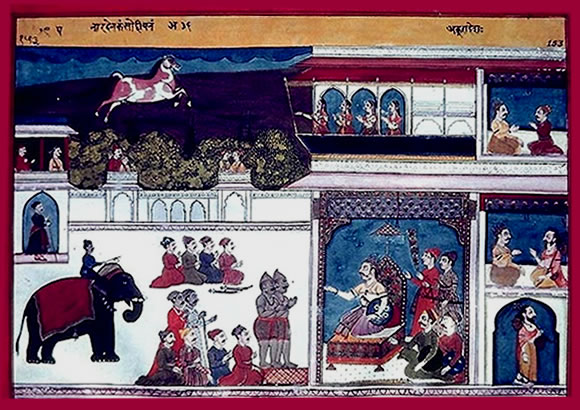
This was all communicated to Kamsa by the all-powerful Nârada [**], who paid him a visit in order to tell him that all the Daityas who burdened the earth were going to be killed [see verse 17 and also 9.24: 56].
All this was communicated to Kamsa by the all-powerful Nârada [**]; who paid him a visit to tell him that all the Daityas and such who burdened the earth were going to be killed [see verse 17 and also 9.24: 56]. (Vedabase)
After the rishi had left Kamsa thought that all the Yadus were divine and that therefore any child born from Devakî could be Vishnu. He thus in fear of his own death arrested Vasudeva and Devakî, confined them at home in shackles and killed, one after the other, each of their newborn sons, not knowing whether it would be the 'Never-born' Lord or not [***].
After the rishi had left thought Kamsa that all the Yadus were divine and that thus any child born from Devakî could be Vishnu. So in fear of his own death arrested he Vasudeva and Devakî confining them at home in shackles and killed he each of their newborn sons one after the other not knowing whether it would be the 'Never-born' Lord or not [***]. (Vedabase)
Kings like him, who on this earth are driven by animalistic pleasures and greed, usually put to death mothers, fathers, brothers, friends or anyone else.
Mothers, fathers, brothers, friends or anyone else are put to death by kings like him who on this earth are driven by envy and greed. (Vedabase)
He had understood [from Nârada] that he, in a previous life as the great Asura Kâlanemi, personally had been killed by Vishnu [see 8.10: 56]. Therefore he, born again in this world, became an enemy of the Yadu dynasty [that carried the blessings of Vishnu].
He, well aware that in a previous life he as the great Asura Kâlanemi [literally: 'rim of the wheel of time'] personally had been killed by Vishnu [see 8.10: 56], became again born in this world inimical with the Yadu dynasty [declared blessed by Vishnu, as Nârada told him]. (Vedabase)
He, the almighty ruler, subdued [and imprisoned] his own father Ugrasena, the king of the Yadus, Bhojas and Andhakas, so that he could enjoy the states of S'ûrasena all by himself.'
His own father Ugrasena, the king of the Yadus, Bhojas and Andhakas was by him, the almighty ruler, subdued [- also imprisoned -] so that he all by himself could enjoy the states of S'ûrasena. (Vedabase)
*: To recall what was described in the previous chapters: Lord Râma appeared in the sûrya-vams'a of Iksvâku or sun dynasty and Lord Krishna appeared in the candra-vams'a or moon dynasty.
**: An additional verse in this chapter of S'rîmad Bhâgavatam is accepted by the Madhvâcârya-sampradâya, represented by Vijayadhvaja Tîrtha. The verse is as follows:
atha kamsam upâgamya
nârado brahma-nandanah
ekântam upasangamya
vâkyam etad uvâca haWord-for-word:
atha: in this way; kamsam: unto Kamsa; upâgamya: after going; nâradah: the great sage Nârada; brahma-nandanah: who is the son of Brahmâ; ekântam upasangamya: after going to a very solitary place; vâkyam: the following instruction; etat: this; uvâca: said; ha: in the past.Translation:
"Thereafter, Nârada, the mental son of Lord Brahmâ, approached Kamsa and, in a very solitary place, informed him of the following news."***: Svâmî Prabhupâda comments: 'Formerly an Asura named Kâlanemi had six sons, named Hamsa, Suvikrama, Krâtha, Damana, Ripurmardana and Krodhahantâ. They were known as the Shad-garbhas, or six Garbhas, and they were all equally powerful and expert in military affairs. These Shad-garbhas gave up the association of Hiranyakas'ipu, their grandfather, and underwent great austerities to satisfy Lord Brahmâ, who, upon being satisfied, agreed to give them whatever benediction they might desire. When asked by Lord Brahmâ to state what they wanted, the Shad-garbhas replied: "Dear Lord Brahmâ, if you want to give us a benediction, give us the blessing that we will not be killed by any demigod, Mahâ-roga, Yaksha, Gandharva-pati, Siddha, Cârana or human being, nor by great sages who are perfect in their penances and austerities." Brahmâ understood their purpose and fulfilled their desire. But when Hiranyakas'ipu came to know of these events, he was very angry at his grandsons. "You have given up my association and have gone to worship Lord Brahmâ", he said, "and therefore I no longer have any affection for you. You have tried to save yourselves from the hands of the demigods, but I curse you in this way: Your father will take birth as Kamsa and kill all of you because you will take birth as sons of Devakî." Because of this curse, the grandsons of Hiranyakas'ipu had to take birth from the womb of Devakî and be killed by Kamsa, although he was previously their father. This description is mentioned in the Hari-vams'a, Vishnu-parva, Second Chapter. According to the comments of the Vaishnava-toshanî, the son of Devakî, known as Kîrtimân, was the third incarnation. In his first incarnation he was known as Smara and was the son of Marîci, and later he became the son of Kâlanemi. This is mentioned in the histories.'

The
text and audio are offered under the conditions of the
Creative
Commons Attribution-Noncommercial-Share Alike
3.0
Unported License.
The first
picture
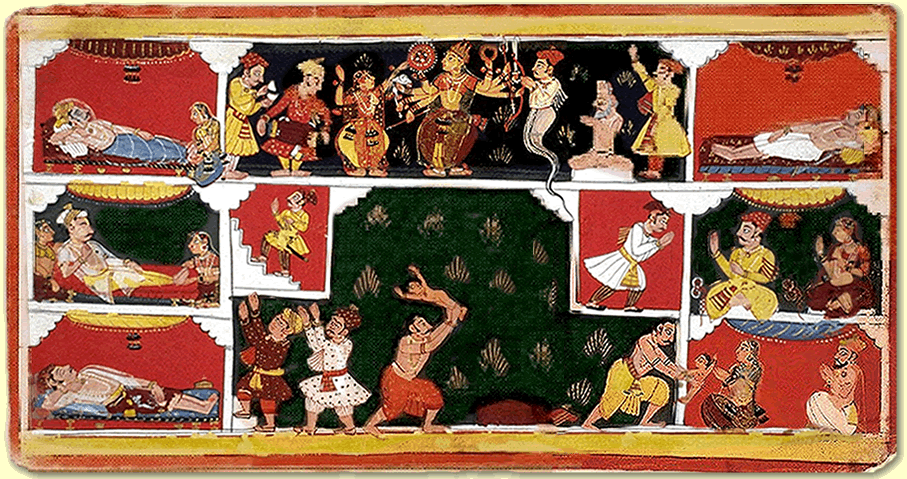
is titled: 'The Story of Krishna's birth',
page from the tenth book of the Bhâgavata Purâna. Source:
Ackland
Art Museum.
The second picture is titled: 'Nârada at the Court of Kamsa'. c
1750. Source.
Production: Filognostic
Association
of The
Order of Time.

Feed-back | Links | Downloads | Music | Pictures | What's New | Search | Donations





 Text
1
Text
1