

Canto 10
Canto 10
Chapter 35: The Gopîs Sing about Krishna as He Wanders in the Forest
(1) S'rî S'uka said: 'Whenever Krishna had left for the forest, the gopîs, unhappy chasing Him in their mind, passed their days singing loudly about Krishna's pastimes.
(2-3) The gopîs said [in double verses]: 'With His left cheek put to His left arm He, oh gopîs, with His eyebrows moving, places the flute at His lips, while stopping the holes with His tender fingers. Where Mukunda thus sounds His flute, the women travel the sky together with the Siddhas. Embarrassed about the desires pursued by their minds, they listen in amazement and forget the sadness they felt, as also their girdles. (4-5) Oh girls, listen how wonderfully Nanda's son, the giver of joy to people in trouble, He with His brilliant smile and fixed streak of lightning [the S'rîvatsa or the goddess] on His chest, sounds His flute. Groups of bulls kept in the pasture, deer and cows, with their ears pricked up at a distance, with their mouths filled, stop chewing and, transfixed by His play, dreaming, stand frozen as if it concerned a drawn picture. (6-7) When Mukunda dear gopîs, looking like a wrestler with an arrangement of [peacock] feathers, [mineral] colors and leaves, together with Balarâma and the gopas, calls for the cows, the flow of the rivers is interrupted. The rivers, just like us lacking in piety, trembling out of love, with their arms of water stand perplexed, while hankering for the dust of His lotus feet that is transported by the wind. (8-9) When He, moving around in the forest and on the hillsides, as the Original Person with His flute calls for the cows and He, for His prowess and inexhaustible opulences, by His company extensively is praised in every way, the creepers and the trees, heavy with flowers and fruits, bend over all by themselves. As if they wanted to reveal Vishnu present within them, they in their love rain down torrents of sweet sap, while the growths on their bodies stand on end in ecstatic love. (10-11) The very moment He, as the most attractive one to behold, raises His flute, with respect for the desirable song of the strongly humming swarm of bees around His divine garland which is intoxicated by the honey sweet [subtle] fragrance of the tulsî flowers, oh then, the cranes, swans and other birds in the lake, with their minds seized by the charm of the song, come forward to pay Him homage with their eyes closed, keeping silent with their minds under control. (12-13) Oh Vraja devîs, when He, being together with Balarâma, for fun wears a garland on His head, and He at the mountain side gives happiness vibrating on His flute and makes the whole world delightfully enjoy, the deck of clouds, afraid to offend such a great personality, in return most gentle minded, thundering and raining flowers upon his Friend, offers its shade as a parasol. (14-15) Oh pious lady [Yas'odâ], when your son, who is an expert in different cowherd matters and a genius in the different styles of playing, places His flute to His bimba-red lips to produce the harmonious sounds of His music, the masters of spiritual authority like Indra, S'iva and Brahmâ, who hear that tonal variety, with their minds confounded bow their heads because they cannot fathom its essence. (16-17) When He plays His famous flute and, moving with the grace of an elephant, with His flower petal lotus feet marks the soil of Vraja with the different symbols of the flag, thunderbolt, lotus and elephant goad, He with His body relieves the earth from the distress caused by the hooves [of the cows]. As He walks [by] and bestows His playful glances, we get excited in our amorous feelings and stand transfixed like trees, in our bewilderment not knowing anymore [what the condition would be of] our dresses and braids.
(18-19) At times, when He, with the garland around His neck smelling of the by Him favored tulsî, counts the cows on a string of colored beads and then, throwing His arm over the shoulder of a loving companion, sings, the wives of the black deer, the doe - just like the gopîs who gave up their civil aspirations -, approach that ocean of transcendental qualities to sit at His side with their hearts stolen by the sound produced by Krishna's flute. (20-21) Oh sinless lady, your darling child, the son of Nanda, is now, with His attire ornamented with a garland of jasmine flowers and surrounded by the gopas and the cows, having fun playing with His companions along the Yamunâ. The wind gently blowing in His favor, honors Him there with a touch of sandalwood scent, while the lesser divinities [the Upadevas] surrounding Him present Him gifts and offer praise with instrumental music and songs. (22-23) Taking care of the cows of Vraja and at His feet being worshiped as the lifter of the mountain [see 10.25] He, at the end of the day, collected the herd of cows. Playing His flute with His companions, He on His way was everywhere worshiped by all adults [and demigods]. This moon, born from the womb of Devakî, who came with the wish to fulfill the desires of His friends, was, even when He was tired and His garland was colored by the dust raised by the hooves, a feast for the eyes. (24-25) He greets His well-wishing friends while slightly rolling His eyes as if He is intoxicated. With His garland of forest flowers, with His face paled like a jujube plum [a badara], with the soft line of His cheeks and with the beauty of the golden earrings adorning Him, He is the Lord of the Yadus, the Lord sporting just like the lord of the elephants. His joyful face is like the moon, the lord of the night, who at the end of the day dispels the miserable heat of the cows [and the gopîs] of Vraja.'
(26) S'rî S'uka said: 'Oh King, the women of Vraja, with their hearts and minds absorbed in Him, thus enjoyed their days, highly spirited singing about Krishna's pastimes.'


Third revised edition, loaded December 10, 2020.
Previous Aadhar edition and Vedabase links:
S'rî S'uka said: 'Whenever Krishna had left for the forest, the gopîs, unhappy chasing Him in their mind, passed their days singing loudly about Krishna's pastimes.S'rî S'uka said: 'The gopîs with Krishna gone to the forest, with their minds running after Him being unhappy, passed their days singing loudly of Krishna's pastimes.The gopîs sang: (Vedabase)
The gopîs said [in double verses]: 'With His left cheek put to His left arm He, oh gopîs, with His eyebrows moving, places the flute at His lips, while stopping the holes with His tender fingers. Where Mukunda thus sounds His flute, the women travel the sky together with the Siddhas. Embarrassed about the desires pursued by their minds, they listen in amazement and forget the sadness they felt, as also their girdles.
'Putting His left cheek to the left
of His arm places He,
arching His eyebrows the flute
to His lips stopping the holes
with His tender fingers, o gopîs;
where Mukunda so vibrates
follow in the air the women
together with the perfected,
amazed listening to that
embarrassed of having yielded
to the pursuit of their desires
and forget they the distress
they felt in their minds,
as well as their good order. (Vedabase)
Oh girls, listen how wonderfully Nanda's son, the giver of joy to people in trouble, He with His brilliant smile and fixed streak of lightning [the S'rîvatsa or the goddess] on His chest, sounds His flute. Groups of bulls kept in the pasture, deer and cows, with their ears pricked up at a distance, with their mouths filled, stop chewing and, transfixed by His play, dreaming, stand frozen as if it concerned a drawn picture.
Oh girls what a wonder
to hear this from Nanda's son,
the giver of joy to people
in trouble, when He with
His brilliant smile and steady streak
of lightning [the S'rîvatsa or the goddess] on His chest
has sounded His flute.
The groups of bulls
kept in the pasture, the deer
and the cows pricking up
their ears at a distance
stop with their mouths full their teeth
from chewing and stand frozen
as if they were
a picture drawn. (Vedabase)
When Mukunda dear gopîs, looking like a wrestler with an arrangement of [peacock] feathers, [mineral] colors and leaves, together with Balarâma and the gopas, calls for the cows, the flow of the rivers is interrupted. The rivers, just like us lacking in piety, trembling out of love, with their arms of water stand perplexed, while hankering for the dust of His lotus feet that is transported by the wind.
When Mukunda, with an arrangement
of [peacock] feathers, [mineral] colors and leaves,
in clothing looking like a wrestler,
with Balarâma and the gopas,
dear gopîs, calls for the cows,
is indeed the flow
of the rivers broken
as they just like us,
slighting their piety,
with their arms of water
have stopped, trembling
of love hankering for
the dust of the lotus feet
brought by the wind. (Vedabase)
When He, moving around in the forest and on the hillsides, as the Original Person with His flute calls for the cows and He, for His prowess and inexhaustible opulences, by His company extensively is praised in every way, the creepers and the trees, heavy with flowers and fruits, bend over all by themselves. As if they wanted to reveal Vishnu present within them, they in their love rain down torrents of sweet sap, while the growths on their bodies stand on end in ecstatic love.
When He as the Original Person
indeed, calling with His flute
for the cows, to the prowess
of His inexhaustible opulences
elaborately is hailed
by His company, moving around
in the forest and on the hillsides,
do the creepers and the trees then,
rich with flowers and fruits,
by themselves - as if revealing
Vishnu - bow down
heavy with their branches,
while out of love raining down
torrents of sweet sap
with the growth on their bodies
erect enthralled. (Vedabase)
The very moment He, as the most attractive one to behold, raises His flute, with respect for the desirable song of the strongly humming swarm of bees around His divine garland which is intoxicated by the honey sweet [subtle] fragrance of the tulsî flowers, oh then, the cranes, swans and other birds in the lake, with their minds seized by the charm of the song, come forward to pay Him homage with their eyes closed, keeping silent with their minds under control
When He as the most
attractive to see
raises His flute,
grateful acknowledging
the dear, strong humming
bee swarms intoxicated
by the honeysweet [subtle] fragrance
of the tulsî flowers around
His divine garland, oh then,
do the cranes, swans and other
birds in the lake
with their minds seized by
the charm of the song
come forward to pay
Him homage with closed eyes,
keeping silent with their
minds in control. (Vedabase)
Oh Vraja devîs, when He, being together with Balarâma, for fun wears a garland on His head, and He at the mountain side gives happiness vibrating on His flute and makes the whole world delightfully enjoy, the deck of clouds, afraid to offend such a great personality, in return most gentle minded, thundering and raining flowers upon his Friend, offers its shade as a parasol.
O Vraja-devîs, when He,
being together with Balarâma,
for fun wearing a garland
on His head at the mountain side
gives happiness vibrating
on His flute and makes
the whole world joyfully delight,
then does the deck of clouds,
afraid to offend
such a great personality
in return most gentleminded
thundering and raining
flowers upon his Friend,
offer its shade as a shield. (Vedabase)
Oh pious lady [Yas'odâ], when your son, who is an expert in different cowherd matters and a genius in the different styles of playing, places His flute to His bimba-red lips to produce the harmonious sounds of His music, the masters of spiritual authority like Indra, S'iva and Brahmâ, who hear that tonal variety, with their minds confounded bow their heads because they cannot fathom its essence.
O pious lady [Yas'odâ],
when your son, an expert
in the various cowherd things
and an original in different styles
of playing, places His flute
to His bimba-red lips
to produce His music
so harmonious in tones,
do the controllers of enlightenment
like Indra, S'iva and Brahmâ
hearing that soundscape,
with the learned going first
bow their heads intimidated
within not being able
to ascertain its essence. (Vedabase)
When He plays His famous flute and, moving with the grace of an elephant, with His flower petal lotus feet marks the soil of Vraja with the different symbols of the flag, thunderbolt, lotus and elephant goad, He with His body relieves the earth from the distress caused by the hooves [of the cows]. As He walks [by] and bestows His playful glances, we get excited in our amorous feelings and stand transfixed like trees, in our bewilderment not knowing anymore [what the condition would be of] our dresses and braids.
When, honored by His flute,
with the diverse flag, thunderbolt,
lotus and elephant goad markings
of His flowerpetal lotus feet
the soil of Vraja
with His body, moving
with the grace of an elephant,
is relieved from its pain
created by the hooves [of the cows],
do we, by that walk
in the good of His glances
so playful agitated
by Cupid, in our bewilderment,
like trees transfixed,
not know anymore [of the condition]
of our dresses and braids. (Vedabase)
At times, when He, with the garland around His neck smelling of the by Him favored tulsî, counts the cows on a string of colored beads and then, throwing His arm over the shoulder of a loving companion, sings, the wives of the black deer, the doe - just like the gopîs who gave up their civil aspirations -, approach that ocean of transcendental qualities to sit at His side with their hearts stolen by the sound produced by Krishna's flute.
When He, with the garland
of the by Him favored fragrance
of tulsî, counts the cows
on a string of colored beads
and, throwing His arm
over the shoulder of a loving
companion, so now and then sings,
do the wives of the black deer,
the doe, just like the gopîs
who gave up their homely aspirations,
approach that ocean
of transcendental qualities to sit
at His side with their hearts stolen
by the sound that Krishna
produces with His flute. (Vedabase)
Oh sinless lady, your darling child, the son of Nanda, is now, with His attire ornamented with a garland of jasmine flowers and surrounded by the gopas and the cows, having fun playing with His companions along the Yamunâ. The wind gently blowing in His favor, honors Him there with a touch of sandalwood scent, while the lesser divinities [the Upadevas] surrounding Him present Him gifts and offer praise with instrumental music and songs.
O sinless lady
your darling child,
the son of Nanda,
with a garland made of jasmine
to His attire and surrounded
by the gopas and the cows
having a good time at the Yamunâ,
was, as He played there amusing
His companions, honored by the wind
blowing gently in His favor
with the scent of sandalwood
and, encircled by the different
categories of the lesser divinities [the Upadevas],
presented with gifts and offered praise
with instrumental music and song. (Vedabase)
Taking care of the cows of Vraja and at His feet being worshiped as the lifter of the mountain [see 10.25] He, at the end of the day, collected the herd of cows. Playing His flute with His companions, He on His way was everywhere worshiped by all adults [and demigods]. This moon, born from the womb of Devakî, who came with the wish to fulfill the desires of His friends, was, even when He was tired and His garland was colored by the dust raised by the hooves, a feast for the eyes.
Caring about the cows
of Vraja and to His feet
as the lifter of the mountain [see 10.25]
being worshiped was He,
at the end of the day
collecting the herd of cows
and playing His flute with His companions,
all along the path by the entirety
of the exalted gods so high
in His glories praised;
this moon born from the womb
of Yas'odâ, who came
with a desire to answer
His friends desires,
was even fatigued
a feast for the eyes
with His garland and color
powdered by the dust
that was raised by the hooves. (Vedabase)
He greets His well-wishing friends while slightly rolling His eyes as if He is intoxicated. With His garland of forest flowers, with His face paled like a jujube plum [a badara], with the soft line of His cheeks and with the beauty of the golden earrings adorning Him, He is the Lord of the Yadus, the Lord sporting just like the lord of the elephants. His joyful face is like the moon, the lord of the night, who at the end of the day dispels the miserable heat of the cows [and the gopîs] of Vraja.'
With His eyes slightly rolling
of intoxication, honoring
His well-wishing friends,
His garland of forest flowers,
His face paled like a jujube plum [a badara],
the soft line of His cheeks
and the beautiful show
of His earrings of gold,
is the sporting Lord of the Yadus
in His beauty just like
an elephant all regal;
like the king of the night [the moon]
at the end of the day
arriving with His joyful face,
drives He away, to prove
the Vraja cows His mercy,
the hard to endure
painful heat of the day.' (Vedabase)
S'rî S'uka said: 'Oh King, the women of Vraja, with their hearts and minds absorbed in Him, thus enjoyed their days, highly spirited singing about Krishna's pastimes.'
S'rî S'uka said: 'Thus o King, did the women of Vraja with their hearts and minds absorbed in Him enjoy the day in high spirits singing about Krishna's pastimes.' (Vedabase)


The text and audio are offered under the
conditions of the
Creative
Commons Attribution-Noncommercial-Share Alike 3.0 Unported
License.
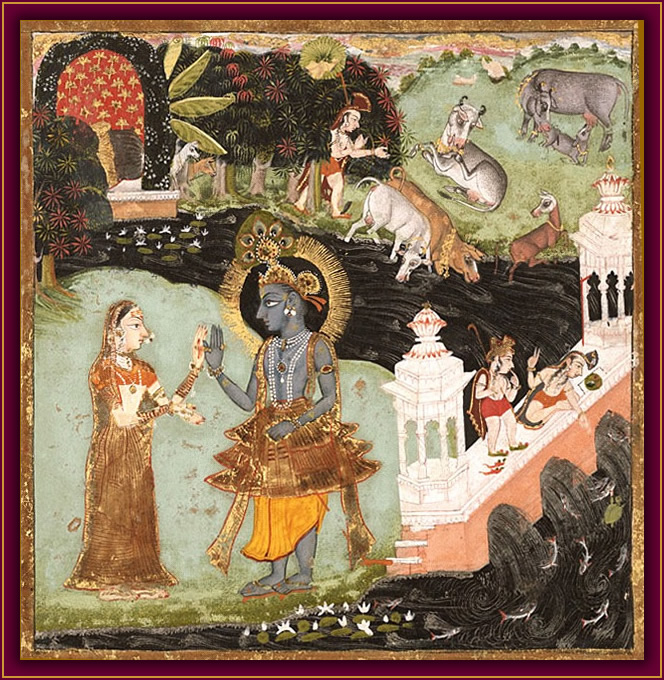
The painting
on this page is titled: 'Krishna and Radha',
India, first quarter 18th century, courtesy of Berkeley
Art Museum/Pacific Film Archive.
Production: Filognostic
Association of The Order of Time.

Feed-back | Links | Downloads | Music | Pictures | What's New | Search | Donations



 Text 1