
Canto
11
Canto
11
Chapter 1: The Curse Upon the Yadu Dynasty
(1) S'rî S'uka said: 'After Lord Krishna, together with Balarâma and surrounded by the Yadus, had realized the elimination of the Daityas and had reduced the burden of the earth, very soon a conflict arose [between the Kauravas and the Pândavas]. (2) They [the Pândavas] who time and again were angered by the duplicitous gambling, the insults, the grabbing by the hair [of Draupadî] and the other transgressions of their enemies [their nephews, the Kauravas], constituted the immediate cause [with the historical dynastic struggle, see also Yayâti and 10.49 & 10.68] for the Supreme Lord to [further] relieve the earth of her burden and [also] kill all the kings who assembled [at Kurukshetra] to take opposite sides. (3) And after the Yadus, being protected by His arms, had eliminated the kings who with their royal armies had burdened the earth, the Unfathomable Lord thought to Himself: 'One may say that the burden of the earth has been eliminated, but I do not think the load is gone. The intolerable burden [alas] remains with the Yadu dynasty itself. (4) They, who in every respect sought their refuge in Me, were never frustrated in the exercise of their power. Since they have no defeat to fear from any other side, I will arrange a quarrel within the Yadu dynasty, just like fire in a bamboo-grove [is generated by the wind through mutual friction]. That is how I will achieve [My purpose:] My abode of peace [see also 3.3: 14 and 8.8: 37].'
(5) Thus having decided, oh King, the Lord, the Almighty One who realizes everything He wants, withdrew His family by means of a curse that was pronounced against them by the brahmins. (6-7) After by His form, the beauty of all the worlds, having freed the eyes of men, by His words having attracted the minds of all who remembered them, and by His feet having redirected the [wrongful] activities of anyone who saw them, the Lord, who effortlessly on earth spread His glories which are praised in the most beautiful verses and by which one may cross the ocean of ignorance, achieved His [desired] position [of peace and beatitude, see also 7.5: 23-24].'
(8) The King said: 'How could it happen that this curse against the Vrishnis was pronounced by the brahmins? The Vrishnis, who were fully absorbed in Krishna, were always charitable and respectful towards the brahmins and served the elders. (9) What led to that curse and what kind of curse was it, oh purest among the twice-born souls? Please tell me how this dissension [could rise] among those who share the same soul [of Krishna].'
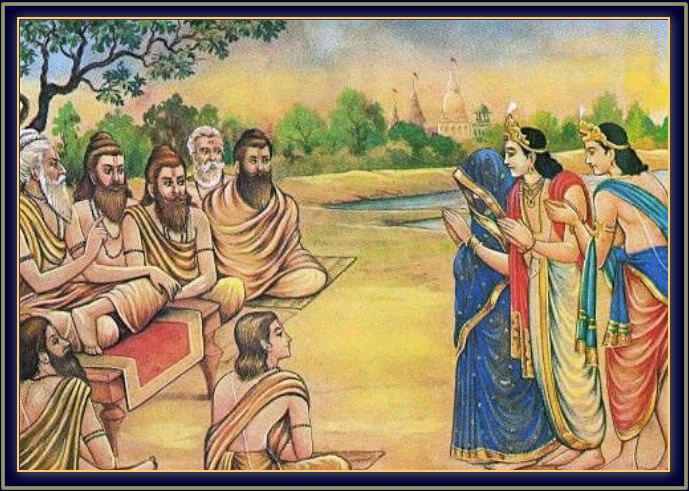
(10) The son of Vyâsa said: 'Embodied in a form that was the amalgamation of all things beautiful, on earth performing the most auspicious activities, and to His full satisfaction enjoying His life as He resided in His abode [of Dvârakâ], He, so greatly famed, [now] wanted to destroy His dynasty. That was the only thing left to do for Him. (11-12) After in the house of the lord of the Yadus [Vasudeva] having performed most favorable rituals to bestow piety and take away the impurities of Kali-yuga, the sages Vis'vâmitra, Asita, Kanva, Durvâsâ, Bhrigu, Angirâ, Kas'yapa, Vâmadeva, Atri, Vasishthha, Nârada and others, were by The Soul of Time [Lord Krishna] sent away to go to Pindâraka [a pilgrimage site]. (13-15) [Having arrived there] they were approached by young boys of the Yadu dynasty in a game in which Sâmba, the son of Jâmbavatî [see also 10.68], had dressed up in women's clothes. Feigning humility they took hold of their feet and impudently asked: 'This black-eyed pregnant woman would like to ask you something, oh men of learning, but she is too embarrassed to do it herself. Can you tell whether she, who is about to give birth and desires a son, will get one?'
(16) Oh King, the sages, thus being tricked, said angrily to them: 'She, oh fools, will for you give birth to a mace that will destroy the dynasty!'
(17) Most terrified to hear that, they hastily uncovered the belly of Sâmba, where indeed a club made of iron could be seen. (18) 'What have we done? What will the family say of us? What a misfortune!' they said perturbed, took the club and went home. (19) With the beauty of their faces faded, they brought the club to an assembly of the king [Ugrasena] and told, in the presence of all the Yadus, what had happened. (20) When they saw the club and heard about the infallible curse of the learned souls, oh King, the inhabitants of Dvârakâ were astonished and distraught with fear. (21) Âhuka [Ugrasena], the Yadu king, ordered the club to be ground to bits, and next threw the iron, together with the remaining pieces of the club, into the water of the ocean. (22) The iron was swallowed by a certain fish, while the fine dust was carried away by the waves and washed ashore where it grew into canes with sharp-edged blades [called eraka]. (23) The fish was, together with other fish in the ocean, by a fisherman caught in a net. The piece of iron, contained in the fish's stomach, was by a hunter [called Jarâ] fixed on a shaft [as an arrowhead]. (24) Even though the Supreme Lord very well knew what it all meant, He did not want to reverse the curse of the scholars and so He, in His form of Time, accepted it.'


Third revised edition, loaded January 27, 2022.
Previous Aadhar edition and Vedabase links:
S'rî S'uka said: 'After Lord Krishna, together with Balarâma and surrounded by the Yadus, had realized the elimination of the Daityas and had reduced the burden of the earth, very soon a conflict arose [between the Kauravas and the Pândavas].S'rî S'uka said: 'After Lord Krishna surrounded by the Yadus together with Râma realized the elimination of the daityas and reduced the burden of the earth, rose very soon a conflict [among the Yadus]. (Vedabase)
They [the Pândavas] who time and again were angered by the duplicitous gambling, the insults, the grabbing by the hair [of Draupadî] and the other transgressions of their enemies [their nephews, the Kauravas], constituted the immediate cause [with the historical dynastic struggle, see also Yayâti and 10.49 & 10.68] for the Supreme Lord to [further] relieve the earth of her burden and [also] kill all the kings who assembled [at Kurukshetra] to take opposite sides.
The Supreme Lord, relieving the earth of its burden by killing all the kings that assembled to confront on opposite sides, made the ones who time and again were driven mad by the duplicitous gambling, the insults, the grabbing by the hair [of Draupadî] and the other transgressions of their enemies, the immediate cause [of the dynastic struggle, see also Yayâti and 10.49 & 10.68]. (Vedabase)
And after the Yadus, being protected by His arms, had eliminated the kings who with their royal armies had burdened the earth, the Unfathomable Lord thought to Himself: 'One may say that the burden of the earth has been eliminated, but I do not think the load is gone. The intolerable burden [alas] remains with the Yadu dynasty itself.
The Unfathomable Lord weighed the elimination of the earth her burden of royal armies by the Yadus, who were protected by His arms: 'One indeed may say the earth's burden is gone, but I think it's not gone; because of the Yadu-dynasty the intolerable alas remains [see also 4.16: 13]. (Vedabase)
They, who in every respect sought their refuge in Me, were never frustrated in the exercise of their power. Since they have no defeat to fear from any other side, I will arrange a quarrel within the Yadu dynasty, just like fire in a bamboo-grove [is generated by the wind through mutual friction]. That is how I will achieve [My purpose:] My abode of peace [see also 3.3: 14 and 8.8: 37].'
Of these ones never frustrated in their control who by all means took shelter of Me, there most certainly will never be defeat from another cause; inspiring a quarrel within the Yadu-dynasty like fire in a bamboo-grove, shall I achieve [My purpose:] My abode of peace [see also 3.3: 14 and 8.8: 37].' (Vedabase)
Thus having decided, oh King, the Lord, the Almighty One who realizes everything He wants, withdrew His family by means of a curse that was pronounced against them by the brahmins.
Thus making up His mind, o King, withdrew the Controller, the Almighty One whose every desire comes to pass, His family by manifesting a curse from the learned. (Vedabase)
After by His form, the beauty of all the worlds, having freed the eyes of men, by His words having attracted the minds of all who remembered them, and by His feet having redirected the [wrongful] activities of anyone who saw them, the Lord, who effortlessly on earth spread His glories which are praised in the most beautiful verses and by which one may cross the ocean of ignorance, achieved His [desired] position [of peace and beatitude, see also 7.5: 23-24].'
By His own form, the beauty of all the worlds, delivering the eyes of men, by His words delivering the minds of all who remembered them and by His feet delivering the actions of those who saw them, was the Lord, who thus having been of attraction attained His own position, certain that the people indeed being ignorant, with on earth the spreading of His glories in the best of verses, with ease would reach through [the hearing and chanting of] them [see also 7.5.23-24].' (Vedabase)
The King said: 'How could it happen that this curse against the Vrishnis was pronounced by the brahmins? The Vrishnis, who were fully absorbed in Krishna, were always charitable and respectful towards the brahmins and served the elders.
The King said: 'How did this curse come about of the learned ones against the Vrishnis, who totally absorbed in Krishna, always charitable and respectful with the brahmins were serving the elders? (Vedabase)
What led to that curse and what kind of curse was it, oh purest among the twice-born souls? Please tell me how this dissension [could rise] among those who share the same soul [of Krishna].'
What caused the rise of that serious curse, what was its nature, o purest of the twice-born; please tell me how there, with those who shared the same soul [of Krishna], could be this discord?' (Vedabase)
The son of Vyâsa said: 'Embodied in a form that was the amalgamation of all things beautiful, on earth performing the most auspicious activities, and to His full satisfaction enjoying His life as He resided in His abode [of Dvârakâ], He, so greatly famed, [now] wanted to destroy His dynasty. That was the only thing left to do for Him.
The son of Vyâsa said: 'Carrying a body that was the amalgamation of all things beautiful, on earth performing the most auspicious activities and all-satisfied enjoying His life residing in His abode [of Dvârakâ], wanted He, so greatly sung, to destroy His dynasty; the only thing left to do. (Vedabase)
After in the house of the lord of the Yadus [Vasudeva] having performed most favorable rituals to bestow piety and take away the impurities of Kali-yuga, the sages Vis'vâmitra, Asita, Kanva, Durvâsâ, Bhrigu, Angirâ, Kas'yapa, Vâmadeva, Atri, Vasishthha, Nârada and others, were by The Soul of Time [Lord Krishna] sent away to go to Pindâraka [a pilgrimage site].
Having performed fruitive rituals bestowing piety stayed the sages Vis'vâmitra, Asita, Kanva, Durvâsâ, Bhrigu, Angirâ, Kas'yapa, Vâmadeva, Atri, Vasishthha, along with Nârada and others, [once] in the house of the lord of the Yadus [Vasudeva]. Bid farewell by Him, the Soul of Time of whom chanting about most auspiciously for the whole world the impurities of Kali-yuga are taken away, they went to Pindâraka [a site of pilgrimage]. (Vedabase)
[Having arrived there] they were approached by young boys of the Yadu dynasty in a game in which Sâmba, the son of Jâmbavatî [see also 10.68], had dressed up in women's clothes. Feigning humility they took hold of their feet and impudently asked: 'This black-eyed pregnant woman would like to ask you something, oh men of learning, but she is too embarrassed to do it herself. Can you tell whether she, who is about to give birth and desires a son, will get one?'
The young boys of the Yadu dynasty playing [there] approached them with Sâmba the son of Jâmbavati [see also 10.68] dressed up in woman's clothes. Taking hold of their feet they, feigning humility, impudently asked: 'This black-eyed pregnant woman wishing for a son, o learned ones, too embarrassed to ask it herself, is asking you whether you, with your vision never clouded, can tell if she'll give birth to a son or not?' (Vedabase)
Oh King, the sages, thus being tricked, said angrily to them: 'She, oh fools, will for you give birth to a mace that will destroy the dynasty!'
The sages thus tricked said angered to the boys, o King: 'For you, o fools, she'll give birth to a mace which will destroy the dynasty!'. (Vedabase)
Most terrified to hear that, they hastily uncovered the belly of Sâmba, where indeed a club made of iron could be seen.
They, greatly terrified to hear that, hastily uncovered the belly of Sâmba wherein they indeed found a club made of iron. (Vedabase)
'What have we done? What will the family say of us? What a misfortune!' they said perturbed, took the club and went home.
'What have we done, what will the family say of us so very unfortunate?' and thus overwhelmed speaking took they the club en went they home. (Vedabase)
With the beauty of their faces faded, they brought the club to an assembly of the king [Ugrasena] and told, in the presence of all the Yadus, what had happened.
Bringing it consequently into the assembly with the beauty of their faces faded, informed they the king [Ugrasena] in the presence of all Yadus. (Vedabase)
When they saw the club and heard about the infallible curse of the learned souls, oh King, the inhabitants of Dvârakâ were astonished and distraught with fear.
Amazed to see the club hearing about the infallible curse of the learned, o King, became the inhabitants of Dvârakâ distraught with fear. (Vedabase)
Âhuka [Ugrasena], the Yadu king, ordered the club to be ground to bits and next threw the iron, together with the remaining pieces of the club, into the water of the ocean.
Having that club ground to bits threw Âhuka [Ugrasena], the Yadu king, them together with the iron left over from the club into the water of the ocean. (Vedabase)
The iron was swallowed by a certain fish, while the fine dust was carried away by the waves and washed ashore where it grew into canes with sharp-edged blades [called eraka].
Some fish swallowed the lump while the bits being carried by the waves from that place washed on shore to grow there into sharp canes [called eraka]. (Vedabase)
The fish was, together with other fish in the ocean, by a fisherman caught in a net. The piece of iron, contained in the fish's stomach, was by a hunter [called Jarâ] fixed on a shaft [as an arrowhead].
The fish in the ocean was together with others caught in a net by a fisherman. The piece of iron contained in the fish's stomach was fixed by a hunter [called Jarâ] on an arrow [as an arrowhead]. (Vedabase)
Even though the Supreme Lord very well knew what it all meant, He did not want to reverse the curse of the scholars and so He, in His form of Time, accepted it.'
The Supreme Lord quite capable knowing the meaning of everything, didn't want to make things different though and was, exhibiting His form of Time, glad to sanction the curse of the learned. (Vedabase)

The Text and audio are offered under the
conditions of the
Creative
Commons
Attribution-Noncommercial-Share
Alike 3.0 Unported License.
The picture
on this page is by B.K. Mitra
Production: Filognostic Association of The Order of Time

Feed-back | Links | Downloads | Music | Pictures | What's New | Search | Donations



 Text 1