Canto
12
Canto
12
Chapter 4: Pralaya: The Four Types of Annihilation
(1) S'rî S'uka said: 'Time, beginning with the smallest unit of the atom and culminating in the two halves [or parârdhas of the life of Brahmâ], oh King, has been described [in 3.11] together with the duration of the yugas. Now hear about the annihilation of a kalpa. (2) A thousand cycles of four yugas is called a kalpa, a day of Brahmâ, in which there are fourteen original progenitors of mankind [Manus], oh ruler of the citizens. (3) At their end there is a period of dissolution of the same duration that is described as the night of Brahmâ. During that time the three worlds are subject to destruction. (4) This is said to be the occasional annihilation [or naimittika pralaya] in which [Nârâyana] the creator of the universe lies down upon His bed Ananta, to absorb the universe including Lord Brahmâ. (5) After the completion of two parârdhas [the two halves of the entire life] of the highest situated living being, Lord Brahmâ, the seven elements [mahat, ahankâra and the five tanmâtras] are subject to destruction. (6) This [occasion], oh King, at which the universal egg, this aggregate [of these seven universal aspects] reaches the time of its disruption and dissolves, constitutes the elemental [prâkritika] annihilation. (7) For a hundred years, oh King, the clouds will not shower rain upon the earth. The people being confounded by the time will, in the distress of their hunger with the lack of food that follows, [even] consume each other and step by step find their destruction. (8) The sun with its terrible rays will evaporate all the juice of the earth, the ocean and the living bodies, and not give the slightest [precipitation] in return. (9) Thereupon from the mouth of Lord Sankarshana the fire of destruction will issue, that, raised by the force of the wind, will burn all levels of existence on earth [and the other planets, 3.11: 30, 8.5: 35]. (10) The universal egg burning on all sides with the flames of the fire from below and the sun above, will glow like a ball of cow dung. (11) Next for more than a hundred years the terrible wind of the ultimate destruction [sâmvartaka] will blow and turn the sky gray with dust. (12) Clusters of multicolored clouds, dear King, then will pour down rain for a hundred years with tremendous claps of thunder. (13) The shell of the universe will thereupon fill up and constitute a single [cosmic] body of water. (14) The moment the water of the flood takes away the quality of fragrance, the element earth, being deprived of its fragrance, will dissolve [see also 3.26: 49-61, 11.3: 9, 11.24: 22-27].
(15-19) Fire then takes away the taste of water, after which it, deprived of this quality, dissolves. Next follows fire that by air is deprived of its form because it takes its quality [of touch] away, after which the air enters the ether that takes away that quality. Then, oh King, the ether dissolves in the original element of nature [âdi, false ego in ignorance] that takes away its quality of sound. Subsequently the senses are seized by the vital power of the universe [tejas or false ego in passion], my best, while the gods are absorbed by the universal modification [vikara, the false ego of goodness]. Cosmic intelligence [mahat] seizes the false ego with all its functions after which mahat is absorbed by the modes of nature of sattva and so on. These three modes, oh King, are then, under the pressure of Time, overtaken by the inexhaustible doer [the original unmanifest form of nature]. The original doer is not subject to transformation in divisions of time [shad-ûrmi] and such qualities; being unmanifest without a beginning and an end, it [or He] constitutes the infallible eternal cause. (20-21) Therein [in His primal state] one finds no speech, mind, or the mode of goodness, passion or ignorance. Neither the elements of the complete whole - the vital air, the intelligence, the senses and so on - are found there, nor are the gods there or the arrangement of the different planetary orders. There is no sleeping, waking or deep sleep, no water, air, ether, fire, earth or sun. That what is like a void or someone fast asleep, is the [primal] substance that defies all logical explanation and serves as the root [the pradhâna], so say the authorities. (22) This [state] constitutes the [prâkritika pralaya] dissolution wherein all the material elements of nature and energies of the unseen Original Person are completely dismantled by Time and helplessly merge.
(23) It is spiritual knowledge [the consciousness, the Absolute Truth alone] that is the foundation which manifests in the form of these elements of intelligence, the senses and the sense objects. Whatever that is perceived as having a beginning and an end is insubstantial, for it has no existence apart from its cause [only being a reference to it, compare 11.28: 21]. (24) A lamp, an eye that perceives and the form perceived do not stand apart from the light [that is treated by them]. The same way intelligence, the senses and sense perceptions do not stand apart from the [one Supreme] reality [the Absolute Truth] that is quite different [see also siddhânta and B.G. 9.15]. (25) The wakefulness, sleep and deep sleep that belong to the intelligence are therefore called a deception of the senses [relative to the fourth state of meditation called turîya]. This, oh King, is the duality experienced by the soul [11.13: 27-34]. (26) Just as clouds are there and are not there in the sky, this entire universe with its different parts being generated and having vanished is there and not there within the Absolute of the Truth. (27) The ingredient cause, my best, of any composite entity out here, is something real [that can be perceived] so is stated [in the Vedânta-sûtra], just as the threads of a piece of cloth can be perceived separately from the fabric they form [see also 6.3: 12, 11.12: 21]. (28) Whatever one may experience as having a general cause and a specific effect constitutes a form of illusion, error or mistake; everything with a beginning and an end is insubstantial because of the interdependence [of cause and effect]. (29) Even though it is knowable to us, the changeable nature of [the phenomenal world or] even a single atom, can in no way be explained without [- or as standing apart from -] the Self inside [of the Time, the Lord, the expansion of the universe, the 'fourth dimension'], for if that would be so [if there would be not such a Self] it should, being equal to the consciousness, stay the way it is.(30) There is no duality or opposition in the Absolute Truth; if an unknowing person thinks in terms of opposites, that is just like having two skies, two daylights or two life breaths. (31) Just as gold appears to men in many forms depending its use, the Supreme Lord Adhokshaja who is inconceivable to the senses, is described in different terms by a worldly person and by a person of Vedic knowledge. (32) A cloud brought about by the sun is made visible by the sun but means darkness to the eyes that are a partial expansion of the sun. Similarly the ego, one's I-awareness, is a quality of the Absolute made visible by the Absolute, but as a partial expansion of the Absolute that ego means darkness [falsehood] to the individual soul being bound to the material self. (33) When a cloud produced by the sun is riven, the eye sees the sun's form. When the same way the false ego that covers the spirit soul is destroyed by spiritual [self-]inquiry, remembrance [of the Original Self] will be the result. (34) When one thus with this sword of discrimination has cut away the false ego originating from illusion that binds the soul and one has developed a firm realization of the Infallible Supreme Soul, one speaks of the entire annihilation [of one's materially determined existence, âtyantika pralaya], dear King.
(35) Oh subduer of the enemies, some expert knowers of the subtle all-pervading spirit assert that the creation and destruction of all living beings beginning with Brahmâ, is an everlasting [nitya] process. (36) The [more or less favorable living] conditions of all living beings subject to transformation, are rapidly and continuously wiped out by the mighty force of the current of Time and constitute the causes of their birth and death. (37) These states of existence created by the Time, the form of the Lord without a beginning or an end, one does not see [directly], just as the [movements of the] planets in the sky are not seen [directly, see also 3.10: 10-14]. (38) Annihilation in the sense of a continuous [nitya], periodical [naimittika], natural [elemental or prâkritika] and complete [âtyantika] destruction has been described. This is how Time [kâla] operates.
(39) These narrations about the lîlâ of the creator of the universe, Nârâyana, the reservoir of all existences, have been related briefly and clearly to you, oh best of the Kurus. Not even the Unborn One [Lord Brahmâ] would be able to enumerate them completely. (40) For a person distressed by the fire of the different miseries of life and the desires to cross the hard to overcome ocean of material existence, there is no boat but the one of being devoted with a taste for the narrations of the pastimes of the Fortunate One, the Supreme Personality. (41) Long ago the infallible Lord Nara-Nârâyana taught this essential compendium of all the classical stories to Nârada Muni, who passed it on to Krishna Dvaipâyana [Vyâsa, the author; see 5.19: 10-15]. (42) He, that powerful Lord Bâdarâyana, thereupon was pleased to teach me this Bhâgavatam, oh Mahârâja, this anthology equal in status to the four Vedas. (43) Sûta Gosvâmî, sitting here with us, oh best of the Kurus, will [in his turn] pass it on when he is questioned by sages headed by S'aunaka during a lengthy sacrificial ceremony in the forest of Naimishâranya [see 1.1].'


Third revised edition, loaded October 7, 2022.
Previous Aadhar edition and Vedabase links:
S'rî S'uka said: 'Time, beginning with the smallest unit of the atom and culminating in the two halves [or parârdhas of the life of Brahmâ], oh King, has been described [in 3.11] together with the duration of the yugas. Now hear about the annihilation of a kalpa.S'rî S'uka said: 'Time beginning with the smallest of the atom and culminating in the two halves [or parârdhas] of the life of Brahmâ, o King has been described [in 3.11] together with the duration of the yugas; now listen to the annihilation of the kalpa. (Vedabase)
A thousand cycles of four yugas is called a kalpa, a day of Brahmâ, in which there are fourteen original progenitors of mankind [Manus], oh ruler of the citizens.
A thousand cycles of four yugas is said to be a kalpa, a day of Brahmâ, in which there are fourteen original progenitors of mankind [Manus]. (Vedabase)
At their end there is a period of dissolution of the same duration that is described as the night of Brahmâ. During that time the three worlds are subject to destruction.
When they are done there is the dissolution described as the night of Brahmâ that is of the same duration; the three worlds remain dissolved till the end of that time. (Vedabase)
This is said to be the occasional annihilation [or naimittika pralaya] in which [Nârâyana] the creator of the universe lies down upon His bed Ananta, to absorb the universe including Lord Brahmâ.
This is said to be the occasional annihilation [or naimittika pralaya] in which [Nârâyana] the creator of the universe lies down upon His bed Ananta, to absorb the universe including Lord Brahmâ. (Vedabase)
After the completion of two parârdhas [the two halves of the entire life] of the highest situated living being, Lord Brahmâ, the seven elements [mahat, ahankâra and the five tanmâtras] are subject to destruction.
After the completion of two parârdhas [viz. the two half life times] of the highest situated living being, Lord Brahmâ, are the seven elements [mahat, ahamkâra and the tanmâtras], subject to destruction. (Vedabase)
This [occasion], oh King, at which the universal egg, this aggregate [of these seven universal aspects] reaches the time of its disruption and dissolves, constitutes the elemental [prâkritika] annihilation.
This, o King, constitutes the elemental annihilation. Therafter this universal egg, this aggregate [of these seven universal principles] reaching the time of its disruption, will dissolve. (Vedabase)
For a hundred years, oh King, the clouds will not shower rain upon the earth. The people being confounded by the time will, in the distress of their hunger with the lack of food that follows, [even] consume each other and step by step find their destruction.
For a hundred years the clouds, o King, will not shower rain upon the earth. The people confounded by the time will, with the famine that follows, in the distress of their hunger [even] consume each other and gradually find themselves destroyed. (Vedabase)
The sun with its terrible rays will evaporate all the juice of the earth, the ocean and the living bodies, and not give the slightest [precipitation] in return.
The sun with its terrible rays not giving the slightest [precipitation] in return, will drink up all the juice of the earth, the ocean and the living bodies. (Vedabase)
Thereupon from the mouth of Lord Sankarshana the fire of destruction will issue, that, raised by the force of the wind, will burn all levels of existence on earth [and the other planets, 3.11: 30, 8.5: 35].
Then from the mouth of Lord Sankarshana will issue the fire of destruction that raised by the force of the wind will burn the empty regions of the planets [3.11: 30, 8.5: 35]. (Vedabase)
The universal egg burning on all sides with the flames of the fire from below and the sun above, will glow like a ball of cow dung.
The universal egg burning on all sides with the flames of the fire from below and the sun above, will glow like a ball of cow-dung. (Vedabase)
Next for more than a hundred years the terrible wind of the ultimate destruction [sâmvartaka] will blow and turn the sky gray with dust.
Next a terrible wind will blow for more than a hundred years and bring annihilation covering the sky gray with dust. (Vedabase)
Clusters of multicolored clouds, dear King, then will pour down rain for a hundred years with tremendous claps of thunder.
Clusters of multicolored clouds, my dearest, then will pour down rain for a hundred years with tremendous claps of thunder. (Vedabase)
The shell of the universe will thereupon fill up and constitute a single [cosmic] body of water.
The shell of the universe will, filling up, thereupon be one single [cosmic] body of water. (Vedabase)
The moment the water of the flood takes away the quality of fragrance, the element earth, being deprived of its fragrance, will dissolve [see also 3.26: 49-61, 11.3: 9, 11.24: 22-27].
When the water at the time of the flooding drives away the quality of fragrance, the element earth, being deprived of its fragrance, will dissolve [see also 3.26: 49-61, 11.3: 9, 11.24: 22-27]. (Vedabase)
Fire then takes away the taste of water, after which it, deprived of this quality, dissolves. Next follows fire that by air is deprived of its form because it takes its quality [of touch] away, after which the air enters the ether that takes away that quality. Then, oh King, the ether dissolves in the original element of nature [âdi, false ego in ignorance] that takes away its quality of sound. Subsequently the senses are seized by the vital power of the universe [tejas or false ego in passion], my best, while the gods are absorbed by the universal modification [vikara, the false ego of goodness]. Cosmic intelligence [mahat] seizes the false ego with all its functions after which mahat is absorbed by the modes of nature of sattva and so on. These three modes, oh King, are then, under the pressure of Time, overtaken by the inexhaustible doer [the original unmanifest form of nature]. The original doer is not subject to transformation in divisions of time [shad-ûrmi] and such qualities; being unmanifest without a beginning and an end, it [or He] constitutes the infallible eternal cause.
Fire then takes away the taste of water, after which it, deprived of its unique quality, dissolves. Next follows fire that by air is deprived of its form. With the fire merged with the wind the ether takes from the air away its quality [of touch] and then follows the quality of the ether, sound, that is taken away by the original elemental of nature [or false ego in ignorance]. With the ether subsequently merging, the vital power [false ego in passion] takes hold of the senses, my best, and are the gods subject to modification seized [by the false ego of goodness]. Cosmic intelligence seizes that [vaikârika] again along with its qualities [or manifest functions] and that mahat is then absorbed by the gunas of sattva and such. These three modes o King, are then, under the pressure of Time, overtaken by the inexhaustible doer [the original unmanifest form of nature] from whom there is not the transformation and such in divisions of time [shath-ûrmi]; unmanifest without a beginning and an end it is the infallible eternal cause. (Vedabase)
Therein [in His primal state] one finds no speech, mind, or the mode of goodness, passion or ignorance. Neither the elements of the complete whole - the vital air, the intelligence, the senses and so on - are found there, nor are the gods there or the arrangement of the different planetary orders. There is no sleeping, waking or deep sleep, no water, air, ether, fire, earth or sun. That what is like a void or someone fast asleep, is the [primal] substance that defies all logical explanation and serves as the root [the pradhâna], so say the authorities.
Therein is speech, mind, nor the mode of goodness, passion or ignorance found; the elements of the greater reality - the vital air, the intelligence, the senses and so on - there are not, nor the gods or the arrangement of the different planetary orders. There is no sleeping, waking or deep sleep, nor water, air, ether, fire, earth or sun. That, being like a void or like someone fast asleep, is the substance which defying all logical explanation serves as the root [the pradhâna], so say the authorities. (Vedabase)
This [state] constitutes the [prâkritika pralaya] dissolution wherein all the material elements of nature and energies of the unseen Original Person are completely dismantled by Time and helplessly merge.
This is the [prâkritika pralaya] dissolution wherein all the material elements of nature and energies of the unseen Original Person are completely dismantled by Time and helplessly merge. (Vedabase)
It is spiritual knowledge [the consciousness, the Absolute Truth alone] that is the foundation which manifests in the form of these elements of intelligence, the senses and the sense objects. Whatever that is perceived as having a beginning and an end is insubstantial, for it has no existence apart from its cause [only being a reference to it, compare 11.28: 21].
It is [nothing but] spiritual knowledge [the consciousness, the Absolute Truth] that manifests in the form of these elements of intelligence, the senses and the sense objects. Whatever that is perceived as having a beginning and an end is, having no existence apart from its cause, insubstantial [being only a reference to it, compare 11.28: 21]. (Vedabase)
A lamp, an eye that perceives and the form perceived do not stand apart from the light [that is treated by them]. The same way intelligence, the senses and sense perceptions do no stand apart from the [one Supreme] reality [the Absolute Truth] that is quite different [see also siddhânta and B.G. 9.15].
A lamp, an eye perceiving and the form perceived do not stand apart from the light [that is treated by them]. The same way intelligence, the senses and sense perceptions do no stand apart from the [one] reality that is quite different [see also siddhânta and B.G. 9.15]. (Vedabase)
The wakefulness, sleep and deep sleep that belong to the intelligence are therefore called a deception of the senses [relative to the fourth state of meditation called turîya]. This, oh King, is the duality experienced by the soul [11.13: 27-34].
Wakefulness, sleep and deep sleep belong to the intelligence and are thus called a deception of the senses. This o King is the duality as it is experienced by the soul. (Vedabase)
Just as clouds are there and are not there in the sky, this entire universe with its different parts being generated and having vanished is there and not there within the Absolute of the Truth.
Just as clouds in the sky are there and are not there within the Absolute of the Truth, similarly this whole universe with its different parts being generated and dissolved is there and not there. (Vedabase)
The ingredient cause, my best, of any composite entity out here, is something real [that can be perceived] so is stated [in the Vedânta-sûtra], just as the threads of a piece of cloth can be perceived separately from the fabric they form [see also 6.3: 12, 11.12: 21].
The ingredient cause, my best, of any composite entity out here, is something real thus is stated [in the Vedânta-sûtra], just as it is with the threads of a fabric that can be perceived apart from the cloth they form [see also 6.3: 12, 11.12: 21]. (Vedabase)
Whatever one may experience as having a general cause and a specific effect constitutes a form of illusion, error or mistake; everything with a beginning and an end is insubstantial because of the interdependence [of cause and effect].
Whatever one may experience in terms of having a general cause and a specific effect is a form of illusion, because everything that in depending on something else is subject to a beginning and an end is insubstantial [viz. a fixation of matter is an illusion, but the energy constituting that matter is real]. (Vedabase)
Even though it is knowable to us, the changeable nature of [the phenomenal world or] even a single atom, can in no way be explained without [- or as standing apart from -] the Self inside [of the Time, the Lord, the expansion of the universe, the 'fourth dimension'], for if that would be so [if there would be not such a Self] it should, being equal to the consciousness, stay the way it is.
A single atom subject to transformation is, even though it manifests, without the Direct Evidence [in the form of Time] of the Supreme Self not conceivable [or even perceivable], even if it the same way [as the immutable soul] remains without change. (Vedabase)
There is no duality or opposition in the Absolute Truth; if an unknowing person thinks in terms of opposites, that is just like having two skies, two daylights or two life breaths.
There cannot be different types of Absolute Truth; if an ignorant person thinks of it in terms of opposites is that as having two skies, two daylights or two winds. (Vedabase)
Just as gold appears to men in many forms depending its use, the Supreme Lord Adhokshaja who is inconceivable to the senses, is described in different terms by a worldly person and by a person of Vedic knowledge.
Just as gold to men appears in many forms depending on its use is similarly the Supreme Lord Adhokshaja who is inconceivable to the senses, described in various terms by the commoner as well as by the vedic person. (Vedabase)
A cloud brought about by the sun is made visible by the sun but means darkness to the eyes that are a partial expansion of the sun. Similarly the ego, one's I-awareness, is a quality of the Absolute made visible by the Absolute, but as a partial expansion of the Absolute that ego means darkness [falsehood] to the individual soul being bound to the material self.
The way a cloud as a product of the sun is made visible by the sun and factually as a partial expansion of the sun is darkness [of casting a shadow] to the eyes, is likewise the I-awareness a quality of God, that visible through Him and as a partial expansion of Him the same time serves as an individual soul [with a clouded vision] who lives in bondage relative to the Supreme Soul. (Vedabase)
When a cloud produced by the sun is riven, the eye sees the sun's form. When the same way the false ego that covers the spirit soul is destroyed by spiritual [self-]inquiry, remembrance [of the Original Self] will be the result.
When a cloud that was produced by the sun is riven the eye then sees the sun in its proper form, the same way is, as soon as the superficial false ego which covers the spirit soul is destroyed by spiritual inquiry, the proper remembrance acquired. (Vedabase)
When one thus with this sword of discrimination has cut away the false ego originating from illusion that binds the soul and one has developed a firm realization of the Infallible Supreme Soul, one speaks of the entire annihilation [of one's materially determined existence, âtyantika pralaya], dear King.
When one this way by means of this sword of discrimination has cut away the deluding false ego [of fixations] that is the cause of the bondage of the soul and has developed a firm realization of the Infallible Supreme Soul [of the Living Being], is that what one calls the ultimate annihilation [âtyantika pralaya], my dear. (Vedabase)
Oh subduer of the enemies, some expert knowers of the subtle all-pervading spirit assert that the creation and destruction of all living beings beginning with Brahmâ, is an everlasting [nitya] process.
O subduer of the enemies, by some expert knowers of the subtle is asserted that the creation and destruction that all created beings beginning with Brahmâ undergo is something constantly taking place. (Vedabase)
The [more or less favorable living] conditions of all living beings subject to transformation, are rapidly and continuously wiped out by the mighty force of the current of Time and constitute the causes of their birth and death.
The various conditions [stages of existence] of the things subject to change are swiftly overtaken by the force of the mighty current of Time; they constitute the proof of their constantly being born and annihilated [called nityah pralaya]. (Vedabase)
These states of existence created by the Time, the form of the Lord without a beginning or an end, one does not see [directly], just as the [movements of the] planets in the sky are not seen [directly, see also 3.10: 10-14].
The different stages created by beginningless and endless Time - itself representing Îs'vara [the Controller in the impersonal sphere] - are, as you know, not directly seen, just as the movements of the planets in outer space [or one's different conditionings] are not immediately seen [see also 3.10; 10-14]. (Vedabase)
Annihilation in the sense of a continuous [nitya], periodical [naimittika], natural [elemental or prâkritika] and complete [âtyantika] destruction has been described. This is how Time [kâla] operates.
This way the progress of Time [kâla] is described as being of a continuous [nitya], occasional [naimittika], natural [elemental or prâkritika] and final [âtyantika] annihilation. (Vedabase)
These narrations about the lîlâ of the creator of the universe, Nârâyana, the reservoir of all existences, have been related briefly and clearly to you, oh best of the Kurus. Not even the Unborn One [Lord Brahmâ] would be able to enumerate them completely.
These narrations about the lîlâ of the creator of the universe, Nârâyana, the reservoir of all existences, have in summary been related to you o best of the Kurus; not even the Unborn One [Brahmâ] can enumerate them completely. (Vedabase)
For a person distressed by the fire of the different miseries of life and the desires to cross the hard to overcome ocean of material existence, there is no boat but the one of being devoted with a taste for the narrations of the pastimes of the Fortunate One, the Supreme Personality.
For the person who suffers as a consequence of the fire of the various forms of misery and desires to cross over the hard to overcome ocean of material existence, there is no other boat but the rendering of service to the Fortunate One, the Supreme Personality, according to the personal taste for the narrations of His pastimes. (Vedabase)
Long ago the infallible Lord Nara-Nârâyana taught this essential compendium of all the classical stories to Nârada Muni, who passed it on to Krishna Dvaipâyana [Vyâsa, the author; see 5.19: 10-15].
This essential compendium of all the classical stories was previously by the infallible Lord Nara-Nârâyana spoken to Nârada who repeated it to Krishna Dvaipâyana [Vyâsa, the writer; see 5.19: 10-15]. (Vedabase)
He, that powerful Lord Bâdarâyana, thereupon was pleased to teach me this Bhâgavatam, oh Mahârâja, this anthology equal in status to the four Vedas.
He, that powerful Lord Bâdarâyana, was sure to teach this Bhâgavatam, this anthology equal in status to the four Vedas, to me o Mahârâja. (Vedabase)
Sûta Gosvâmî, sitting here with us, oh best of the Kurus, will [in his turn] pass it on when he is questioned by sages headed by S'aunaka during a lengthy sacrificial ceremony in the forest of Naimishâranya [see 1.1].'
Sûta Gosvâmî, sitting here with us, will [on his turn] pass it on to the sages present in the forest of Naimishâranya for a lengthy sacrifice presided by S'aunaka, o best of the Kurus [see 1.1].' (Vedabase)

The
text and audio are offered under the conditions of
the
Creative Commons
Attribution-Noncommercial-Share Alike 3.0
Unported License.
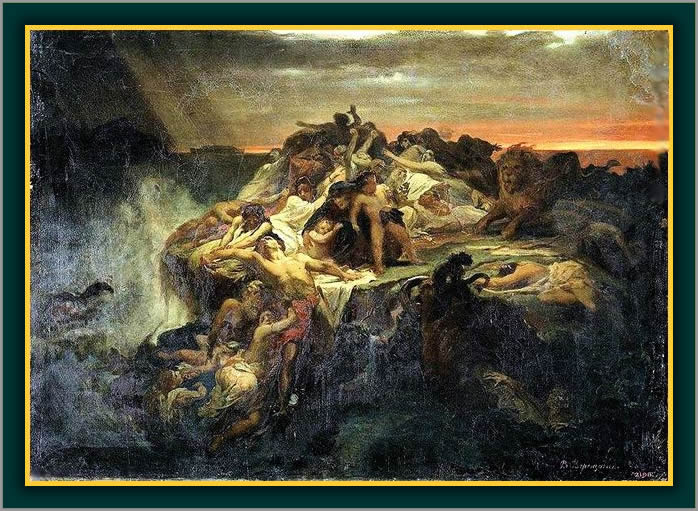
The first
painting of the flood is of Wassilij Petrovich Wereschtschagin
(1835 - 1909). Source.
The second painting is of Joseph Mallord William Turner,
and titled: 'Light and Colour (Goethe's Theory)
- the Morning after the Deluge, Moses Writing the Book of
Genesis' (1843). Source.
Production: Filognostic Association of The Order of Time.

Feed-back | Links | Downloads | Music | Pictures | What's New | Search | Donations