
Canto 11

Canto 11
Chapter 24: Analytic Knowledge, Sânkhya, Summarized
(1) The Supreme Lord said: 'I shall now discuss with you the analytic knowledge as established by the classical authorities. Knowing this a person can immediately give up the bewilderment based upon the material duality. (2) In the first age of dutifulness [Krita], in the beginning when there were [only] persons expert in [spiritual] discrimination, as also before that time [during the period of annihilation], the Knower was simply one and the same as the [universe] known [see also 11.22: 29]. (3) That One Great Undifferentiated Truth inaccessible to speech and mind [Brahman], turned into the two forms of material nature on the one hand and the enjoyment [of the enjoyer of that result] on the other hand [see 11.22]. (4) One essential half, material nature [prakriti], is she [the 'mother'] who is of a dualistic nature, while he, the other entity, the knower, is called the purusha [the enjoying person or male principle]. (5) By My agitation of the elementary nature [in the form of time, of kâla], the modes of tamas, rajas and sattva [the gunas] have manifested in order to fulfill the desires of the living entity. (6) From them the thread [the activating principle of the sûtra] arose, together with the principle of intelligence [mahat]. From the transformation of mahat came about the false ego [the ahankâra of the purusha who identifies with the object of perception] that is the cause of bewilderment. (7) That I-awareness is thus of the three [guna] categories and [accordingly makes] with clarity, emotion and ignorance [alternately use of] the sense objects [tanmâtra], the senses [indriyas] and the mind [manas]. Thus it [the identified self] constitutes the cause of understanding and not understanding [the so-called conscious and unconscious]. (8) The darkness of the false ego gave rise to the subtle sensations [or perceptions] of gross matter, its emotion awakened the senses and the clarity of the identified self called for the eleven gods [see deva]. (9) Because all the elements combined to function under My influence, they brought about the egg of the universe that serves as My supreme residence [see from 11.22: 18].
(10) I appeared [as Nârâyana] in the egg that was situated in the water of the causal ocean, and from My navel a lotus arose that is known as the universe. On that lotus the self-born one found his existence [Brahmâ, see 3.8]. (11) He, the soul of the universe endowed with passion, created from his penance by My mercy the three different worlds called earth, the atmosphere [or ether] and heaven [bhûh, bhuvah and svaha], as also its rulers [see Gâyatrî and loka]. (12) Heaven became the residence of the demigods, the atmosphere the home of the ghostly spirits, the earthly places offered the humans and other living beings shelter and the place beyond these three is there for the Siddhas, the souls of perfection [Siddhaloka]. (13) The places of the underworld were by the master created as the residence for all asuras ['unenlightened souls' or demons] and those perfect in their ego [the 'snakes', the Nâgas]. All the destinations of the three worlds thus owe their existence to the fruitful activities proper to the modes [see B.G. 4: 17, 10.1: 42-43]. (14) By penance, yoga and by forsaking [in sannyâsa] one is of the spotless destinations of mahar, janas, tapas and satya, but My destination [Vaikunthha] is reached by performing devotional service. (15) As arranged by Me, the Supporter, the Soul [the energy] of Time, one rises up from or drowns in the mighty stream of the modes of this world in which one is bound to performing fruitive labor. (16) Whatever the small, the big, the thin and the massive of manifestation, is all brought about by the combination of material nature and its enjoyer [see also B.G. 18: 16]. (17) That what constitutes the cause of something - common matters like things of gold and things of clay - is there in the beginning, during the life as also in the end of that what was produced and is subject to transformation [and is thus illusory as for its form, compare 6.16: 22, 10.87: 15, 11.22: 8]. (18) Something that serves as a previous ingredient of a thing that - as something different - constitutes a change of form of that ingredient, is called the true of something provided it is present from the beginning to the end [compare B.G. 2: 13, 2: 16]. (19) Material nature [prakriti] the foundation of which is constituted by the causal [transformed] ingredient of the Supreme Person [the purusha], together with that what is the agitating agent, viz. Time [kâla], makes up the threefold of the Absolute Truth [Brahman] that I am. (20) For as long as I look after it [or cast My glance], the grand creation will perpetually, for the sake of the variegation of its qualities, generation after generation continue to exist until its dissolution [see also B.G. 3: 24]. (21) When the form of the universe that is pervaded by Me has manifested the planetary variety of its time periods [of creation, maintenance and decay], this variety with its different worlds [losing its synergy] arrives at [a dissolution into] its five composing gross elements [see yugas, manvantaras, and B.G. 11: 13]. (22-27) The mortal frame [at the time of annihilation] will merge with the food, the food with the grains, the grains with the earth and the earth with the fragrance. Fragrance becomes merged with the water, the water with its quality of taste, the taste with the fire and the fire with the form. Form merges with air, air merges with touch and touch merges thereupon with the ether. Ether merges with the subtle object of sound and the senses [of sound etc.] become merged with their sources [the gods of the sun and moon etc.]. The sources, My dear Uddhava, merge with the mind of the ego of goodness, the controller of the sound, that dissolves in the original state of the elements [the ego of slowness]. This all-powerful primal elementary nature then merges with the cosmic intelligence [mahat]. That greater principle dissolves in its own basic qualities and they in their turn merge with their ultimate abode, the unmanifest state of nature that merges with the infallible Time. Time merges with the individuality [the jîva] of the Supreme in command of the illusory potency and that individuality merges with Me, the Supreme Self Unborn [âtmâ], who, characterized by creation and annihilation, is perfectly established in Himself and remains alone [see also 3.11: 28, 4.23: 15-18, 11.3: 12-15]. (28) Just as with the darkness when the sun rises in the sky, how can the bewilderment of the dual mind remain in the heart of the one who seriously studies this? (29) This is what I, the Supervisor of the Spiritual and Material world, had to say concerning this Sânkhya instruction of analysis [see also 3.25 - 3.33] that breaks through the bondage of doubts of the people who both go along with and go against nature.'


Third revised edition, loaded July 15, 2022.
Previous Aadhar edition and Vedabase links:
The Supreme Lord said: 'I shall now discuss with you the analytic knowledge as established by the classical authorities. Knowing this a person can immediately give up the bewilderment based upon the material duality.The Supreme Lord said: 'And now I shall discuss with you the analytic knowledge as established by the classical authorities. Knowing this a person is immediately able to give up the bewilderment that is based upon the duality. (Vedabase)
In the first age of dutifulness [Krita], in the beginning when there were [only] persons expert in [spiritual] discrimination, as also before that time [during the period of annihilation], the Knower was simply one and the same as the [universe] known [see also 11.22: 29].
In the beginning, during the epoch of dutifulness [Krita] and before that time there existed people expert in discrimination to whom the seer and the seen were simply one and the same [see also 11.22: 29]. (Vedabase)
That One Great Undifferentiated Truth inaccessible to speech and mind [Brahman], turned into the two forms of material nature on the one hand and the enjoyment [of the enjoyer of that result] on the other hand [prakriti and purusha, see 11.22].
That one undifferentiated truth inaccessible to speech and mind turned into the twofold of the forms brought about by material nature on the one hand and the complete whole [the integrity of nature itself] on the other hand [prakriti and purusha, see 11.22]. (Vedabase)
One essential half, material nature [prakriti], is she [the 'mother'] who is of a dualistic nature, while he, the other entity, the knower, is called the purusha [the enjoying person or male principle].
One of the two indeed is she, the substance of material nature, consisting of a double self [products and causes, symmetry and complementarity] while the other entity is he, the knower, who is called the original person [the enjoyer or male principle]. (Vedabase)
By My agitation of the elementary nature [in the form of time, of kâla], the modes of tamas, rajas and sattva [the gunas] have manifested in order to fulfill the desires of the living entity.
In order to fulfill the desires of the living entity manifested from My agitation of material nature [in the form of time, of Kâla], the modes themselves: tamas, rajas and sattva [the gunas]. (Vedabase)
From them the thread [the activating principle of the sûtra] arose, together with the principle of intelligence [mahat]. From the transformation of mahat came about the false ego [the ahankâra of the purusha who identifies with the object of perception] that is the cause of bewilderment.
From the realization of these arose the possibility of the lead, the thread, of primeval nature [the sûtra], because in the transformation of the greater reality [the mahat-tattva] that is associated with it the identification came about [of the purusha with it leading to ahankâra or false ego], which is the cause of bewilderment. (Vedabase)
That I-awareness is thus of the three [guna] categories and [accordingly makes] with clarity, emotion and ignorance [alternately use of] the sense objects [tanmâtra], the senses [indriyas] and the mind [manas]. Thus it [the identified self] constitutes the cause of understanding and not understanding [the so-called conscious and unconscious].
That I-awareness [or false ego] is thus of the three categories and [makes accordingly] with emotion, clarity and ignorance [alternately use of] the sense objects [tanmâtra], the senses [indriyas] and the mind [manas]. Thus it [the identified self] constitutes the cause of understanding and not understanding [the so-called conscious and unconscious]. (Vedabase)
The darkness of the false ego gave rise to the subtle sensations [or perceptions] of gross matter, its emotion awakened the senses and the clarity of the identified self called for the eleven gods [see deva].
sFrom the darkness of the false ego arose the subtle sensations of gross matter, from its clarity arose the senses and from the goodness of the identified self arose the eleven gods [see deva]. (Vedabase)
Because all the elements combined to function under My influence, they brought about the egg of the universe that serves as My supreme residence [see from 11.22: 18].
Because all the elements under My influence were combined came the egg of the universe into being which serves as My supreme residence [see from 11.22: 18]. (Vedabase)
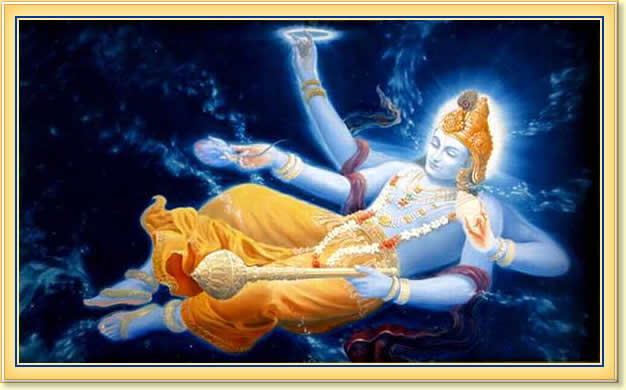
I appeared [as Nârâyana] in the egg that was situated in the water of the causal ocean, and from My navel a lotus arose that is known as the universe. On that lotus the self-born one found his existence [Brahmâ, see 3.8].
Within that egg situated in the water of the causal ocean I appeared [as Nârâyana], whereupon from My navel a lotus arose that is known as the universe. On that lotus found the selfborn one his existence [Brahmâ, see 3.8]. (Vedabase)
He, the soul of the universe endowed with passion, created from his penance by My mercy the three different worlds called earth, the atmosphere [or ether] and heaven [bhûh, bhuvah and svaha], as also its rulers [see Gâyatrî and loka].
He, the soul of the universe endowed with passion, created from his penance by My mercy the three different worlds called earth, the atmosphere and heaven [bhûh, bhuvah and svaha], along with its rulers [see Gâyatrî and loka]. (Vedabase)
Heaven became the residence of the demigods, the atmosphere the home of the ghostly spirits, the earthly places offered the humans and other living beings shelter and the place beyond these three is there for the Siddhas, the souls of perfection [Siddhaloka].
Heaven became the home of the demigods, the atmosphere the home of the ghostly spirits, the earthly places are the home of the humans and other living beings and the beyond of these three is there for the ones of perfection [Siddhaloka]. (Vedabase)
The places of the underworld were by the master created as the residence for all asuras ['unenlightened souls' or demons] and those perfect in their ego [the 'snakes', the Nâgas]. All the destinations of the three worlds thus owe their existence to the fruitful activities proper to the modes [see B.G. 4: 17, 10.1: 42-43].
The places of the underworld were by the master created as the residence of the unenlightened and the ones perfect to the ego [the 'snakes', the Nâgas]. All the destinations of the three worlds thus owe their existence to the fruitive activities of the souls who are entangled in the modes [see B.G. 4: 17, 10.1: 42-43]. (Vedabase)
By penance, yoga and by forsaking [in sannyâsa] one is of the spotless destinations of mahar, janas, tapas and satya, but My destination [Vaikunthha] is reached by performing devotional service.
By penance, yoga and even by forsaking [in sannyâsa] one is of the spotless destinations of mahar, janas, tapas and satya, but My destination [Vaikunthha] is reached by devotional service. (Vedabase)
As arranged by Me, the Supporter, the Soul [the energy] of Time, one rises up from or drowns in the mighty stream of the modes of this world in which one is bound to performing fruitive labor.
As arranged by Me, the Supporter, the Self of Time, one rises up from or drowns in the mighty stream of the modes of this world in which one is bound to profit-minded labor. (Vedabase)
Whatever the small, the big, the thin and the massive of manifestation, is all brought about by the combination of material nature and its enjoyer [see also B.G. 18: 16].
Whatever the small, the great, the thin and the massive of the manifestation, is all brought about by the combination of the two of material nature and the enjoyer [see also B.G. 18: 16]. (Vedabase)
That what constitutes the cause of something - common matters like things of gold and things of clay - is there in the beginning, during the life as also in the end of that what was produced and is subject to transformation [and is thus illusory as for its form, compare 6.16: 22, 10.87: 15, 11.22: 8].
That what constitutes the cause of something is there in the beginning, during the life as well as in the end of that what was produced. The transformation [the ingredient as well as he who transforms and not so much this or that form] is what makes the real of common utensils like matters of gold and things of clay [compare 6.16: 22, 10.87: 15, 11.22: 8]. (Vedabase)
Something that serves as a previous ingredient of a thing that - as something different - constitutes a change of form of that ingredient, is called the true of something provided it is present from the beginning to the end [compare B.G. 2: 13, 2: 16].
Something which operates as a previous ingredient in the production of another thing that is thus a modification of that ingredient, is called the true of something when it is present from the beginning to the end [compare B.G. 2: 13, 2: 16]. (Vedabase)
Material nature [prakriti] the foundation of which is constituted by the causal [transformed] ingredient of the Supreme Person [the purusha], together with that what is the agitating agent, viz. Time [kâla], makes up the threefold of the Absolute Truth [Brahman] that I am.
Material nature constituting the basis [âdhâra] of the causal ingredient [the transformed], the real of the Original Person [He who transforms], and that what sets in operation, viz. Time [the transformation], are the three [of resp. prakriti, Purusha and kâla] who together constitute the Absolute Truth [the Brahman] that I am. (Vedabase)
For as long as I look after it [or cast My glance], the grand creation will perpetually, for the sake of the variegation of its qualities, generation after generation continue to exist until its dissolution [see also B.G. 3: 24].
The bountiful creation will for the sake of the variegatedness of its qualities generation after generation continually be maintained until its dissolution for as long as I look after it [see also B.G. 3: 24]. (Vedabase)
When the form of the universe that is pervaded by Me has manifested the planetary variety of its time periods [of creation, maintenance and decay], this variety with its different worlds [losing its synergy] arrives at [a dissolution into] its five composing gross elements [see yugas, manvantaras, and B.G. 11: 13].
When the universal form that is pervaded by Me has manifested the planetary variety of its time periods [of creation, maintenance and decay], this variety with its different worlds [losing its synergy] becomes fit for [dissolution into] its five composing gross elements [see yugas, manvantaras, and B.G. 11: 13]. (Vedabase)
The mortal frame [at the time of annihilation] will merge with the food, the food with the grains, the grains with the earth and the earth with the fragrance. Fragrance becomes merged with the water, the water with its quality of taste, the taste with the fire and the fire with the form. Form merges with air, air merges with touch and touch merges thereupon with the ether. Ether merges with the subtle object of sound and the senses [of sound etc.] become merged with their sources [the gods of the sun and moon etc.]. The sources, My dear Uddhava, merge with the mind of the ego of goodness, the controller of the sound, that dissolves in the original state of the elements [the ego of slowness]. This all-powerful primal elementary nature then merges with the cosmic intelligence [mahat]. That greater principle dissolves in its own basic qualities and they in their turn merge with their ultimate abode, the unmanifest state of nature that merges with the infallible Time. Time merges with the individuality [the jîva] of the Supreme in command of the illusory potency and that individuality merges with Me, the Supreme Self Unborn [âtmâ], who, characterized by creation and annihilation, is perfectly established in Himself and remains alone [see also 3.11: 28, 4.23: 15-18, 11.3: 12-15].
The mortal frame [at the time of annihilation] merges with the food, the food with the grains, the grains with the earth and the earth with the fragrance. The fragrance is merged with the water, the water with its quality, that taste with the fire and the fire with the form. Form is being merged with the touch, the touch then with the ether, ether with the subtle object of sound and the senses [of sound etc.] with their sources [the gods of the sun and moon etc.]. The sources [as the ahankâra ego of passion] are merged with the emotions [the ego of goodness], My dearest, and they merge with the mind, the controller of the sound, which dissolves in the original of the elements [ego of slowness], and that all powerful primal elementary nature merges with the cosmic intelligence [mahat]. That greater nature merges in its own modes and they on their turn merge with their ultimate abode of the unmanifest which merges with the infallible Time. Time merges with the individuality [the jîva] of the Supreme in command of the illusory potency and that individuality merges with Me, the Supreme Self Unborn [âtmâ], who, characterized by creation and annihilation, perfectly being established in Himself remains alone [see also 3.11: 28, 4.23: 15-18, 11.3: 12-15]. (Vedabase)
Just as with the darkness when the sun rises in the sky, how can the bewilderment of the dual mind remain in the heart of the one who seriously studies this?
Just as the darkness cannot remain with the sun rising in the sky, the same way the bewilderment of the dual mind cannot remain in the heart of someone who seriously studies this. (Vedabase)
This is what I, the Supervisor of the Spiritual and Material world, had to say concerning this Sânkhya instruction of analysis [see also 3.25 - 3.33] that breaks through the bondage of doubts of the people who both go along with and go against nature.'
This is what I, the Overseer of the Spiritual and Material world, had to say about this Sânkhya direction of analysis [see also 3.25 - 3.33] which breaks the bondage of doubts of people who in their lives go along with and go against the nature of things.' (Vedabase)

The
text and audio are offered under the conditions of the
Creative
Commons
Attribution-Noncommercial-Share
Alike 3.0 Unported License.
Painting
'Drieluik' (middenpaneel) courtesy of Wim Kuenen, used with permission.
Production: Filognostic Association of The Order of Time

Feed-back | Links | Downloads | Music | Pictures | What's New | Search | Donations


 Text 1