

Canto 10
Canto 10
Chapter 39: Krishna and Balarâma Leave for Mathurâ
(1) S'rî S'uka said: 'After comfortably seated on a couch thus having been honored that much by Râma and Krishna, he [Akrûra] saw that everything had taken place what he on his way had pictured in his mind. (2) What would be unattainable when the Supreme Lord, the shelter of S'rî, is satisfied? Still, the souls devoted to Him, oh King, do not desire anything. (3) After having enjoyed supper the Supreme Lord, the son of Devakî, asked how Kamsa treated His friends and relatives, as also what his plans were. (4) The Supreme Lord said: 'Oh gentle one, have you recovered from your trip? I wish you all the best! Are your friends, relatives and other associates all hale and hearty? (5) But why, My dear one, would I ask about the well-being of us, our relatives and the citizens, as long as Kamsa, that disease of the family, who only in name is our maternal uncle, is prospering? (6) Ah! Because of Me there was great suffering for My noble parents: their sons were killed and they were imprisoned. (7) Fortunately, today My wish has been fulfilled to see you, My close relative, oh gentle soul. Please uncle, tell Me why you came here.'
(8) S'rî S'uka said: 'On the request of the Supreme Lord the descendant of Madhu [Akrûra, see 9.23: 29] described everything of the inimical attitude [of Kamsa] towards the Yadus and his murderous intentions in relation to Vasudeva. (9) He disclosed what the message was he was sent for as an envoy and what Nârada had told him [Kamsa] about Krishna being born as a son of Ânakadundubhi. (10) When Krishna and Balarâma, the destroyer of all boldness in opposition, heard what Akrûra had to say, They laughed and told Nanda, Their [foster] father, what the king had ordered. (11-12) Nanda then issued the following official announcement to the gopas and the other people of Gokula: 'Gather all dairy products, take gifts and yoke the wagons. Tomorrow we together with all the people, will go to Mathurâ to offer the king our products and have a great festival.'
(13) When the cowherd girls heard that Akrûra had come to Vraja to take Râma and Krishna along to the city, they got totally upset. (14) That created in the hearts of some of them such a great pain, that their beautiful faces turned pale because of their sighing, while the knots in the hair, the bracelets and dresses of other girls slipped away.(15) Of other gopîs fixed in meditation on Him, all the sensory functions ceased, so that they took no notion of this world anymore, just like it happens with those who attained the realm of self-realization. (16) Women fainted, thinking of how S'auri had touched their hearts by sending His loving smiles and expressing Himself in wonderful phrases. (17-18) Thinking about Mukunda's charming movements, His activities, affectionate smiles, His glances that removed all unhappiness, His jesting words and mighty deeds, they joined in fear of the separation, greatly distressed, in groups to speak deeply absorbed with tears on their faces, about Acyuta. (19) The fine gopîs said: 'Oh Providence, where is your mercy to bring together the embodied souls in love and friendship? Separating us you leave us unfulfilled in our purposes. How uselessly you, just like a child, toy with us! (20) Having shown to us the face of Mukunda framed in black locks, His fine cheeks, straight nose, and the beauty of His modest smile dispelling the misery, you are not doing any good by [now] making all of this invisible to us. (21) By the name of Akrûra ['not-cruel'] you certainly are cruel, in your, like a fool, alas, taking away from us the Perfection of All Creation in one form, the enemy of Madhu, you allowed our eyes to see. (22) The son of Nanda breaks in a moment with His friendship. He has taken up a new love and has, alas, no eyes for us [anymore], we who under His influence were made to give up our homes, relatives, children and husbands, and directly serve Him. (23) How happy the dawn is after this night, when unfailingly the hopes have been fulfilled of the women of the city [of Mathurâ]! For then they imbibe the face of the master of Vraja arriving there with the nectarean smile from the corners of His eyes. (24) However subservient and intelligent Mukunda may be, once His mind is seized by their honey-sweet words, oh girls, what chance is there for us? Would He, spellbound by the enchantments of their bashful smiles, still return to us rustics? (25) Today there certainly will be a great festival before the eyes of the Dâs'ârhas, Bhojas, Andhakas, Vrishnis and Sâtvatas and all others out there, when they on the road see the Darling of the Goddess, the reservoir of all transcendental qualities who is the son of Devakî. (26) Such an unkind person, a person as extremely cruel as he, should not be called 'a-krûra' because he, without the least excuse, removes from the presence of us people [of Vraja] full of sorrow, the one dearer to us than the dearest. (27) He who so coldly has mounted the chariot [Krishna], is by these foolish gopas followed in their bullock carts. And the elders do not even say a word. Today providence is not working in our favor! (28) Let us go to Him now and stop Him! What will that do to us, the family, the elders and our relatives, we who not even for half a second can miss the association of Mukunda? Separated by that fate our hearts will be broken! (29) For us, who by the charm of His loving affection, attractive smiles, intimate discussions, playful glances and embraces, were drawn to the assembly of the râsa dance [10.33], the night passed in a single moment! How, oh gopîs, can we ever defeat the insurmountable darkness of His absence? (30) How can we ever exist without Him, that Friend of Ananta [Balarâma], who at the end of the day, surrounded by the gopas entered Vraja with His hair and garland smeared with the dust of the hoofs, He who, playing His flute and smiling from the corners of His eyes, stole our minds with His glances?'
(31) S'rî S'uka said: 'Thus speaking in pain about the separation, the ladies of Vraja, in attachment thinking of Krishna, forgot all their shame and cried out loudly: 'Oh Govinda, oh Dâmodara, oh Mâdhava!'
(32) While the women were lamenting thus, Akrûra at sunrise, after having performed his morning duties, set out with his chariot. (33) The gopas, who led by Nanda followed Him in their wagons, took along an abundance of offerings and clay pots filled with dairy products. (34) Also the gopîs followed their beloved Krishna [for some time] and [then] stood waiting, hoping for some pleasing words from the Lord. (35) The Greatest among the Yadus saw them lamenting at His departure and consoled them lovingly with the message: 'I will do My best!' (36) Sending their minds after Him for as long as the flag and the dust of the chariot were visible, they stood there like painted figures. (37) Without the hope of ever seeing Him back, they returned and free from sorrow spent their days and nights singing about the activities of their Beloved.
(38) With the chariot moving as swiftly as the wind, the Supreme Lord together with Râma and Akrûra, oh King, arrived at the Yamunâ, the river removing all sin. (39) After touching the water there with His hand and drinking the sweet liquid that was as effulgent as jewels, He led the chariot to a grove and then climbed [back] on it together with Balarâma. (40) Akrûra asked Them to stay behind on the chariot and went to a pool in the Yamunâ to perform a bath in accord with the injunctions. (41) Immersing himself in that water and reciting perennial mantras, Akrûra saw before him the likeness of Râma and Krishna. (42-43) He thought: 'How can the two sons of Ânakadundhubhi positioned on the chariot be present here? Let me see whether They are still there...', and rising from the water he saw Them sitting where he had left Them. Again alone entering the water he wondered: 'Was my vision of Them in the water a hallucination maybe?' (44-45) And again he saw in that same place the Lord of the Serpents [Ananta or Balarâma], the Godhead with the thousands of heads, hoods and helmets, who by the perfected souls, the venerable souls, the singers of heaven and those of darkness was praised with bowed heads. Clad in blue and [with a complexion] as white as the filaments of a lotus stem, He was situated there like mount Kailâsa with its white peaks. (46-48) On His lap there was situated peacefully, like a dark cloud, the Original Personality with the four arms, clad in yellow silk. He had reddish eyes like the petals of a lotus, an attractive cheerful face with a charming, smiling glance, fine eyebrows, ears and a straight nose, beautiful cheeks and red lips. He had high shoulders and a broad chest home to the Goddess, stout, long arms and a conch shell-like neck, a deep navel and a belly with lines like those of a [banyan] leaf. (49-50) He had firm hips and loins, two thighs like an elephant's trunk, shapely knees and an attractive pair of shanks. His ankles were high, reddish were the rays emanating from His toenails, and the soft toes of His lotus feet surrounding His two big toes glowed like flower petals. (51-52) Adorned with a helmet bedecked with large and precious gems, wearing bracelets, armlets, a belt, a sacred thread, necklaces, ankle bells and earrings, He carried an effulgent lotus, a conch shell, a disc and a club in His hands, next to the S'rîvatsa mark on His chest, His brilliant Kaustubha jewel and a flower garland. (53-55) He was accompanied by attendants headed by Nanda and Sunanda and was, according to each different type of loving attitude, praised in sanctified words by Sanaka and the others [the Kumâras], by the leading demigods headed by Brahmâ and S'iva, by the foremost twice-born souls [headed by Marîci] and by the most exalted devotees led by Prahlâda, Nârada and Vasu. He was served by His [feminine] internal potencies of fortune [S'rî], development [Pushthi or also strength], speech [Gîr or knowledge], beauty [Kânti], renown [Kîrti], contentment [Tushthi or renunciation - these first ones are His six opulences]; comfort [Ilâ, bhû-s'akti, the earth-element or sandhinî] and power [Ûrjâ, expanding as Tulasî] as also by His potencies of knowing and ignorance [vidyâ and avidyâ, leading to liberation and bondage], His internal pleasure potency [S'akti or hlâdinî], [His marginal potency, jîva-s'akti] and His creative potency [Mâyâ].
(56-57) Witnessing this to his great pleasure, he [Akrûra], stood enthused with supreme devotion, with the hairs of his body standing on end and with his eyes and body getting wet because of his loving ecstasy. Regaining his composure the great devotee with a choked voice offered his respects with his head bowed down. Joining his hands he attentively prayed slowly.'


Third revised edition, loaded January 9, 2021.
Previous Aadhar edition and Vedabase links:
S'rî S'uka said: 'After comfortably seated on a couch thus having been honored that much by Râma and Krishna, he [Akrûra] saw that everything had taken place what he on his way had pictured in his mind.S'rî S'uka said: 'Comfortably seated on a couch after having been that much honored by Râma and Krishna saw he [Akrûra] thus all he on his way had pictured in his mind realized before him. (Vedabase)
What would be unattainable when the Supreme Lord, the shelter of S'rî, is satisfied? Still, the souls devoted to Him, oh King, do not desire anything.
What would be unattainable with the Supreme Lord, the shelter of S'rî, being satisfied; yet do the ones devoted to Him, o King, indeed not desire anything. (Vedabase)
After having enjoyed supper the Supreme Lord, the son of Devakî, asked how Kamsa treated His friends and relatives, as also what his plans were.
After the evening meal had been enjoyed asked the Supreme Lord, the son of Devakî about the behavior of Kamsa towards His friends and relatives as also what his plans were. (Vedabase)
The Supreme Lord said: 'Oh gentle one, have you recovered from your trip? I wish you all the best! Are your friends, relatives and other associates all hale and hearty?
The Supreme Lord said: 'O gentle one, have you recovered from your trip? All good to you! Are your friends and relatives and other associates all healthy and hale? (Vedabase)
But why, My dear one, would I ask about the well-being of us, our relatives and the citizens, as long as Kamsa, that disease of the family, who only in name is our maternal uncle, is prospering?
But what my dear, am I to ask about our well-being, our relatives and the subject citizens, as long as that disease of the family Kamsa, in name our maternal uncle, is insolent? (Vedabase)
Ah! Because of Me there was great suffering for My noble parents: their sons were killed and they were imprisoned.
Just see how my offenseless parents because of Me had to suffer greatly with him causing the death of their sons and holding them captive. (Vedabase)
Fortunately, today My wish has been fulfilled to see you, My close relative, oh gentle soul. Please uncle, tell Me why you came here.'
Today has the wish been fulfilled that We may enjoy the good fortune of you, My close relative, seeking My presence, o gentle one; please explain o uncle for what reason you came here.' (Vedabase)
S'rî S'uka said: 'On the request of the Supreme Lord the descendant of Madhu [Akrûra, see 9.23: 29] described everything of the inimical attitude [of Kamsa] towards the Yadus and his murderous intentions in relation to Vasudeva.
S'rî S'uka said: 'On the request of the Supreme Lord described the descendant of Madhu [Akrûra, see 9.23: 29] the inimical attitude and the murder schemes [of Kamsa] towards Vasudeva and the Yadus. (Vedabase)
He disclosed what the message was he was sent for as an envoy and what Nârada had told him [Kamsa] about Krishna being born as a son of Ânakadundubhi.
He disclosed for what message he had been sent as an envoy and what Nârada had told him [Kamsa] about Krishna's being born as a son of Ânakadundubhi. (Vedabase)
When Krishna and Balarâma, the destroyer of all boldness in opposition, heard what Akrûra had to say, They laughed and told Nanda, Their [foster] father, what the king had ordered.
Hearing what Akrûra had to say made Krishna and Balarâma, the destroyer of all boldness in opposition, laugh and they told Nanda, their (foster-)father, what the king had ordered. (Vedabase)
Nanda then issued the following official announcement to the gopas and the other people of Gokula: 'Gather all dairy products, take gifts and yoke the wagons. Tomorrow we together with all the people, will go to Mathurâ to offer the king our products and have a great festival.'
The gopas he then on his turn told: 'Gather all dairy, take gifts and yoke the wagons. Tomorrow will we together with all the people under my care go to Mathurâ to offer the king our products and have a great festival', and so had the gopa Nanda it announced by spokesmen all over his domain. (Vedabase)
When the cowherd girls heard that Akrûra had come to Vraja to take Râma and Krishna along to the city, they got totally upset.
The cowherd-girls then who heard that Akrûra had come to Vraja to take Râma and Krishna to the city, got totally upset. (Vedabase)
That created in the hearts of some of them such a great pain, that their beautiful faces turned pale because of their sighing, while the knots in the hair, the bracelets and dresses of other girls slipped away.
With some of them created that in their hearts such a great pain that they with their beautiful faces sighing turned pale while of others the knots in their hair, their bracelets and dresses came to slip. (Vedabase)
Of other gopîs fixed in meditation on Him, all the sensory functions ceased, so that they took no notion of this world anymore, just like it happens with those who attained the realm of self-realization.
With others, fixed in meditation on Him, ceased, just like with those who have attained the realm of self-realization, all the sensory functions taking no notion of this world anymore. (Vedabase)
Women fainted, thinking of how S'auri had touched their hearts by sending His loving smiles and expressing Himself in wonderful phrases.
Still other women fainted, thinking of how S'auri sending His loving smiles would touch the heart and express Himself in wonderful phrases. (Vedabase)
Thinking about Mukunda's charming movements, His activities, affectionate smiles, His glances that removed all unhappiness, His jesting words and mighty deeds, they joined in fear of the separation, greatly distressed, in groups to speak deeply absorbed with tears on their faces, about Acyuta.
Thinking about the movements so charming, the activities, the affectionate smiles, the glances removing all unhappiness, the jesting words and mighty deeds of Mukunda, joined they in fear of the separation greatly distressed in groups speaking deeply absorbed in Acyuta with tears on their faces. (Vedabase)
The fine gopîs said: 'Oh Providence, where is your mercy to bring together the embodied souls in love and friendship? Separating us you leave us unfulfilled in our purposes. How uselessly you, just like a child, toy with us!
The fine gopîs said: 'O providence, where is your mercy to bring together the embodied in love and friendship while you leave each of us to her devices unfulfilled in her aims; how useless you toy with us like a child! (Vedabase)
Having shown to us the face of Mukunda framed in black locks, His fine cheeks, straight nose, and the beauty of His modest smile dispelling the misery, you are not doing any good by [now] making all of this invisible to us.
Having shown to us the face of Mukunda framed in black locks, His fine cheeks and straight nose and the beauty of His modest smile dispelling the misery, you're not doing any good making them invisible. (Vedabase)
By the name of Akrûra ['not-cruel'] you certainly are cruel, in your, like a fool, alas, taking away from us the Perfection of All Creation in one form, the enemy of Madhu, you allowed our eyes to see.
By the name of Akrûra [meaning 'not-cruel'] you for certain are cruel; the Perfection of All Creation, the perfection of the enemy of Madhu, that you once granted our eyes to see you indeed just like a fool alas take away. (Vedabase)
The son of Nanda breaks in a moment with His friendship. He has taken up a new love and has, alas, no eyes for us [anymore], we who under His influence were made to give up our homes, relatives, children and husbands, and directly serve Him.
Alas, now that He has taken up a new love, does the son of Nanda, in a second breaking with His friendship, have no eyes for us who under His control in direct service to Him were moved to give up our homes, relatives, children and husbands.(Vedabase)
How happy the dawn is after this night, when unfailingly the hopes have been fulfilled of the women of the city [of Mathurâ]! For then they imbibe the face of the master of Vraja arriving there with the nectarean smile from the corners of His eyes.
How happy is the dawn after this night when unfailingly the hopes have been fulfilled of the women of the city [of Mathurâ] who will drink in the face of the master of Vraja entering there with a nectarean smile that is hiding in the corners of His eyes. (Vedabase)
However subservient and intelligent Mukunda may be, once His mind is seized by their honey-sweet words, oh girls, what chance is there for us? Would He, spellbound by the enchantments of their bashful smiles, still return to us rustics?
However subservient and intelligent Mukunda may be, once His mind is seized by their honey-sweet words, o girls, what chance have we that He, moved by the enchantments of their bashful smiles, will return to us rustics? (Vedabase)
Today there certainly will be a great festival before the eyes of the Dâs'ârhas, Bhojas, Andhakas, Vrishnis and Sâtvatas and all others out there, when they on the road see the Darling of the Goddess, the reservoir of all transcendental qualities who is the son of Devakî.
Today will there certainly be a great festival to the eyes of the Dâs'ârhas, Bhojas, Andhakas, Vrishnis and Sâtvatas and all others out there when they on the road see passing by the Darling of the Goddess, the reservoir of all transcendental qualities that is the son of Devakî. (Vedabase)
Such an unkind person, a person as extremely cruel as he, should not be called 'a-krûra' because he, without the least excuse, removes from the presence of us people [of Vraja] full of sorrow, the one dearer to us than the dearest.
The name of such an unkind person, a person as extremely cruel as him here, shouldn't be 'a-krûra' because he without any excuse takes away from the presence of us people [of Vraja] full of sorrow, the One dearer to us than the dearest. (Vedabase)
He who so coldly has mounted the chariot [Krishna], is by these foolish gopas followed in their bullock carts. And the elders do not even say a word. Today providence is not working in our favor!
This one, He who, to the indifference of the elders, so coolly has mounted the chariot, is by these besotted gopas followed in their bullock carts; today providence is not working in our favor. (Vedabase)
Let us go to Him now and stop Him! What will that do to us, the family, the elders and our relatives, we who not even for half a second can miss the association of Mukunda? Separated by that fate our hearts will be broken!
Let's go to Him and stop Him, He cannot do this to us, the family, the elders and our relatives who not even for a half a second can miss the association of Mukunda; separated by that fate our hearts will be broken! (Vedabase)
For us, who by the charm of His loving affection, attractive smiles, intimate discussions, playful glances and embraces, were drawn to the assembly of the râsa dance [10.33], the night passed in a single moment! How, oh gopîs, can we ever defeat the insurmountable darkness of His absence?
For us who to the charm of His loving affection, attractive smiles, intimate discussions and playful glances and embraces, were brought to the assembly of the râsadance [10.33], passed the night in a moment; how, o gopîs, can we now get over the insurmountable darkness of being without Him? (Vedabase)
How can we ever exist without Him, that Friend of Ananta [Balarâma], who at the end of the day, surrounded by the gopas entered Vraja with His hair and garland smeared with the dust of the hoofs, He who, playing His flute and smiling from the corners of His eyes, stole our minds with His glances?'
How can we ever exist without Him, that Friend of Ananta [Râma] who at the end of the day, surrounded by gopas entered Vraja with His hair and garland smeared with the dust of the hoofs and who, playing His flute, smiling from the corners of His eyes, with His glances stole our minds?' (Vedabase)
S'rî S'uka said: 'Thus speaking in pain about the separation, the ladies of Vraja, in attachment thinking of Krishna, forgot all their shame and cried out loudly: 'Oh Govinda, oh Dâmodara, oh Mâdhava!'
S'rî S'uka said: 'Thus speaking hopelessly unsettled of the separation, forgot the ladies of Vraja, in attachment thinking of Krishna, all their shame and cried they out aloud: 'O Govinda, o Dâmodara, o Mâdhava!' (Vedabase)
While the women were lamenting thus, Akrûra at sunrise, after having performed his morning duties, set out with his chariot.
As the women thus lamented then set at sunrise Akrûra, having performed his morning duties, out with his chariot. (Vedabase)
The gopas, who led by Nanda followed Him in their wagons, took along an abundance of offerings and clay pots filled with dairy products.
The gopas headed by Nanda following Him then in their wagons brought along an abundance of offerings and clay pots filled with dairy products. (Vedabase)
Also the gopîs followed their beloved Krishna [for some time] and [then] stood waiting, hoping for some pleasing words from the Lord.
The gopîs to that, following Krishna hoping for some pacifying words to comfort them, stood waiting. (Vedabase)
The Greatest among the Yadus saw them lamenting at His departure and consoled them lovingly with the message: 'I will do My best!'
Seeing them thus lamenting as He was leaving, consoled the Greatest of the Yadus them full of love giving the message: 'Keep courage' [*]. (Vedabase)
Sending their minds after Him for as long as the flag and the dust of the chariot were visible, they stood there like painted figures.
Sending their minds after him for as long as the flag was visible and the dust of the chariot could be seen, stood they there as painted figures. (Vedabase)
Without the hope of ever seeing Him back, they returned and free from sorrow spent their days and nights singing about the activities of their Beloved.
They without hope of ever seeing Him returning, full of sorrow went back spending their days and nights singing about the activities of their Beloved. (Vedabase)
With the chariot moving as swiftly as the wind, the Supreme Lord together with Râma and Akrûra, oh King, arrived at the Yamunâ, the river removing all sin.
With the chariot swift as the wind arrived the Supreme Lord together with Râma and Akrûra, o King, at the Yamunâ, the river defeating all sin. (Vedabase)
After touching the water there with His hand and drinking the sweet liquid that was as effulgent as jewels, He led the chariot to a grove and then climbed [back] on it together with Balarâma.
After touching the water there, drinking the sweet liquid as effulgent as jewels from His hand, moved He on to a grove and mounted He with Balarâma the chariot. (Vedabase)
Akrûra asked Them to stay behind on the chariot and went to a pool in the Yamunâ to perform a bath in accord with the injunctions.
Akrûra asking Them to stay behind on the chariot went to a pool of the Yamunâ and performed his bath according the injunctions. (Vedabase)
Immersing himself in that water and reciting perennial mantras, Akrûra saw before him the likeness of Râma and Krishna.
Immersing himself in that water reciting perennial mantras saw Akrûra before him the both of Râma and Krishna together. (Vedabase)
He thought: 'How can the two sons of Ânakadundhubhi positioned on the chariot be present here? Let me see whether They are still there...', and rising from the water he saw Them sitting where he had left Them. Again alone entering the water he wondered: 'Was my vision of Them in the water a hallucination maybe?'
He thought: 'How can the two sons of Ânakadundubhi present on the chariot be here; let's see if they're still there', and rising from the water saw he Them sitting where he left Them. Again entering the water alone he wondered: 'Was it perhaps a hallucination of me seeing Them in the water?' (Vedabase)
And again he saw in that same place the Lord of the Serpents [Ananta or Balarâma], the Godhead with the thousands of heads, hoods and helmets, who by the perfected souls, the venerable souls, the singers of heaven and those of darkness was praised with bowed heads. Clad in blue and [with a complexion] as white as the filaments of a lotus stem, He was situated there like mount Kailâsa with its white peaks.
And again in that same place saw he the Lord of the Serpents [Ananta or Balarâma], the Godhead with the thousands of heads, hoods and helmets, clad in blue and white like the filaments of a lotus stem, situated as if He were mount Kailâsa with its white peaks, with the perfected, the venerable ones, the singers of heaven and the ones of darkness bowing their heads. (Vedabase)
On His lap there was situated peacefully, like a dark cloud, the Original Personality with the four arms, clad in yellow silk. He had reddish eyes like the petals of a lotus, an attractive cheerful face with a charming, smiling glance, fine eyebrows, ears and a straight nose, beautiful cheeks and red lips. He had high shoulders and a broad chest home to the Goddess, stout, long arms and a conch shell-like neck, a deep navel and a belly with lines like those of a [banyan] leaf.
On His lap there was, like a dark cloud clad in yellow silk, the Original Personality with the four arms in peace; with reddish eyes like the petals of a lotus; an attractive cheerful face with a charming, smiling glance; fine eyebrows, ears and a straight nose; beautiful cheeks and red lips; a broad chest and high shoulders; stout, long arms and a conchshell-like neck; a deep navel and a belly with lines like those of a [banyan] leaf. (Vedabase)
He had firm hips and loins, two thighs like an elephant's trunk, shapely knees and an attractive pair of shanks. His ankles were high, reddish were the rays emanating from His toenails, and the soft toes of His lotus feet surrounding His two big toes glowed like flower petals.
Tight were His buttocks and hips, like an elephant's trunk His two thighs and shapely His two knees and attractive the pair of shanks He had. High were His ankles, reddish the rays emanating from His toenails and glowing like flower petals the soft toes surrounding the two big toes. (Vedabase)
Adorned with a helmet bedecked with large and precious gems, wearing bracelets, armlets, a belt, a sacred thread, necklaces, ankle bells and earrings, He carried an effulgent lotus, a conch shell, a disc and a club in His hands, next to the S'rîvatsa mark on His chest, His brilliant Kaustubha jewel and a flower garland.
Adorned with a helmet bedecked with great and precious gems, with bracelets, armlets, a belt, a sacred thread, necklaces, ankle bells and earrings, carried He an effulgent lotus, a conchshell, a disc and held He a club in His hands to the S'rîvatsa on His chest, the brilliant Kaustubha jewel and a flower garland. (Vedabase)
He was accompanied by attendants headed by Nanda and Sunanda and was, according to each different type of loving attitude, praised in sanctified words by Sanaka and the others [the Kumâras], by the leading demigods headed by Brahmâ and S'iva, by the foremost twice-born souls [headed by Marîci] and by the most exalted devotees led by Prahlâda, Nârada and Vasu. He was served by His [feminine] internal potencies of fortune [S'rî], development [Pushthi or also strength], speech [Gîr or knowledge], beauty [Kânti], renown [Kîrti], contentment [Tushthi or renunciation - these first ones are His six opulences]; comfort [Ilâ, bhû-s'akti, the earth-element or sandhinî] and power [Ûrjâ, expanding as Tulasî] as also by His potencies of knowing and ignorance [vidyâ and avidyâ, leading to liberation and bondage], His internal pleasure potency [S'akti or hlâdinî], [His marginal potency, jîva-s'akti] and His creative potency [Mâyâ].
He was awaited by His attendants with Nanda and Sunanda first. By Sanaka and the others [the Kumâras], by the leading demigods headed by Brahmâ and S'iva, by the foremost twiceborn [headed by Marîci] and by the most exalted devotees lead by Prahlâda, Nârada and Vasu, was He, according each his different type of loving attitude, praised in sanctified words and served by His [feminine] internal potencies of fortune [S'rî], development [Pushthi or also strength], speech [Gîr or knowledge], beauty [Kânti], renown [Kîrti], contentment [Tushthi or renunciation - these first ones are His six opulences]; comfort [Ilâ, bhû-s'akti, the earth-element or sandhinî] and power [Ûrjâ, expanding as Tulasî]; His potencies of knowing and ignorance [vidyâ and avidyâ, leading to liberation and bondage]; His internal pleasure potency [S'akti or hlâdinî], his marginal potency [jîva-s'akti] and His creative potency [Mâyâ]. (Vedabase)
Witnessing this to his great pleasure, he [Akrûra], stood enthused with supreme devotion, with the hairs of his body standing on end and with his eyes and body getting wet because of his loving ecstasy. Regaining his composure the great devotee with a choked voice offered his respects with his head bowed down. Joining his hands he attentively prayed slowly.'
Witnessing this to his great pleasure, stood he [Akrûra] there, enthused with supreme devotion, with the hairs on his body erect and with his eyes and body getting wet of loving ecstasy. Getting himself together offered the great devotee with his voice choked his respects bowing his head down and joined he his hands attentively praying slowly.' (Vedabase)


The text and audio are offered under the conditions of
the
Creative
Commons Attribution-Noncommercial-Share Alike 3.0 Unported
License.
The first
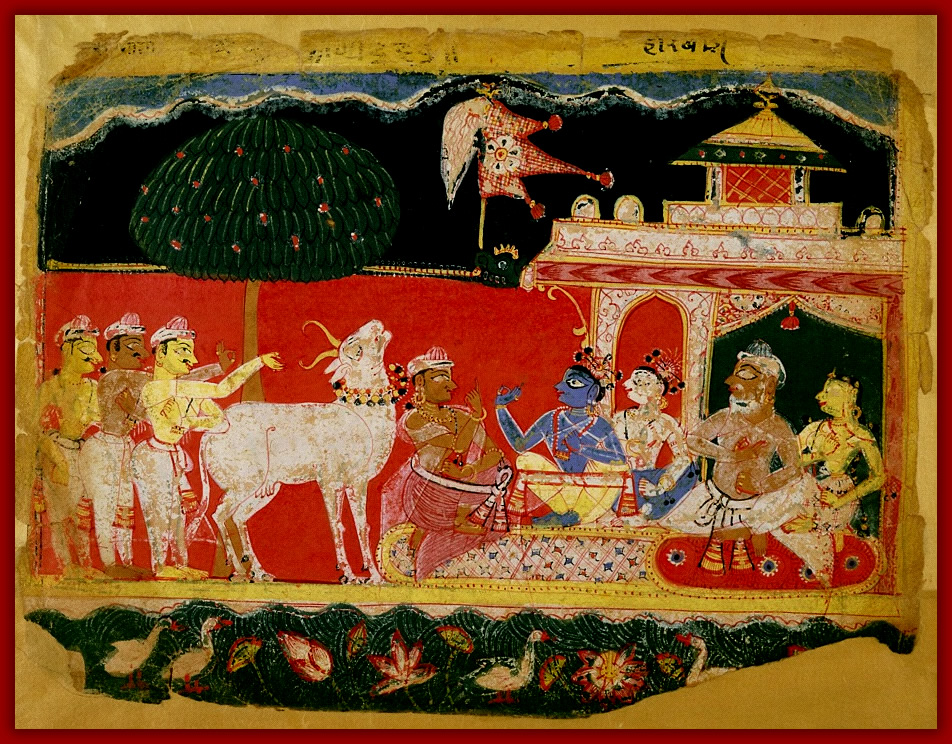
painting is titled: 'Akrura invites Krishna and Balarâma to
Mathurâ'. Pre-Mughal period, Delhi-Agra, India, ca. 1525-40.
Source: Smithsonian
Sackler Gallery.
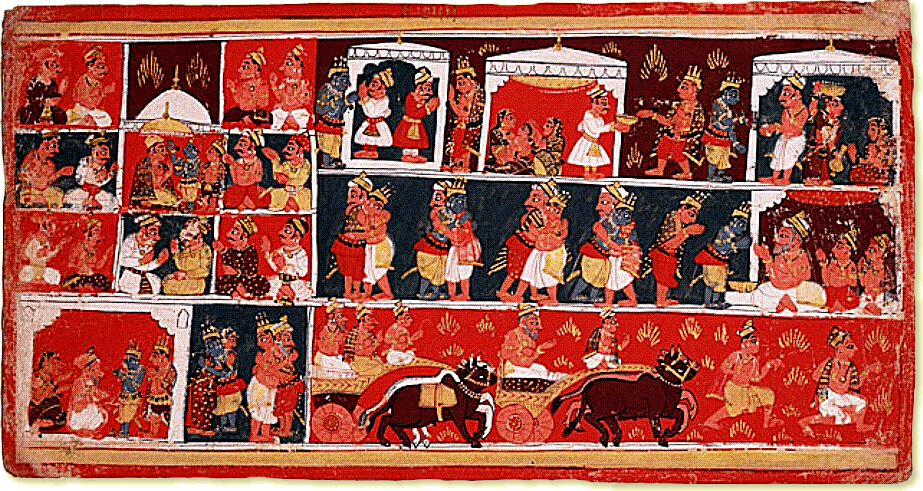
The third painting is titled: "Krishna and Balarama take leave
of their foster parents", India
1686
Courtesy
of Berkeley Art Museum/Pacific Film Archive.
Production: Filognostic
Association of The Order of Time.

Feed-back | Links | Downloads | Music | Pictures | What's New | Search | Donations



 Text 1