

Canto 11

Canto 11
Chapter 4: The Activities of Nara-Nârâyana and the other Avatâras described
(1) The honorable king [Nimi] said: 'Please speak to us about the activities of each of these self-chosen appearances by which the Lord performed, is performing and will perform in this world [see also 2.7].'
(2) S'rî Drumila said: 'Truly, he who tries to enumerate the unlimited transcendental qualities of the Unlimited One, is a person with the intelligence of a child. One may somehow, in due course of time, be able to count the dust particles on earth, but one can never count the qualities of the Reservoir of all Potencies [see also 10.14: 7, 10.51: 38]. (3) When the Original Personality of Godhead Nârâyana assumed the, from Himself generated, body of the universe that was created out of the five material elements, and entered it in His plenary expansion, He thus became known as the Purusha [see also 1.3: 1]. (4) In the vastness of this three-world body originated, from His senses, the two kinds of senses of action and perception of the embodied beings, originated from His Will the spiritual knowledge, and from His breathing strength, ability and endeavor. He is the prime mover of the creation, destruction and maintenance, in passion, ignorance and goodness [see B.G. 3: 27, 13: 30 and S.B. 6.17: 19, 3.26: 7, 3.27: 2, 3.32: 12-15, 10.46: 41, 10.83: 3]. (5) In the beginning He with the mode of passion became S'ata-dhriti [Lord Brahmâ] for the creation of this universe, for the maintenance of dharma and protection of the brahmins He became Vishnu, the Lord of Sacrifice, and for the annihilation in ignorance the Original Person assumed the form of Rudra [Lord S'iva]; among the created beings He is thus always of creation, maintenance and destruction [see also 2.10: 41-46, 4.29: 79, 4.30: 23].
(6) He was born from Mûrti, the daughter of Daksha and wife of Dharma [*], as Nara and Nârâyana, the best of sages perfectly of peace. They spoke in favor of performing the duty that is characterized by a cessation of all material activities, and even live today being served by the greatest of sages at Their feet [see B.G. 9: 27 and also 2.7: 6, 4.1: 49: 57, 5.19: 9]. (7) Lord Indra was afraid and thought: 'He [Nârâyana] wants to usurp my kingdom.' He engaged Cupid who went to Badarikâs'rama together with his associates the Apsaras. There he in the gentle breeze of spring with his arrows, [consisting of] the glances of the women, tried to pierce Him, not knowing His greatness. (8) The Original Godhead understood the offense committed by Indra and spoke free from pride with a smile to the ones who stood there trembling: 'Please do not fear, oh mighty Madana [Lord of Love], oh god of the wind and wives of the demigods, please accept these gifts from Us and bless this âs'rama with your presence.'
(9) Oh god of men [Nimi], after He who Brings Fearlessness had spoken this way, the gods full of shame bowed to Him and said, begging for compassion with their heads down: 'Oh Almighty One, with You, the Supreme Unchanging One, this [kind of respect] is not that unusual, not with You at whose feet in great numbers those bow down who are self-controlled and satisfied within [see also 1.7: 10]. (10) For those who serve You to transcend their material worlds and to reach the Supreme, there exist many hindrances [temptations] created by the enlightened souls [or the demigods]. But when one allots those souls their share by means of offerings in sacrifices, there are, for this other type of devotee, no such impediments. Because of You being the Protector he can get over those obstacles [see also 9.4: 8 and 10.2: 33].(11) Some people [dealing] with us in the form of [penances like] hunger, thirst, the three time bound qualities [of seasonal heat, cold and rain], the wind, the tongue and the genitals, fall victim of anger finding no results and abandon their difficult austerities as being useless. Having crossed endless oceans [of hardship] they then [with their anger, so to speak] drown in [the water of] a cow's hoof print [see B.G. 17: 5-6, 6.1: 16 and compare 5.8: 23 and 10.12: 12].'
(12) As they were praising Him [Nârâyana] He before their eyes showed [a number of] women most wonderful to behold, who nicely being decorated were serving the Almighty One [see also 2.7: 6]. (13) Seeing these women, who were like the Goddess of Fortune in person, the followers of the god [of love] were bewildered by the magnificence of the beauty and fragrance that humbled their own luster. (14) The Lord of All Lords with a faint smile said to those who bowed down before Him: 'Please, choose from these ladies one you deem suitable as an ornament of heaven.'
(15) The servants of the demigods, vibrating 'om' in consent, offered Him their obeisances, chose Urvas'î, the best of the Apsaras, and then returned to heaven with her put in front. (16) Bowing down before lord Indra in his assembly they, before an audience of all the residents of the three heavens, told him about the strength of Nârâyana. He stood amazed. (17) The Infallible Lord, Vishnu who with His expansions descends into this world for the welfare of the entire universe, spoke about self-realization assuming the forms of the [transcendental] swan [Hamsa], Dattâtreya, the Kumâras and our father, the Supreme Lord Rishabha [B.G. 14: 4]. The original texts of the Vedas were brought back by Him, the killer of Madhu, in His horse incarnation [Hayagrîva]. (18) In His fish incarnation [Matsya] He protected Vaivasvata Manu [Satyavrata], the planet earth, and the herbs during the deluge. In His boar incarnation [Varâha] He delivered the earth from the waters and killed the demoniac son of Diti [Hiranyâksha]. In the form of a tortoise [Kurma] He held the mountain [Mandara] upon His back with which the nectar was churned. He [in His transcendental form, Vishnu] freed the king of the elephants [Gajendra] who in his distress surrendered to Him because of the crocodile. (19) He delivered the ascetic sages [the tiny Vâlakhilyas] offering prayers, who had fallen [into the water of a cow's hoof print]. He delivered Indra from being absorbed in darkness after he had killed Vritrâsura. He delivered the wives of the demigods who were helplessly imprisoned in the asura palace [by Bhaumâsura]. He in the form of Nrisimhadeva killed Hiranyakas'ipu, the Asura king, in order to free the saintly devotees from fear. (20) As Lord Vâmana He, on the preText_of charity, took the earth away from Bali and gave her to the sons of Aditi. By His various appearances [the ams'a-avatâras] He during the reign of each Manu protects the worlds. For the sake of the God-fearing souls He [seated on Garuda thus also] killed the Daitya leaders in a battle between the gods and demons [see 8.10]. (21) As Lord Paras'urâma He rid the earth of the members of the ruling class and destroyed, as the fire that He descending from Bhrigu was, twenty-seven times the dynasty of Haihaya. As the husband of Sîtâ [Râmacandra] He subdued the ocean and killed on Lankâ Ten-head [Râvana] along with his soldiers. When one tells the stories about the glories of Him who is always victorious, the contamination of the entire world is annihilated. (22) The Unborn Lord will take His birth [as Krishna] in the Yadu dynasty and will, in order to diminish the burden of the earth, perform deeds that are even hard to perform for the demigods. At the end of Kali-yuga He [as the Buddha] with speculative arguments will bewilder those who perform their sacrifices apart from Him [or the traditions]. He [as Lord Kalki] will finally put an end to all low-class rulers. (23) There are of the so very glorious Lord of the Living Being [the Lord of the Universe Jagadîs'vara] we have thus described, oh mighty-armed one, countless appearances and activities just like these.'


Third revised edition, loaded February 18, 2022.
Previous Aadhar edition and Vedabase links:
The honorable king [Nimi] said: 'Please speak to us about the activities of each of these self chosen appearances by which the Lord performed, is performing and will perform in this world [see also 2.7].'The honorable king [Nimi] said: 'Please tell us of the activities of each of these appearances of His own assumed, by which the Lord performed, is performing and will perform in this world [see also 2.7].' (Vedabase)
S'rî Drumila said: 'Truly, he who tries to enumerate the unlimited transcendental qualities of the Unlimited One, is a person with the intelligence of a child. One may somehow, in due course of time, be able to count the dust particles on earth, but one can never count the qualities of the Reservoir of all Potencies [see also 10.14: 7, 10.51: 38].
S'rî Drumila said: 'Indeed, he who tries to enumerate the unlimited transcendental qualities of the Unlimited One is certainly a person with the intelligence of a child; somehow may one in time count the particles of dust of the earth, but not so the qualities of the Reservoir of all Potencies [see also 10.14: 7, 10.51: 38]. (Vedabase)
When the Original Personality of Godhead Nârâyana assumed the, from Himself generated, body of the universe that was created out of the five material elements, and entered it in His plenary expansion, He thus became known as the Purusha [see also 1.3: 1].
When the Original Personality of Godhead Nârâyana entered into His plenary expansion, the from Himself generated body of the universe created out of the five material elements, became He thus known as the purusha [see also 1.3:1]. (Vedabase)
In the vastness of this three-world body originated, from His senses, the two kinds of senses of action and perception of the embodied beings, originated from His Will the spiritual knowledge, and from His breathing strength, ability and endeavor. He is the prime mover of the creation, destruction and maintenance, in passion, ignorance and goodness [see B.G. 3: 27, 13: 30 and S.B. 6.17: 19, 3.26: 7, 3.27: 2, 3.32: 12-15, 10.46: 41, 10.83: 3].
Within this elaborate three-world body of His is He to the embodied beings, of His senses being both the senses of action and perception, by His nature being the spiritual knowledge and from His tradition being the strength and ability, the prime mover [the original doer ànd non-doer] who by the goodness and the other qualities is of creation, destruction and maintenance [see B.G. 3: 27, 13: 30 and S.B. 6.17: 19, 3.26: 7, 3.27: 2, 3.32: 12-15, 10.46: 41, 10.83: 3]. (Vedabase)
In the beginning He with the mode of passion became S'ata-dhriti [Lord Brahmâ] for the creation of this universe, for the maintenance of dharma and protection of the brahmins He became Vishnu, the Lord of Sacrifice, and for the annihilation in ignorance the Original Person assumed the form of Rudra [Lord S'iva]; among the created beings He is thus always of creation, maintenance and destruction [see also 2.10: 41-46, 4.29: 79, 4.30: 23].
In the beginning became He in the passion of creating this universe the One commanding the hundreds [of sages: Lord Brahmâ]; in the maintenance as the protector of dharma of the twice-born He became Vishnu, the Lord of Sacrifice and for the annihilation in the mode of ignorance He became Rudra [Lord S'iva]; thus is He the Original Person always of creation, maintenance and destruction among the created beings [see also 2.10: 41-46, 4.29: 79, 4.30: 23]. (Vedabase)
He was born from Mûrti, the daughter of Daksha and wife of Dharma [*], as Nara and Nârâyana, the best of sages perfectly of peace. They spoke in favor of performing the duty that is characterized by a cessation of all material activities, and even live today being served by the greatest of sages at Their feet [see B.G. 9: 27 and also 2.7: 6, 4.1: 49: 57, 5.19: 9].
As Nara-Nârâyana, the best of sages perfectly peaceful, was He born from Mûrti the daughter of Daksha and wife of Dharma [*]; characterized by the cessation of all material work did, even living today, He, whose feet are being served by the greatest of sages, speak about and perform the work [actually] to be done [see B.G. 9: 27 and also 2.7: 6, 4.1: 49-57, 5.19: 9]. (Vedabase)
Lord Indra was afraid and thought: 'He [Nârâyana] wants to usurp my kingdom.' He engaged Cupid who went to Badarikâs'rama together with his associates the Apsaras. There he in the gentle breeze of spring with his arrows, [consisting of] the glances of the women, tried to pierce Him, not knowing His greatness.
Lord Indra afraid thinking 'He wants to usurp my kingdom', engaged Cupid who going to Badarikâs'rama with his associates the Apsaras, with his arrows, the glances of the women and the gentle breeze of spring, not knowing His greatness, attempted to pierce Him. (Vedabase)
The Original Godhead understood the offense committed by Indra and spoke free from pride with a smile to the ones who stood there trembling: 'Please do not fear, oh mighty Madana [Lord of Love], oh god of the wind and wives of the demigods, please accept these gifts from Us and bless this âs'rama with your presence.'
The Original Godhead understanding the offense committed by Indra, spoke free from pride laughingly to those who were trembling: 'Please fear not, o mighty Madana [Lord of Love], o god of the wind and wives of the demigods, please accept these gifts from Us, do not leave this âs'rama empty'. (Vedabase)
Oh god of men [Nimi], after He who Brings Fearlessness had spoken this way, the gods full of shame bowed to Him and said, begging for compassion with their heads down: 'Oh Almighty One, with You, the Supreme Unchanging One, this [kind of respect] is not that unusual, not with You at whose feet in great numbers those bow down who are self-controlled and satisfied within [see also 1.7: 10].
O god of men [Nimi], when the Giver of Fearlessness had spoken this way, bowed the gods ashamed to Him, begging with their heads down for compassion saying: 'O Almighty, this is not surprising for You, the Supreme One Unchanging to whose feet in great numbers bow down the ones sober and self-satisfied [see also 1.7: 10]. (Vedabase)
For those who serve You to transcend their material worlds and to reach the Supreme, there exist many hindrances [temptations] created by the enlightened souls [or the demigods]. But when one allots those souls their share by means of offerings in sacrifices, there are, for this other type of devotee, no such impediments. Because of You being the Protector he can get over those obstacles [see also 9.4: 8 and 10.2: 33].
To those serving You, who going beyond their own abode try to reach Yours, there are many disturbances created by the godly, but the other devotee, who in sacrifices bringing offers gives them their shares, there is no such thing as he with You, the Protector, places his foot over the head of the disturbance [see also 9.4: 9 and 10.2: 33]. (Vedabase)
Some people [dealing] with us in the form of [penances like] hunger, thirst, the three time bound qualities [of seasonal heat, cold and rain], the wind, the tongue and the genitals, fall victim of anger finding no results and abandon their difficult austerities as being useless. Having crossed endless oceans [of hardship] they then [with their anger, so to speak] drown in [the water of] a cow's hoof print [see B.G. 17: 5-6, 6.1: 16 and compare 5.8: 23 and 10.12: 12].'
Some persons having crossed the limitless oceans of ourselves of the lust of the tongue and the genitals, the winds, the hunger and the thirst to the three qualities of time [summer winter and spring-autumn], do, fallen under the sway of an anger leading nowhere having drown in the hoofprint of a cow, caste aside their difficult to execute penances as being without any good purpose [see B.G. 17: 5-6: also 6.1: 16 and compare 5.8: 23 and 10.12: 12].' (Vedabase)
As they were praising Him [Nârâyana] He before their eyes showed [a number of] women most wonderful to behold, who nicely being decorated were serving the Almighty One [see also 2.7: 6].
With them thus offering praise manifested He before their eyes [a host of] women most wonderful in appearance, who all nicely decorated performed reverential service to the Almighty One [see also 2.7: 6]. (Vedabase)
Seeing these women, who were like the Goddess of Fortune in person, the followers of the god [of love] were bewildered by the magnificence of the beauty and fragrance that humbled their own luster.
They, the followers of the godly, seeing these women were, bewildered by the magnificence of the women that were as beautiful as the goddess of fortune, defeated in their opulence. (Vedabase)
The Lord of All Lords with a faint smile said to those who bowed down before Him: 'Please, choose from these ladies one you deem suitable as an ornament of heaven.'
To them who had bowed down said the Lord of All Lords with a faint smile: 'Please choose any of these ladies suitable as an ornament of heaven.' (Vedabase)
The servants of the demigods, vibrating 'om' in consent, offered Him their obeisances, chose Urvas'î, the best of the Apsaras, and then returned to heaven with her put in front.
Vibrating 'om' to that, offered those servants of the demigods to Him their obeisances and returned they, placing Urvas'î, the best of the Apsaras, in front of them, to heaven. (Vedabase)
Bowing down before lord Indra in his assembly they, before an audience of all the residents of the three heavens, told him about the strength of Nârâyana. He stood amazed.
Bowing down to Lord Indra in his assembly told they him, as the residents of the three heavens were listening, about the strength of Nârâyana, at which he fell in perplexity. (Vedabase)
The Infallible Lord, Vishnu who with His expansions descends into this world for the welfare of the entire universe, spoke about self-realization assuming the forms of the [transcendental] swan [Hamsa], Dattâtreya, the Kumâras and our father, the Supreme Lord Rishabha [B.G. 14: 4]. The original texts of the Vedas were brought back by Him, the killer of Madhu, in His horse incarnation [Hayagrîva].
Acyuta in the form of the [transcendental] swan speaking about selfrealization, Dattâtreya, the Kumâras and Rishabha, is the father, the Supreme Lord Vishnu who for the welfare of all the world by His expansions descends into this world [B.G. 14: 4]; by Him, the killer of Madhu, were in his horse-incarnation [Hayagrîva] the original texts of the Veda's brought back. (Vedabase)
In His fish incarnation [Matsya] He protected Vaivasvata Manu [Satyavrata], the planet earth, and the herbs during the deluge. In His boar incarnation [Varâha] He delivered the earth from the waters and killed the demoniac son of Diti [Hiranyâksha]. In the form of a tortoise [Kurma] He held the mountain [Mandara] upon His back with which the nectar was churned. He [in His transcendental form, Vishnu] freed the king of the elephants [Gajendra] who in his distress surrendered to Him because of the crocodile.
In His fish-incarnation [Matsya] were Vaivasvata Manu [Satyavrata], the planet earth, and the herbs protected; in His boar-incarnation [Varâha] delivering the earth from the waters, was de demoniac son [Hiranyâksha] of Diti killed; as a tortoise [Kurma] He held the mountain when the nectar was being churned upon His back and [as Vishnu] He freed the king of the elephants [Gajendra] who surrendered in distress of the crocodile. (Vedabase)
He delivered the ascetic sages [the tiny Vâlakhilyas] offering prayers, who had fallen [into the water of a cow's hoof print]. He delivered Indra from being absorbed in darkness after he had killed Vritrâsura. He delivered the wives of the demigods who were helplessly imprisoned in the Asura palace [by Bhaumâsura]. He in the form of Nrisimhadeva killed Hiranyakas'ipu, the asura king, in order to free the saintly devotees from fear.
He delivered from [a laughing] Indra the ascetic sages [the Vâlakhilyas] who offering prayers had fallen [into the water of a cow's hoofprint]; He delivered Indra from the darkness of having killed Vritrâsura; He delivered the wives of the demigods imprisoned in the asura palace [by Bhaumâsura]; as Nrisimhadeva He killed Hiranyakas'ipu, the asura-king, in order to bring the saintly devotees fearlessness.(Vedabase)
As Lord Vâmana He, on the preText_of charity, took the earth away from Bali and gave her to the sons of Aditi. By His various appearances [the ams'a-avatâras] He during the reign of each Manu protects the worlds. For the sake of the God-fearing souls He [seated on Garuda thus also] killed the Daitya leaders in a battle between the gods and demons [see 8.10].
For the sake of the godfearing He killed the daitya leaders in the battle between the gods and the demons [see 8.10], by His various appearances [the ams'a-avatâras] during the reign of each Manu He protects all the worlds and as Lord Vâmana took He with the excuse of charity the earth away from Bali giving her to the sons of Aditi. (Vedabase)
As Lord Paras'urâma He rid the earth of the members of the ruling class and destroyed, as the fire that He descending from Bhrigu was, twenty-seven times the dynasty of Haihaya. As the husband of Sîtâ [Râmacandra] He subdued the ocean and killed on Lankâ Ten-head [Râvana] along with his soldiers. When one tells the stories about the glories of Him who is always victorious, the contamination of the entire world is annihilated.
As Lord Paras'urâma ridding the earth of the members of the warrior class, destroyed the fire of Him descending from Bhrigu, twenty-seven times the dynasty of Haihaya; as the husband of Sîtâ [Râmacandra] subduing the ocean killed He Ten-head [Râvana] along with the soldiers of Lankâ - with recounting the glories of Him always victorious, is the contamination of the entire world destroyed. (Vedabase)
The Unborn Lord will take His birth [as Krishna] in the Yadu dynasty and will, in order to diminish the burden of the earth, perform deeds that are even hard to perform for the demigods. At the end of Kali-yuga He [as the Buddha] with speculative arguments will bewilder those who perform there sacrifices apart from Him [or the traditions]. He [as Lord Kalki] will finally put an end to all low-class rulers.
The Unborn Lord [as Krishna] taking His birth in the Yadu-dynasty, will, in order to diminish the burden of the earth, perform deeds even difficult for the godly; as [the Buddha] will He by speculative arguments bewilder the ones unfit to perform the vedic sacrifices and at the end of Kali-yuga will He [as Lord Kalki] put an end to all the low-class rulers. (Vedabase)
There are of the so very glorious Lord of the Living Being [the Lord of the Universe Jagadîs'vara] we have thus described, oh mighty-armed one, countless appearances and activities just like these.'
Of the so very glorious Lord of the Living Being [Jagadîs'vara] described, o mighty-armed one, there are innumerable appearances and activities just like these. (Vedabase)
*: According to the Matsya Purâna (3.10), Dharma, the father of Nara-Nârâyana Rishi, was born from the right breast of Brahmâ and later married thirteen of the daughters of Prajâpati Daksha.


The Text_and audio are offered under the
conditions of the
Creative
Commons
Attribution-Noncommercial-Share
Alike 3.0 Unported License.
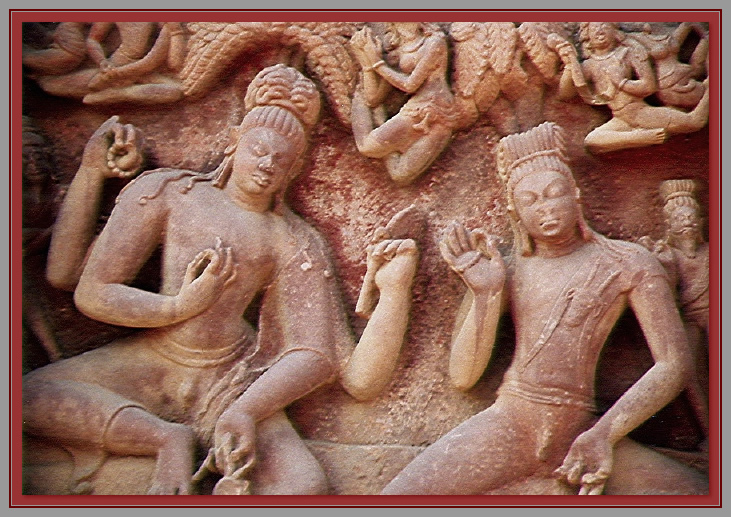
The first image is a relief of Nara-Nârâyana from Deogarh (Uttar
Pradesh), ca. 5th century. Source.
The second image is a painting of the ten Vishnu avatâras. 19th
century Jaipur India.
Source: Victoria
and Albert Museum.
Production: Filognostic
Association of The Order of Time

Feed-back | Links | Downloads | Music | Pictures | What's New | Search | Donations


 Text_1