
Canto 10
Canto 10
Chapter 51: The Deliverance of Mucukunda
(1-6) S'rî S'uka said: 'Seeing Him coming out [of the city, see 50: 57] like the rising moon, most beautiful to behold, with a dark complexion, a yellow silk garment, the S'rîvatsa on His chest, the brilliant Kaustubha gem decorating His neck, His mighty, long four arms and eyes as pink as newly grown lotuses, His always effulgent, clean, joyful smile to His beautiful cheeks, His lotuslike face and the display of His shark-shaped earrings, he [Kâlayavana] thought: 'This person indeed, with the S'rîvatsa, the four arms, the lotus eyes, wearing forest-flowers and with a great beauty, must be Vâsudeva. Considering the marks as mentioned by Nârada He, going there without weapons on foot, can be no one else. I shall fight Him without weapons!' The Yavana in pursuit thus decided to catch up with Him who had turned His face and fled away, He, who is unattainable even for mystic yogis. (7) With every step seeming to be within the reach of his hands, the Lord led the leader of the Yavanas over a great distance to a mountain cave. (8) In his pursuit he insulted Him with words like 'Fleeing does not behove someone like You born in the Yadu dynasty!' Yet he, whose mischief had not found its end, could not get hold of Him. (9) Despite being insulted this way, the Supreme Lord entered the mountain cave. The Yavana followed Him, but saw another man lying there. (10) 'And now, after leading me over such a long distance, He lies here like a saint!' Thus erroneously thinking that the man was Acyuta, he struck him full force with his foot. (11) The man woke up after a long period of sleep and slowly opened his eyes. Looking around in every direction, he saw him standing at his side. (12) Oh descendant of Bharata, with the glance the angered man cast on him, he was instantly burned to ashes by a fire that was generated from within his own body [*].'
(13) The honorable king [Parîkchit] said: 'Who precisely was that person, oh brahmin, of which family was he and of what powers? Why had he retreated into the cave to sleep, and from whose seed was that destroyer of the Yavana born?'
(14) S'rî S'uka said: 'He is known as Mucukunda. He was born in the Ikshvâku dynasty as a son of Mândhâtâ [see 9.6: 38 and 9.7]. He is a great personality devoted to the brahminical order and someone true to his vow in battle. (15) On the request for help of the gods headed by Indra, who were terrified because of the Asuras, he for a long time was of service to offer them protection. (16) After having secured Guha ['from the cave'; Skanda or Kârttikeya] as their guardian of heaven, they said to Mucukunda: 'Oh King, please desist from the difficult task to protect us. (17) Forgetting all your personal desires, you oh hero, with abandoning a kingdom in the world of man, have removed those [asura] thorns for our protection. (18) Your children, your queens and your other relatives, ministers, advisors and subjects, do not live anymore. Time has swept them away. (19) The Supreme, Inexhaustible Lord of Control is the Time itself, more powerful than the most powerful, who, playing a game of herdsman and flock, sets the mortal beings in motion. (20) We wish you all good fortune, please choose today any benediction from us, except for the boon of liberation that can only be conferred by the Supreme Inexhaustible Lord S'rî Vishnu.'
(21) He, who for his great fame thus was addressed by the demigods, respectfully saluted them and entered a cave to enjoy the sleep the gods had granted him [**]. (22) After the barbarian was burned to ashes, the Supreme Lord, the great hero of the Sâtvatas, revealed Himself to sage Mucukunda. (23-26) He, as dark as a cloud, was clad in a yellow, silken garment, carried the S'rîvatsa on His chest and the brilliant Kaustubha gem that radiated. With His four arms and the beautifying Vaijayantî garland, with His attractive, calm face and glittering shark-shaped earrings, with His affectionate smile appealing to all mankind and His glance, with His youthful handsome form, His noble gait and His fire that was like that of a lion, He formed an appearance of an overwhelming effulgence. Facing this unassailable splendor he, who was highly intelligent, filled with awe hesitantly posed a question. (27) S'rî Mucukunda said: 'Who are You to join with me in the wilderness in a mountain cave, while You with Your feet, that are like the petals of a lotus, walk the thorny ground? (28) Maybe You are the Supreme Lord, the origin of all empowered beings, or else the god of fire, the sun god, the moon god, the king of heaven or perhaps a ruler from another planet. (29) I think You are the leading godhead [Vishnu] among the three principal demigod personalities [Brahmâ, S'iva and Vishnu], the Greatest One, for You dispel the darkness of this cave [the 'heart'] like a lamp with its light. (30) Oh Most Eminent Among All Man, if You like, please describe truthfully for us eager to hear, Your birth, activities and lineage. (31) We from our side, oh tiger among men, are descendants of Ikshvâku, a family of kshatriyas. I myself was born from the son of Yuvanâs'va and am called Mucukunda, oh Lord. (32 or my comfort lay down in this solitary place. Then I was awakened by someone. (33) That person because of his sinful mentality turned to ashes. Immediately thereafter I then saw Your good Self so glorious, oh Chastiser of the Enemies. (34) Because of Your unbearable effulgence we, being diminished in our faculties, cannot behold You, oh most Gracious One; You deserve it to be honored by all embodied beings!'
(35) Thus being addressed by the king, the Supreme Lord and Origin of the Entire Creation replied with a broad smile, using words rumbling as deep as the clouds. (36) The Supreme Lord said: 'There are thousands of My births, activities and names, My dear one, limitless as they are, they cannot even be enumerated by Me! (37) Some time, after many lives, one may succeed in counting all the dust particles of the earth, but that will never be accomplished with My qualities, activities, names and births. (38) Not even the greatest sages enumerating My births and activities, which take place in respect of the three aspects of time [past, present, future], oh King, can reach the end [compare 8.5: 6 and 8.23: 29]. (39-40) Nonetheless, oh friend, just listen to what I have to tell you about My current birth. In the past I was beseeched by Lord Brahmâ [see 3.9 and also 10.14 ] to secure the dharma and destroy the demons who constituted a burden to the earth. Thus I descended into the Yadu dynasty in the home of Vasudeva, and because of that fact the people call Me Vâsudeva, the son of Vasudeva. (41) I killed Kâlanemi [see 10.8: 56] as also Kamsa [10.44], Pralamba [10.18] and others who were hateful with the virtuous souls. This Yavana, oh King, was burned by your scorching glance. (42) I, the one person caring for the devotees, approached this cave for the sake of favoring you, for in the past you have often prayed for it. (43) Tell Me what blessing you want from Me, oh saintly King, I will fulfill all your wishes. Any person who has satisfied Me, will never again need to lament.'
(44) S'rî S'uka said: 'Thus being addressed Mucukunda bowed down to Him and spoke. Knowing He was Nârâyana, the [original] Godhead, he filled with joy remembered the words of Garga [***]. (45) S'rî Mucukunda said: 'Man being cheated by Your bewildering potency mâyâ, oh Lord, is not of worship for You. Not understanding the true purpose of life he - whether he is male or female - seeking his happiness gets entangled in household affairs that make him unhappy. (46) The person who somehow or other in this world attains the rarely obtained, highly evolved human form of life and not an idle [animal] form, oh sinless one, will, with an impure mind, not be of worship at Your lotusfeet, and like an animal be fallen in the blind well of his home. (47) Oh Unconquerable One, I thus have wasted my time with building a kingdom and acquiring opulence. All of this is now gone. Intoxicated like an earthly ruler who mistakes his mortal frame for himself, I suffered endless anxieties; I got attached to children, wives, riches and land. (48) Minding this body, which is a confinement like a pot or a wall, I thus thought myself to be a god among man. Surrounded by chariots, elephants, horses, infantry and generals I traveled around on this earth, but, in my great pride, I never seriously regarded You. (49) Forgetful about what needs to be done, hankering for sense objects and endlessly ruminating with an ever growing greed, one is suddenly placed before You, who are as attentive as a hungry snake licking its fangs to kill a mouse. (50) The same vehicle of time, the body which first was called 'the king', riding in chariots furnished with gold or on fierce elephants, is unavoidably in the course of time named 'feces', 'worms' and 'ashes' [see also 16.4: 2-6]. (51) Full circle having conquered the directions, without further conflicts, being seated on a throne and praised by rulers alike, the person in his home is led about like a pet animal, while deriving his happiness from intercourse with women, oh Lord. (52) Reaching in that situation for having more than others, he, by strictly avoiding pleasures, performs his duties with penance, but thinking of himself as 'I am mightier, I am my own master' he, whose urges are so pronounced, cannot attain happiness. (53) When the wandering person reaches the end of his material existence, he, oh Infallible One, may find association with those who are good and honest [the sat-sanga]. With that good company thereupon devotion unto Him will develop, He who, as the Lord of the Higher [cause] and Lower [effects], for pious souls is the only goal. (54) Oh Lord, I think that with the spontaneous disappearance of my attachment to my kingdom, You have shown me Your mercy. For that is what the saintly rulers of endless stretches of land pray for, when they enter the forest in want of their solitude. (55) I do not desire anything else but to be of service at Your feet, for they are, to those not desiring a material life, the object of desire, the boon that is sought, oh Almighty One. Which faithful man of worship for You, the Bestower of the Path of Emancipation, oh Lord, would choose as a boon for that which causes his bondage? (56) Therefore, oh Lord, entirely putting aside the worldly blessings because of which one is entangled in the modes of passion, ignorance and goodness, I approach You, the Original Person of Pure Knowledge, who, free from mundane designations and duality, are transcendental to the modes. (57) Tormented by disturbances I, for a long time, was full of sorrow being distressed in the world. With my six enemies [the senses and the mind] never being satisfied, there was no way to find peace, oh Bestower of the Shelter. Please, oh Lord, protect me who, facing these dangers, oh Supreme Soul, has approached Your lotus feet, the truth that is free from sorrow and fear.'
(58) The Supreme Lord said: 'Oh great King, emperor of all, you have a pure and capable mind, for, even though you were tempted to ask for benedictions, you were not spoiled by desires. (59) Please know that I tempted you with benedictions in order to ascertain whether you are free from bewilderment. The exclusive[ly to Me devoted] intelligence of the bhaktas is never diverted by material blessings. (60) Those who, not devoted to Me, occupy themselves with breathing exercises and such, did not diminish their material desires [the vâsanâs], oh King, so that one sees that their minds again assert themselves [materially]. (61) Wander this earth at will, and may there, with your mind fixed on Me, for you thus always be an uninterrupted devotion unto Me. (62) Following the dharma of the ruling class, you have killed living beings when you were hunting and with other actions. That sin you should now uproot completely by fully immersing yourself in penances with Me as your shelter. (63) In your birth following this one, oh King, you, becoming a supreme well-wisher to all living beings, will be a fine brahmin and attain Me for certain [see also B.G. 5:29 ].'


Third revised edition, loaded April 9, 2021.
Previous Aadhar edition and Vedabase links:
S'rî S'uka said: 'Seeing Him coming out [of the city, see 50: 57] like the rising moon, most beautiful to behold, with a dark complexion, a yellow silk garment, the S'rîvatsa on His chest, the brilliant Kaustubha gem decorating His neck, His mighty, long four arms and eyes as pink as newly grown lotuses, His always effulgent, clean, joyful smile to His beautiful cheeks, His lotuslike face and the display of His shark-shaped earrings, he [Kâlayavana] thought: 'This person indeed, with the S'rîvatsa, the four arms, the lotus eyes, wearing forest-flowers and with a great beauty, must be Vâsudeva. Considering the marks as mentioned by Nârada, He, going there without weapons on foot, can be no one else. I shall fight Him without weapons!' The Yavana in pursuit thus decided to catch up with Him who had turned His face and fled away, He, who is unattainable even for mystic yogis.S'rî S'uka said: 'Seeing Him coming out [see 50: 57] like the moon rising, most beautiful to behold, with a dark complexion, a yellow silk garment, the S'rîvatsa on His chest, the brilliant Kaustubha gem decorating His neck, His mighty, long four arms and eyes as pink as newly grown lotuses; His always effulgent, clean, joyful smile to His beautiful cheeks, His lotuslike face and the display of His shark-shaped earrings, thought he [Kâlayavana]: 'This person indeed must be Vâsudeva with the S'rîvatsa, the four arms, the lotus-eyes, the wearing of forest-flowers and with the great beauty. From the marks Nârada mentioned can He be no one else, going there without weapons on foot; I'll fight Him without weapons!' The Yavana thus decided, in pursuit wanted to catch Him who had turned His face away and fled, He, who is unattainable even to the mystic yogis. (Vedabase)With every step seeming to be within the reach of his hands, the Lord led the leader of the Yavanas over a great distance to a mountain cave.
With every step He made seemed He to be within the reach of his hands and after that way having covered a great distance placed He the lord of the Yavanas before a mountain cave. (Vedabase)
In his pursuit he insulted Him with words like 'Fleeing does not behove someone like You born in the Yadu dynasty!' Yet he, whose mischief had not found its end, could not get hold of Him.
In his pursuit insulting Him with words like 'Fleeing is for You being born in the Yadu-dynasty improper!', could he, whose mischief had not found its end [yet], not get hold of Him. (Vedabase)
Despite being insulted this way, the Supreme Lord entered the mountain cave. The Yavana followed Him, but saw another man lying there.
Even though He was insulted this way, entered the Supreme Lord the mountain cave, but when the Yavana followed Him saw he lying there another man. (Vedabase)
'And now, after leading me over such a long distance, He lies here like a saint!' Thus erroneously thinking that the man was Acyuta, he struck him full force with his foot.
'And now, bringing me this long distance is He lying down here like a saint!' and thus erroneously thinking him to be Acyuta, struck he him full force with his foot. (Vedabase)
The man woke up after a long period of sleep and slowly opened his eyes. Looking around in every direction, he saw him standing at his side.
The man, waking up after a long period of sleep, slowly opened his eyes and, looking about in every direction, saw him standing beside him. (Vedabase)
Oh descendant of Bharata, with the glance the angered man cast on him, he was instantly burned to ashes by a fire that was generated from within his own body [*].
O descendant of Bharata he as such, was by the glance, the angered man cast on him, in a moment burnt to ashes by a fire that generated from within his own body [*].' (Vedabase)
The honorable king [Parîkchit] said: 'Who precisely was that person, oh brahmin, of which family was he and of what powers? Why had he retreated into the cave to sleep, and from whose seed was that destroyer of the Yavana born?'
The honorable king [Parîkchit] said: 'Who precisely was that person, o brahmin, of which family was he and of what powers; why had he retreated into the cave to sleep and of whose seed was he born that destroyer of the Yavana?' (Vedabase)
S'rî S'uka said: 'He is known as Mucukunda. He was born in the Ikshvâku dynasty as a son of Mândhâtâ [see 9.6: 38 and 9.7]. He is a great personality devoted to the brahminical order and someone true to his vow in battle.
S'rî S'uka said: 'He is known as Mucukunda. He was born in the Ikshvâku dynasty as a son of Mândhâtâ [see 9.6: 38 and 9.7]. He is a great personality devoted to the brahminical and someone true to his vow in battle. (Vedabase)
On the request for help of the gods headed by Indra, who were terrified because of the Asuras, he for a long time was of service to offer them protection.
He, on the request of the godly headed by Indra who were terrified because of the Asuras, was for a long time of service to assure them their protection. (Vedabase)
After having secured Guha ['from the cave'; Skanda or Kârttikeya] as their guardian of heaven, they said to Mucukunda: 'Oh King, please desist from the difficult task to protect us.
They, obtaining Guha ['from the cave'; Skanda or Kârttikeya] as their protector of heaven, then said to Mucukunda: 'O King, please desist from the trouble your good self has to protect us. (Vedabase)
Forgetting all your personal desires, you oh hero, with abandoning a kingdom in the world of man, have removed those [asura] thorns for our protection.
You forgetting all your personal desires have, with abandoning a kingdom in the world of man, for our protection removed those [asura] thorns, o hero. (Vedabase).
Your children, your queens and your other relatives, ministers, advisors and subjects, do not live anymore. Time has swept them away.
Your children, your queens and your other relatives, ministers, advisors and subjects are not alive now, are not of this time anymore; time swept them away. (Vedabase)
The Supreme, Inexhaustible Lord of Control is the Time itself, more powerful than the most powerful, who, playing a game of herdsman and flock, sets the mortal beings in motion.
Time, more powerful than the powerful, is the Supreme Inexhaustible Lord in Control who, playing a game of herdsman and flock, sets the mortal beings in motion. (Vedabase)
We wish you all good fortune, please choose today any benediction from us, except for the boon of liberation that can only be conferred by the Supreme Inexhaustible Lord S'rî Vishnu.'
All good fortune to you, choose today any benediction from us except for the one of liberation, for only the Supreme Inexhaustible Lord S'rî Vishnu is capable of that.' (Vedabase)
He, who for his great fame thus was addressed by the demigods, respectfully saluted them and entered a cave to enjoy the sleep the gods had granted him [**].
He, for his great fame thus addressed by the demigods, respectfully saluted them and laid himself down in a cave to enjoy the sleep the gods had granted him [**]. (Vedabase)
After the barbarian was burned to ashes, the Supreme Lord, the great hero of the Sâtvatas, revealed Himself to sage Mucukunda.
After the barbarian was turned into ashes revealed the Supreme Lord, the great hero of the Sâtvatas, Himself to the wise Mucukunda. (Vedabase)
He, as dark as a cloud, was clad in a yellow, silken garment, carried the S'rîvatsa on His chest and the brilliant Kaustubha gem that radiated. With His four arms and the beautifying Vaijayantî garland, with His attractive, calm face and glittering shark-shaped earrings, with His affectionate smile appealing to all mankind and His glance, with His youthful handsome form, His noble gait and His fire that was like that of a lion, He formed an appearance of an overwhelming effulgence. Facing this unassailable splendor he, who was highly intelligent, filled with awe hesitantly posed a question.
Looking at Him, He who was as dark as a cloud, in a yellow, silken garment, the S'rîvatsa on His chest, the brilliant Kaustubha gem glowing, the four arms and the beautifying Vaijayantî garland; His attractive, calm face and glittering shark-shaped earrings, His affectionate smile appealing to all mankind, His glance, His youthful handsome form, His noble gait and His fire that was like that of a lion - was he, as highly intelligent as he was, overwhelmed by His effulgence, which was a splendor unassailable indeed, and posed he in doubt hesitantly a question. (Vedabase)
S'rî Mucukunda said: 'Who are You to join with me in the wilderness in a mountain cave, while You with Your feet, that are like the petals of a lotus, walk the thorny ground?
S'rî Mucukunda said: 'Who are You to join with me in the wilderness in a mountain cave, with Your feet like the petals of a lotus walking the thorny ground? (Vedabase)
Maybe You are the Supreme Lord, the origin of all empowered beings, or else the god of fire, the sun god, the moon god, the king of heaven or perhaps a ruler from another planet.
Maybe You're the Supreme Lord, the origin of all empowered beings, or else the god of fire, the sungod, the moongod, the king of heaven or perhaps a ruler from another planet? (Vedabase)
I think You are the leading godhead [Vishnu] among the three principal demigod personalities [Brahmâ, S'iva and Vishnu], the Greatest One, for You dispel the darkness of this cave [the 'heart'] like a lamp with its light.
I think You're the God of the three personalities of the demigods, the Greatest, because You dispel the darkness of the cave [the 'heart'] like a lamp with its light. (Vedabase)
Oh Most Eminent Among All Man, if You like, please describe truthfully for us eager to hear, Your birth, activities and lineage.
O Most Eminent Among Man, if You like, if You can, veraciously describe for us eager to hear, Your birth, activities and lineage. (Vedabase)
We from our side oh tiger among men, are descendants of Ikshvâku, a family of kshatriyas. I myself was born from the son of Yuvanâs'va and am called Mucukunda, oh Lord.
We from our side, o tiger among men, are descendants of Ikshvâku, a family of kshatriyas. And I, born from the son of Yuvanâs'va, am called Mucukunda o Lord. (Vedabase)
Because I remained awake for a long time and my fatigued senses were overwhelmed by sleep, I for my comfort lay down in this solitary place. Then I was awakened by someone.
Because I remained awake for a long time was I, fatigued in my senses and overwhelmed by sleep, to my comfort lying in this solitary place and have I now been awakened by someone. (Vedabase)
That person because of his sinful mentality turned to ashes. Immediately thereafter I then saw Your good Self so glorious, oh Chastiser of the Enemies.
That person turned to ashes indeed out of his own sinful conduct only, and Your good Self so glorious, o Chastiser of Enemies, I saw following immediately thereafter. (Vedabase)
Because of Your unbearable effulgence we, being diminished in our faculties, cannot behold You, oh most Gracious One; You deserve it to be honored by all embodied beings!'
Because of Your unbearable effulgence are we, diminished in our faculties, not able to behold You, o most Gracious One; You are to be honored by all embodied beings!' (Vedabase)
Thus being addressed by the king, the Supreme Lord and Origin of the Entire Creation replied, with a broad smile using words rumbling as deep as the clouds.
Thus addressed by the king replied the Supreme Lord and Origin of All Creation, smiling broadly, with words deep as the rumbling of clouds. (Vedabase)
The Supreme Lord said: 'There are thousands of My births, activities and names, My dear one, limitless as they are, they cannot even be enumerated by Me!
The Supreme Lord said: 'My births, activities and names are there by the thousands, My dearest, limitless as they are they cannot even be enumerated by Me! (Vedabase)
Some time, after many lives, one may succeed in counting all the dust particles of the earth, but that will never be accomplished with My qualities, activities, names and births.
Some time, after many lives, one might count the particles of dust on earth, but never ever so My many qualities, activities, names and births. (Vedabase)
Not even the greatest sages enumerating My births and activities, which take place in respect of the three aspects of time [past, present, future], oh King, can reach the end [compare 8.5: 6 and 8.23: 29].
Not even the greatest sages counting My births and activities taking place to the three of time [past, present, future], o King, can reach the end of them [compare 8.5: 6 and 8.23: 29]. (Vedabase)
Nonetheless, oh friend, just listen to what I have to tell you about My current birth. In the past I was beseeched by Lord Brahmâ [see 3.9 and also 10.14 ] to secure the dharma and destroy the demons who constituted a burden to the earth. Thus I descended into the Yadu dynasty in the home of Vasudeva, and because of that fact the people call Me Vâsudeva, the son of Vasudeva.
Nonetheless, o friend, just hear from Me about the current one, this Speaker. In the past I was beseeched by Lord Brahmâ [see 3.9 and also 10.14] to secure the dharma and destroy the demons who are a burden to the earth, and so I descended into the Yadu dynasty in the home of Vasudeva and do the people as such call Me Vâsudeva, the son of Vasudeva. (Vedabase)
I killed Kâlanemi [see 10.8: 56] as also Kamsa [10.44], Pralamba [10.18] and others who were hateful with the virtuous souls. This Yavana, oh King, was burned by your scorching glance.
Kâlanemi I killed [see 10.8: 56], Kamsa [10.44], Pralamba [10.18] and others envious of the virtuous, and this Yavana, o King was burned by your scorching glance. (Vedabase)
I, the one person caring for the devotees, approached this cave for the sake of favoring you, for in the past you have often prayed for it.
I, that very same person caring for the devotees, approached this cave for the sake of favoring you, because you in the past have often prayed for it. (Vedabase)
Tell Me what blessing you want from Me oh saintly King, I will fulfill all your wishes. Any person who has satisfied Me, will never again need to lament.'
Tell Me what you want Me to bless you with, o saintly King, I will give you all that you desire; any person who has satisfied Me, will never again need to lament.' (Vedabase)
S'rî S'uka said: 'Thus being addressed Mucukunda bowed down to Him and spoke. Knowing He was Nârâyana, the [original] Godhead, he filled with joy remembered the words of Garga [***].
S'rî S'uka said: 'Thus being addressed bowing down to Him spoke Mucukunda remembering the words of Garga [***], being filled with joy knowing He was Nârâyana the [original] Godhead. (Vedabase)
S'rî Mucukunda said: 'Man being cheated by Your bewildering potency mâyâ, oh Lord, is not of worship for You. Not understanding the true purpose of life he - whether he is male or female - seeking his happiness gets entangled in household affairs that make him unhappy.
S'rî Mucukunda said: 'This person, not of worship for You, can, bewildered by Your deluding potency mâyâ o Lord, not see his own benefit when he, wishing for happiness, gets cheated as a family man - or also as a woman - who being entangled goes for things that bring misery. (Vedabase)
The person who somehow or other in this world attains the rarely obtained, highly evolved human form of life and not an idle [animal] form, oh sinless one, will, with an impure mind, not be of worship at Your lotusfeet, and like an animal be fallen in the blind well of his home.
The person who somehow or other attaining to what is rarely obtained in this world - a human form and not the paws, but not being of worship doesn't try to go, o sinless one, for Your lotuslike feet, has, impure in his mentality, like an animal fallen in the blind well of his home. (Vedabase)
Oh Unconquerable One, I thus have wasted my time with building a kingdom and acquiring opulence. All of this is now gone. Intoxicated like an earthly ruler who mistakes his mortal frame for himself, I suffered endless anxieties; I got attached to children, wives, riches and land.
O Unconquerable One, wasting my time on this, I built a kingdom and opulence that now are all gone; intoxicated as an earthly ruler who mistakes the mortal frame for himself, suffered I endless anxieties getting attached to children, wives, riches and land. (Vedabase)
Minding this body, which is a confinement like a pot or a wall, I thus thought myself to be a god among man. Surrounded by chariots, elephants, horses, infantry and generals I traveled around on this earth, but, in my great pride, I never seriously regarded You.
Minding this body, which is a confinement like a pot or a wall, I thus thought myself to be a god among man, surrounded as I was by chariots, elephants, horses, infantry and generals with whom I traveled around on this earth without seriously regarding You in my great pride. (Vedabase)
Forgetful about what needs to be done, hankering for sense objects and endlessly ruminating with an ever growing greed, one is suddenly placed before You, who are as attentive as a hungry snake licking its fangs to kill a mouse.
Forgetful about what needs to be done, hankering for sense objects endlessly ruminating with an ever growing greed, is one suddenly confronted with You, the one who does mind; You are like what death is to a mouse in front of a hungry snake that licks its fangs. (Vedabase)
The same vehicle of time, the body which first was called 'the king', riding in chariots furnished with gold or on fierce elephants, is unavoidably in the course of time named 'feces', 'worms' and 'ashes' [see also 16.4: 2-6].
Previously named 'the king' riding chariots furnished with gold or fierce elephants is that same one unavoidably with the Time of Your body called 'feces', 'worms' and 'ashes' [see also 16.4: 2-6]. (Vedabase)
Full circle having conquered the directions, without further conflicts, being seated on a throne and praised by rulers alike, the person in his home is led about like a pet animal, while deriving his happiness from intercourse with women, oh Lord.
Full circle having conquered the directions with no opposition to fear and being seated on a throne and praised by kings alike is the person in his home like a pet led about, sexually borrowing his happiness from women, o Lord. (Vedabase)
Reaching in that situation for having more than others, he, by strictly avoiding pleasures, performs his duties with penance, but thinking of himself as 'I am mightier, I am my own master' he, whose urges are so pronounced, cannot attain happiness.
In that enviously reaching for more, performs he with penance his duties in strictly avoiding pleasures, but thinking of himself as 'I the greater sovereign' can he, whose urges are so pronounced, not attain happiness. (Vedabase)
When the wandering person reaches the end of his material existence, he, oh Infallible One, may find association with those who are good and honest [the sat-sanga]. With that good company thereupon devotion unto Him will develop, He who, as the Lord of the Higher [cause] and Lower [effects], for pious souls is the only goal.
When it happens that the wandering person reaches the end of his material existence will at that time o Infallible One, the association of the good and honest [the sat-sanga] be found after which next the devotion is born for Him who for the virtuous is the only goal as the Lord of the Higher [cause] and Lower [effects]. (Vedabase)
Oh Lord, I think that with the spontaneous disappearance of my attachment to my kingdom, You have shown me Your mercy. For that is what the saintly rulers of endless stretches of land pray for, when they enter the forest in want of their solitude.
I think o Lord that, with the spontaneous removal of the attachment to my kingdom, You've been merciful with me: it is that for which the saintly rulers of endless stretches of land pray when, wishing the solitude, they enter the forest. (Vedabase)
I do not desire anything else but to be of service at Your feet, for they are, to those not desiring a material life, the object of desire, the boon that is sought, oh Almighty One. Which faithful man of worship for You, the Bestower of the Path of Emancipation, oh Lord, would choose as a boon for that which causes his bondage?
I do not desire anything else but to be of service at Your feet that to those not desiring a material life are the object of desire, the boon sought, o Almighty one; what faithful man of worship for You, the Bestower of the Path of Emancipation, o Lord, would as a boon choose for that which causes his bondage? (Vedabase)
Therefore, oh Lord, entirely putting aside the worldly blessings because of which one is entangled in the modes of passion, ignorance and goodness, I approach You, the Original Person of Pure Knowledge, who, free from mundane designations and duality, are transcendental to the modes.
Therefore o Lord, entirely putting aside the worldly blessings from which one is entangled in the modes of passion, ignorance and goodness, am I approaching You, the Original Person of Pure Knowledge free from mundane designations who is nondual and supreme above the modes. (Vedabase)
Tormented by disturbances I, for a long time, was full of sorrow being distressed in the world. With my six enemies [the senses and the mind] never being satisfied, there was no way to find peace, oh Bestower of the Shelter. Please, oh Lord, protect me who, facing these dangers, oh Supreme Soul, has approached Your lotus feet, the truth that is free from sorrow and fear.'
For long was I full of remorse distressed in the world being tormented by disturbances; with my six enemies [the senses and the mind] never satisfied there was no way to find peace o Bestower of the Shelter, please o Lord protect me who facing these dangers, o Supreme Soul, approached Your lotus feet, the truth free from sorrow that frees one from fear.' (Vedabase)
The Supreme Lord said: 'Oh great King, emperor of all, you have a pure and capable mind, for, even though you were tempted to ask for benedictions, you were not spoiled by desires.
The Supreme Lord said: 'O great King, emperor of all, even though being tempted to ask for benedictions were you, capable of mind, impeccable in not being spoiled by desires. (Vedabase)
Please know that I tempted you with benedictions in order to ascertain whether you are free from bewilderment. The exclusive[ly to Me devoted] intelligence of the bhaktas is never diverted by material blessings.
Please know that the fact that you were tempted with benedictions was to prove your freedom from bewilderment; never is the exclusive[-ly to Me devoted] intelligence of the bhaktas diverted by material blessings. (Vedabase)
Those who, not devoted to Me, occupy themselves with breathing exercises and such, did not diminish their material desires [the vâsanâs], oh King, so that one sees that their minds again assert themselves [materially].
With those who in not being devoted to Me are occupying themselves with breathing exercises and such, is, since they did not eliminate the traces of material desire [the vâsanâs], o King, observed that again their minds awaken [to sense-gratification]. (Vedabase)
Wander this earth at will, and may there, with your mind fixed on Me, for you thus always be an uninterrupted devotion unto Me.
Wander this earth as you like and may, with your mind fixed on Me, there for you thus always be the devotion for Me that does not fail. (Vedabase)
Following the dharma of the ruling class, you have killed living beings when you were hunting and with other actions. That sin you should now uproot completely by fully immersing yourself in penances with Me as your shelter.
Following the dharma of the ruling class you've killed living beings when you were hunting and with other actions; that sin you should uproot completely in fully being focussed in penances in which you seek My shelter. (Vedabase)
In your birth following this one, oh King, you, becoming a supreme well-wisher to all living beings, will be a fine brahmin and attain Me for certain [see also B.G. 5:29 ].'
In your birth immediately hereafter o King, will you, becoming a supreme well-wisher to all living beings, be a fine brahmin going for Me only [see also B.G. 5: 29]. (Vedabase)
*: Mucukunda, the man asleep, as stated hereafter fought for a long time on behalf of the demigods and finally took as his benediction the right to sleep undisturbed. The paramparâ by S'rîla Vis'vanâtha Cakravartî quotes the Hari-vams'a that explains he secured the further benediction of being able to destroy anyone who disturbed his sleep. He further elucidates that Mucukunda made this rather morbid request to scare Lord Indra, who, so Mucukunda thought, might otherwise wake him up repeatedly to request his help in fighting Indra's cosmic enemies. Indra's consent to Mucukunda's request is described in the S'rî Vishnu Purâna as follows: "The demigods declared, 'Whoever awakens you from sleep will suddenly be burnt to ashes by a fire generated from his own body.' "
**: S'rîla Bhaktisiddhânta Sarasvatî Thhâkura gives the following lines from an alternate reading of this chapter. These lines are to be inserted between the two halves of this verse:
nidrâm eva tato vavre
sa râjâ s'rama-karshitah
yah kas'cin mama nidrâyâ
bhangam kuryâd surottamâh
sa hi bhasmî-bhaved âs'u
tathoktas' ca surais tadâ
svâpam yâtam yo madhye tu
bodhayet tvâm acetanah
sa tvayâ drishtha-mâtras tu
bhasmî-bhavatu tat-kshanât"The King, exhausted by his labor, then chose sleep as his benediction. He further stated, 'O best of the demigods, may whoever disturbs my sleep immediately be burned to ashes.' The demigods replied, 'So be it,' and told him, 'That insensitive person who wakes you in the middle of your sleep, will immediately turn to ashes simply by your seeing him."
***: The paramparâ states: 'S'rîla S'rîdhara Svâmî informs us that Mucukunda was aware of the prediction of the ancient sage Garga that in the twenty-eighth millennium the Supreme Lord would descend. According to Âcârya Vis'vanâtha, Garga Muni further informed Mucukunda that he would personally see the Lord. Now it was all happening.'

The text and audio are offered under the conditions of
the
Creative
Commons Attribution-Noncommercial-Share Alike 3.0 Unported
License.
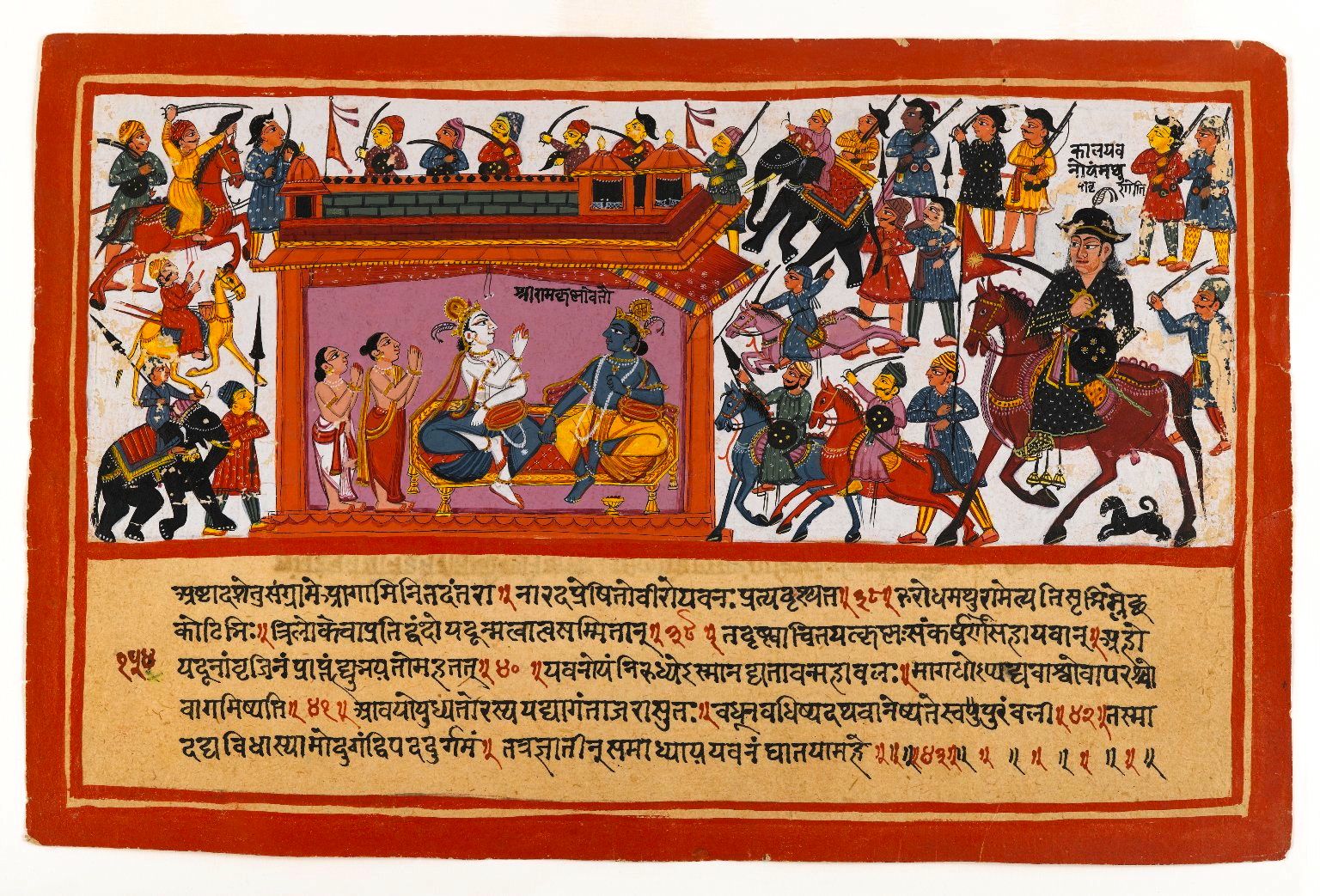
The first picture is called: Kalayavana surrounds Mathura, Page
from a Dispersed Bhagavata Purana Series. Source: Brooklyn
Museum.
The second picture called 'Time Vishnu' on this page is a blend
by Anand Aadhar
of a statue of a four armed Vishnu of the Pandya Dynasty (Metropolitan
Museum)
and a © painting by Vlad Holst called 'Clock", used
with permission.
Production: Filognostic
Association of The Order of Time.

Feed-back | Links | Downloads | Music | Pictures | What's New | Search | Donations



 Text 1-6