Canto 9

Canto 9
Chapter 22: The Descendants of Ajamîdha: the Pândavas and Kauravas
(1) S'rî S'uka said: 'Mitrâyu was born from Divodâsa and his sons, oh protector of man, were Cyavana, Sudâsa, Sahadeva and Somaka. Somaka next was the father of Jantu. (2) From him there were a hundred sons and Prishata was the youngest of them. Prishata begot Drupada who was opulent in every way. (3) Draupadî [the wife of the Pândavas] was fathered by Drupada. His sons were headed by Dhrishthadyumna who begot Dhrishthaketu. All these descendants of Bharmyâs'va [9.21: 31-33] are known as the Pâñcâlas.
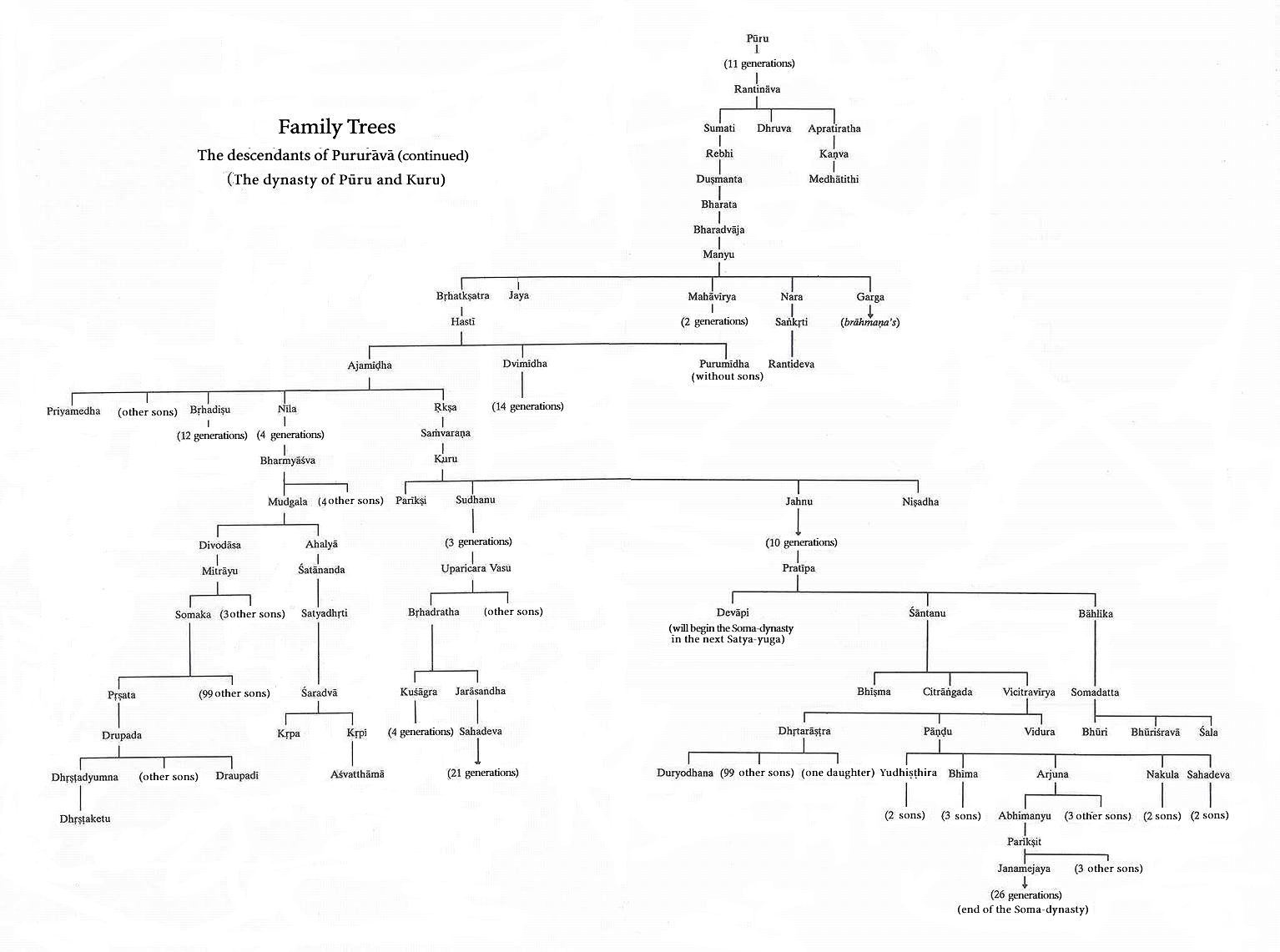
(4-5) Riksha was another son begotten by Ajamîdha. He fathered Samvarana who with his wife Tapatî, the daughter of the sun god, gave birth to Kuru [see family-tree], the king of Kurukshetra. Parîkshi, Sudhanu, Jahnu and Nishadha were the sons of Kuru. Sudhanu fathered Suhotra and he begot [another] Cyavana. Kriti was born from his loins. (6) Uparicara Vasu was born because of Kritî. His sons who were headed by Brihadratha were Kus'âmba, Matsya, Pratyagra, Cedipa and others. They all ruled the state of Cedi. (7) Brihadratha gave life to Kus'âgra who begot Rishabha. He in his turn fathered Satyahita who had a son called Pushpavân whose son was Jahu. (8) Brihadratha begot with a second wife he had a son in two halves who, because the mother rejected them, by Jarâ [the daughter of Time, see also 4.27: 19] playfully were united while she said: 'Come alive, come alive'. Thus a son called Jarâsandha ['Jarâ's hermaphrodite'] was born [who later became a vital enemy of Lord Krishna]. (9) He [Jarâsandha] gave life to Sahadeva whose son Somâpi fathered S'rutas'ravâ. Parîkshi [another son of Kuru] had no children while Jahnu begot a son named Suratha. (10) From him there was Vidûratha who brought Sârvabauma into the world. He had Jayasena and his son Râdhika gave life to Ayutâyu. (11) Ayutâyu became the father of Akrodhana who had a son named Devâtithi. He brought Riksha into the world who had a son called Dilîpa and because of him the son Pratîpa appeared. (12-13) From him the sons Devâpi, S'ântanu and Bâhlîka appeared. It was Devâpi, the eldest one, who rejected his father's realm and left for the forest so that S'ântanu became the king. He in a previous life had been the celebrated Mahâbhisha. Whomever was touched by him with his hands attained youth, however old that person would be. (14-15) Because one primarily by the touch of his hands was purified, he was known as S'ântanu. When Indra, the king of heaven, for twelve years had not showered any rain in his kingdom, his brahmins told him: 'You are at fault for preceding your older brother [Devâpi] in enjoying the kingdom [and are thus a so-called parivettâ]. For the full development of your homestead and kingdom, immediately return the realm to him.'
(16-17) Thus being advised by the brahmins he asked Devâpi to take charge of the kingdom, but from what he replied became clear that he had given up on the Vedas. That had happened because the brahmins in the past, on the instigation of S'ântanu's minister, had prompted him with words that went against the Vedic instructions. When that was said [and S'ântanu finally accepted the realm] the demigod showered the rains. Devâpi thereupon sought his refuge in the village of Kalâpa where he took up the practice of yoga [in which he is still engaged today]. (18-19) After the Soma dynasty in Kali-yuga has disappeared, it will [by him] at the beginning of the next one, Satya-yuga, be re-established. Bâhlîka [S'ântanu's brother] begot Somadatta and from him there were Bhûri, Bhûris'ravâ and S'ala. S'ântanu begot in his wife Gangâ the self-realized great devotee and scholar Bhîshma [see also 1.9], who is the best defender of the dharma. (20) By him, the foremost of all warriors, even Paras'urâma - to his own satisfaction - was defeated in a fight [*]. From the womb of [Satyavatî] the daughter of Dâsa [a fisherman **] S'ântanu brought about the son Citrângada.(21-24) Citrângada was killed by a Gandharva carrying the same name. Vicitravîrya was a younger brother of Citrângada. The sage Parâs'ara gave with his mother [Satyavatî, previous to her marriage to S'ântanu] life to a direct expansion of the Lord, a great muni who protected the Vedas: Krishna Dvaipâyana Vyâsadeva [also called Bâdarâyana], from whom I [S'ukadeva] was born. With him I studied this [Bhâgavatam] thoroughly. He, the [partial] incarnation of the Lord, rejected his pupils Paila and others. But me, his son who was far removed from sense gratification, he taught this supreme literature of confidential knowledge. Vicitravîrya later on married the two daughters of Kâs'îrâja called Ambikâ and Ambâlikâ who by force were brought from the arena of selection. But because he was too attached in his heart to the both of them he died of an infection with tuberculosis. (25) With no offspring from the half-brother, Vyâsadeva was instructed by [in devarena sutotpatti, see footnote 9.6] his mother [Satyavatî] to father sons: Dhritarâshthra, Pându [with respectively Ambikâ and Ambâlikâ] and also a son named Vidura [whom he begot with Vicitravîrya's maidservant, see also 1: 13]. (26) From Gândhârî, the wife of Dhritarâshthra, a hundred sons were born, oh protector of man. Duryodhana was the eldest. There was also a daughter called Duhs'alâ.
(27-28) Pându had to restrain his sexual life because of a curse, and therefore the great [Pândava] heroes, the three sons [Bhîma and Arjuna who were] headed by Yudhishthhira, were begotten with [his wife] Kuntî by Dharma [the god of piety], Anila [the god of the wind] and Indra [not mentioning Karna who was brought forth by the sun god]. Nakula and Sahadeva were begotten by the two As'vins [Nâsatya and Dasra] in the womb of Mâdrî. From these five brothers [with Draupadî] five sons were born: your uncles. (29) Yudhishthhira had the son Prativindhya, Bhîma had S'rutasena, from Arjuna came S'rutakîrti and from Nakula S'atânîka appeared. (30-31) Sahadeva, oh King, had S'rutakarmâ. Yudhishthhira furthermore had the son Devaka with Pauravî and Bhîma had Ghathotkaca with Hidimbâ and Sarvagata with Kâlî. Sahadeva fathered the son Suhotra with Vijayâ, the daughter of the Himalayan king [Pârvatî]. (32) Nakula had with Karenumatî a son named Naramitra and Arjuna begot the son Irâvân together with Ulupî [a Nâga daughter] and the son Babhruvâhana with the princess of Manipura. Even though he was Arjuna's son, Abhruvâhana was adopted by the father-in-law [because of a condition he set for the marriage].
(33) Your father Abhimanyu was born from Subhadrâ [Krishna's sister wed to Arjuna]. He was a great hero who defeated all atirathas ['those who can oppose a thousand charioteers']. You have taken birth from Uttarâ because of him. (34) With the annihilation of the Kuru dynasty As'vatthâmâ also tried to put you to death with the heat of the brahmâstra weapon, but by the mercy of Lord Krishna you were saved from ending that way [see 1.8]. (35) Your sons, my best one, with Janamejaya first and then S'rutasena, Bhîmasena and Ugrasena, are all greatly powerful. (36) When Janamejaya learns that you have died because of Takshaka, he in great anger will offer all snakes during a fire sacrifice. (37) After having conquered each and every part of the world, he will appoint Tura, the son of Kalasha, for his priest and be of sacrifice in as'vamedha offerings, for which he will be celebrated as Turuga-medhashâth ['performer of many horse-sacrifices']. (38) S'atânîka, his son, will under Yâjñavalkya thoroughly study the three Vedas, as also the way to put the spiritual knowledge into practice [with ceremonies]. He will realize the military art [from Kripâcârya] and with S'aunaka he will arrive at the realization of the transcendental truth. (39) His son Sahasrânîka will have one carrying the name As'vamedhaja who will beget Asîmakrishna who will have a son called Nemicakra. (40) With Hastinâpura flooded by the river [the Ganges], he [Nemicakra] from sheer necessity will live at Kaus'âmbî, whereafter from his son called Citraratha there will be the son S'uciratha. (41) From him there will also be a son, Vrishthimân, because of whom next Sushena will take his birth, an emperor. His son Sunîtha will have one called Nricakshu and he will father Sukhînala. (42) Pariplava will be his son and from Sunaya succeeding him Medhâvî will appear. Nripañjaya will be his son and he will beget Dûrva from whose loins Timi will take birth. (43) From Timi the son Brihadratha will appear from whose son Sudâsa the son S'atânîka will be given life. S'atânîka will have a son called Durdamana and his son will be Mahînara. (44-45) Dandapâni, fathered by him, will give life to Nimi because of whom Kshemaka will take birth. With Kshemaka closing the row as the monarch this dynasty will end, this source of brahmins and kshatriyas that is respected by the seers and the godly souls in Kali-yuga. In the future there will be next the kings of Mâgadha. Let me tell you about them.
(46-48) Sahadeva [the son of Jarâsandha] will beget the son Mârjâri. S'rutas'ravâ will be his son, Yutâyu will be his successor and his son Niramitra will father Sunakshatra. Sunakshatra will be the father of Brihatsena and his son Karmajit will have the son Sutañjaya from whose loins Vipra will be born who will give life to a son called S'uci. Kshema, who is born thereafter, will have the son Suvrata from whom Dharmasûtra will appear. His son Sama will beget Dyumatsena who is succeeded by Sumati from whose loins Subala will take birth. (49) From Sunîtha [Subala's son] Satyajit will be brought into the world and from his son Vis'vajit there will be a son called Ripuñjaya. The line of Brihadratha, in which all these kings are born, will last a thousand years.'(Picture: family tree from Kuru up to the Pândavas)
Third revised edition, loaded March 10, 2020.
Previous Aadhar edition and Vedabase links:
S'rî S'uka said: 'Mitrâyu was born from Divodâsa and his sons, oh protector of man, were Cyavana, Sudâsa, Sahadeva and Somaka. Somaka next was the father of Jantu.S'rî S'uka said: 'From Divodâsa was Mitrâyu born and his sons, o protector of man, were Cyavana, Sudâsa, Sahadeva and Somaka. Somaka next was the father of Jantu. (Vedabase)
From him there were a hundred sons and Prishata was the youngest of them. Prishata begot Drupada who was opulent in every way.
Of him there were a hundred sons, and the youngest of them was Prishata. From him was Drupada born who was opulent in every way. (Vedabase)
Draupadî [the wife of the Pândavas] was fathered by Drupada. His sons were headed by Dhrishthadyumna who begot Dhrishthaketu. All these descendants of Bharmyâs'va [9.21: 31-33] are known as the Pâñcâlas.
From Drupada was Draupadî [the wife of the Pândavas] born. His sons were led by Dhrishthadyumna of whom there was Dhrishthaketu. All these descendants of Bharmyâs'va [9.21: 31-33] are known as the Pâñcâlakas. (Vedabase)
Riksha was another son begotten by Ajamîdha. He fathered Samvarana who with his wife Tapatî, the daughter of the sun god, gave birth to Kuru [see family-tree], the king of Kurukshetra. Parîkshi, Sudhanu, Jahnu and Nishadha were the sons of Kuru. Sudhanu fathered Suhotra and he begot [another] Cyavana. Kriti was born from his loins.
Riksha was another son born from Ajamîdha. He begot Samvarana from whose wife Tapatî, the daughter of the sungod, Kuru was born [see family-tree], the king of Kurukshetra. Parîkshi, Sudhanu, Jahnu and Nishadha were Kuru's sons. From Sudhanu was Suhotra born and from him took Cyavana birth of whom there was Kritî. (Vedabase)
Uparicara Vasu was born because of Kritî. His sons who were headed by Brihadratha were Kus'âmba, Matsya, Pratyagra, Cedipa and others. They all ruled the state of Cedi.
From him there was Uparicara Vasu and his sons headed by Brihadratha were Kus'âmba, Matsya, Pratyagra and Cedipa and others. They all became rulers of the state of Cedi. (Vedabase)
Brihadratha gave life to Kus'âgra who begot Rishabha. He in his turn fathered Satyahita who had a son called Pushpavân whose son was Jahu.
From Brihadratha was Kus'âgra born. From his son Rishabha was Satyahita born who as his offspring had Pushpavân whose son was Jahu. (Vedabase)
Brihadratha begot with a second wife he had a son in two halves who, because the mother rejected them, by Jarâ [the daughter of Time, see also 4.27: 19] playfully were united while she said: 'Come alive, come alive'. Thus a son called Jarâsandha ['Jarâ's hermaphrodite'] was born [who later became a vital enemy of Lord Krishna].
Brihadratha begot with a second wife he had a son in two halves who, because of the mother rejecting them, by Jarâ [the daughter of Time, see also 4.27: 19] playfully were united saying: 'Come alive, come alive', so that a son called Jarâsandha ['Jarâ's hermaphrodite'] was born [that later became a vital enemy of Lord Krishna]. (Vedabase)
He [Jarâsandha] gave life to Sahadeva whose son Somâpi fathered S'rutas'ravâ. Parîkshi [another son of Kuru] had no children while Jahnu begot a son named Suratha.
From him was then Sahadeva born of whose son Somâpi there was S'rutas'ravâ. Parîkshi [another son of Kuru] had no children while of Jahnu one was born named Suratha. (Vedabase)
From him there was Vidûratha who brought Sârvabauma into the world. He had Jayasena and his son Râdhika gave life to Ayutâyu.
From him there was Vidûratha of whom Sârvabhauma was born. He had Jayasena and from his son Râdhika was Ayutâyu born. (Vedabase)
Ayutâyu became the father of Akrodhana who had a son named Devâtithi. He brought Riksha into the world who had a son called Dilîpa and because of him the son Pratîpa appeared.
From him then there was Akrodhana who had a son named Devâtithi of whom Riksha was born who had a son called Dilîpa and because of him there was the son Pratîpa. (Vedabase)
From him the sons Devâpi, S'ântanu and Bâhlîka appeared. It was Devâpi, the eldest one, who rejected his father's realm and left for the forest so that S'ântanu became the king. He in a previous life had been the celebrated Mahâbhisha. Whomever was touched by him with his hands attained youth, however old that person would be.
From him were born the sons Devâpi, S'ântanu and Bâhlîka. It was Devâpi the eldest who rejected his father's realm and left for the forest so that S'ântanu became the king. He a life before had been the celebrated Mahâbhisha; whomever he touched with his hands attained youth however old that person would be. (Vedabase)
Because one primarily by the touch of his hands was purified, he was known as S'ântanu. When Indra, the king of heaven, for twelve years had not showered any rain in his kingdom, his brahmins told him: 'You are at fault for preceding your older brother [Devâpi] in enjoying the kingdom [and are thus a so-called parivettâ]. For the full development of your homestead and kingdom, immediately return the realm to him.'
Because one indeed primarily by the touch of his hands could receive the youth of pleasure was he known as S'ântanu. When Indra, the might of the heavens, for twelve years had not sent down rain in his kingdom was S'ântanu, who at fault as an usurper [parivetta] was enjoying the kingdom of his elder brother, by his brahmins advised: 'Give immediately, for the elevation of your stronghold and kingdom, the realm back to your elder brother.' (Vedabase)
Thus being advised by the brahmins he asked Devâpi to take charge of the kingdom, but from what he replied became clear that he had given up on the Vedas. That had happened because the brahmins in the past, on the instigation of S'ântanu's minister, had prompted him with words that went against the Vedic instructions. When that was said [and S'ântanu finally accepted the realm] the demigod showered the rains. Devâpi thereupon sought his refuge in the village of Kalâpa where he took up the practice of yoga [in which he is still engaged today].
Thus advised by the twice-born asked he Devâpi to take charge of the kingdom but from what he replied became clear that he had fallen from the principles. That had happened because in the past instigated by S'ântanu's minister the brahmins had prompted him with words in offense with the Vedas. When that was said showered [with S'ântanu accepting the realm] the demigod the rains. Devâpi later on sought his refuge in the village of Kalâpa taking up the practice of yoga [in which he is still engaged today]. (Vedabase)
After the Soma dynasty in Kali-yuga has disappeared, it will [by him] at the beginning of the next one, Satya-yuga, be re-established. Bâhlîka [S'ântanu's brother] begot Somadatta and from him there were Bhûri, Bhûris'ravâ and S'ala. S'ântanu begot in his wife Gangâ the self-realized great devotee and scholar Bhîshma [see also 1.9], who is the best defender of the dharma.
When the Soma dynasty in Kali-yuga has disappeared, will it [by him] at the beginning of the next one, Satya-yuga, be reestablished. Bâhlîka [S'ântanu's brother] begot Somadatta and from him there were Bhûri, Bhûris'ravâ and next the son S'ala. S'ântanu begot in his wife Gangâ the selfrealized great devotee and scholar Bhîshma [see also 1.9], the best of all defenders of the dharma. (Vedabase)
By him, the foremost of all warriors, even Paras'urâma - to his own satisfaction - was defeated in a fight [*]. From the womb of [Satyavatî] the daughter of Dâsa [a fisherman **] S'ântanu brought about the son Citrângada.
By him, the best of all warriors, was even Paras'urâma to his own satisfaction defeated in a fight [*]. By S'ântanu was from the womb of [Satyavatî] the daughter of Dâsa [a fisherman **] brought about the son Citrângada. (Vedabase)
Citrângada was killed by a Gandharva carrying the same name. Vicitravîrya was a younger brother of Citrângada. The sage Parâs'ara gave with his mother [Satyavatî, previous to her marriage to S'ântanu] life to a direct expansion of the Lord, a great muni who protected the Vedas: Krishna Dvaipâyana Vyâsadeva [also called Bâdarâyana], from whom I [S'ukadeva] was born. With him I studied this [Bhâgavatam] thoroughly. He, the [partial] incarnation of the Lord, rejected his pupils Paila and others. But me, his son who was far removed from sense gratification, he taught this supreme literature of confidential knowledge. Vicitravîrya later on married the two daughters of Kâs'îrâja called Ambikâ and Ambâlikâ who by force were brought from the arena of selection. But because he was too attached in his heart to the both of them he died of an infection with tuberculosis.
Vicitravîrya his elder brother Citrângada was by a Gandharva carrying the same name killed. By the sage Parâs'ara incarnated from her [Satyavatî, previous to her marriage to S'ântanu] directly an expansion of the Lord who was a great muni protecting the Vedas: Krishna Dvaipâyana from whom I was born to study this [Bhâgavatam] thoroughly. Vyâsadeva, the [partial] incarnation of the Lord, rejected his pupils Paila and others while he unto me, I as his son far removed from sense gratification, was of instruction with the most confidential of this supreme literature. Vicitravîrya later on married the two daughters of Kâs'îrâja who by force were brought from the arena of selection, but because he was too attached in his heart to the both of Ambikâ and Ambâlikâ died he of an infection with tuberculosis. (Vedabase)
With no offspring from the half-brother, Vyâsadeva was instructed by [in devarena sutotpatti, see footnote 9.6] his mother [Satyavatî] to father sons: Dhritarâshthra, Pându [with respectively Ambikâ and Ambâlikâ] and also a son named Vidura [whom he begot with Vicitravîrya's maidservant, see also 1: 13].
Therein of the brother having no offspring begot Vyâsadeva commissioned [in devarena sutotpatti, see footnote 9.6] by the mother [Satyavatî] two sons called Dhritarâshthra and Pându [with respectively Ambikâ and Ambâlikâ] and was [with Vicitravîrya's maidservant, see also 1: 13] also a son begotten named Vidura. (Vedabase)
From Gândhârî, the wife of Dhritarâshthra, a hundred sons were born, oh protector of man. Duryodhana was the eldest. There was also a daughter called Duhs'alâ.
From Dhritarâshthra's wife Gândhârî were a hundred sons born, o protector of man, of whom Duryodhana was the oldest, as well as one daughter called Duhs'alâ. (Vedabase)
Pându had to restrain his sexual life because of a curse, and therefore the great [Pândava] heroes, the three sons [Bhîma and Arjuna who were] headed by Yudhishthhira, were begotten with [his wife] Kuntî by Dharma [the god of piety], Anila [the god of the wind] and Indra [not mentioning Karna who was brought forth by the sun god]. Nakula and Sahadeva were begotten by the two As'vins [Nâsatya and Dasra] in the womb of Mâdrî. From these five brothers [with Draupadî] five sons were born: your uncles.
Pându because of a curse had to restrain his sexual life, and so were the great [Pândava] heroes, the three sons headed by Yudhishthhira born from [his wife] Kuntî begotten by Dharma, Anila and Indra [not mentioning Karna brought forth by the sungod]. Nakula and Sahadeva were in the womb of Mâdrî begotten by the two As'vins [Nâsatya and Dasra]. From these five brothers came [with Draupadî] five sons into this world: your uncles. (Vedabase)
Yudhishthhira had the son Prativindhya, Bhîma had S'rutasena, from Arjuna came S'rutakîrti and from Nakula S'atânîka appeared.
Yudhishthhira had Prativindhya, Bhîma had S'rutasena, from Arjuna came S'rutakîrti and from Nakula there was S'atânîka. (Vedabase)
Sahadeva oh King, had S'rutakarmâ. Yudhishthhira furthermore had the son Devaka with Pauravî and Bhîma had Ghathotkaca with Hidimbâ and Sarvagata with Kâlî. Sahadeva fathered the son Suhotra with Vijayâ, the daughter of the Himalayan king [Pârvatî].
Sahadeva, o King, had S'rutakarmâ. There indeed were also other sons: from Yudhishthhira was there with Pauravî Devaka, Bhîma had Ghathotkaca with Hidimbâ and Sarvagata with Kâlî, and likewise had Sahadeva with Vijayâ, the daughter of the Himalayan king [Pârvatî], Suhotra born from him. (Vedabase)
Nakula had with Karenumatî a son named Naramitra and Arjuna begot the son Irâvân together with Ulupî [a Nâga daughter] and the son Babhruvâhana with the princess of Manipura. Even though he was Arjuna's son, Abhruvâhana was adopted by the father-in-law [because of a condition he set for the marriage].
Nakula had with Karenumatî a son named Naramitra and Arjuna had the son Irâvân from the womb of Ulupî [a Nâga-daughter] and the son Babhruvâhana with the princess of Manipura, who, although being his son, was adopted by the father-in-law. (Vedabase)
Your father Abhimanyu was born from Subhadrâ [Krishna's sister wed to Arjuna]. He was a great hero who defeated all atirathas ['those who can oppose a thousand charioteers']. You have taken birth from Uttarâ because of him.
From Subhadrâ [Krishna's sister] was [by Arjuna] your father Abhimanyu born, he was a great hero who defeated all Atirathas ['those who can oppose a thousand charioteers']. And your good self took begotten by him birth from Uttarâ. (Vedabase)
With the annihilation of the Kuru dynasty As'vatthâmâ also tried to put you to death with the heat of the brahmâstra weapon, but by the mercy of Lord Krishna you were saved from ending that way [see 1.8].
With the annihilation of the Kuru dynasty tried As'vatthâmâ also to put you to death with the heat of the brahmâstra weapon, but by the mercy of Lord Krishna were you saved from ending that way [see 1.8]. (Vedabase)
Your sons, my best one, with Janamejaya first and then S'rutasena, Bhîmasena and Ugrasena, are all greatly powerful.
All your sons, my best, with Janamejaya first, S'rutasena, Bhîmasena and Ugrasena - are all of great power. (Vedabase)
When Janamejaya learns that you have died because of Takshaka, he in great anger will offer all snakes during a fire sacrifice.
Your eldest son, knowing that you died of Takshaka, will in great anger in a fire sacrifice offer all snakes. (Vedabase)
After having conquered each and every part of the world, he will appoint Tura, the son of Kalasha, for his priest and be of sacrifice in as'vamedha offerings, for which he will be celebrated as Turuga-medhashâth ['performer of many horse-sacrifices'].
Accepting Tura, the son of Kalasha, for his priest will he, having conquered each and every part of the world, be of sacrifice in as'vamedha-offerings and be known as Turuga-medhashâth ['performer of many horse-sacrifices']. (Vedabase)
S'atânîka, his son, will under Yâjñavalkya thoroughly study the three Vedas, as also the way to put the spiritual knowledge into practice [with ceremonies]. He will realize the military art [from Kripâcârya] and with S'aunaka he will arrive at the realization of the transcendental truth.
S'atânîka, his son, will with Yâjñavalkya thoroughly study the three Vedas and the way to perform [cermonies] according the spiritual knowledge, realize the military art [from Kripâcârya] and will with S'aunaka achieve the transcendental. (Vedabase)
His son Sahasrânîka will have one carrying the name As'vamedhaja who will beget Asîmakrishna who will have a son called Nemicakra.
Sahasrânîka his son will have As'vamedhaja for his son and from him will there be Asîmakrishna who will have a son named Nemicakra. (Vedabase)
With Hastinâpura flooded by the river [the Ganges], he [Nemicakra] from sheer necessity will live at Kaus'âmbî, whereafter from his son called Citraratha there will be the son S'uciratha.
With Hastinâpura flooded by the river, will he [Nemicakra] duly live at Kaus'âmbî, whereafter from his son called Citraratha there will be the son S'uciratha. (Vedabase)
From him there will also be a son, Vrishthimân, because of whom next Sushena will take his birth, an emperor. His son Sunîtha will have one called Nricakshu and he will father Sukhînala.
From him will there also be a son: Vrishthimân from whom following there will be Sushena, an emperor. His son Sunîtha will have one called Nricakshu and from him there will be Sukhînala. (Vedabase)
Pariplava will be his son and from Sunaya succeeding him Medhâvî will appear. Nripañjaya will be his son and he will beget Dûrva from whose loins Timi will take birth.
Pariplava will be his son and from Sunaya after him will there be Medhâvî; from him there will be Nripañjaya, he will have Dûrva and by him will Timi take birth. (Vedabase)
From Timi the son Brihadratha will appear from whose son Sudâsa the son S'atânîka will be given life. S'atânîka will have a son called Durdamana and his son will be Mahînara.
Of Timi, we'll have Brihadratha of whom Sudâsa will have the son S'atânîka. S'atânîka will have a son named Durdamana and his son will be Mahînara. (Vedabase)
Dandapâni, fathered by him, will give life to Nimi because of whom Kshemaka will take birth. With Kshemaka closing the row as the monarch this dynasty will end, this source of brahmins and kshatriyas that is respected by the seers and the godly souls in Kali-yuga. In the future there will be next the kings of Mâgadha. Let me tell you about them.
Dandapâni, from him, will have Nimi from whom Kshemaka will take birth. With Kshemaka closing the row as the monarch will there be an end to this dynasty, this source of brahmins and kshatriyas respected by the seers and the godly in Kali-yuga. Next will there in the future be the kings of Mâgadha; let me tell you about them. (Vedabase)
Sahadeva [the son of Jarâsandha] will beget the son Mârjâri. S'rutas'ravâ will be his son, Yutâyu will be his successor and his son Niramitra will father Sunakshatra. Sunakshatra will be the father of Brihatsena and his son Karmajit will have the son Sutañjaya from whose loins Vipra will be born who will give life to a son called S'uci. Kshema, who is born thereafter, will have the son Suvrata from whom Dharmasûtra will appear. His son Sama will beget Dyumatsena who is succeeded by Sumati from whose loins Subala will take birth.
The son of Sahadeva [born of Jarâsandha] will have Mârjâri for his son. S'rutas'ravâ will there be of him, Yutâyu will be his son and Niramitra after him will have Sunakshatra. Sunakshatra will beget Brihatsena and Karmajit from him will have Sutañjaya whose son Vipra will have one born called S'uci. Kshema thereafter born from him will have the son Suvrata from whom Dharmasûtra will appear. Sama his son will have Dyumatsena after whom next from Sumati, his son, Subala will take birth. (Vedabase)
From Sunîtha [Subala's son] Satyajit will be brought into the world and from his son Vis'vajit there will be a son called Ripuñjaya. The line of Brihadratha, in which all these kings are born, will last a thousand years.'
From Sunîtha [Subala's son] there will be Satyajit from whose son Vis'vajit there will be Ripuñjaya; and so will all the other kings in the line of Brihadratha for a thousands years in a row take birth.' (Vedabase)
*: The fight between Paras'urâma and Bhîshmadeva concerns three daughters of Kas'îrâja - Ambikâ, Ambâlikâ and Ambâ - who were forcibly abducted by Bhîshmadeva on behalf of his brother Vicitravîrya. Ambâ thought that Bhîshmadeva would marry her and became attached to him, but Bhîshmadeva refused to marry her for he had taken the vow of brahmacarya. Ambâ therefore approached Bhîshmadeva's military spiritual master, Paras'urâma, who instructed Bhîshma to marry her. Bhîshmadeva refused and therefore Paras'urâma fought with him to force him to accept the marriage. But Paras'urâma was defeated and he was pleased with Bhîshma.
**: Satyavatî was actually the daughter of Uparicara Vasu from the womb of a fisherwoman known as Matsyagarbhâ. Later on Satyavatî was raised by a fisherman.

The text and audio are offered under the conditions of
the
Creative
Commons Attribution-Noncommercial-Share Alike 3.0 Unported
License.
The contemporary painting presents Vyâsadeva.
Source unknown.
Production: Filognostic
Association of The Order of Time

Feed-back | Links | Downloads | Music | Pictures | What's New | Search | Donations




 Text 1