Canto 1 |
|
Chapter 9: The Passing Away of Bhîshmadeva in the Presence of Krishna
(1) Sûta said: "Yudhishthhira, in fear because he had killed, in order to understand all duties, thereafter went to the battlefield where the dying Bhîshmadeva was lying down. (2) Drawn by the best horses decorated with golden ornaments, all the brothers followed him hither, accompanied by Vyâsa, Dhaumya [the priest of the Pândavas] and other rishis. (3) Also the Supreme Lord came along with Arjuna on the chariot, oh sages among the scholars. Thus the King appeared very aristocratic, like Kuvera [the treasurer of the demigods] together with his companions. (4) Seeing Bhîshma lying on the ground like a demigod fallen from heaven, he together with his Pândava brothers and the One Carrying the Disc [Krishna], bowed down before him. (5) All the sages among the brahmins, the God-conscious souls and the royalty were there, just to see the leader of the descendants of King Bharata [the common ancestor]. (6-7) Parvata Muni, Nârada, Dhaumya, Vyâsadeva, Brihadas'va, Bharadvâja and Paras'urâma were present there with their disciples and also Vasishthha, Indrapramada, Trita, Gritsamada, Asita, Kakshîvân, Gautama, Atri, Kaus'ika and Sudars'ana had come. (8) Oh brahmins, also many other sages like S'ukadeva, the instrument of God, and other pure souls like Kas'yapa and Ângirasa arrived there accompanied by their disciples.
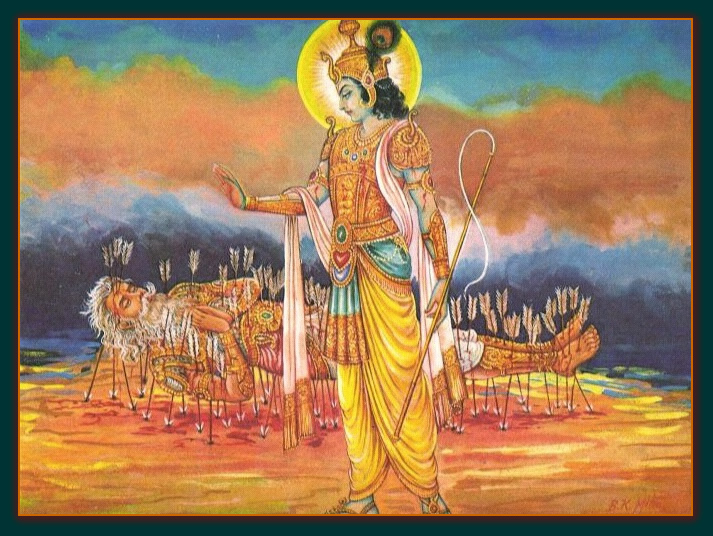
(9) Bhîshmadeva, the best among the Vasus, knowing well how to adapt the dharma according to time and circumstances, welcomed all the great and powerful souls who had assembled there. (10) Knowing His glories he honored Krishna, the Lord of the Universe situated in the heart who manifests His form through His internal potency. (11) Overtaken by feelings of love about the gathering he, with tears in his eyes in ecstasy, congratulated the sons of Pându sitting silently at his side. (12) He said: 'Oh how painful and unjust it has been for you good souls, sons of righteousness, to have had such a life of suffering you never really deserved under the protection of the brahmins, the religion and the Infallible One. (13) After the death of the great general Pându, when you, the children of Kuntî, his wife, were still tender of age, she had to suffer a great deal on your account, and that continued even after you boys had grown up. (14) All the unpleasant that transpired, I think, is the inescapable effect of Time; you, just like the rest of the world with its ruling demigods, fall under that control the way clouds are carried by the wind. (15) Why else would there be such misfortune with Yudhishthhira, the son of the ruler of religion, being present, as also Bhîma with his mighty club, Arjuna carrying his Gândîva and our well-wisher Krishna? (16) No one may fathom His plan, oh King, it bewilders even the great philosophers who are engaged in exhaustive inquiries. (17) Therefore, I assure you, [Yudhishthhira,] oh best soul of Bharata, that this was only due to His providence, His desire. Oh ruler, just take care of the helpless subjects, 0h master. (18) He [Krishna] who inconceivably moves among the Vrishni family, is no one else but the Supreme Lord, the original, primordial, supreme enjoyer Nârâyana who bewilders the world with His energies. (19) Oh King, Lord S'iva, Nârada the divine sage and the great Lord Kapila have direct knowledge of His most confidential glories [but do not know his intentions]. (20) He is the very same person you consider your maternal cousin, dearest friend, ardent well-wisher, counselor, messenger, benefactor and charioteer. (21) He who is present in everyone's heart, who is equal to all and who, being from the Absolute, never falsely identifies Himself, makes, in His consciousness, never at any time a difference, free as He is from any bias. (22) Yet, despite His impartiality with the devotees, see, oh King, how Krishna at the end of my life, cared to be visibly present at my side. (23) Those yoga adepts who with Him in mind devoutly meditate on His holy name and with their mouth sing His glories, will, upon abandoning the material conception of life [their body], be freed from their desire for materially motivated actions. (24) May He, the path of my meditations, the four-handed God of the Gods, the Supreme Lord, with His cheerful smile, His eyes red like the morning sun and His decorated lotus face, await me when I leave this material body.' "
(25) Sûta said: "Yudhishthhira, who heard this from him who was lying on a bed of arrows, asked him, with the rishis listening, about the different religious duties. (26) Bhîshma described to him the various stages of life and the vocations as determined by a person's character, as also the way one should systematically deal with both the symptoms of attachment and detachment. (27) He gave an outline of the duties of charity, rulership and liberation, including a more detailed description, and also discussed the duties of women and those of devotional service. (28) Knowing the truth he, oh sages, described the [civil virtues of regulating the] religion, economy, desires and liberation, thereby giving examples of known histories. (29) The time Bhîshma described the duties, the sun ran over the northern hemisphere, which is precisely the period preferred by mystics for leaving this world [see B.G. 8: 24]. (30) Bhîshmadeva, the protector of thousands of sciences and arts, then fell silent. With a mind freed from all bondage he thereupon fixed his eyes, wide open, on Krishna, the Fourhanded Original Person, who was standing before him clad in yellow. (31) Simply looking at Him, the Annihilator of the Inauspicious, his meditation purified and his pain from the arrows disappeared instantly. And as he was praying before the material tabernacle, all the activities of his senses ceased when he departed for the Controller of All Living Beings. (32) S'rî Bhîshmadeva said: 'Freed from desires, my mind is now ready for the Supreme Lord, the Leader of the Devotees, the Great Self-contented One who in the realization of His transcendental joy at times [as an avâtara] takes pleasure in accepting this material world that changes constantly. (33) He is the most desirable person of the higher, lower and middle worlds. Bluish like a tamâla tree, He wears His dress that shines like the golden rays of the sun. He has a body decorated with sandalwood pulp and a face like a lotus. May my love, free from material motives, repose in the friend of Arjuna. (34) Let the mind be directed towards S'rî Krishna who, with His scattered hair that on the battlefield turned ashen from the dust of the hoofs, with His face decorated with perspiration and His skin pierced by my sharp arrows, took pleasure in wearing His protective armor. (35) After hearing the command of His friend, He drove the chariot between the opposing forces, where positioned He diminished the lifespan of the enemy by simply looking at them. Let there be my love for that friend of Arjuna. (36) Seeing the faces of the troops standing at a distance, He with His transcendental knowledge eradicated the ignorance of him who, because of a polluted intelligence, was reluctant to kill his kinsmen. Let there be the transcendence of my attraction to His feet.
(37) Giving up His own promise not to fight and fulfilling my vow to make Him do so, He got down from His chariot, took up its wheel and - while dropping His outer garment - paced towards me like a lion about to kill an elephant. (38) Wounded by the sharp arrows of the aggressor that I was and with His armor broken He, smeared with blood, in an angry mood moved towards me in order to kill me. May the Supreme Lord who awards salvation become my destination. (39) Let me in my dying hour, be of love for the Personality of Godhead who, controlling the horses with a whip in His right hand and the reins in His left, so elegant to behold, by all means protected the chariot of Arjuna. It was by looking at Him that those who died at this place realized their original form [of service]. (40) Watching the attractive movements of His supremely spirited, fascinating acts and sweet loving smiles, the gopîs of Vrajadhâma [the village of Krishna's youth] imitating Him madly in ecstasy, experienced His nature. (41) When King Yudhishthhira performed the [Râjasûya] royal sacrifice where the great sages and kings were assembled, He received the respectful worship of all the members of the elite. I present there recognized Him at the time [and still remember Him now] als the [Supreme] Soul, as the object of worship. (42) Having experienced the absorption of being freed from the misconceptions of duality, I know [ever since] that He, now present before me, is the One Unborn in the heart of the conditioned soul. It is He who, situated as the Supersoul in the heart of all beings created by Him, is looked upon differently from every angle, just like the one sun.' "
(43) Sûta said: "With his mind, speech, sight and actions thus being fixed on Krishna alone, he fell silent and stopped breathing after having merged in the living being of the Supersoul. (44) Understanding that Bhîshmadeva had merged into the Absolute and Unlimited Supreme, everyone fell silent like birds at the end of the day. (45) Thereafter from everywhere drums sounded being beaten by gods and men, accompanied by heartfelt praise from the pious royal order and showers of flowers falling from the sky. (46) Oh descendant of Bhrigu [S'aunaka], after having performed the funeral rites for the dead body, Yudhishthhira was afflicted for a moment. (47) The sages who were satisfied and happy about the [revelation of the] confidential secret of Krishna's glories, then turned back to their hermitages with Him installed in their hearts. (48) Yudhishthhira went together with Krishna to Hastinâpura and consoled his uncle [Dhritarâshthra] and ascetic aunt Ghândhârî. (49) With the approval of his uncle and consent of Vâsudeva he thereafter ruled the kingdom, conform the dharma and greatness of his father [Pându] and forefathers."
Read the inspiration to this chapter by Anand Aadhar.


Third revised edition, loaded february 16, 2023.
Previous Aadhar edition and Vedabase links:
Sûta said: "Yudhishthhira, in fear because he had killed, in order to understand all duties, thereafter went to the battlefield where the dying Bhîshmadeva was lying down.
Sûta said: "In fear because of having killed, went Yudhishthhira thereafter, for the sake of the full knowledge of the religious duty, to the battlefield, where he found the dying Bhîshmadeva lying down. (Vedabase)
Drawn by the best horses decorated with golden ornaments, all the brothers followed him hither, accompanied by Vyâsa, Dhaumya [the priest of the Pândavas] and other rishis.
Drawn by the best horses decorated with golden ornaments, followed all the brothers him there, accompanied by Vyâsa, Dhaumya [the priest of the Pândavas] and other rishis. (Vedabase)
Also the Supreme Lord came along with Arjuna on the chariot, oh sages among the scholars. Thus the King appeared very aristocratic, like Kuvera [the treasurer of the demigods] together with his companions.
The Supreme Lord also followed him with Arjuna on the chariot, o sages among the learned, and thus appearing very aristocratic he was like Kuvera [the treasurer of the demigods] and his companions. (Vedabase)
Seeing Bhîshma lying on the ground like a demigod fallen from heaven, he together with his Pândava brothers and the One Carrying the Disc [Krishna], bowed down before him.
Upon seeing Bhîshma lying on the ground like a demi-god fallen from heaven, bowed Yudhishthhira, together with his brothers and the Lord with the disc, Krishna, down before him. (Vedabase)
All the sages among the brahmins, the God-conscious souls and the royalty were there, just to see the leader of the descendants of King Bharata [the common ancestor].
There were present the rishis of goodness amongst the learned, together with the godly and the kings, just to see the chief of the descendants of King Bharata [the common ancestor]. (Vedabase)
Parvata Muni, Nârada, Dhaumya, Vyâsadeva, Brihadas'va, Bharadvâja and Paras'urâma were present there with their disciples and also Vasishthha, Indrapramada, Trita, Gritsamada, Asita, Kakshîvân, Gautama, Atri, Kaus'ika and Sudars'ana had come.
Parvata Muni, Nârada, Dhaumya, Lord Vyâsa, Brihadas'va, Bharadvâja and Paras'urâma were there with their disciples as also Vasishthha, Indrapramada, Trita, Gritsamada, Asita, Kakshîvân, Gautama, Atri and Kaus'ika as well as Sudars'ana. (Vedabase)
Oh brahmins, also many other sages like S'ukadeva, the instrument of God, and other pure souls like Kas'yapa and Ângirasa arrived there accompanied by their disciples.
O learned ones, also many other sages like S'ukadeva, the instrument of God, , the instrument of God, and other pure souls as Kas'yapa and Ângirasa arrived there accompanied by their disciples. (Vedabase)
Bhîshmadeva, the best among the Vasus, knowing well how to adapt the dharma according to time and circumstances, welcomed all the great and powerful souls who had assembled there.
Bhîshmadeva, the best amongst the Vasus, knowing well how to behave religiously according time and circumstances, welcomed all the great and powerful ones who had assembled there. (Vedabase)
Knowing His glories he honored Krishna, the Lord of the Universe situated in the heart who manifests His form through His internal potency.
Knowing of His glories he also in worship welcomed Lord Krishna, the Lord of the Universe who, situated in the heart, manifests His form through His internal potency. (Vedabase)
Overtaken by feelings of love about the gathering he, with tears in his eyes in ecstasy, congratulated the sons of Pându sitting silently at his side.
Seeing the sons of Pându sitting silently by his side, congratulated Bhîshma them warmheartedly. In ecstacy overtaken by feelings of love about the gathering, had he tears in his eyes. (Vedabase)
He said: 'Oh how painful and unjust it has been for you good souls, sons of righteousness, to have had such a life of suffering you never really deserved under the protection of the brahmins, the religion and the Infallible One.
He said: 'O how painful and unjust it has been for you good souls, sons of righteousness, to have had a life of suffering you never deserved under the protection of the learned, the religion and the Infallible One. (Vedabase)
After the death of the great general Pându, when you, the children of Kuntî, his wife, were still tender of age, she had to suffer a great deal on your account, and that continued even after you boys had grown up.
After the death of the great general Pându, Kuntî, my daughter in law, having young children, suffered a great deal and that continued because of what you all did, even after the boys had grown up. (Vedabase)
All the unpleasant that transpired, I think, is the inescapable effect of Time; you, just like the rest of the world with its ruling demigods, fall under that control the way clouds are carried by the wind.
All the unpleasant I think, is the inescapable effect of Time, because you, just as the whole world with its ruling demigods, fall under that control like the clouds carried by the wind. (Vedabase)
Why else would there be such misfortune with Yudhishthhira, the son of the ruler of religion, being present, as also Bhîma with his mighty club, Arjuna carrying his Gândîva and our well-wisher Krishna?
How else could there be misfortune with the presence of Yudhishthhira, the son of the ruler of religion, Bhîma with his mighty club, Arjuna carrying his Gândîva and our well-wisher Lord Krishna? (Vedabase)
No one may fathom His plan, oh King, it bewilders even the great philosophers who are engaged in exhaustive inquiries.
No one knows what His intentions are, o King; even great philosophers engaged in exhaustive inquiries for sure are bewildered. (Vedabase)
Therefore, I assure you, [Yudhishthhira,] oh best soul of Bharata, that this was only due to His providence, His desire. Oh ruler, just take care of the helpless subjects, 0h master.
Therefore, I assure you, o best of the descendants of Bharata, that this was only due to His providence, His desire; 0 ruler - just take care of the helpless subjects 0 master. (Vedabase)
He [Krishna] who inconceivably moves among the Vrishni family, is no one else but the Supreme Lord, the original, primordial, supreme enjoyer Nârâyana who bewilders the world with His energies.
He [Krishna] who inconceivably moves amongst the Vrishni family, is no one else but the Supreme Lord, the original, primordial, supreme enjoyer Nârâyana who bewilders each by His energies. (Vedabase)
Oh King, Lord S'iva, Nârada the divine sage and the great Lord Kapila have direct knowledge of His most confidential glories [but do not know his intentions].
O King, it are Lord S'iva, the sage among the godly Nârada and the great Lord Kapila who have direct knowledge of the most confidential glories of His Lordship. (Vedabase)
He is the very same person you consider your maternal cousin, dearest friend, ardent well-wisher, counselor, messenger, benefactor and charioteer.
He is the same person you consider your maternal cousin, dearest friend, ardent well-wisher, counselor, messenger, benefactor and charioteer. (Vedabase)
He who is present in everyone's heart, who is equal to all and who, being from the Absolute, never falsely identifies Himself, makes, in His consciousness, never at any time a difference, free as He is from any bias.
He who is present in everyone's heart, who is equal to all, who from the Absolute never falsely identifies Himself, is in His consciousness of differentiating at each moment and in all He does, free from whatever predilection. (Vedabase)
Yet, despite His impartiality with the devotees, see, oh King, how Krishna at the end of my life, cared to be visibly present at my side.
Yet, despite of His invariability with the devotees, see, o King, how Krishna directly, at the end of my life, cared to be present at my side. (Vedabase)
Those yoga adepts who with Him in mind devoutly meditate on His holy name and with their mouth sing His glories, will, upon abandoning the material conception of life [their body], be freed from their desire for materially motivated actions.
Those yoga-adepts who in their words meditate devoutly on His holy name, singing His glories, will, upon abandoning the material conception of life, find release from the desire of their materially motivated actions. (Vedabase)
May He, the path of my meditations, the four-handed God of the Gods, the Supreme Lord, with His cheerful smile, His eyes red like the morning sun and His decorated lotus face, await me when I leave this material body.' "
May He, the God of the Gods, the Supreme Lord, in the line of my meditation on the four-handed one [Vishnu], await me with His cheerful smile, His eyes red like the morning sun and His decorated lotus face, the moment I leave this material body'." (Vedabase)
Sûta said: "Yudhishthhira, who heard this from him who was lying on a bed of arrows, asked him, with the rishis listening, about the different religious duties.
Sûta said: "Yudhishthhira hearing that from him who was lying down on a bed of arrows, asked him, with the rishis listening, about the diverse religious duties. (Vedabase)
Bhîshma described to him the various stages of life and the vocations as determined by a person's character, as also the way one should systematically deal with both the symptoms of attachment and detachment.
Bhîshma described to him the different stages of life and the vocations as determined by the qualities of the person next to the way how to deal systematically with both the symptoms of attachment and detachment. (Vedabase)
He gave an outline of the duties of charity, rulership and liberation, including a more detailed description, and also discussed the duties of women and those of devotional service.
He explained about the duties of charity, rulership and liberation by giving their divisions and gave the general outline of the duties of women and devotional service. (Vedabase)
Knowing the truth he, oh sages, described the [civil virtues of regulating the] religion, economy, desires and liberation, thereby giving examples of known histories.
Knowing the truth, he described, o sages, the [four basic civil virtues of] religious dutifulness, the economy, the fulfillment of desires and the liberation, citing from the various known histories. (Vedabase)
The time Bhîshma described the duties, the sun ran over the northern hemisphere, which is precisely the period preferred by mystics for leaving this world [see B.G. 8: 24].
At the time when Bhîshma described the duties, the sun ran over the northern hemisphere which is the exact desired time preferred by the mystics for leaving this world [see B.G. 8: 24]. (Vedabase)
Bhîshmadeva, the protector of thousands of sciences and arts, then fell silent. With a mind freed from all bondage he thereupon fixed his eyes, wide open, on Krishna, the Fourhanded Original Person, who was standing before him clad in yellow.
Then Bhîshmadeva, the protector of thousands of sciences and arts, fell silent, and with a mind freed from all bondage fixed he his eyes opened wide upon the Original Person Lord S'rî Krishna, the Fourhanded One who was standing before him in yellow garments. (Vedabase)
Simply looking at Him, the Annihilator of the Inauspicious, his meditation purified and his pain from the arrows disappeared instantly. And as he was praying before the material tabernacle, all the activities of his senses ceased when he departed for the Controller of All Living Beings.
Simply looking at Him, the Annihilator of the Inauspicious, purified his meditation and disappeared his pain from the arrows instantly - and while he prayed before the material tabernacle ceased all the activities of his senses as he quit for the Controller of All Living Beings. (Vedabase)
S'rî Bhîshmadeva said: 'Freed from desires, my mind is now ready for the Supreme Lord, the Leader of the Devotees, the Great Self-contented One who in the realization of His transcendental joy at times [as an avâtara] takes pleasure in accepting this material world that changes constantly.
S'rî Bhîshmadeva said: 'Let me, being freed from desires, prepare my mind for the Supreme Lord, the Leader of the Devotees, the Great Self-contented One who in the realization of His transcendental joy at times takes pleasure in accepting this material world with its creation and destruction. (Vedabase)
He is the most desirable person of the higher, lower and middle worlds. Bluish like a tamâla tree, He wears His dress that shines like the golden rays of the sun. He has a body decorated with sandalwood pulp and a face like a lotus. May my love, free from material motives, repose in the friend of Arjuna.
He is the most desirable from the high, low and middle worlds, bluish like a tamâla tree, wears His dress shining like the golden rays of the sun, has a body decorated with sandalwood pulp and a face like a lotus - may my love free from material motives repose in the friend of Arjuna. (Vedabase)
Let the mind be directed towards S'rî Krishna who, with His scattered hair that on the battlefield turned ashen from the dust of the hoofs, with His face decorated with perspiration and His skin pierced by my sharp arrows, took pleasure in wearing His protective armor.
Let the mind be directed towards S'rî Krishna who, with His scattered hair on the battlefield turned ashen from the dust of the hoofs, His face decorated with perspiration and His skin pierced by my sharp arrows, with His protecting armor took pleasure in all of it. (Vedabase)
After hearing the command of His friend, He drove the chariot between the opposing forces, where positioned He diminished the lifespan of the enemy by simply looking at them. Let there be my love for that friend of Arjuna.
After hearing the command of His friend He drove His chariot between the opposing forces, where positioned He diminished the lifespan of the enemy by simply looking at them - let there be my love for that friend of Arjuna. (Vedabase)
Seeing the faces of the troops standing at a distance, He with His transcendental knowledge eradicated the ignorance of him who, because of a polluted intelligence, was reluctant to kill his kinsmen. Let there be the transcendence of my attraction to His feet.
With the soldiers looking from a distance, He with His transcendental knowledge eradicated the ignorance of him who, from a polluted intelligence, was reluctant to kill his kinsmen - let there be the transcendence of my attraction for His feet. (Vedabase)
Giving up His own promise not to fight and fulfilling my vow to make Him do so, He got down from His chariot, took up its wheel and - while dropping His outer garment - paced towards me like a lion about to kill an elephant.
Against His own word got He, to nullify my promise of factually being more of it [of violence], down from His chariot, took He up it's wheel, and paced He towards me like a lion about to kill an elephant, meanwhile dropping His outer garment. (Vedabase)
Wounded by the sharp arrows of the aggressor that I was and with His armor broken He, smeared with blood, in an angry mood moved towards me in order to kill me. May the Supreme Lord who awards salvation become my destination.
Wounded by the sharp arrows and without His shield, He, smeared with blood, in the angry mood of the great aggressor, began to move for the purpose of killing me - may that Supreme Lord who awards salvation become my destination. (Vedabase)
Let me in my dying hour, be of love for the Personality of Godhead who, controlling the horses with a whip in His right hand and the reins in His left, so elegant to behold, by all means protected the chariot of Arjuna. It was by looking at Him that those who died at this place realized their original form [of service].
Let me, at this hour of death, be of love for the Personality of Godhead who, controlling the horses with a whip in His right hand and the reins in the left, so elegant to behold by all means protected the chariot of Arjuna; it was by looking at Him that those who died in this world attained their original form. (Vedabase)
Watching the attractive movements of His supremely spirited, fascinating acts and sweet loving smiles, the gopîs of Vrajadhâma [the village of Krishna's youth] imitating Him madly in ecstasy, experienced His nature.
Watching the attractive movements of His supremely spirited, fascinating acts and sweet smiles, found the gopîs of Vrajadhâma [the village of Krishna's youth] imitating Him in ecstasy, their original nature. (Vedabase)
When King Yudhishthhira performed the [Râjasûya] royal sacrifice where the great sages and kings were assembled, He received the respectful worship of all the members of the elite. I present there recognized Him at the time [and still remember Him now] als the [Supreme] Soul, as the object of worship.
In a royal performance of sacrifice of King Yudhishthhira, where the great sages and kings were assembled, received He, with me personally present recognizing Him as my object of attraction, the respectful worship of all the members of the elite. (Vedabase)
Having experienced the absorption of being freed from the misconceptions of duality, I know [ever since] that He, now present before me, is the One Unborn in the heart of the conditioned soul. It is He who, situated as the Supersoul in the heart of all beings created by Him, is looked upon differently from every angle, just like the one sun.' "
Him, now present before me, do I, having experienced the absorption of being freed from the misconceptions of duality, know to be the Unborn One of the conditioned body. It is He who, though being One alike the sun, in His being situated as the Supersoul in the heart of all that are created by Him, is looked different upon from every angle." (Vedabase)
Sûta said: "With his mind, speech, sight and actions thus being fixed on Krishna alone, he fell silent and stopped breathing after having merged in the living being of the Supersoul.
Sûta said: "With his mind, speech, sight and activities thus fixed on Krishna only, he fell silent and stopped breathing, having merged in the living being of the Supersoul. (Vedabase)
Understanding that Bhîshmadeva had merged into the Absolute and Unlimited Supreme, everyone fell silent like birds at the end of the day.
After hearing this all from Bhîshmadeva as he merged into the Supreme Absolute and Unlimited, everyone fell silent like birds at the end of the day. (Vedabase)
Thereafter from everywhere drums sounded being beaten by gods and men, accompanied by heartfelt praise from the pious royal order and showers of flowers falling from the sky.
Thereafter from everywhere sounded drums beaten by gods and men, with heartfelt praise from the pious royal order and showers of flowers falling from the sky. (Vedabase)
Oh descendant of Bhrigu [S'aunaka], after having performed the funeral rites for the dead body, Yudhishthhira was afflicted for a moment.
O descendant of Bhrigu [S'aunaka], after having performed the funeral rites for the dead body, was Yudhishthhira for a moment afflicted. (Vedabase)
The sages who were satisfied and happy about the [revelation of the] confidential secret of Krishna's glories, then turned back to their hermitages with Him installed in their hearts.
Then, the sages, satisfied and happy by the confidentiality of the glories of Lord Krishna, went back to their own hermitages with Him installed in their hearts. (Vedabase)
Yudhishthhira went together with Krishna to Hastinâpura and consoled his uncle [Dhritarâshthra] and ascetic aunt Ghândhârî.
King Yudhishthhira with Lord Krishna went to Hastinâpura to console his uncle [Dhritarâshthra] and ascetic aunt Ghândhârî. (Vedabase)
With the approval of his uncle and consent of Vâsudeva he thereafter ruled the kingdom, conform the dharma and greatness of his father [Pându] and forefathers."
With the approval of his uncle and consent of Lord Vâsudeva he thereafter, to the greatness of his forefathers, executed the royal duties over the kingdom." (Vedabase)


The text and audio are offered under the conditions of the
Creative
Commons
Attribution-Noncommercial-Share Alike 3.0 Unported License.
The copyright of the images differs according to their source.
The image
of Krishna standing near Bhîshma on the arrow bed is of B.K.
Mitra.
Production: Filognostic Association of The
Order
of
Time.

Feed-back | Links | Downloads | Music | Pictures | What's New | Search | Donations





 Text
Text