
Canto 8
Chapter 1: The Manus, Administrators of the Universe
(1) The honorable king [Parîkchit] said: 'Oh guru, thus far I extensively heard about the dynasty of Svâyambhuva Manu wherein the great rulers of the universe have contributed to the creation. Can you please also describe the other Manus to us [see also 3.11: 23-28]? (2) Oh brahmin, the scholars speak about the appearances and activities of the Supreme Glorified Lord during the manvantaras [the periods of the Manus *, see also 2.1: 36, 2.3: 9, 2.7: 2, 2.10: 4]. Can you please also describe these to us, your eager listeners? (3) As for the past, the present and the future, oh brahmin, what are for each particular era the activities that the Supreme Lord, the creator of this universe, was engaged in, is now engaged in and will be engaged in [compare B.G. 2: 12 and **]?'
(4) The great rishi said: 'This day of Brahmâ [kalpa] six Manus have passed: Svâyambhuva and five others. I already described the period of the first one [Svâyambhuva] including the divine personalities who appeared during that time [see 2.7: 43-45, 3.12: 54, 4.1 and 4.8: 6]. (5) From Âkûti and Devahûti, two daughters of [Svâyambhuva] Manu, sons were born [Yajña and Kapila] known as [incarnations of] the Supreme Lord for [respectively] instructing dharma and jñâna [spiritual knowledge]. (6) Kapila I have fully described to you [see Canto 3b], let me now tell you everything that Yajña[mûrti or Yajñapati] did, oh best of the Kurus. (7) The master of the world [Svâyambhuva Manu], the husband of S'atarûpâ, detached from enjoying his senses, after renouncing his kingdom, went together with his wife into the forest for doing his tapas [see 3.22: 31]. (8) At the river Sunandâ he performed for a hundred years the severest austerities, in which he on one leg touching the earth [see also 4.8: 78-79] murmured the following, oh scion of Bhârata.
(9) Lord Manu said: 'He by whom this entire universe is set in motion, is not moved by the universe himself. He who is always awake while one is asleep in this body, He, the One knowing, is not known by the living entity itself [see also B.G. 18: 55]. (10) One may enjoy that what is allotted by Him, the Supersoul who is present everywhere with everything and everyone in the universe, but one should not covet the wealth of others. (11) He whose eye sees all and who is not seen by the living entity, He, the original source of all beings who knows no diminution, is the godhead and companion [see 6.4: 24] everyone should worship. (12) There is no beginning, no end, nor a middle to Him, no one is his friend or foe. He is not [just] the inside nor [just] the outside of the cosmic creation. All these [aspects] of Him and the universe originating from Him, together constitute the Complete Reality [Om pûrnam, see also the S'rî Îs'opanishad and 2.1: 24]. (13) That assemblage of the universe known by many names [like purusha and virâth-rûpa] is the Supreme Master, the Ultimate Truth of His person, the unborn self-effulgent one who is the oldest. By means of His external energy He gives rise to birth, death and maintenance, while He remains aloof, inactive and untouched by dint of His spiritual potency [compare 1.7: 23]. (14) For the purpose of being freed from karma [fruitive labor] all sages therefore, to begin with, request [people] to engage in [nonprofit, charitable, voluntary] activities [in karma yoga]. A person thus engaged almost always will become indifferent [about performing work with an ulterior motive, see also 1.5: 12, 1.2: 13 and B.G. 3: 9, 6: 3, 3: 6]. (15) Because He in His completeness is fully satisfied from within, the Supreme Lord, the Master [of yoga], never gets entangled in the matters He is engaged in, and that is why people who follow Him never get discouraged. (16) I surrender myself to Him who, free from selfhood, acts to our benefit, to Him who is complete in His knowledge, He who has no desire to enjoy, is fulfilled and is not led by others. I offer my obeisances to that master of all principles and duties who is there to instruct all of mankind and map out His path.'
(17) S'rî S'uka said: 'When the Asuras saw how he [Svâyambhuva Manu] concentrated his mind with the philosophical mantras, the evil spirits chased him in order to devour him. (18) But Yajña [Vishnu], the Supreme Personality, the Lord in the heart of everyone, saw what the Asuras had in mind and killed them. Thereafter He ruled the heavenly worlds surrounded by the gods [named] the Yâmas [the ones sworn, His sons].
(19) Svârocisha, the son of Agni became the second Manu. From his loins the sons headed by Dyumat, Sushena and Rocishmat were born. (20) In that period [of Manu] Rocana [the son of Yajña] became the king of heaven [the Indra], Tushita and others faithful to the Absolute Truth were the gods, while Ûrja, Stambha and others were the seven sages. (21) From the saint Vedas'irâ, impregnating his wife Tushitâ, the Lord was born who is known as Vibhu. (22) From Him remaining a celibate brahmacârî, eighty-eight thousand saintly persons fixed in that vow took initiation and instruction.
(23) The third Manu was named Uttama, he was a son of Priyavrata [see 5.1] and from him the sons called Pavana, S'rîñjaya, Yajñahotra and others were born. (24) The seven sages [during his reign] were the sons of Vasishthha headed by Pramada. The Satyas, Vedas'rutas and Bhadras were the gods and Satyajit was the Indra. (25) [In this manvantara] the Supreme Lord, the Personality of Godhead celebrated as Satyasena, was born from the womb of Sûnritâ and the demigod Dharma. He appeared together with the Satyavratas. (26) He together with his friend Satyajit [as the Indra] killed all the Yakshas and Râkshasas, the sworn liars and evil spirits, who with their misconduct constantly harassed the living beings.
(27) The fourth Manu was the brother of Uttama known by the name of Tâmasa. He fathered ten sons headed by Prithu, Khyâti, Nara and Ketu. (28) The Satyakas, the Haris and the Vîras were the gods, Tris'ikha was the king of heaven and the seven sages during the reign of Tâmasa were headed by Jyotirdhâma. (29) The [other] gods were called the Vaidhritis. They were the sons of Vidhriti, oh King, who by their own strength managed to protect the Vedas that over time had been lost. (30) In that period the Supreme Lord appeared who was begotten by Harimedhâ in the womb of Harinî. He was called Hari. Gajendra, the king of the elephants, was freed by Him from the mouth of a crocodile [for a description of the fifth and sixth Manu see chapter 7.5].'
(31) The honorable king [Parîkchit] said: 'Oh son of Vyâsa, we would like to hear from you how the king of the elephants who was harassed by a crocodile, was delivered by the Lord. (32) Whenever and wherever there are the narrations in which Hari, the Supreme Personality, Uttamas'loka [the Lord Praised in the Verses] is glorified, great piety, fortune, auspiciousness and virtue are found.' "
(33) S'rî Sûta said: "By the words of Parîkchit, who awaited his impending death, thus being encouraged to speak, dear brahmins, the son of Vyâsa, after complimenting him, spoke with great pleasure to the sages who had assembled there to listen to him."
Third revised edition, loaded Januari 27, 2026.
Previous Aadhar edition and Vedabase links:
The honorable king [Parîkchit] said: 'Oh guru, thus far I extensively heard about the dynasty of Svâyambhuva Manu wherein the great rulers of the universe have contributed to the creation. Can you please also describe the other Manus to us [see also 3.11: 23-28]?The honorable king said: 'Till now, o guru, I've extensively heard about the dynasty of Svâyambhuva Manu wherein the great rulers of the universe were of creation; please describe for us also the other Manus [see also 3.11: 23-28]. (Vedabase)
Oh brahmin, the scholars speak about the appearances and activities of the Supreme Glorified Lord during the manvantaras [the periods of the Manus *, see also 2.1: 36, 2.3: 9, 2.7: 2, 2.10: 4]. Can you please also describe these to us, your eager listeners?
O brahmin, please tell us, so eager to hear, about all the, by the learned glorified and described, appearances and activities of the Supreme Lord during the changes of the manvantaras [the periods of the Manus * , see also 2.1: 36, 2.3: 9, 2.7: 2, 2.10: 4]. (Vedabase)
As for the past, the present and the future, oh brahmin, what are for each particular era the activities that the Supreme Lord, the creator of this universe, was engaged in, is now engaged in and will be engaged in [compare B.G. 2: 12 and **]?'
As for the past, the present and the future, what are the activities that the Supreme Lord, the creator of this universe, in a particular era, o brahmin, either was engaged in, is engaged in and will be engaged in [compare B.G. 2: 12 and **]? (Vedabase)
The great rishi said: 'This day of Brahmâ [kalpa] six Manus have passed: Svâyambhuva and five others. I already described the period of the first one [Svâyambhuva] including the divine personalities who appeared during that time [see 2.7: 43-45, 3.12: 54, 4.1 and 4.8: 6].
The great rishi said: 'For this day of Brahmâ [kalpa] have already the six of Svâyambhuva and other Manus passed. I already described the first one to you as well as the appearance of all the godly with him [see 2.7: 43-45, 3.12: 54, 4.1 and 4.8: 6]. (Vedabase)
From Âkûti and Devahûti, two daughters of [Svâyambhuva] Manu, sons were born [Yajña and Kapila] known as [incarnations of] the Supreme Lord for [respectively] instructing dharma and jñâna [spiritual knowledge].
From Âkûti and Devahûti, the two daughters of [Svâyambhuva] Manu, were, for instructing the dharma and the jñâna, the sons born who are accepted as being the Supreme Lord. (Vedabase)
Kapila I have fully described to you [see Canto 3b], let me now tell you everything that Yajña[mûrti or Yajñapati] did, oh best of the Kurus.
Before I in full described Kapila to you [see Canto 3b], now I'll tell you about all that was done by Yajña[-mûrti or-pati], o best of the Kurus. (Vedabase)
The master of the world [Svâyambhuva Manu], the husband of S'atarûpâ, detached from enjoying his senses, after renouncing his kingdom, went together with his wife into the forest for doing his tapas [see 3.22: 31].
The master of the world [Svâyambhuva Manu], the husband of S'atarûpâ, after totally renouncing his kingdom went with his wife into the forest for doing his tapas [see: 3.22: 31]. (Vedabase)
At the river Sunandâ he performed for a hundred years the severest austerities, in which he on one leg touching the earth [see also 4.8: 78-79] murmured the following, oh scion of Bhârata.
At the river Sunandâ he for a hundred years performed the most severe austerities touching the earth standing on his one leg [see also 4.8: 78-79] murmuring the following, o scion of Bhârata. (Vedabase)
Lord Manu said: 'He by whom this entire universe is set in motion, is not moved by the universe himself. He who is always awake while one is asleep in this body, He, the One knowing, is not known by the living entity itself [see also B.G. 18: 55].
Lord Manu said: 'He by whom this whole universe is set in motion is not moved by the universe, He who is always awake while one is asleep in this body, Him, the One knowing, does the living entity not know [see also B.G. 18: 55]. (Vedabase)
One may enjoy that what is allotted by Him, the Supersoul who is present everywhere with everything and everyone in the universe, but one should not covet the wealth of others.
What by Him, the Supersoul everywhere present, with everything animate and inanimate in this and in all other universes, is allotted one may enjoy; on the property of anyone else one should not infringe. (Vedabase)
He whose eye sees all and who is not seen by the living entity, He, the original source of all beings who knows no diminution, is the godhead and companion [see 6.4: 24] everyone should worship.
He is not seen by the living entity although His eye always sees, He as the original source of all beings never diminishes, He is the godhead and companion [see 6.4: 24] everyone should worship. (Vedabase)
There is no beginning, no end, nor a middle to Him, no one is his friend or foe. He is not [just] the inside nor [just] the outside of the cosmic creation. All these [aspects] of Him and the universe originating from Him, together constitute the Complete Reality [Om pûrnam, see also the S'rî Îs'opanishad and 2.1: 24].
Nor is there of Him a beginning, an end or a middle, He belongs to nowhere and to no one, He is the inside nor [just] the outside of the cosmic creation; all these insights on His form and on Him as the cause of the whole universe all together make up the Greatest Truth [see also 2.1: 24]. (Vedabase)
That assemblage of the universe known by many names [like purusha and virâth-rûpa] is the Supreme Master, the Ultimate Truth of His person, the unborn self-effulgent one who is the oldest. By means of His external energy He gives rise to birth, death and maintenance, while He remains aloof, inactive and untouched by dint of His spiritual potency [compare 1.7: 23].
That complete of the universe known by so many names [like purusha and virâth rûpa] is the Supreme Controller, the Ultimate Truth of Him personally, self-effulgent, beginningless and the oldest; He by His external energy engenders birth, death and maintenance, by the potency of His Self and Spirit He remains aloof, inactive and untouched [compare 1.7: 23]. (Vedabase)
For the purpose of being freed from karma [fruitive labor] all sages therefore, to begin with, request [people] to engage in [nonprofit, charitable, voluntary] activities [in karma yoga]. A person thus engaged almost always will become indifferent [about performing work with an ulterior motive, see also 1.5: 12, 1.2: 13 and B.G. 3: 9, 6: 3, 3: 6].
Therefore do all the saintly people for the purpose of being free from karma in the beginning perform fruitive labor [karma yoga], as a person engaging thus indeed as good as always attains liberation [see also 1.5: 12, 1.2: 13 and B.G. 3: 9, 6: 3, 3: 6]. (Vedabase)
Because He in His completeness is fully satisfied from within, the Supreme Lord, the Master [of yoga], never gets entangled in the matters He is engaged in, and that is why people who follow Him never get discouraged.
Because of His own gain being satisfied from within, becomes the Supreme Lord, the Controller, engaged indeed never entangled with it and hence are persons following Him never disheartened. (Vedabase)
I surrender myself to Him who, free from selfhood, acts to our benefit, to Him who is complete in His knowledge, He who has no desire to enjoy, is fulfilled and is not led by others. I offer my obeisances to that master of all principles and duties who is there to instruct all of mankind and map out His path.'
Unto Him who free from selfhood is acting for our benefit, who is complete in knowledge, has no desire to enjoy, is fulfilled, and not led by others, unto Him who is there to instruct all of mankind and to lay out His path; unto that master of all principles and duties I pray that each may surrender.' (Vedabase)
Text 17
S'rî S'uka said: 'When the Asuras saw how he [Svâyambhuva Manu] concentrated his mind with the philosophical mantras, the evil spirits chased him in order to devour him.
S'rî S'uka said: 'The philosophical mantras thus prayed concentrated the mind, but the Asuras witnessing speeded thereafter desiring to guzzle to their taste. (Vedabase)
But Yajña [Vishnu], the Supreme Personality, the Lord in the heart of everyone, saw what the Asuras had in mind and killed them. Thereafter He ruled the heavenly worlds surrounded by the gods [named] the Yâmas [the ones sworn, His sons].
When Yajña [Vishnu], the Lord in each his heart, saw them that way determined, ruled the Supreme Personality, after having killed them, together with the Yâmas [the ones vowed, His sons] and surrounded by the godly the heavenly worlds. (Vedabase)
Svârocisha, the son of Agni became the second Manu. From his loins the sons headed by Dyumat, Sushena and Rocishmat were born.
The second Manu next became Svârocisha, the son of Agni and of him there were also the sons headed by Dyumat, Sushena and Rocishmat. (Vedabase)
In that period [of Manu] Rocana [the son of Yajña] became the king of heaven [the Indra], Tushita and others faithful to the Absolute Truth were the gods, while Ûrja, Stambha and others were the seven sages.
In that period became, all together faithful to the Absolute Truth, Rocana the heavenly king [the Indra] and were Tushita and other ones there as the godly, while Ûrja, Stambha and others were the seven saints. (Vedabase)
From the saint Vedas'irâ, impregnating his wife Tushitâ, the Lord was born who is known as Vibhu.
Of the saint Vedas'irâ, impregnating the wife named Tushitâ, was the Lord who was celebrated as Vibhu born. (Vedabase)
From Him remaining a celibate brahmacârî, eighty-eight thousand saintly persons fixed in that vow took initiation and instruction.
Eighty-eight thousand saintly persons fixed to the vow took initiation and instruction from Him who remained a celibate brahmacârî. (Vedabase)
The third Manu was named Uttama, he was a son of Priyavrata [see 5.1] and from him the sons called Pavana, S'rîñjaya, Yajñahotra and others were born.
The third who became the Manu was named Uttama, a son of Priyavrata [see 5.1], and of him there were the sons called Pavana, S'rîñjaya, Yajñahotra and others. (Vedabase)
The seven sages [during his reign] were the sons of Vasishthha headed by Pramada. The Satyas, Vedas'rutas and Bhadras were the gods and Satyajit was the Indra.
The seven sages were the sons of Vasishthha headed by Pramada, the ones of Satya, Vedas'ruta and Bhadra were the godly and Satyajit was the Indra. (Vedabase)
[In this manvantara] the Supreme Lord, the Personality of Godhead celebrated as Satyasena, was born from the womb of Sûnritâ and the demigod Dharma. He appeared together with the Satyavratas.
From the demigod Dharma was from the womb of Sûnritâ, the Supreme Lord, the Personality of Godhead celebrated as Satyasena born, appearing together with the Satyavratas. (Vedabase)
He together with his friend Satyajit [as the Indra] killed all the Yakshas and Râkshasas, the sworn liars and evil spirits, who with their misconduct constantly harassed the living beings.
He together with his friend Satyajit killed all the yaksha and râkshasa sworn liars and evil spirits of misconduct who constantly harass the living beings. (Vedabase)
The fourth Manu was the brother of Uttama known by the name of Tâmasa. He fathered ten sons headed by Prithu, Khyâti, Nara and Ketu.
The fourth Manu to be was the brother of Uttama known by the name of Tâmasa, and thus there were his ten sons headed by Prithu, Khyâti, Nara and Ketu. (Vedabase)
The Satyakas, the Haris and the Vîras were the gods, Tris'ikha was the king of heaven and the seven sages during the reign of Tâmasa were headed by Jyotirdhâma.
The Satyakas, the Haris and the Viras were the godly, Tris'ikha was the heavenly king and the seven sages during the reign of Tâmasa were the ones headed by Jyotirdhâma. (Vedabase)
The [other] gods were called the Vaidhritis. They were the sons of Vidhriti, oh King, who by their own strength managed to protect the Vedas that over time had been lost.
The godly named the Vaidhritis were the sons, o King, who by their own strength managed to protect the Vedas that over time had been lost. (Vedabase)
In that period the Supreme Lord appeared who was begotten by Harimedhâ in the womb of Harinî. He was called Hari. Gajendra, the king of the elephants, was freed by Him from the mouth of a crocodile [for a description of the fifth and sixth Manu see chapter 7.5].
In that period appeared the Supreme Lord begotten by Harimedhâ from the womb of Harinî and He was called Hari; by Him was Gajendra the king of the elephants, freed from the mouth of a crocodile.' (Vedabase)
The honorable king [Parîkchit] said: 'Oh son of Vyâsa, we would like to hear from you how the king of the elephants who was harassed by a crocodile, was delivered by the Lord.
The honorable king [Parîkchit] said: 'O son of Vyâsa, this is what we would like to hear from you: in what way delivered the Lord the king of the elephants who was harassed by a crocodile? (Vedabase)Whenever and wherever there are the narrations in which Hari, the Supreme Personality, Uttamas'loka [the Lord Praised in the Verses] is glorified, great piety, fortune, auspiciousness and virtue are found.' "Whenever and wherever there are the narrations in which one glorifies Hari, the Supreme Personality, Uttamas'loka [the Lord Praised in the Verses], finds one great piety, fortune, auspiciousness and all that is good'." (Vedabase)
S'rî Sûta said: "By the words of Parîkchit, who awaited his impending death, thus being encouraged to speak, dear brabmins, the son of Vyâsa, after complimenting him, spoke with great pleasure to the sages who had assembled there to listen to him."
S'rî Sûta said: "The son of Vyâsa, thus exhorted by the words of Parîkchit, the son of Arjuna who was awaiting his impending death, o dear brahmins, after complimenting him with great pleasure spoke in the assembly of sages who indeed longed to hear from him." (Vedabase)
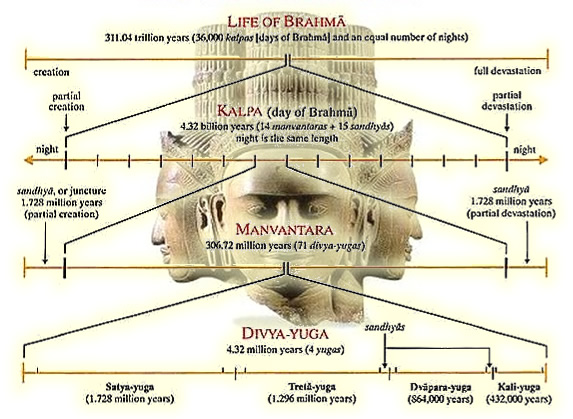
*: There are fourteen Manus during a day of Brahmâ, and the age of each Manu lasts for seventy-one yugas (see picture). Thus there are thousands of Manus during the life of Brahmâ. The six mentioned here are: Svâyambhuva, Svârocisha, Uttama, Tâmasa, Raivata and Câkshusha. A manvantara is a period to the measure of one cycle of the sun around the centre of our galaxy [see the Galactic Order].
**: Often quoted in this context is the dictum: 'nityo nityânâm cetanas cetanânâm'. Both the Lord and the living entities are eternal and sentient.


The text and audio are offered
under the conditions of the
Creative
Commons
Attribution-Noncommercial-Share Alike 3.0 Unported License.
The collage
on this page is by Anand Aadhar against a background
of a Brahmâ statue from Cambodja,
province of Siemreap, Phnom Bok, Bakheng style, end 9th century/
beginning 10th century. Musée Guimet, Paris. Source.
Production: Filognostic
Association of The Order of Time

Feed-back | Links | Downloads | Music | Pictures | What's New | Search | Donations