Canto 3
Chapter 22: The Marriage of Kardama Muni and Devahûti
(1) Maitreya said: 'After the sage this way had described the greatness of all the virtues and activities of emperor Manu, he fell silent. The emperor feeling somewhat embarrassed then addressed him. (2) Manu said: 'You [brahmins] were in your connectedness in penance, knowledge, yoga and aversion from sense gratification, by the Creator created from His mouth for the purpose of defending Him in the form of praises [Vedic hymns]. (3) And the Father with the Thousand Feet [the Lord of the Universal Form] created us from His thousand arms in order to protect them. Therefore, with us, the kshatriyas, the rulers being His arms, the brahmins are called His heart. (4) Because the godhead, He, the Imperishable One, who is both cause and effect, defends them both, do the brahmins and the kshatriyas protect each other as also the [interest of the] soul. (5) By just seeing how you, oh supreme one, personally so full of love explained what the duty of a king is to his subjects, all my doubts have resolved. (6) To my good fortune, oh powerful one, I could meet you who cannot be seen easily by those not acting in accord with the soul. I am so happy that my head could touch the dust of your feet that bring all the blessing. (7) I am lucky to have been granted the great favor of being instructed by you. How lucky I am to have listened with pricked up ears to your pure words! (8) Oh sage, your honor, oh divine mercy, now be pleased yourself to listen to the prayer of this humble person whose mind is full of worries out of love for his daughter. (9) This daughter of mine, the sister of Priyavrata and Uttânapâda, is seeking a husband suitable for her age, character and good qualities. (10) The moment she heard from Nârada Muni about your noble character, learning, appearance, youth and virtues, she fixed her mind upon you. (11) Therefore, please accept her, oh best of the twice-born souls, I offered her to you being convinced that she in every way is fit for taking charge of your household duties. (12) To deny a thing of one's desire that in fact came by itself is not commendable, not even for someone who is free from attachment to sensual pleasures, let alone someone addicted. (13) He who rejects what is offered [generously] but begs from a miser, loses his honor and will see his reputation and renown ruined. (14) Oh wise man, I heard that you intended to marry and hence have not taken the vow of perpetual celibacy. Then please accept my offer [*].'
(15) The rishi replied: 'Yes I would like to marry and your daughter has not promised herself to anyone. Based upon this a marriage of us according to the rules will be proper. (16) Let that desire of your daughter, which is recognized by scriptural authority, be fulfilled, oh King. Who would not adore your daughter? Her bodily luster alone outshines the beauty of her ornaments! (17) Was it not Vis'vâvasu [a Gandharva, a heavenly being] who, when he on the roof of the palace saw her with tinkling ankle bells and restless eyes playing with a ball, infatuated fell down from his elevated position ['his heavenly vehicle'] with a mind in disarray? (18) What man of wisdom would not welcome her, that gem of womanhood who came of her own accord [to seek my hand] as the beloved daughter of Manu and sister of Uttânapâda, a woman who cannot be seen when one is not engaged at the feet of the goddess of fortune? (19) This is therefore my condition: I will accept the chaste girl for as long as it takes her to be with child from the semen of my body. Thereafter I consider to take up the duties of service as respected by the best ones of perfection [the paramahamsas], they who are nonviolent, about whom the Lord spoke to me [in 3.21: 31]. (20) The highest authority for me is the Supreme Unlimited One, the Lord of the fathers of mankind [the Prajâpatis] from whom this wonderful creation emanated, He in whom it will dissolve and th e one by whom it presently exists.'
(21) Maitreya said: 'This, oh great warrior, was all he said, whereupon he became silent with his thoughts focussed on Vishnu's lotus navel. With a beautiful smile on his face, he then captured the mind of Devahûti. (22) After Manu had confirmed the decision taken by the queen mother [S'atarûpâ] and also had probed his daughter's mind about him, he was most pleased to give her away who was endowed with as many good qualities and thus was a good match for him [Kardama]. (23) S'atarûpâ, the empress, lovingly gave in dowry valuable presents to the bride and bridegroom like ornaments, clothes and household articles. (24) The emperor, relieved of the responsibility of giving his daughter to a suitable man, then embraced her with an agitated mind full of anxiety. (25) Unable to part from her he shed tears, drenching his daughter's hair over and over with the water from his eyes and cried: 'Oh dear mother, my dearest daughter!'
(26-27) After asking and receiving permission to leave him, the best of sages, the emperor with his wife mounted his chariot and headed, along with his retinue, for his capital, on the road enjoying the tranquil scenery of the hermitages of the sages on both the charming banks of the river the Sarasvatî. (28) Elated to know who was arriving, the subjects of Brahmâvarta went to meet him with songs, praise and instrumental music. (29-30) The city, rich with all kinds of wealth, was named Barhishmatî after the hairs of the shaking body of Lord Boar that had fallen down and turned into the evergreen kus'a and kâs'a grass [grasses used for sitting places and mats] with which the sages in worship of Lord Vishnu defeated the disturbers of their sacrifices. (31) Having spread that kus'a and kâs'a grass, the greatly fortunate Manu had created a seat in worship of the Lord of Sacrifice [Vishnu] by whom he had achieved his position on earth. (32) After arriving in the city of Barhishmatî where he thus far had lived, the mighty one entered his palace that eradicated the threefold miseries [of one's own body and mind, as caused by others and because of nature]. (33) Together with his wife and subjects he, not disturbed by others, enjoyed the pleasures of life and was praised for his reputation of piety, for he was in his heart very drawn to listening with his wives each morning to the celestial musicians and talks about the Lord. (34) Despite being absorbed in the bewildering power of his wealth, Svâyambhuva Manu was alike a saint. As a supreme devotee of the Lord he could not be led astray by his material enjoyments. (35) He did not waste his time. Till the end of his life he spent his days with listening to, contemplating, recording and discussing the topics of Lord Vishnu. (36) Being connected by the topics of Vâsudeva he, thus transcending the three destinations [according to the modes, see B.G. chapter 18], made his era last for the time of seventy-one mahâyugas. (37) How can the miseries pertaining to one's body and mind, to the powers of nature and to other men and living beings, oh Vidura, ever trouble someone who has taken shelter of the Lord? (38) On the request of the sages he [Manu], who always cared about the welfare of all living beings, spoke about the different duties of the status orientations in society [the varnas and âs'ramas, the vocations and age groups]. (39) This is what I could tell you about the wonderful character of Manu, the first emperor, who deserves all praise. Now, please listen to the success of his daughter [Devahûti].'


Third revised edition, loaded December 21, 2023.
Previous Aadhar edition and Vedabase links:
Maitreya said: 'After the sage this way had described the greatness of all the virtues and activities of emperor Manu, he fell silent. The emperor feeling somewhat embarrassed then addressed him.Maitreya said: 'After the sage this way had described the greatness of the virtues and activities of Emperor Manu did he fall silent. The Emperor feeling somewhat embarrassed about it then addressed him. (Vedabase)
Manu said: 'You [brahmins] were in your connectedness in penance, knowledge, yoga and aversion from sense gratification, by the Creator created from His mouth for the purpose of defending Him in the form of praises [Vedic hymns].
Manu said: 'Lord Brahmâ created you people, in your being connected in penance, knowledge and yoga and being turned away from sense gratification, after his own image, to his own interest expanding himself into the form of the Vedas. (Vedabase)
And the Father with the Thousand Feet [the Lord of the Universal Form] created us from His thousand arms in order to protect them. Therefore, with us, the kshatriyas, the rulers being His arms, the brahmins are called His heart.
To protect that created he, the thousand legged father, us as his thousands of arms; so that the brahmins are called his heart and the kshatriyas [the rulers] his arms. (Vedabase)
Because the godhead, He, the Imperishable One, who is both cause and effect, defends them both, do the brahmins and the kshatriyas protect each other as also the [interest of the] soul.
Therefore do the brahmins and the kshatriyas factually protect one another as well as themselves, just as godhead, he imperishable who is both cause and effect, protects them. (Vedabase)
By just seeing how you, oh supreme one, personally so full of love explained what the duty of a king is to his subjects, all my doubts have resolved.
By just seeing you all my doubts resolved, the way you, supreme one, personally, lovingly explained what the duty of a king is to his subjects. (Vedabase)
To my good fortune, oh powerful one, I could meet you who cannot be seen easily by those not acting in accord with the soul. I am so happy that my head could touch the dust of your feet that bring all the blessing.
It is my good fortune o powerful one, that I could see you, who cannot easily be seen by those who are not acting to the soul; it is my good fortune that my head could touch the dust of your feet that bring all the blessing. (Vedabase)
I am lucky to have been granted the great favor of being instructed by you. How lucky I am to have listened with pricked up ears to your pure words!
I am lucky to have been granted the great favor of receiving your speech; what good fortune to have received with open ears the pure of those words! (Vedabase)
Oh sage, your honor, oh divine mercy, now be pleased yourself to listen to the prayer of this humble person whose mind is full of worries out of love for his daughter.
O sage, your honor, be pleased yourself to listen to the prayer of this humble person whose mind is worried out of affection for his daughter. (Vedabase)
This daughter of mine, the sister of Priyavrata and Uttânapâda, is seeking a husband suitable for her age, character and good qualities.
This daughter of mine, the sister of Priyavrata and Uttânapâda, is seeking a husband suitable qua age, character and good qualities. (Vedabase)
The moment she heard from Nârada Muni about your noble character, learning, appearance, youth and virtues, she fixed her mind upon you.
The moment she heard about your noble character, learning, appearance, youth and virtues from Nârada Muni, she fixed her mind upon you. (Vedabase)
Therefore, please accept her, oh best of the twice-born souls, I offered her to you being convinced that she in every way is fit for taking charge of your household duties.
Therefore, please accept her, o best of the twiceborn; she is offered by me believing that she is in every way suitable to take charge of your household. (Vedabase)
To deny a thing of one's desire that in fact came by itself is not commendable, not even for someone who is free from attachment to sensual pleasures, let alone someone addicted.
To deny what in fact came of its own accord is not commendable, not even for one who is free from attachment to sensual pleasure, not to mention one addicted. (Vedabase)
He who rejects what is offered [generously] but begs from a miser, loses his honor and will see his reputation and renown ruined.
One who rejects [such an] an offering and [rather] begs from a miser, will see his reputation with the people ruined, and his honor destroyed in neglect. (Vedabase)
Oh wise man, I heard that you intended to marry and hence have not taken the vow of perpetual celibacy. Then please accept my offer [*].'
O wise man, I heard that you were preparing to get married and hence have not taken the vow of perpetual celibacy; then please accept my offer [naishthhika-brahmacârîs vow for lifelong celibacy, upakurvâna-brahmacârîs do so up to a certain age].' (Vedabase)
The rishi replied: 'Yes I would like to marry and your daughter has not promised herself to anyone. Based upon this a marriage of us according to the rules will be proper.
The rishi replied: 'I am very well willing to get married and your daughter has not promised herself to anyone; properly answering to both these preconditions we can perform the rituals of marriage. (Vedabase)
Let that desire of your daughter, which is recognized by scriptural authority, be fulfilled, oh King. Who would not adore your daughter? Her bodily luster alone outshines the beauty of her ornaments!
Let that desire of your daughter, which is recognized by scriptural authority, be fulfilled, o King; who, in fact, would not adore your daughter, who by her bodily luster alone outshines her ornaments. (Vedabase)
Was it not Vis'vâvasu [a Gandharva, a heavenly being] who, when he on the roof of the palace saw her with tinkling ankle bells and restless eyes playing with a ball, infatuated fell down from his elevated position ['his heavenly vehicle'] with a mind in disarray?
Didn't Vis'vâvasu [a Gandharva, a heavenly being], who saw her playing on the roof of the palace when she was chasing her ball, infatuated fall down from his high position with a mind stupefied? (Vedabase)
What man of wisdom would not welcome her, that gem of womanhood who came of her own accord [to seek my hand] as the beloved daughter of Manu and sister of Uttânapâda, a woman who cannot be seen when one is not engaged at the feet of the goddess of fortune?
What wise man would not welcome her who came of her own accord as the beloved daughter of Manu and sister of Uttânapâda, that gem of womanhood not found by the ones who missed the feet of the goddess? (Vedabase)
This is therefore my condition: I will accept the chaste girl for as long as it takes her to be with child from the semen of my body. Thereafter I consider to take up the duties of service as respected by the best ones of perfection [the paramahamsas], they who are nonviolent, about whom the Lord spoke to me [in 3.21: 31].
Therefore I will accept the chaste girl as long as she may bear from the semen of my body, on the condition that I thereafter take up the duties of service as done by the best of the perfected ones [the paramahamsas] and all that I, nonenvious, will consider to be to the word of the Lord. (Vedabase)
The highest authority for me is the Supreme Unlimited One, the Lord of the fathers of mankind [the Prajâpatis] from whom this wonderful creation emanated, He in whom it will dissolve and the one by whom it presently exists.'
To me, is the highest authority the Supreme unlimited One, the Lord of the fathers of mankind [the Prajâpatis], from whom this wonderful creation emanated, in whom it will dissolve and by whom it presently exists.' (Vedabase)
Maitreya said: 'This, oh great warrior, was all he said, whereupon he became silent with his thoughts focussed on Vishnu's lotus navel. With a beautiful smile on his face, he then captured the mind of Devahûti.
Maitreya said: 'He, o great warrior, spoke this much only and became silent with his thoughts on Vishnu's lotus, seizing, with a beautiful smile on his face, the mind of a captivated Devahûti. (Vedabase)
After Manu had confirmed the decision taken by the queen mother [S'atarûpâ] and also had probed his daughter's mind about him, he was most pleased to give her away who was endowed with as many good qualities and thus was a good match for him [Kardama].
After Manu had confirmed the decision taken by the queen and as well was certain of his daughter's mind about him, gave he, extremely pleased, her away who was an equal with as many good qualities. (Vedabase)
S'atarûpâ, the empress, lovingly gave in dowry valuable presents to the bride and bridegroom like ornaments, clothes and household articles.
S'atarûpâ, the empress, lovingly gave in dowry valuable presents like ornaments, clothes and household articles to the bride and bridegroom. (Vedabase)
The emperor, relieved of the responsibility of giving his daughter to a suitable man, then embraced her with an agitated mind full of anxiety.
The emperor relieved of the responsibility of giving his daughter to a suitable man then embraced her with his two arms and an agitated mind full of anxiety. (Vedabase)
Text 25
Unable to part from her he shed tears, drenching his daughter's hair over and over with the water from his eyes and cried: 'Oh dear mother, my dearest daughter!'
Unable to part from her he shed tears, over and over drenching his daughter's hair with the water from his eyes uttering: 'O dear mother, my dearest daughter!' (Vedabase)
After asking and receiving permission to leave him, the best of sages, the emperor with his wife mounted his chariot and headed, along with his retinue, for his capital, on the road enjoying the tranquil scenery of the hermitages of the sages on both the charming banks of the river the Sarasvatî.
After asking and receiving permission to take leave of him, the best of sages, did he, the Emperor with his wife mount his chariot and, along with his retinue, start out for his capital, enjoying the tranquil scenery of the beautiful hermitages so pleasant for the sages on both the banks of the river the Sarasvatî. (Vedabase)
Elated to know who was arriving, the subjects of Brahmâvarta went to meet him with songs, praise and instrumental music.
Overjoyed of knowing who was arriving, were the subjects of Brahmâvarta coming forth to greet him with songs, praise and instrumental music. (Vedabase)
The city, rich with all kinds of wealth, was named Barhishmatî after the hairs of the shaking body of Lord Boar that had fallen down and turned into the evergreen kus'a and kâs'a grass [grasses used for sitting places and mats] with which the sages in worship of Lord Vishnu defeated the disturbers of their sacrifices.
The city, which had all kinds of wealth, was named Barhishmatî, after the hairs of the shaking body of Lord Boar that had fallen down and had turned into the evergreen colored kus'a- and kâs'a grass [grasses used for sitting places and mats] by which the sages defeated the disturbers of the sacrifices to the by them worshiped Lord Vishnu. (Vedabase)
Having spread that kus'a and kâs'a grass the greatly fortunate Manu had created a seat in worship of the Lord of Sacrifice [Vishnu] by whom he had achieved his position on earth.
Having spread that kus'a and kâs'a grass had the greatly fortunate Manu created a seat in worship of the Lord of sacrifice [Vishnu] from whom he had achieved his position on earth. (Vedabase)
After arriving in the city of Barhishmatî where he thus far had lived, the mighty one entered his palace that eradicated the threefold miseries [of one's own body and mind, as caused by others and because of nature].
Entering the city of Barhishmatî where he till then had lived, went the powerful one into his palace that defeated the threefold miseries [of body, mind and outer nature]. (Vedabase)
Together with his wife and subjects he, not disturbed by others, enjoyed the pleasures of life and was praised for his reputation of piety, for he was in his heart very drawn to listening with his wives each morning to the celestial musicians and talks about the Lord.
Along with his wife and subjects enjoyed he not disturbed by others life's pleasures and was he praised for his reputation of piety, for he was in his heart very drawn to listen with his wives each morning to the celestial musicians and the talks about the Lord. (Vedabase)
Despite being absorbed in the bewildering power of his wealth, Svâyambhuva Manu was alike a saint. As a supreme devotee of the Lord he could not be led astray by his material enjoyments.
Though absorbed in the deluding oneness of matter, was Svâyambhuva Manu as a saint; being a supreme devotee of the Lord could his material enjoyments not lead him astray. (Vedabase)
He did not waste his time. Till the end of his life he spent his days with listening to, contemplating, recording and discussing the topics of Lord Vishnu.
He didn't spend his hours in vain with his to the end of his days spending his life with the hearing and contemplating, recording and discussing of the topics of Lord Vishnu. (Vedabase)
Being connected by the topics of Vâsudeva he, thus transcending the three destinations [according to the modes, see B.G. chapter 18], made his era last for the time of seventy-one mahâyugas.
His thus transcending the three destinations [according the modes, see Gîtâ ch.18] in being connected with the topics of Vâsudeva, made His era last for the time of seventy-one mahâyugas. (Vedabase)
How can the miseries pertaining to one's body and mind, to the powers of nature and to other men and living beings, oh Vidura, ever trouble someone who has taken shelter of the Lord?
How can the miseries pertaining to the body, the mind, the [natural and supernatural] powers and other men and living beings, o Vidura, ever trouble one who lives under the shelter of the Lord? (Vedabase)
On the request of the sages he [Manu], who always cared about the welfare of all living beings, spoke about the different duties of the status orientations in society [the varnas and âs'ramas, the vocations and age groups].
He [Manu], who was always for the welfare of all living beings, formulated, on request of the sages, the many kinds of duties of the status orientations [varnas and âs'ramas, the vocations and agegroups] beneficial to human society. (Vedabase)
This is what I could tell you about the wonderful character of Manu, the first emperor, who deserves all praise. Now, please listen to the success of his daughter [Devahûti].'
This is what I could tell you about the wonderful character of Manu the first emperor, whose reputation is worth the description. Now please listen to how his daughter [Devahûti] flourished. (Vedabase)
*: Naishthhika-brahmacârîs vow for lifelong celibacy, upakurvâna-brahmacârîs do so up to a certain age.

The text and audio are offered under the
conditions of the
Creative Commons Attribution-Noncommercial-Share Alike 3.0
Unported License.
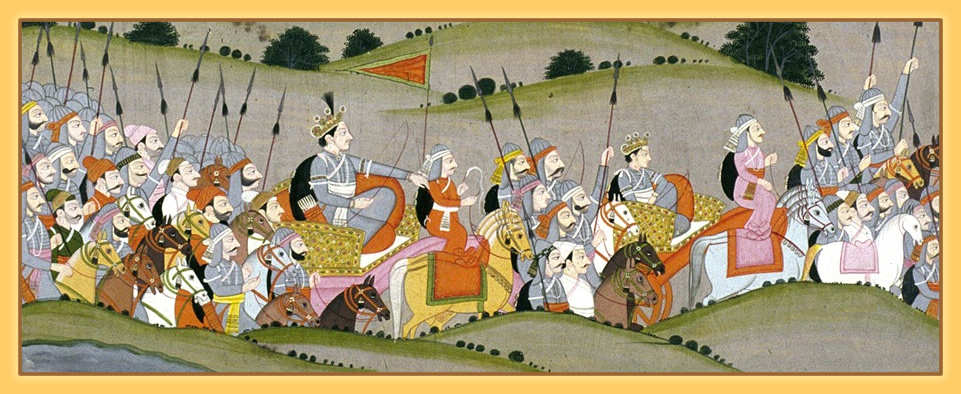
The parade
of Vedic royalty traveling with their retinue is factually
a detail of a picture illustrating the Ramâyana.
It is titled: "Vâlmîki's Narration, Page from the Aranyakanda,
3rd Book of the Ramâyana, Verses 19-34"
Indian, Punjab Hills, Kangra, ca. 1830-1840.
Source: Ackland Museum
of Art.
Production: Filognostic Association of The Order of Time

Feed-back | Links | Downloads | Music | Pictures | What's New | Search | Donations