Canto
2
Chapter 1: The First Step in God Realization
(-) My obeisances unto the Supreme Lord Vâsudeva. (1) S'rî S'uka said: 'This inquiry of yours for the good of all people is the best thing you can do, because this subject of study, oh King, carries the approval of the transcendentalists and constitutes the supreme of all that is worth the attention. (2) Oh Emperor, there are countless subject matters to hear about in human society that are of interest to those who, attached to their household life, are materially engrossed and are blind to the reality of the soul. (3) They spend their lives, oh King, with sleeping and making love during the night, and with making money and taking care of their family during the day. (4) Overly attached to the fallible allies of the body, the children, the wife and everything thereto, they, despite their experience, do not see the finality of these matters. (5) For that reason, oh descendant of Bharata, He must be discussed, glorified and remembered who as the Supersoul, the Supreme Personality, the controller and vanquishing Lord, frees those who are of desire from their anxieties. (6) All this analyzing in the knowledge of yoga of one's particular nature and how a person after being born should attain the full awareness of the Supreme, in the end only concerns the remembrance of Nârâyana [Krishna as the Supreme Personality]. (7) In general it are the sages who, free from the material modes having mastered the prescriptions and restrictions, oh King, take pleasure in especially describing the glories of the Lord.
(8) This story called the Bhâgavatam contains the essence of the Vedas and was by me, at the end of this Dvâpara-yuga [the age of honoring monarchs], studied under the guidance of my father Dvaipâyana Vyâsa. (9) Despite being fully accomplished in transcendence the enlightened verses about the [Lord's] pastimes drew my attention, oh saintly King, and thus I studied them. (10) I will recite it to you, because you, oh goodness, are a most sincere devotee. They who respectfully dedicate their full attention to it very soon will realize an unflinching faith in Mukunda [Krishna as the Lord granting liberation]. (11) For both those who crave free from piously exercising respect and for yoga practitioners who are free from fear and doubts, oh King, the, according to the tradition, repeating of the name of the Lord constitutes the approved method. (12) What is the use of spending one's years as an ignoramus in this world without having [this] experience? The hour one deliberately spends in service of the higher cause is the better one. (13) The saintly king known as Khathvânga cast aside everything when he knew that he had but a moment to live longer in this world and thus experienced the full security of the Lord. (14) Oh member of the Kuru family, therefore also your life's duration that is limited to seven days, should inspire you to perform everything that traditionally belongs to the rituals for a next life. (15) Facing the end of one's life one should be free from the fear of death by cutting, with the help of the weapon of non-attachment, with one's desires and everything material associated with them. (16) In pious self control leaving one's home behind, one should head for a sacred place and properly cleansed in solitude sit down in a position in accordance with the regulations. (17) The mind should then be turned to the three sacred transcendental letters [A-U-M]. Regulating one's breath one thus should get the mind under control so that the primary cause of the absolute Spirit [Brahman] is not forgotten. (18) With the intelligence as the driver, the [horses of the] senses with the help of the mind should be led away from their objects. The mind that is motivated for results should for that purpose consciously be fixed on the auspicious cause [of the Lord]. (19) Not allowing to be distracted by the outside world, one thereafter consecutively focusses one's mind on the different parts of His body. One should thereto not think of anything else but the refuge [constituted by the feet] of the Supreme Lord Vishnu who thus pacifies the mind. (20) Because of the passion and inertia of nature the mind is always agitated and bewildered, but one will get that under control in the concentration of the ones pacified, in the focus that puts an end to all impurity. (21) They who fixed in the habit of such a systematic remembrance seek unification and hold on to this devotion will soon be of success under the shelter of the yoga that approves this.'
(22) The king, attentive to what was said, asked: 'Oh brahmin, what is in summary the idea of the way by which a person may directly put an end to the impurities of his mind?'
(23) S'rî S'uka said: 'When one sits down in control, has subdued one's breath and has conquered one's attachment as also one's senses, one should focus one's attention on the gross matter of the outer appearance of the Supreme Lord [the virâth-rûpa]. (24) His personal body is this gross material world in which we experience all that belongs to the past, the present and the future of the existence of this universe. (25) This outer shell of the universe that we know as a body consisting of seven coverings [see kos'as], constitutes the notion of the object of the Universal Form of the Purusha [the Original Person] who is the Supreme Lord. (26) The lower worlds are by the ones who studied it recognized as the soles of His feet [called Pâtâla] of which His heels and toes are called Rasâtala, His ankles Mahâtala, while the shanks of the gigantic person are called the Talâtala worlds. (27) The two knees of the Universal Form are called Sutala, the thighs Vitala and Atala and the hips are named Mahîtala, oh King. Outer space is accepted as the depression of His navel. (28) The higher, illumined worlds are His chest, with above it the neck called Mahar. His mouth is called Jana while Tapas is the name of the worlds of the forehead with Satyaloka [the world of Truth] as the uppermost of the [middle] worlds of the Original Personality who has a thousand heads. (29) The gods headed by Indra are His arms, the four directions are His ears and sound is His sense of hearing. The nostrils of the Supreme One are the As'vinî-Kumâras [a type of demigods] while fragrance is His sense of smell and His mouth the blazing fire. (30) The sphere of outer space constitutes the pits of His eyes, while the eyeball of the sun makes up His seeing. The eyelids of Vishnu are the day and night, the movements of His eyebrows are the supreme entity [Brahmâ and the other demigods], His palate is the director of water [Varuna] and His tongue is the nectarine juice. (31) They say that the Vedic hymns are the thought process of the Unlimited One, that His jaws make up Yamarâja [the Lord of death], His teeth are His affection and that His smile is the most alluring, unsurpassable material energy [mâyâ]. Material creation is only the casting of His glance. (32) Modesty is His upper lip, His chin stands for the hankering, religion is His breast and the path of irreligion is His back. Brahmâ is His genitals, His testicles are the Mitrâ-varunas [the friends], His waist the oceans and the stack of His bones are the mountains. (33) His veins are the rivers and the plants and trees are the hairs on the body of the Universal Form, oh King. The air is His omnipotent breathing, the passing of the ages, Time, is His movement and the constant operation of the modes of material nature is His activity. (34) Let me tell you that the hairs on the head of the Supreme One are the clouds, oh best of the Kurus, and that the intelligence of the Almighty One is the prime cause of the material creation, so one says. His mind, the reservoir of all changes, is known as the moon. (35) The great principle constitutes His consciousness, so one says, while Lord S'iva is the cause within [His ego, His self]. The horse, mule, camel and elephant are His nails, and all other game and quadrupeds are represented in the region of His belt. (36) The singing of the birds is His artistic sense and Manu, the father of man, forms the contents of His thought with humanity as His residence. The angelic and celestial beings [the Gandharvas, Vidyâdharas and Caranas] constitute His musical rhythm while the remembrance of terrorizing soldiers represents His prowess. (37) With the intellectuals [brahmins] for the face and the rulers [kshatriyas] for the arms of the Universal Form, the traders [vais'yas] are the thighs and the laborers [s'ûdras, the dark or 'krishna'-class] occupy His feet. Through the various names of the demigods He gains in stature with the provision of feasible goods [that appease Him] by means of the performance of sacrifices.
(38) I explained all these locations in the Form of the Supreme Lord to you so that anyone who concentrates his mind on this virâth-rûpa Universal Form can attain his goal by intelligence. Beyond Him after all, there is nothing else to be found in the gross of matter. (39) He who as the Supersoul in so many ways can be seen present in all kinds of forms, just like a dreamer can see himself [in different situations], is the one and only Supreme Truth and ocean of bliss. One must direct oneself to Him alone and nothing else if one does not want to see oneself degraded by attachments.'
Read the inspiration to this chapter by Anand Aadhar.


Third revised edition, loaded May 09, 2023.
Previous Aadhar edition and Vedabase links:
My obeisances unto the Supreme Lord Vâsudeva.
My obeisances unto the Supreme Lord Vâsudeva. (Vedabase)
S'rî S'uka said: 'This inquiry of yours for the good of all people is the best thing you can do, because this subject of study, oh King, carries the approval of the transcendentalists and constitutes the supreme of all that is worth the attention.
S'rî S'uka said: 'This inquiry of yours for the good of all is the best thing you can do, because this subject of study o King, carries the approval of the transcendentalists and constitutes the supreme of all that is worth the attention. (Vedabase)
Oh Emperor, there are countless subject matters to hear about in human society that are of interest to those who, attached to their household life, are materially engrossed and are blind to the reality of the soul.
There are countless of subject matters to hear about in human society, o Emperor, that are the interest of those materially engrossed who are blind to the reality of the soul. (Vedabase)
They spend their lives, oh King, with sleeping and making love during the night, and with making money and taking care of their family during the day.
They spend their lives with sleeping and having sex during the night and with making money and taking care of their family during the day, o King. (Vedabase)
Overly attached to the fallible allies of the body, the children, the wife and everything thereto, they, despite their experience, do not see the finality of these matters.
All too attached to the fallible allies of the body, the children, the wife and everything thereto, do they despite of their experience, not see the finality of these matters. (Vedabase)
For that reason, oh descendant of Bharata, He must be discussed, glorified and remembered who as the Supersoul, the Supreme Personality, the controller and vanquishing Lord, frees those who are of desire from their anxieties.
For this reason, o descendant of Bharata, must He be discussed, glorified and remembered who is the Supersoul, the Supreme Personality, who as the controller and vanquishing Lord frees the ones of desire from their anxieties. (Vedabase)
All this analyzing in the knowledge of yoga of one's particular nature and how a person after being born should attain the full awareness of the Supreme, in the end only concerns the remembrance of Nârâyana [Krishna as the Supreme Personality].
All this analyzing in the knowledge of yoga of one's particular nature and on how a person after being born should attain to the full awareness of the Supreme, in the end only concerns the remembrance of Nârâyana [Krishna as the Supreme Personality]. (Vedabase)
In general it are the sages who, free from the material modes having mastered the prescriptions and restrictions, oh King, take pleasure in especially describing the glories of the Lord.
It are generally those sages who went beyond the sphere of prescriptions and restrictions o King, that are the ones who take pleasure in especially describing the glories of the Lord. (Vedabase)
This story called the Bhâgavatam contains the essence of the Vedas and was by me, at the end of this Dvâpara-yuga [the age of honoring monarchs], studied under the guidance of my father Dvaipâyana Vyâsa.
This story called the Bhâgavatam contains the essence of the Vedas and was by me, at the end of this Dvâpara-yuga [the age of honoring monarchs], studied under the guidance of my father Dvaipâyana Vyâsa. (Vedabase)
Despite being fully accomplished in transcendence the enlightened verses about the [Lord's] pastimes drew my attention, oh saintly King, and thus I studied them.
Fully realized as I was in transcendence was my attention drawn towards the enlightened verses on the [Lord His] pastimes o saintly King, and so I studied the narration. (Vedabase)
I will recite it to you, because you, oh goodness, are a most sincere devotee. They who respectfully dedicate their full attention to it very soon will realize an unflinching faith in Mukunda [Krishna as the Lord granting liberation].
I will recite it to you, because you, o goodness, are a most sincere devotee. They who give full respect and attention will very soon realize an unflinching faith in Mukunda [Krishna as the Lord granting liberation]. (Vedabase)
For both those who crave free from piously exercising respect and for yoga practitioners who are free from fear and doubts, oh King, the, according to the tradition, repeating of the name of the Lord constitutes the approved method.
For as well those who are free from material desires as for those who are desirous as also for all who being free from fear and doubts are united within [the yogis] o King, is the, according the tradition, repeated singing of the Lord His holy name the approved method. (Vedabase)
What is the use of spending one's years as an ignoramus in this world without having [this] experience? The hour one deliberately spends in service of the higher cause is the better one.
What use is it to spend as an ignoramus one's years in this world without having [this] experience? Better is the hour that one deliberatey spends in service of the higher cause. (Vedabase)
The saintly king known as Khathvânga cast aside everything when he knew that he had but a moment to live longer in this world and thus experienced the full security of the Lord.
The saintly king known as Khatvânga, when he knew that he had but a moment to live longer in this world, set aside everything and experienced the full security of the Lord. (Vedabase)
Oh member of the Kuru family, therefore also your life's duration that is limited to seven days, should inspire you to perform everything that traditionally belongs to the rituals for a next life.
O member of the Kuru-family, therefore should also your life's duration that is limited to seven days, inspire you to perform everything that traditionally belongs to the rituals for a next life. (Vedabase)
Facing the end of one's life one should be free from the fear of death by cutting, with the help of the weapon of non-attachment, with one's desires and everything material associated with them.
Seeing the end of one's life one should be free from the fear of death in cutting, by means of the weapon of non-attachment, with all desires, as well as with everybody associated with them. (Vedabase)
In pious self control leaving one's home behind, one should head for a sacred place and properly cleansed in solitude sit down in a position in accordance with the regulations.
Piously self-controlled having left one's home for a sacred place, one should, properly cleansed and purified, seat oneself poised, in solitude according the regulations. (Vedabase)
Text 17
The mind should then be turned to the three sacred transcendental letters [A-U-M]. Regulating one's breath one thus should get the mind under control so that the primary cause of the absolute Spirit [Brahman] is not forgotten.
The mind should be set to the practice of the three transcendental letters [A-U-M], and thus one attains, without forgetting the seed of the absolute [Brahman, the impersonal spirit], to the control of the Supreme by regulating the breath. (Vedabase)
With the intelligence as the driver, the [horses of the] senses with the help of the mind should be led away from their objects. The mind that is motivated for results should for that purpose consciously be fixed on the auspicious cause [of the Lord].
For the sake of the virtue, being fixed in meditation, withdraw the mind from the senses their engagement, for, being absorbed in fruitive labor, the intelligence tends to be driven by the mind. (Vedabase)
Not allowing to be distracted by the outside world, one thereafter consecutively focusses one's mind on the different parts of His body. One should thereto not think of anything else but the refuge [constituted by the feet] of the Supreme Lord Vishnu who thus pacifies the mind.
Concentrating, without losing sight of the complete, the mind thereafter on the different parts and divisions [of the body as also of the logic], one should consequently not think of anything but the feet of that Supreme Vishnu, the reconciler of the mind. (Vedabase)
Because of the passion and inertia of nature the mind is always agitated and bewildered, but one will get that under control in the concentration of the ones pacified, in the focus that puts an end to all impurity.
By the passion and inertia of nature the mind is always agitated and bewildered, but one will find that rectified in the concentration of the pacified that destroys all the wrong done. (Vedabase)
They who fixed in the habit of such a systematic remembrance seek unification and hold on to this devotion will soon be of success under the shelter of the yoga that approves this.'
Being fixed in the habit of such systematic remembrance the mystics holding on to this devotion will soon attain to success in the shelter of the yoga that sees this as all-good. (Vedabase)
The king, attentive to what was said, asked: 'Oh brahmin, what is in summary the idea of the way by which a person may directly put an end to the impurities of his mind?'
The king, attentive to what was said, asked: 'O brahmin, what is in short the idea of where and how a person must engage in or hold on to, to escape without delay from a polluted mind?' (Vedabase)
S'rî S'uka said: 'When one sits down in control, has subdued one's breath and has conquered one's attachment as also one's senses, one should focus one's attention on the gross matter of the outer appearance of the Supreme Lord [the virâth-rûpa].
S'rî S'uka said: 'From the controlled sitting and breathing, one's association to the senses about the gross matter of the Supreme Lord His features, must engage the thinking intelligently. (Vedabase)
His personal body is this gross material world in which we experience all that belongs to the past, the present and the future of the existence of this universe.
His individual body is this gross material world wherein we experience all past, the present and future of this universe its existence. (Vedabase)
This outer shell of the universe that we know as a body consisting of seven coverings [see kos'as], constitutes the notion of the object of the Universal Form of the Purusha [the Original Person] who is the Supreme Lord.
This outer shell of the universe known as a body with seven coverings [fire, water, earth, sky, ego, noumenon and phenomenon, see also kos'as], is the conception of the object of the Universal Form of the purusha as the Supreme Lord. (Vedabase)
The lower worlds are by the ones who studied it recognized as the soles of His feet [called Pâtâla] of which His heels and toes are called Rasâtala, His ankles Mahâtala, while the shanks of the gigantic person are called the Talâtala worlds.
The lower worlds are recognized by the ones who studied it as the soles of His feet [called Pâtâla] to which His heels and toes are called Rasâtala, His ankles Mahâtala while the shanks of the gigantic person are called the Talâtala worlds. (Vedabase)
The two knees of the Universal Form are called Sutala, the thighs Vitala and Atala and the hips are named Mahîtala, oh King. Outer space is accepted as the depression of His navel.
The two knees of the Universal Form are called Sutala, the thighs Vitala and Atala and the hips are named Mahîtala, o King, while outer space is taken to be the depression of His navel. (Vedabase)
The higher, illumined worlds are His chest, with above it the neck called Mahar. His mouth is called Jana while Tapas is the name of the worlds of the forehead with Satyaloka [the world of Truth] as the uppermost of the [middle] worlds of the Original Personality who has a thousand heads.
The higher illumined worlds are of His chest, with above it the neck called Mahar, His mouth called Jana while Tapas is the name of the worlds of the forehead with Satyaloka [the world of Truth] as the uppermost of the [middle] worlds of the Original Personality who has a thousand heads. (Vedabase)
The gods headed by Indra are His arms, the four directions are His ears and sound is His sense of hearing. The nostrils of the Supreme One are the As'vinî-Kumâras [a type of demigods] while fragrance is His sense of smell and His mouth the blazing fire.
The gods headed by Indra are His arms, the four directions are His ears and sound is His sense of hearing. The nostrils of the Supreme are the As'vinî-Kumâras [a type of demigods], while fragrance is His sense of smell and His mouth the blazing fire. (Vedabase)
The sphere of outer space constitutes the pits of His eyes, while the eyeball of the sun makes up His seeing. The eyelids of Vishnu are the day and night, the movements of His eyebrows are the supreme entity [Brahmâ and the other demigods], His palate is the director of water [Varuna] and His tongue is the nectarine juice.
The sphere of outer space are the pits of His eyes, while the eyeball of the sun is making up His seeing. The eyelids of Vishnu are the day and night, the movements of His eyebrows are the supreme entity [Brahmâ and other demigods], His palate is the director of water [Varuna] and His tongue is verily the nectarine juice. (Vedabase)
They say that the Vedic hymns are the thought process of the Unlimited One, that His jaws make up Yamarâja [the Lord of death], His teeth are His affection and that His smile is the most alluring, unsurpassable material energy [mâyâ]. Material creation is only the casting of His glance.
They say that the vedic hymns are the thought process of the Unlimited One, that His jaws make up Yamarâja [the Lord of death], His teeth are His affection and that His smile is the most alluring unsurpassable material energy [mâyâ]; the material creation is but the casting of His glance. (Vedabase)
Modesty is His upper lip, His chin stands for the hankering, religion is His breast and the path of irreligion is His back. Brahmâ is His genitals, His testicles are the Mitrâ-varunas [the friends], His waist the oceans and the stack of His bones are the mountains.
Modesty is His upper lip, His chin for sure the hankering, religion is His breast, and the way of irreligion His back. Brahmâ is His genitals, His testicles are the Mitrâ-varunas [the friends], His waist the oceans and the stack of His bones are the mountains. (Vedabase)
His veins are the rivers and the plants and trees are the hairs on the body of the Universal Form, oh King. The air is His omnipotent breathing, the passing of the ages, Time, is His movement and the constant operation of the modes of material nature is His activity.
His veins are the rivers and the plants and trees are the hairs on the body of the Universal Form, o King. The air is His omnipotent breathing, the passing ages are His movement and the reactions of the modes of material nature are His activities. (Vedabase)
Let me tell you that the hairs on the head of the Supreme One are the clouds, oh best of the Kurus, and that the intelligence of the Almighty One is the prime cause of the material creation, so one says. His mind, the reservoir of all changes, is known as the moon.
Let me tell you that the hairs on the head of the Supreme Controller are the clouds, o best of the Kurus, and that the intelligence of the Almighty is the prime cause of the material creation, so one says. His mind, the reservoir of all changes, is known as the moon. (Vedabase)
The great principle constitutes His consciousness, so one says, while Lord S'iva is the cause within [His ego, His self]. The horse, mule, camel and elephant are His nails, and all other game and quadrupeds are represented in the region of His belt.
The material principle constitutes His consciousness, so one says, while Lord S'iva is the cause within (His ego, His self). The horse, mule, camel and elephant are His nails, and all other game and quadrupeds are represented in the region of His belt. (Vedabase)
The singing of the birds is His artistic sense and Manu, the father of man, forms the contents of His thought with humanity as His residence. The angelic and celestial beings [the Gandharvas, Vidyâdharas and Caranas] constitute His musical rhythm while the remembrance of terrorizing soldiers represents His prowess.
The singing of the birds is His artistic sense and Manu, the father of man forms the contents of His thought with humanity as His residence. The angelic and celestial beings [the Gandharvas, Vidyâdharas and Caranas] constitute His musical rhythm while the remembrance of terrorizing soldiers represents His prowess. (Vedabase)
With the intellectuals [brahmins] for the face and the rulers [kshatriyas] for the arms of the Universal Form, the traders [vais'yas] are the thighs and the laborers [s'ûdras, the dark or 'krishna'-class] occupy His feet. Through the various names of the demigods He gains in stature with the provision of feasible goods [that appease Him] by means of the performance of sacrifices.
With the intellectuals [brahmins] for the face and the rulers [kshatriyas] for the grip of the Universal Form, are the traders [vais'yas] the thighs and the laborers [s'ûdras, the dark or 'krishna'-class] those who are protected by His feet. Through the various names of the demigods He overtakes with the provision of feasible goods [that appease Him] through the performance of sacrifices. (Vedabase)
I explained all these locations in the Form of the Supreme Lord to you so that anyone who concentrates his mind on this virâth-rûpa Universal Form can attain his goal by intelligence. Beyond Him after all, there is nothing else to be found in the gross of matter.
I explained all these locations in the Form of the Supreme Lord to you so that anyone who may concentrate the mind on this virâth-rûpa Universal Form can attain through intelligence, as beyond Him as such there is nothing else to be found in the gross of matter. (Vedabase)
He who as the Supersoul in so many ways can be seen present in all kinds of forms, just like a dreamer can see himself [in different situations], is the one and only Supreme Truth and ocean of bliss. One must direct oneself to Him alone and nothing else if one does not want to see oneself degraded by attachments.'
He who from all realization knows everyone as the Supersoul as much as a dreamer sees it, is the one and only Supreme Truth and ocean of bliss. Towards Him one should never worship anything else or else see oneself degraded by attachments.' (Vedabase)

The text and audio are offered
under the conditions of the
Creative Commons Attribution-Noncommercial-Share Alike
3.0
Unported License.
The
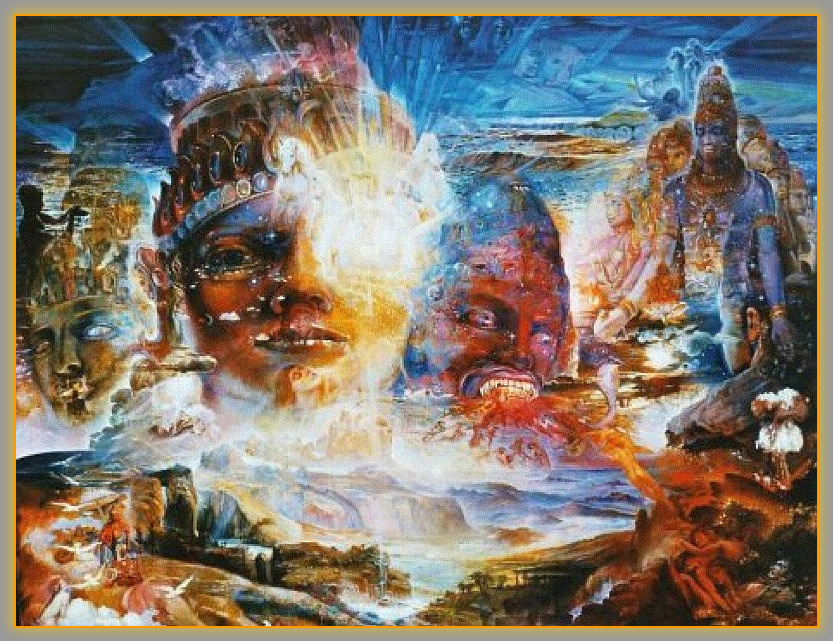
painting of the universal form is © of Johannes
Ptok.
Production: Filognostic
Association
of The
Order of Time

Feed-back | Links | Downloads | Music | Pictures | What's New | Search | Donations