
Canto 10
Canto 10
Chapter 45: Krishna Rescues His Teacher's Son
(1) S'rî S'uka said: 'Knowing that His parents had arrived at the notion that He would be the Supreme Personality, He said to Himself: 'This should not be so'. And thus He expanded His personal illusory potency [His yogamâyâ] that bewilders the people. (2) Approaching them together with His elder brother, He, the Greatest Devotee of All [the Sâtvatas], with humility bowed down to His parents in order to satisfy them and respectfully said: 'Dear father and mother! (3) Oh father, because of Us you were always afraid and could never enjoy anything of the toddler age, the boyhood and youth of your two sons [*]. (4) As ordained by fate We, being deprived of living in your presence, could not experience the cherished happiness of children living at home with their parents. (5) A mortal man is never, not even for a lifespan of a hundred years, capable of repaying the debt to his parents. He took his birth from them and by them he is maintained. They are the source of the body suitable for all goals of life [all purushârthas, compare 10.32: 22]. (6) A son who, even though capable, with his resources and wealth does not provide for their sustenance, will after his death be forced to eat his own flesh [see also 5.26]. (7) When one is capable of, but not maintains one's mother and father, the elderly, one's chaste wife, one's very young child, one's spiritual master, a [depending] brahmin or anyone seeking one's protection, one is a person who is dead even though he breathes [see B.G. 11: 33]. (8) Because of Kamsa who always disturbed Our minds, We could not honor you and have spent Our days [of youth] without being of any consequence to you. (9) Please, oh father and mother, forgive Us the fact that We, controlled by others, from Our part could not serve you and that the hardhearted one [Kamsa] thus could cause such great pain.'
(10) S'rî S'uka said: 'Thus bewildered by the words of Him, the Lord and Soul of the Universe who through His mâyâ appeared as a human being, they raised Them upon their laps to experience the joy of closing Them in their arms. (11) Bound by the rope of affection crying a river they, with their throats full of tears being overwhelmed, could not say a word, oh King. (12) The Supreme Lord, the son of Devakî, who thus comforted His parents, then made His maternal grandfather Ugrasena, King over the Yadus. (13) He told him: 'Please, oh great King, with Us as your subjects, take command, for because of the curse of Yayâti [see 9.18: 42] one, being born as a Yadu, should not sit on the throne. (14) When I am there as a servant to attend to you, the demigods and such will bow down before you to offer you tribute. Then what may be expected from the other rulers of men?'
(15-16) All His close relatives and other relations, the Yadus, Vrishnis, Andhakas, Madhus, Dâs'ârhas, Kukuras and other clans, who, disturbed in their fear of Kamsa, had fled in all directions, were honored and consoled, for living in foreign regions had made them weary. He, the Maker of the Universe, brought them back to their homes and satisfied them with valuable gifts. (17-18) Protected by the arms of Krishna and Sankarshana they in their homes enjoyed the complete fulfillment of their desires because, now that they day after day saw the loving, always cheerful, beautiful lotus face and merciful, smiling glances of Mukunda, with Krishna and Balarâma the fever [of a material existence] had ended. (19) Even the elderly were youthful and full of strength and vitality, now that they, there [in Mathurâ], time and again through their eyes could imbibe the nectar of Mukunda's lotus face. (20) Thereupon the Supreme Lord, the son of Devakî, and Sankarshana approached Nanda, oh great King. They, embracing him, said: (21) 'Oh father, with the great affection and fondling of you both, you have cherished Us greatly. The love the parents have for their children is truly greater than the love they have for each other. (22) They are father and mother who nourish, like they were their own sons, the children who were abandoned by relatives unable to maintain and protect them. (23) Please return all together to Vraja, dear father, We will come to see you, relatives frustrated in your love, after We have made Our friends [out here] happy.' (24) The Supreme Lord, the Infallible One, thus appeasing Nanda and the people from Vraja, thereupon respectfully honored them with clothing, jewelry and pots and such.
(25) Thus being addressed, Nanda engulfed by affection, embraced Them with tears filling his eyes, and went together with the gopas to Vraja. (26) The son of S'ûrasena [Vasudeva], oh King, then arranged for a priest and brahmins to properly perform the second-birth initiation of his sons. (27) For their remuneration he donated in worship fully decorated cows with golden chains and ornaments, complete with calves and linen wreaths. (28) Magnanimously he gave them in charity the cows that were stolen away by Kamsa, the same cows he previously had donated within his mind the very day Krishna and Râma were born [see 3.10: 11-12]. (29) After having been initiated into the twice-born status, They, of proper vows, took the vow of celibacy [to be a student] from Garga, the preceptor of the Yadus [see also gâyatrî and brahmacârya]. (30-31) The Lords of the Universe who are the source of any form of knowledge, concealed in Their human activities the perfection of Their omniscience not founded on any knowledge from the outside. They [nevertheless] then desired to reside in the school of the guru and approached Sândîpani, a native of Kâsî [Benares], who dwelt in the city of Avantî [Ujjain]. (32) Thus obtaining [the company of] these self-controlled souls, he was by Them respected as if he was the Lord Himself. Doing this They in Their devotion formed an irreproachable example of service to the teacher. (33) That best of the twice-born souls as Their guru, taught Them, contented as he was with Their pure love and submissive acts, all the Vedas with their corollary literatures and philosophical treatises [Upanishads], [**] (34) the Dhanur-veda [military science, archery] along with all its secrets [the mantras], the dharma [the codes of human conduct, the laws] and the nyâya [the methods of logic] as also the ânvîkshikîm [the knowledge of philosophical debate or tarka] and the six aspects of the râja-nîtim [political science, see ***]. (35-36) As the best of all first class persons and as the promulgators of all knowledge They, oh ruler of man, fixed in concentration, fully assimilated with simply having heard it only once, the complete of the sixty-four arts in as many days and nights [*4], and satisfied Their preceptor, oh King, by offering him compensation [gurudakshinâ]. (37) Oh King, in consideration of the amazing greatness of Their superhuman intelligence, the brahmin, after consulting with his wife, arrived at the wish to see his child again that had perished in the ocean at Prabhâsa [see also 1.15: 49, 3.1: 20, 3.3: 25]. (38) 'So be it' the two great warlords of unlimited prowess said and next mounted a chariot to head for Prabhâsa. Having arrived there, they walked up to the shore to sit there for a moment. The [god of the] ocean recognized Them and offered Them tribute [compare 9.3: 13]. (39) The Supreme Lord said to him: 'Present Us at once the son of Our guru, a young boy you have seized here with a mighty wave.'
(40) The person of the ocean said: 'It was not I who took him away, oh Lord, it was a powerful Daitya named Pañcajana, oh Krishna, a demon who moves through the water in the form of a conch. (41) He, who lives here, indeed has kidnapped him.' Hearing that, the Master quickly entered the water and killed him, but He could not find the boy in his belly. (42-44) He took the conch shell, which had grown as a part of the demon, returned to the chariot and went to the beloved city of Yamarâja [the lord of death] known as Samyamanî [*5]. [Arriving there,] Janârdana, together with the Lord who has a plow for His weapon [Balarâma], blew loudly on His conch shell [see also B.G. 1: 15] so that Yamarâja, he who restrains the living beings, could hear the sound. Overflowing with devotion Yamarâja worshiped Them elaborately and humbly bowing down said to Krishna, who dwells in the heart of each: 'What can I do for the two of You, oh Vishnu who, for Your pastime, has appeared in the form of [two] human beings?'
(45) The Supreme Lord said: 'Please bring Me the son of My guru who was brought here because of his karmic bondage, oh great King. It is My command that should be given priority.'
(46) 'So be it', he said, and brought forward the preceptor's son. The Best of the Yadus gave him back to Their guru to whom They then said: 'Please make another wish.'
(47) The honorable guru said: 'My dear Boys, I am completely fulfilled by the remuneration for the guru the two of You have offered. What more could a spiritual master wish from Persons like You? (48) Please go home, oh heroes, may Your fame purify [the entire world] and may the mantras [Your appearance and delight] ever be fresh in this life and in the next [see also 10.13: 2]!'
(49) Thus by Their guru permitted to leave, They reached Their city on Their chariot, that was as fast as the wind and thundered like a cloud. (50) The citizens who had not seen Balarâma and Janârdana for many days, all rejoiced to see Them again, like having regained a lost treasure.'


Third revised edition, loaded February 24, 2021.
Previous Aadhar edition and Vedabase links:
S'rî S'uka said: 'Knowing that His parents had arrived at the notion that He would be the Supreme Personality, He said to Himself: 'This should not be so'. And thus He expanded His personal illusory potency [His yogamâyâ] that bewilders the people.S'rî S'uka said: 'With His parents arriving at the idea that He would be the Supreme Personality said He to Himself: 'This should not be so', and thus expanded He the personal illusory potency [of His yogamâyâ] which bewilders the people. (Vedabase)
Approaching them together with His elder brother, He, the Greatest Devotee of All [the Sâtvatas], with humility bowed down to His parents in order to satisfy them and respectfully said: 'Dear father and mother!
Approaching them together with His elder brother, the Greatest of the Veritable [the Sâtvatas], said He, to gratify them, with humility bowing down to His parents respectfully: 'Dear father and mother! (Vedabase)
Oh father, because of Us you were always afraid and could never enjoy anything of the toddler age, the boyhood and youth of your two sons [*].
There has, o father [and mother] who because of us were always in anxiety, indeed for the two of you never been anything of the toddler-age, the boyhood and youth of your two sons [see *]. (Vedabase)
As ordained by fate We, being deprived of living in your presence, could not experience the cherished happiness of children living at home with their parents.
As ordained by fate could We, deprived of residing in your presence, not experience the pampered happiness of children living at home with their parents. (Vedabase)
A mortal man is never, not even for a lifespan of a hundred years, capable of repaying the debt to his parents. He took his birth from them and by them he is maintained. They are the source of the body suitable for all goals of life [all purushârthas, compare 10.32: 22].
To the parents from whom one is born and by whom one is maintained, is a mortal person never, not for a lifespan of hundred years, able to repay the debt, for they are the source of the body that is there for all goals of life [purushârthas, compare 10.32: 22]. (Vedabase)
A son who, even though capable, with his resources and wealth does not provide for their sustenance, will after his death be forced to eat his own flesh [see also 5.26].
A son who, of them capable, with his resources and wealth does not provide for their sustenance, will after death be made to eat his own flesh [see also 5.26]. (Vedabase)
When one is capable of, but not maintains one's mother and father, the elderly, one's chaste wife, one's very young child, one's spiritual master, a [depending] brahmin or anyone seeking one's protection, one is a person who is dead even though he breathes [see B.G. 11: 33].
Being capable of but not maintaining one's mother and father, the elderly, one's chaste wife, one's very young child, the spiritual master and the learned one seeking shelter, is one dead even though one breathes [see B.G. 11: 33]. (Vedabase)
Because of Kamsa who always disturbed Our minds, We could not honor you and have spent Our days [of youth] without being of any consequence to you.
Therefore were the two of Us, because of Kamsa who was always disturbing, with a mind motivated for counteraction unable to honor you and have We spent these days [of youth] without having been of any use to you. (Vedabase)
Please, oh father and mother, forgive Us the fact that We, controlled by others, from Our part could not serve you and that the hardhearted one [Kamsa] thus could cause such great pain.'
Please forgive Us the fact that, o father and mother, under the control of others from Our part not being at your service, the hardhearted one [Kamsa] caused such a great pain.' (Vedabase)
S'rî S'uka said: 'Thus bewildered by the words of Him, the Lord and Soul of the Universe who through His mâyâ appeared as a human being, they raised Them upon their laps to experience the joy of closing Them in their arms.
S'rî S'uka said: 'Thus bewildered by the deluding power of Him, the Lord and Soul of the Universe appearing as a human being, raised they Them upon their laps to experience the joy of closing Them in their arms. (Vedabase)
Bound by the rope of affection crying a river they, with their throats full of tears being overwhelmed, could not say a word, oh King.
Bound by the rope of affection crying a river couldn't they say a thing, o King, being overwhelmed with their throats full of tears. (Vedabase)
The Supreme Lord, the son of Devakî, who thus comforted His parents, then made His maternal grandfather Ugrasena, King over the Yadus.
The Supreme Lord, the son of Devakî, thus consoled His parents and made His maternal grandfather Ugrasena, King over the Yadus. (Vedabase)
He told him: 'Please, oh great King, with Us as your subjects, take command, for because of the curse of Yayâti [see 9.18: 42] one, being born as a Yadu, should not sit on the throne.
He then told him: 'With Us, o great King, as your subjects please take command, since one because of the curse of Yayâti [see 9.18: 42] being born as a Yadu should not sit on the throne. (Vedabase)
When I am there as a servant to attend to you, the demigods and such will bow down before you to offer you tribute. Then what may be expected from the other rulers of men?'
When I am present attending to you as a servant, will the demigods and all belonging to them bow down to offer you tribute; and what then to say of other rulers of men?' (Vedabase)
All His close relatives and other relations, the Yadus, Vrishnis, Andhakas, Madhus, Dâs'ârhas, Kukuras and other clans, who, disturbed in their fear of Kamsa, had fled in all directions, were honored and consoled, for living in foreign regions had made them weary. He, the Maker of the Universe, brought them back to their homes and satisfied them with valuable gifts.
All His close relatives and other relations, the Yadus, Vrishnis, Andhakas, Madhus, Dâs'ârhas, Kukuras and other clans, who disturbed in fear of Kamsa had fled in all directions, were honored and consoled, for living in foreign regions had made them weary. He, the Maker of the Universe, arranged for their homes and gratified them with valuable gifts. (Vedabase)
Protected by the arms of Krishna and Sankarshana they in their homes enjoyed the complete fulfillment of their desires because, now that they day after day saw the loving, always cheerful, beautiful lotus face and merciful, smiling glances of Mukunda, with Krishna and Balarâma the fever [of a material existence] had ended.
Protected by the arms of Krishna and Sankarshana enjoyed they in their homes perfectly the fulfillment of their desires as because of Krishna and Râma the fever [of a material life] had ceased, now that they day by day saw the loving, always cheerful, beautiful lotuslike face of Mukunda with the merciful, smiling glances. (Vedabase)
Even the elderly were youthful and full of strength and vitality, now that they, there [in Mathurâ], time and again through their eyes could imbibe the nectar of Mukunda's lotus face.
Even the eldest were youthful and full of strength and vitality, there [in Mathurâ] drinking in with their eyes repeatedly the nectar of Mukunda's lotus face. (Vedabase)
Thereupon the Supreme Lord, the son of Devakî, and Sankarshana approached Nanda, oh great King. They, embracing him, said:
Next, o great King, were the Supreme Lord, the son of Devakî, and Sankarshana approached by Nanda and this is what They, embracing him, said: (Vedabase)
'Oh father, with the great affection and fondling of you both, you have cherished Us greatly. The love the parents have for their children is truly greater than the love they have for each other.
'O father, by the great affection and the fondling of the two of you, have you cared for Us in a great way, truely is for parents the love for their children greater even than the love they have for themselves. (Vedabase)
They are father and mother who nourish, like they were their own sons, the children who were abandoned by relatives unable to maintain and protect them.
Those persons are father and mother who nourish as their own children the sons who were abandoned by their own family not capable of maintaining and protecting them. (Vedabase)
Please return all together to Vraja, dear father, We will come to see you, relatives frustrated in your love, after We have made Our friends [out here] happy.'
Please, all of you, go to Vraja dear father, We [represented by ...] will visit you and your kin aching of love, after We've made our friends here happy.' (Vedabase)
The Supreme Lord, the Infallible One, thus appeasing Nanda and the people from Vraja, thereupon respectfully honored them with clothing, jewelry and pots and such.
Acyuta thus appeasing Nanda and the folk of Vraja, then respectfully honored them with clothing, jewelry and pots and such. (Vedabase)
Thus being addressed, Nanda engulfed by affection, embraced Them with tears filling his eyes, and went together with the gopas to Vraja.
Thus addressed by the two of Them embraced Nanda Them, engulfed by affection, with tears filling his eyes and went he with the gopas to Vraja. (Vedabase)
The son of S'ûrasena [Vasudeva], oh King, then arranged for a priest and brahmins to properly perform the second-birth initiation of his sons.
Then had the son of S'ûrasena [Vasudeva], o King, by a priest and brahmins for his sons the second-birth initiation properly performed. (Vedabase)
For their remuneration he donated in worship fully decorated cows with golden chains and ornaments, complete with calves and linen wreaths.
He donated to them in worship, for remuneration fully decorated cows with golden chains and ornaments complete with calves and garlands of flowers of flax. (Vedabase)
Magnanimously he gave them in charity the cows that were stolen away by Kamsa, the same cows he previously had donated within his mind the very day Krishna and Râma were born [see 3.10: 11-12].
He, magnanimous, gave them in charity the cows that were stolen away by Kamsa, the same cows he previously had donated within his mind on the day that Krishna and Râma were born [see 3.10: 11-12]. (Vedabase)
After having been initiated into the twice-born status, They, of proper vows, took the vow of celibacy [to be a student] from Garga, the preceptor of the Yadus [see also gâyatrî and brahmacârya].
After by initiation having attained the twice-born status, took They, sincere in Their vows from Garga, the preceptor of the Yadus, the vow of celibacy [to be a student, see also gâyatrî and brahmacârya]. (Vedabase)
The Lords of the Universe who are the source of any form of knowledge, concealed in Their human activities the perfection of Their omniscience not founded on any knowledge from the outside. They [nevertheless] then desired to reside in the school of the guru and approached Sândîpani, a native of Kâsî [Benares], who dwelt in the city of Avantî [Ujjain].
As the Lords of the Universe of all being the origin and in knowledge being omniscient did They, by their humanlike activities concealing the impeccable knowledge that was achieved from no other source, then desire to live at the school of the guru native to Kâsî [Benares] named Sândîpani who dwelt in the city of Avantî [Ujjain]. (Vedabase)
Thus obtaining [the company of] these self-controlled souls, he was by Them respected as if he was the Lord Himself. Doing this They in Their devotion formed an irreproachable example of service to the teacher.
The spiritual teacher who in that circumstance was allowed to receive Them in self-restraint, was by Them, who approached him for his service as if he was the Lord, that way with Their devotion used to set an irreproachable example for others. (Vedabase)
That best of the twice-born souls as Their guru, taught Them, contented as he was with Their pure love and submissive acts, all the Vedas with their corollary literatures and philosophical treatises [Upanishads], [**]
That best one of the twiceborn, satisfied as he was with Their pure love and submissive acts, taught as Their guru Them all the Vedas with their corollary literatures and philosophical treatises, [**] (Vedabase)
the Dhanur-veda [military science, archery] along with all its secrets [the mantras], the dharma [the codes of human conduct, the laws] and the nyâya [the methods of logic] as also the ânvîkshikîm [the knowledge of philosophical debate or tarka] and the six aspects of the râja-nîtim [political science, see ***].
the Dhanur-veda [military science, archery] along with all its secrets [the mantras], the dharma [codes of human conduct, the laws] and the nyâya [the methods of logic] as also ânvîkshikîm [the knowledge of philosophical debate or tarka] and the six aspects of râja-nîtim [political science, see ***]. (Vedabase)
As the best of all first class persons and as the promulgators of all knowledge They oh ruler of man, fixed in concentration, fully assimilated with simply having heard it only once, the complete of the sixty-four arts in as many days and nights [*4], and satisfied Their preceptor, oh King, by offering him compensation [gurudakshinâ].
As the best of all first class persons and of all knowledge being the promulgators did They, o ruler of man, fixed in concentration fully assimilate with simply having it heard once, the complete of the sixty-four arts in as many days and nights [*4] and offered They being satisfied their preceptor, o King, compensation [gurudakshinâ]. (Vedabase)
Oh King, in consideration of the amazing greatness of Their superhuman intelligence, the brahmin, after consulting with his wife, arrived at the wish to see his child again that had perished in the ocean at Prabhâsa [see also 1.15: 49, 3.1: 20, 3.3: 25].
The twiceborn man, in due consideration of that amazing greatness of Their superhuman intelligence, o King, after consulting with his wife, arrived at the wish to see his child back that had perished in the ocean at Prabhâsa [see also 1.15: 49, 3.1: 20, 3.3: 25]. (Vedabase)
'So be it' the two great warlords of unlimited prowess said and next mounted a chariot to head for Prabhâsa. Having arrived there, they walked up to the shore to sit there for a moment. The [god of the] ocean recognized Them and offered Them tribute [compare 9.3: 13].
Saying 'So be it' mounted the two great charioteers of unlimited prowess then a chariot and walked they, reaching there, up to the shore to sit down for a moment, upon which the ocean in recognition brought Them offerings of tribute [compare 9.10: 13]. (Vedabase)
The Supreme Lord said to him: 'Present Us at once the son of Our guru, a young boy you have seized here with a mighty wave.'
To him said the Supreme Lord: 'At once present Us the son of Our guru, a young boy whom by you with a mighty wave has been seized here.' (Vedabase)
The person of the ocean said: 'It was not I who took him away, oh Lord, it was a powerful Daitya named Pañcajana, oh Krishna, a demon who moves through the water in the form of a conch.
The person of the ocean said: 'It was not I who took him away, o Lord, it was a powerful Daitya named Pañcajana, o Krishna, a demon who roams in the water assuming the form of a conch. (Vedabase)
He, who lives here, indeed has kidnapped him.' Hearing that, the Master quickly entered the water and killed him, but He could not find the boy in his belly.
By him living here has he indeed been taken away'.Hearing that hurried the Master into the water and killed He him, but the boy He couldn't find in his belly. (Vedabase)
He took the conch shell, which had grown as a part of the demon, returned to the chariot and went to the beloved city of Yamarâja [the lord of death] known as Samyamanî [*5]. [Arriving there,] Janârdana together with the Lord, who has a plow for His weapon [Balarâma], blew loudly on His conch shell [see also B.G. 1: 15] so that Yamarâja, he who restrains the living beings, could hear the sound. Overflowing with devotion Yamarâja worshiped Them elaborately and humbly bowing down said to Krishna, who dwells in the heart of each: 'What can I do for the two of You, oh Vishnu who, for Your pastime, has appeared in the form of [two] human beings?'
Taking the conchshell, that had grown as a part of the demon, returned He to the chariot and left He for the beloved city of Yamarâja [the Lord of death] known as Samyamanî [*5]. On His way being accompanied by Him who has the Plow for His Weapon [Balarâma], blew Janârdana loudly on the conchshell [see also B.G. 1: 15] of which the sound was heard by Yamarâja, the restrainer of the ones born. Overflowing with devotion performed he elaborate worship for Them and said he humbly, bowing down to Krishna who dwells in each his heart: 'What can I do for the two of You, o Vishnu, who appeared as human beings?' (Vedabase)
The Supreme Lord said: 'Please bring Me the son of My guru who was brought here because of his karmic bondage oh great King. It is My command that should be given priority.'
The Supreme Lord said: 'Please bring the son of My guru taken from here to suffer the bondage of his karma o great King, it is My command that should be given priority.' (Vedabase)
'So be it', he said, and brought forward the preceptor's son. The Best of the Yadus gave him back to Their guru to whom They then said: 'Please make another wish.'
'Let it be so' he said and brought forth the preceptor's son. The Best of the Yadus then gave him back to Their guru whom They so said: 'Please make another wish'. (Vedabase)
The honorable guru said: 'My dear Boys, I am completely fulfilled by the remuneration for the guru the two of You have offered. What more could a spiritual master wish from Persons like You?
The honorable guru said: 'I am completely fulfilled, my Boys, by the remuneration for the guru of the two of You; what else would there for the spiritual master of Persons like You be left to desire? (Vedabase)
Please go home oh heroes, may Your fame purify [the entire world] and may the mantras [Your appearance and delight] ever be fresh in this life and in the next [see also 10.13: 2]!'
Please go to Your home, o heroes, may Your fame purify and may the words of Your delight [the mantras, the vedic hymns] be ever fresh ['never die away' or 'never be forgotten'] in this life and in the next!' [see also: 10.13: 2] (Vedabase)
Thus by Their guru permitted to leave, They reached Their city on Their chariot, that was as fast as the wind and thundered like a cloud.
Thus by Their guru permitted to leave, reached They on Their chariot fast as the wind and thundering like a cloud Their city. (Vedabase)
The citizens who had not seen Balarâma and Janârdana for many days, all rejoiced to see Them again, like having regained a lost treasure.'
The citizens seeing Râma and Janârdana, not having seen Them for many days, all rejoiced like people who having lost their wealth had regained it.' (Vedabase)*: S'rîla Vis'vanâtha Cakravartî points out: 'The kaumâra stage lasts until the age of five, pauganda up to age ten and kais'ora to age fifteen. From then on, one is known as yauvana.' According to this statement, the kais'ora period ends at the age of fifteen. Krishna was only eleven years old when He killed Kamsa, according to Uddhava's words: ekâdas'a-samâs tatra gûdhârcih sa-balo 'vasat. 'Like a covered flame, Lord Krishna remained there incognito with Balarâma for eleven years' (S.B. 3.2: 26). The three years and four months that Lord Krishna stayed in Mahâvana were the equivalent of five years for an ordinary child, and thus in that period He completed His kaumâra stage of childhood. The period from then to the age of six years and eight months, during which He lived in Vrindâvana, constitutes His pauganda stage. And the period from the age of six years and eight months through His tenth year, during which time He lived in Nandîs'vara [Nandagrâma], constitutes His kais'ora stage. Then, at the age of ten years and seven months, on the eleventh lunar day of the dark fortnight of the month of Caitra, He went to Mathurâ, and on the fourteenth day thereafter He killed Kamsa. Thus He completed His kais'ora period at age ten, and He eternally remains at that age. In other words, we should understand that from this point on the Lord remains forever a kis'ora.'
**: These are the so-called angas and Upanishads. The six angas are: s'iks'a (phonetics), chanda, (prosody), vyâkarana (grammar), jyotisha (astronomy), kalpa (content and rules for the rituals) and nirukta (etymology).
***: The six aspects of political science are: (1) sandhi, making peace; (2) vigraha, war; (3) yâna, marching or expedition; (4) âsana, sitting tight or encampment; (5) dvaidha, dividing one's forces or separating one's allies; and (6) sams'aya, depending on allies or seeking the protection of a more powerful ruler.
*4: The Lords learned: (1) gîtam, singing; (2) vâdyam, playing on musical instruments; (3) nrityam, dancing; (4) nâthyam, drama; (5) âlekhyam, painting; (6) vis'eshaka-cchedyam, painting the face and body with colored unguents and cosmetics; (7) tandula-kusuma-bali-vikârâh, preparing auspicious designs on the floor with rice and flowers; (8) pushpâstaranam, making a bed of flowers; (9) das'ana-vasanânga-râgâh, coloring one's teeth, clothes and limbs; (10) mani-bhûmikâ-karma, inlaying a floor with jewels; (11) s'ayyâ-racanam, covering a bed; (12) udaka-vâdyam, ringing waterpots; (13) udaka-ghâtah, splashing with water; (14) citra-yogâh, mixing colors; (15) mâlya-grathana-vikalpâh, preparing wreaths; (16) s'ekharâpîda-yojanam, setting a helmet on the head; (17) nepathya-yogâh, putting on apparel in a dressing room; (18) karna-patra-bhangâh, decorating the earlobe; (19) sugandha-yuktih, applying aromatics; (20) bhûshana-yojanam, decorating with jewelry; (21) aindrajâlam, jugglery; (22) kaucumâra-yogah, the art of disguise; (23) hasta-lâghavam, sleight of hand; (24) citra-s'âkâpûpa-bhakshya- vikâra-kriyah, preparing varieties of salad, bread, cake and other delicious food; (25) pânaka-rasa-râgâsava-yojanam, preparing palatable drinks and tinging draughts with red color; (26) sûcî-vâya-karma, needlework and weaving; (27) sûtra-krîdâ, making puppets dance by manipulating thin threads; (28) vînâ-damarukavâdyâni, playing on a lute and a small X-shaped drum; (29) prahelikâ, making and solving riddles; (29a) pratimâlâ, capping verses, or reciting poems verse for verse as a trial of memory or skill; (30) durvacaka-yogâh, uttering statements difficult for others to answer; (31) pustaka-vâcanam, reciting books; and (32) nâthikâkhyâyikâ-dars'anam, enacting short plays and writing anecdotes.(33) kâvya-samasyâ-pûranam, solving enigmatic verses; (34) paththikâ-vetra-bâna-vikalpâh, making a bow from a strip of cloth and a stick; (35) tarku-karma, spinning with a spindle; (36) takshanam, carpentry; (37) vâstu-vidyâ, architecture; (38) raupya-ratna- parîkshâ, testing silver and jewels; (39) dhâtu-vâdah, metallurgy; (40) mani- raga-jñânam, tinging jewels with various colors; (41) âkara-jñânam, mineralogy; (42) vrikshâyur-veda-yogâh, herbal medicine; (43) mesha-kukkutha- lâvaka-yuddha-vidhih, the art of training and engaging rams, cocks and quails in fighting; (44) s'uka-s'ârikâ-pralâpanam, knowledge of how to train male and female parrots to speak and to answer the questions of human beings; (45) utsâdanam, healing a person with ointments; (46) kes'a-mârjana- kaus'alam, hairdressing; (47) akshara-mushthikâ-kathanam, telling what is written in a book without seeing it, and telling what is hidden in another's fist; (48) mlecchita-kutarka-vikalpâh, fabricating barbarous or foreign sophistry; (49) des'a-bhâshâ-jñânam, knowledge of provincial dialects; (50) pushpa-s'akathikâ-nirmiti-jñânam, knowledge of how to build toy carts with flowers; (51) yantra-mâtrikâ, composing magic squares, arrangements of numbers adding up to the same total in all directions; (52) dhârana-mâtrikâ, the use of amulets; (53) samvâcyam, conversation; (54) mânasî-kâvya-kriyâ, composing verses mentally; (55) kriyâ-vikalpâh, designing a literary work or a medical remedy; (56) chalitaka-yogâh, building shrines; (57) abhidhâna-kosha-cchando-jñânam, lexicography and the knowledge of poetic meters; (58) vastra-gopanam, disguising one kind of cloth to look like another; (59) dyûta-vis'esham, knowledge of various forms of gambling; (so) âkarsha-krîda, playing dice; (61) bâlaka-krîdanakam, playing with children's toys; (62) vainâyikî vidyâ, enforcing discipline by mystic power; (63) vaijayikî vidyâ, gaining victory; and (64) vaitâlikî vidyâ, awakening one's master with music at dawn. [see also Krishna book chapter 45].
*5: Samyama means self-control, restraint, holding together, the integration of concentration [dhâranâ], meditation [dhyâna], and absorption [samâdhi] in yoga.

The text and audio are offered under the conditions of
the
Creative
Commons Attribution-Noncommercial-Share Alike 3.0 Unported
License.
The first
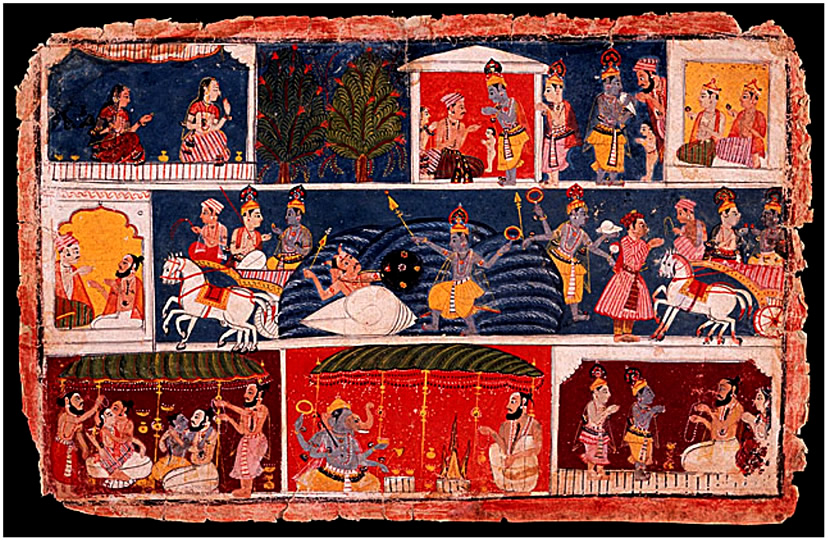
painting on this page of Krishna, Balarama and Their parents is
of Raja
Ravi
Varma.
The second picture is titled: " Krishna Receives the Sacred
Thread and Returns his Preceptor Sandipani's Son",
India, Madhya Pradesh, Malwa, South Asia, folio from a Bhagavata
Purana (Ancient Stories of the Lord), circa 1640. Courtesy
LACMA.
Production: Filognostic
Association of The Order of Time.

Feed-back | Links | Downloads | Music | Pictures | What's New | Search | Donations



 Text 1