

Canto 1
Chapter 15: The Pândavas Retire
(1) Sûta said: "Arjuna, the friend of Krishna, who was emaciated because of his separation from Krishna, thus was subjected to the various forms of doubt and speculation of his elder brother the king. (2) Because of his grief his mouth and lotus heart had dried up and his bodily luster had vanished. Preoccupied with thoughts about the Lord he was incapable of replying properly. (3) The more he wiped the tears from his eyes and with great difficulty checked the force of his sadness not seeing Him anymore, the more he eagerly thought about Him in his affection and the more distressed he became. (4) Remembering Him as a well-wisher, benefactor, friend and charioteer, Arjuna, overwhelmed and heavily breathing, addressed his eldest brother the king.(5) He said: 'Oh great King, Lord Hari in the form of my friend, has left me. Now I am bereft of the amazing power that even astonished the gods. (6) I lost Him from whom being separated but for a moment all universes would appear unfavorable and void of all life, like they are all dead. (7) By the strength of His mercy I could vanquish the power of all the lusty princes during the selection of the bridegroom at King Drupada's palace where I gained Draupadî's hand by piercing the fish-target with my bow. (8) With Him at my side I was able to defeat Indra and his godly associates and could thus enable the god of fire to set ablaze his forest. With His support we could realize our wonderfully built assembly house that was designed by Maya [out of gratitude for saving him from that fire in the forest named Khândava] where all the princes assembled to your honor bringing presents collected from all directions. (9) Under His influence our younger brother [Bhîma], who has the strength of a thousand elephants, managed to kill him [Jarâsandha] whose feet were worshiped by the heads of many kings he wanted to sacrifice. It was He who saved the kings who by Jarâsandha had been brought [to his capital] to be sacrificed to the lord of the ghosts [Mahâbhairava, S'iva]. They all paid you tribute afterwards. (10) He [leading to the great war] took the life of the husbands of the wives [of the Kurus] whose hair was condemned to be loosened [*] because the cluster of your wife's [Draupadî's] hair had been loosened, that was beautifully dressed and blessed for the great ceremony. Being caught by the miscreants [the Kurus headed by Duhs'âsana] she in tears fell down at the Feet. (11) He protected us when we ran into trouble, being endangered in the forest by the intrigue of our enemies associated with Durvâsâ Muni. The moment the sage arrived there to eat with his ten thousand disciples, He by simply accepting the remnants of the food before they did, satisfied the three worlds as also the munis. He did that at the time they were bathing, by giving them the thought that they had been fed already. (12) Under His influence I once could astonish the Lord with the Trident [S'iva] and his wife, the daughter of the Himalaya, because of which he and other gods awarded me their weapons. That is how I, in this body, managed to obtain a half-elevated seat in the House of Indra. (13) As a guest of that heaven I could with both my arms, with the help of my bow Gândîva, offer protection to Indra and all the gods, by killing the demon Nivâtakavaca. I after all,, oh descendant of King Ajamîdha, was empowered by Him, the Supreme Personality whom I at present am bereft of. (14) Because of His friendship alone I, seated on the chariot, could cross the insurmountable ocean of the military strength of the Kauravas. Thanks to His friendship only, I could return with the enormous wealth of the enemy, the brilliance of all the jewels I by force took from their heads. (15) It was He who by the power of His glance put an end to my mental agitation concerning the duration of life of all the fighters who with the wealth of their chariots were positioned on the battlefield, oh great King. With the immensity of great royal personalities like Bhîshma, Karna, Drona and S'alya, He was the one driving me forward from their ranks. (16) Under His protection the very powerful invincible weapons wielded by Drona, Bhîshma, Karna, Bhûris'ravâ, King Sus'armâ, S'alya, King Jayadratha, Bâhlika [a brother of Bhîshma] etc., could not touch me, just like it was when Prahlâda [the famous devotee of Nrisimhadeva, the lion-incarnation] was compromised by the demons. (17) Thinking wrongly about my Lord as being my chariot driver, about Him whose feet are served by the intelligent souls for the sake of salvation, the hostile charioteers by His mercy did not take notice and did not attack me when I alighted for my thirsty horses. (18) Oh King, remembering how He with a smiling face made jokes, was frank with me and addressed me with 'son of Prithâ', 'Arjuna My friend' and 'son of the Kuru dynasty' and such, my soul is overwhelmed by these heartfelt words of Mâdhava [Krishna]. (19) When we were sleeping, sitting, walking and dining together and truthfully confronted each other and so on, I took Him erroneously for a friend equal to me. Despite regarding Him lower in my misconduct, He tolerated me, glorious in His greatness, the way a friend accepts a friend or a father accepts his child. (20) Oh Emperor, without the Supreme Personality, my dear most friend and well-wisher, my heart and soul are vacant. Recently I, just like a weak woman, was defeated by infidel cowherds while I was protecting Krishna's wives. (21) Having the same bow, arrows, chariot and horses, I am the same Arjuna and chariot fighter to whom all the kings offered their respects. But with Him absent, all of this in a single moment has become as useless as butter offered to ashes, as money obtained by magic or as seeds sown on barren land.
(22-23) Oh King, in reply to your question about our friends and relatives in Dvârakâ I can tell you that they lost their minds being cursed by the brahmins. Being drunk with rice wine, they killed one another with sticks, not even recognizing each other in that intoxicated state. Only four or five of them remained. (24) In general it is the program of the Supreme Personality, our Lord, that sometimes the living beings kill one another and at other times protect each other. (25-26) Like in the ocean where the bigger creatures eat the smaller ones and the stronger devour the weaker, oh King, the Omnipotent One in one stroke removed the burden of all the Yadus from the earth by having the stronger Yadu in a fight kill the weaker one and the bigger Yadu kill the smaller one. (27) Bearing in mind the words spoken by Govinda, I remember how attractive they are, and how they, imbued with importance and appropriate to time and circumstance, put an end to the pain in the heart.' "
(28) Sûta said: "Thus thinking of the lotus feet of the Lord and what He had instructed in the intimacy of their deep friendship, Arjuna, with his mind freed from all material concerns, found his calm. (29) Constantly remembering the feet of Vâsudeva, Arjuna's devotion increased rapidly so that the endless ruminations ended. (30) He again thought of the spiritual instructions the Supreme Lord gave in the midst of the battlefield. By thinking of His time and actions he dispelled the darkness of his ignorance and became the master of his senses. (31) Free from lamentation, by his spiritual capacity managing to cut with the doubts that were raised by the duality of being identified with the material world, he, due to the transcendence of being without a material form, was freed from the entanglement of birth and death. (32) Yudhishthhira, listening to the deliberations about the end of the Yadu dynasty and the disappearance of the Supreme Lord to His abode, undisturbed within made up his mind [to leave] in favor of the way to heaven. (33) Also Queen Kuntî, who had overheard what Arjuna told about the end of the Yadus and the disappearance of the Lord, found, absorbed in the soul, release from her material existence in pure devotion unto the Lord who was now [fully] situated beyond the senses. (34) By taking away from the world the burden constituted by the body [of the Yadu dynasty], the Unborn Lord equal in His control rejected both the thorn [of the opposing military forces] that was removed and the thorn [of his own family] He used for its removal. (35) Just like with His Matsya incarnation and other incarnations, like a magician giving up one body in order to accept another, He relinquished the body by which He relieved the burden of the world. (36) When Mukunda [the Lord of Liberation], the Fortunate One so worthwhile to hear about, left this earth, from that day on Kali[-yuga] manifested itself in full, the age so inauspicious to all who in ignorance are not in control of their minds [who have not awakened].
(37) When Yudhishthhira grasped what was going on in his capital, state and home as also in the self, observing how everything became worse in a vicious circle of avarice, falsehood, dishonesty, irreligion, violence and so on, he understood that it was time to leave and dressed himself accordingly. (38) His grandson [Parîkchit], who was properly trained and in every respect was as qualified as he was, was by the emperor for the occasion enthroned in the capital of Hastinâpura as the master of all land bordered by the seas. (39) At Mathurâ he made Vajra [the son of Aniruddha] king of S'ûrasena, after which he had a prâjâpatya sacrifice performed in order to find the fire for attaining his goal in himself. (40) Renouncing his belt, ornaments and all of that, he became uninterested, being detached in having broken with the endless bondage. (41) He withdrew his speech into his mind, his mind and his other senses into his breath, his breath he withdrew in death and in full resignation then united that with the body composed of the five elements. (42) Having offered those five elements to the three qualities of nature, he united them in one combination and that he offered in the thoughtful self. Next he fixed that sum total in the soul and that soul in the inexhaustible Absolute Self, Brahman. (43) Accepting torn clothes and refusing solid food, he stopped with talking. He untied his hair and not listening to anyone anymore as if he had become deaf, he thus began to look like a dumb madman and an irresponsible urchin. (44) He headed for the north, just like all others following the path of his mindful forefathers, constantly in his heart thinking about the Supreme One in the Beyond, without turning back from wherever he went.
(45) Like their friend seeing that the age of Kali and its irreligion had overtaken the citizens on earth, all his brothers took the decision to follow him and left home. (46) They had performed everything worthy of a saint and kept themselves, with the ultimate goal of the Supreme Soul in mind, steadfast to the lotus feet of the Lord of Vaikunthha. (47-48) That is the destination of those who, purified by meditation, in their devotion found liberation in fixing their mind on the transcendental feet of the One Nârâyana. With their material contaminations washed away, they attained, in the same bodies they were born with, the abode so difficult to attain for materialists who are absorbed in material concerns. (49) Vidura also returned to his abode [Yama's realm]. With his consciousness absorbed in Krishna, he accompanied by his forefathers quitted his physical self at Prabhâsa. (50) And so did Draupadî who realized that her husbands did not care about her anymore. She focussed her mind on Vâsudeva, the Supreme Personality of Godhead, and reached Him thus. (51) Anyone who with devotion hears about this departure for the ultimate goal of the sons of Pându who are so dear to the Supreme Lord, will find nothing but good fortune and purity, will gain in perfection and attain the devotional service of the Lord."
Read the inspiration to this chapter by Anand Aadhar.


Third revised edition, loaded March 31, 2023.
Previous Aadhar edition and Vedabase links:Sûta said: "Arjuna, the friend of Krishna, who was emaciated because of his separation from Krishna, thus was subjected to the various forms of doubt and speculation of his elder brother the king.Sûta said: "Thus was Arjuna, the friend of Krishna, emaciated as he was because of his separation from Krishna, subjected to the various forms of doubt and speculation of his elder brother the king. (Vedabase)
Because of his grief his mouth and lotus heart had dried up and his bodily luster had vanished. Preoccupied with thoughts about the Lord he was incapable of replying properly.
Because of his grief had his mouth and lotus-like heart dried up and had his bodily luster vanished. Preoccupied with thoughts about the Supreme Lord S'rî Krishna wasn't he able to reply properly. (Vedabase)
The more he wiped the tears from his eyes and with great difficulty checked the force of his sadness not seeing Him anymore, the more he eagerly thought about Him in his affection and the more distressed he became.
The more he with great difficulty checked the force of his sadness while he wiped the tears out of his eyes, the more he eagerly thought about Him in his affection and the more distressed he became. (Vedabase)
Remembering Him as a well-wisher, benefactor, friend and charioteer, Arjuna, overwhelmed and heavily breathing, addressed his eldest brother the king.
Remembering Him as well-wisher, benefactor, intimate associate and charioteer, began Arjuna, overwhelmed and heavily breathing, to speak to his eldest brother the king. (Vedabase)
He said: 'Oh great King, Lord Hari in the form of my friend, has left me. Now I am bereft of the amazing power that even astonished the gods.
He said: 'O my King, the Personality of Godhead Hari who treated me like His intimate friend has left me. Now I am bereft of the astounding power that even astonished the gods. (Vedabase)
I lost Him from whom being separated but for a moment all universes would appear unfavorable and void of all life, like they are all dead.
I lost Him of whom being separated but for a moment certainly would make all universes appear unfavorable and void of all life, like they were all dead bodies. (Vedabase)
By the strength of His mercy I could vanquish the power of all the lusty princes during the selection of the bridegroom at King Drupada's palace where I gained Draupadî's hand by piercing the fish-target with my bow.
By the strength of His mercy could I vanquish all the princes who lusted for power at the selection of the bridegroom at King Drupada's palace where I gained Draupadî's hand by piercing the fish-target with my bow. (Vedabase)
With Him at my side I was able to defeat Indra and his godly associates and could thus enable the god of fire to set ablaze his forest. With His support we could realize our wonderfully built assembly house that was designed by Maya [out of gratitude for saving him from that fire in the forest named Khândava] where all the princes assembled to your honor bringing presents collected from all directions.
Because of His support was I able to defeat Indra and his godly associates, managed I to enable the god of fire to set ablaze his forest, and could we realize our wonderfully decorated assembly house built by Maya [out of gratitude for saving him from that fire in the forest named Khândava] where all the princes assembled to your honor bringing presents collected from everywhere. (Vedabase)
Under His influence our younger brother [Bhîma], who has the strength of a thousand elephants, managed to kill him [Jarâsandha] whose feet were worshiped by the heads of many kings he wanted to sacrifice. It was He who saved the kings who by Jarâsandha had been brought [to his capital] to be sacrificed to the lord of the ghosts [Mahâbhairava, S'iva]. They all paid you tribute afterwards.
Under His influence could our younger brother [Bhîma], who has the strength of a thousand elephants, for the sake of the [râjasûya] sacrifice kill him [Jarâsandha] who was worshiped by many a king. It was He who saved the kings who by Jarâsandha had been brought [to his capital] to be sacrificed to the lord of the ghosts [Mahâbhairava]. They all paid you tribute afterwards. (Vedabase)
He [leading to the great war] took the life of the husbands of the wives [of the Kurus] whose hair was condemned to be loosened [*] because the cluster of your wife's [Draupadî's] hair had been loosened, that was beautifully dressed and blessed for the great ceremony. Being caught by the miscreants [the Kurus headed by Duhs'âsana] she in tears fell down at the Feet.
He [in turn] took the life of the husbands [the Kurus] of the wives whose hair was condemned to be loosened because of the fact that the cluster of your wife's [Draupadî's] hair had been loosened, which was beautifully dressed and blessed for the great ceremony. Being caught by the miscreants [the Kurus headed by Duhs'âsana], fell she in tears down at the Feet. (Vedabase)
He protected us when we ran into trouble, being endangered in the forest by the intrigue of our enemies associated with Durvâsâ Muni. The moment the sage arrived there to eat with his ten thousand disciples, He by simply accepting the remnants of the food before they did, satisfied the three worlds as also the munis. He did that at the time they were bathing, by giving them the thought that they had been fed already.
He protected us when we ran into trouble, endangered in the forest by the intrigue of our enemies associated with Durvâsâ Muni, who arrived there to eat with his ten thousand disciples. By simply before they came to it accepting the remnants of the food, satisfied He all the three worlds as well as the munis, who at the moment were bathing, by giving them the thought that they had been fed already. (Vedabase)
Under His influence I once could astonish the Lord with the Trident [Lord S'iva] and his wife, the daughter of the Himalaya, because of which he and other gods awarded me their weapons. That is how I, in this body, managed to obtain a half-elevated seat in the House of Indra.
Under His influence could I once astonish the Personality of God with the Trident [Lord S'iva] and his wife the daughter of the Himalaya, because of which He and other gods rewarded me with their own weapons. And thus succeeded I, living in this body, to obtain a half-elevated seat in the House of Indra. (Vedabase)
As a guest of that heaven I could with both my arms, with the help of my bow Gândîva, offer protection to Indra and all the gods, by killing the demon Nivâtakavaca. I after all,, oh descendant of King Ajamîdha, was empowered by Him, the Supreme Personality whom I at present am bereft of.
As a guest of that heaven could I with both my arms, with my bow Gândîva, Indra and all the gods, because of being empowered, o descendant of King Ajamîdha, by Him, the Supreme Personality whom at present I am bereft of, kill the demon Nivâtakavaca. (Vedabase)
Because of His friendship alone I, seated on the chariot, could cross the insurmountable ocean of the military strength of the Kauravas. Thanks to His friendship only, I could return with the enormous wealth of the enemy, the brilliance of all the jewels I by force took from their heads.
Because of His friendship alone could I, seated on the chariot, cross the insurmountable ocean of the invincible existence of the military strength of the Kauravas, and thanks alone to His friendship, could I return with the enormous wealth of the enemy; the brilliance of all the jewels I by force took from their heads. (Vedabase)
It was He who by the power of His glance put an end to my mental agitation concerning the duration of life of all the fighters who with the wealth of their chariots were positioned on the battlefield, oh great King. With the immensity of great royal personalities like Bhîshma, Karna, Drona and S'alya, He was the one driving me forward from their ranks.
It was He who by the power of His glance ended the mental agitation sprouting from the motivation for results of all the fighters who with the wealth of their chariots were positioned on the battlefield, o great King, and from whose ranks I stepped forward with before my eyes the immensity of great royal personalities like Bhîshma, Karna, Drona and S'alya. (Vedabase)
Under His protection the very powerful invincible weapons wielded by Drona, Bhîshma, Karna, Bhûris'ravâ, King Sus'armâ, S'alya, King Jayadratha, Bâhlika [a brother of Bhîshma] etc., could not touch me, just like it was when Prahlâda [the famous devotee of Nrisimhadeva, the lion-incarnation] was compromised by the demons.
Under His protection could the very powerful invincible weapons wielded by Drona, Bhîshma, Karna, Bhûris'ravâ, King Sus'armâ, S'alya, King Jayadratha, Bâhlika [a brother of Bhîshma] etc., not touch me, just like when Prahlâda [the famous devotee of Nrisimhadev, the lion-incarnation] was threatened by the demons. (Vedabase)
Thinking wrongly about my Lord as being my chariot driver, about Him whose feet are served by the intelligent souls for the sake of salvation, the hostile charioteers by His mercy did not take notice and did not attack me when I alighted for my thirsty horses.
Thinking erroneously of Him as only my chariot driver delivered He me, whose feet are rendered service by the intelligent for the sake of salvation. By His mercy were my enemies absentminded and didn't they attack me when I alighted for my thirsty horses. (Vedabase)
Oh King, remembering how He with a smiling face made jokes, was frank with me and addressed me with 'son of Prithâ', 'Arjuna My friend' and 'son of the Kuru dynasty' and such, my soul is overwhelmed by these heartfelt words of Mâdhava [Krishna].
With His smiling face He made jokes and frank with me addressed He me with 'son of Prithâ', 'friend' and 'son of the Kuru dynasty' and such; heartful sayings of my Mâdhava [Krishna] that touch and overwhelm my soul remembering them. (Vedabase)
When we were sleeping, sitting, walking and dining together and truthfully confronted each other and so on, I took Him erroneously for a friend equal to me. Despite regarding Him lower in my misconduct, He tolerated me, glorious in His greatness, the way a friend accepts a friend or a father accepts his child.
When sleeping, sitting, walking and dining together, truthfully confronting one another and so on, I took Him by mistake for a friend alike me, while He, despite of my seeing Him lower in my offenses, tolerated me in the glory of His magnanimity like a friend accepting a friend or a father accepting his child. (Vedabase)
Oh Emperor, without the Supreme Personality, my dear most friend and well-wisher, my heart and soul are vacant. Recently I, just like a weak woman, was defeated by infidel cowherds while I was protecting Krishna's wives.
O Emperor, without the Supreme Personality, my dearmost friend and well-wisher, my heart and soul are vacant. Recently was I, like a weak woman, defeated by infidel cowherds while I was protecting Krishna's wives. (Vedabase)
Having the same bow, arrows, chariot and horses, I am the same Arjuna and chariot fighter to whom all the kings offered their respects. But with Him absent, all of this in a single moment has become as useless as butter offered to ashes, as money obtained by magic or as seeds sown on barren land.
Having the same bow, arrows, chariot and horses, I am the same Arjuna and chariot fighter to whom all the kings offered their respects - all this became in a single moment, missing Him, as useless as butter offered to ashes, as money obtained by magic or as seeds sown on barren land. (Vedabase)
Oh King, in reply to your question about our friends and relatives in Dvârakâ I can tell you that they lost their minds being cursed by the brahmins. Being drunk with rice wine, they killed one another with sticks, not even recognizing each other in that intoxicated state. Only four or five of them remained.
O King, to your question about our friends and relatives in Dvârakâ I can say that they were cursed by the brahmins as a consequence of which they, being drunk with rice wine, like fools killed one another with sticks, not even recognizing each other in that intoxicated state. Only four or five of them remained. (Vedabase)
In general it is the program of the Supreme Personality, our Lord, that sometimes the living beings kill one another and at other times protect each other.
It is the Supreme Personality, our Lord, His program that sometimes the living beings kill and at other times protect each other. (Vedabase)
Like in the ocean where the bigger creatures eat the smaller ones and the stronger devour the weaker, oh King, the Omnipotent One in one stroke removed the burden of all the Yadus from the earth by having the stronger Yadu in a fight kill the weaker one and the bigger Yadu kill the smaller one.
Like in the ocean where the bigger ones eat the smaller and the stronger ones devour the weaker, o King, took the same way the Omnipotent One the burden of all the Yadus in one stroke away from the earth, by having the stronger Yadu kill the weaker one and the bigger Yadu kill the smaller one in a fight. (Vedabase)
in mind the words spoken by Govinda, I remember how attractive they are, and how they, imbued with importance and appropriate to time and circumstance, put an end to the pain in the heart.' "
Bearing in mind the words spoken by Govinda, I remember how attractive they are, and how they, imbued with importance and appropriate to the time and circumstance, put an end to the pain in the heart'." (Vedabase)
Sûta said: "Thus thinking of the lotus feet of the Lord and what He had instructed in the intimacy of their deep friendship, Arjuna, with his mind freed from all material concerns, found his calm.
Sûta said: "Thus thinking of the lotus feet of the Lord and what He had instructed in the intimacy of deep friendship, found Arjuna his calm with his mind freed from all material concerns. (Vedabase)
Constantly remembering the feet of Vâsudeva, Arjuna's devotion increased rapidly so that the endless ruminations ended.
Constantly remembering the feet of Vâsudeva, increased Arjuna's devotion rapidly and ended the endless ruminations. (Vedabase)
He again thought of the spiritual instructions the Supreme Lord gave in the midst of the battlefield. By thinking of His time and actions he dispelled the darkness of his ignorance and became the master of his senses.
Recalling the instructions of the Supreme Lord about the transcendental in the midst of the battle and thinking of His time and actions he dispelled the darkness of his ignorance and became master of his senses. (Vedabase)
Free from lamentation, by his spiritual capacity managing to cut with the doubts that were raised by the duality of being identified with the material world, he, due to the transcendence of being without a material form, was freed from the entanglement of birth and death.
Free from lamentation, by his spiritual capacity managing to cut with the doubts raised by the duality of being identified with the material world, was he, due to the transcendence being without the material form, freed from the entanglement of birth and death. (Vedabase)
Yudhishthhira, listening to the deliberations about the end of the Yadu dynasty and the disappearance of the Supreme Lord to His abode, undisturbed within made up his mind [to leave] in favor of the way to heaven.
Listening to the deliberations about the disappearance of the Supreme Lord to His abode and the end of the Yadu dynasty, Yudhishthhira decided to withdraw himself and also leave for the sake of the soul. (Vedabase)
Also Queen Kuntî, who had overheard what Arjuna told about the end of the Yadus and the disappearance of the Lord, found, absorbed in the soul, release from her material existence in pure devotion unto the Lord who was now [fully] situated beyond the senses.
Also Queen Kuntî, who had overheard what Arjuna told about the end of the Yadus and the disappearance of the Lord, found, as well as all the others did who were undivided in their devotion for the Lord's transcendence, in her soulful commitment release from her material existence. (Vedabase)
By taking away from the world the burden constituted by the body [of the Yadu dynasty], the Unborn Lord equal in His control rejected both the thorn [of the opposing military forces] that was removed and the thorn [of his own family] He used for its removal.
By taking away the burden of the world was that body [of the Yadu dynasty] relinquished by the Unborn One the way a thorn is thrown away when it is used to extract another thorn, because those thorns to the Lord are one and the same. (Vedabase)
Just like with His Matsya incarnation and other incarnations, like a magician giving up one body in order to accept another, He relinquished the body by which He relieved the burden of the world.
Like with His Matsya incarnation and others, as a magician giving up one body to accept another one, relinquished He the body He manifested to diminish the burden of the world. (Vedabase)
When Mukunda [the Lord of Liberation], the Fortunate One so worthwhile to hear about, left this earth, from that day on Kali[-yuga] manifested itself in full, the age so inauspicious to all who in ignorance are not in control of their minds [who have not awakened].
When Mukunda [the Lord of Liberation] the Fortunate One so worthwhile to hear about, left this earth - manifested from that very day on Kali[-yuga] itself in full, inauspicious to all whose minds have not awakened. (Vedabase)
When Yudhishthhira grasped what was going on in his capital, state and home as also in the self, observing how everything became worse in a vicious circle of avarice, falsehood, dishonesty, irreligion, violence and so on, he understood that it was time to leave and dressed himself accordingly.
Yudhishthhira keenly in his capital, state and home as also in the self seeing things grow worse with the vicious circle of avarice, falsehood, dishonesty, irreligion and violence and such, understood that it was time to leave and dressed himself accordingly. (Vedabase)
His grandson [Parîkchit], who was properly trained and in every respect was as qualified as he was, was by the emperor for the occasion enthroned in the capital of Hastinâpura as the master of all land bordered by the seas.
His grandson [Parîkchit], who was properly trained and equal to himself in all respects by his qualities, was by the emperor to that in the capital of Hastinâpura enthroned as the master of all land bordered by the seas. (Vedabase)
At Mathurâ he made Vajra [the son of Aniruddha] king of S'ûrasena, after which he had a prâjâpatya sacrifice performed in order to find the fire for attaining his goal in himself.
At Mathurâ he made Vajra [the son of Aniruddha] king of S'ûrasena, after which he had a prâjâpatya sacrifice performed for being able to find the fire in himself to attain his goal. (Vedabase)
Renouncing his belt, ornaments and all of that, he became uninterested, being detached in having broken with the endless bondage.
Renouncing his belt, ornaments and all of that, he became uninterested perfectly being detached from the unlimited bondage. (Vedabase)
He withdrew his speech into his mind, his mind and his other senses into his breath, his breath he withdrew in death and in full resignation then united that with the body composed of the five elements.
He withdrew his speech into his mind, his mind with his other senses into his breath, his breath he withdrew in death, and in full dedication he united that with the body made of the five elements. (Vedabase)
Having offered those five elements to the three qualities of nature, he united them in one combination and that he offered in the thoughtful self. Next he fixed that sum total in the soul and that soul in the inexhaustible Absolute Self, Brahman.
Having offered those five elements to the three qualities of nature, he united the thoughtfulness in one indifference, fixing the sumtotal of that in the soul directed to the spiritual soul of the inexhaustible Brahman. (Vedabase)
Accepting torn clothes and refusing solid food, he stopped with talking. He untied his hair and not listening to anyone anymore as if he had become deaf, he thus began to look like a dumb madman and an irresponsible urchin.
Accepting torn clothes, refusing solid food, stopping to talk and untying his hair, he began to look like a dumb madman and an unengaged urchin not listening to anyone as if he had become deaf. (Vedabase)
He headed for the north, just like all others following the path of his mindful forefathers, constantly in his heart thinking about the Supreme One in the Beyond, without turning back from wherever he went.
Heading for the north he trod, as all others going there, the path of his mindful forefathers, passing his days constantly thinking from within his heart of the Supreme Beyond wherever he went. (Vedabase)
Like their friend seeing that the age of Kali and its irreligion had overtaken the citizens on earth, all his brothers took the decision to follow him and left home.
In accord with their friend seeing that the Age of Kali and its irreligion had overtaken the citizens on earth, followed all the brothers the eldest one and left they from home. (Vedabase)
They had performed everything worthy of a saint and kept themselves, with the ultimate goal of the Supreme Soul in mind, steadfast to the lotus feet of the Lord of Vaikunthha.
They all, having performed with all the virtue and knowledge of holiness, kept themselves, with the ultimate goal of the living being in mind, steadfast to the lotus feet of the Lord of Vaikunthha. (Vedabase)
That is the destination of those who, purified by meditation, in their devotion found liberation in fixing their mind on the transcendental feet of the One Nârâyana. With their material contaminations washed away, they attained, in the same bodies they were born with, the abode so difficult to attain for materialists who are absorbed in material concerns.
That is the destination of those who by positive meditation purified in devotion found liberation in fixing their mind on the transcendental feet of the One Nârâyana. They attained, with their material contaminations washed off, in the same bodies as they were born with the abode which for the materialists absorbed in material concerns is so very difficult to attain. (Vedabase)
Vidura also returned to his abode [Yama's realm]. With his consciousness absorbed in Krishna, he accompanied by his forefathers quitted his physical self at Prabhâsa.
Also Vidura who with his mind and actions was devoted to Krishna, returned after quitting his physical self at Prabhâsa in the company of his forefathers to his own abode [Yama's realm]. (Vedabase)
And so did Draupadî who realized that her husbands did not care about her anymore. She focussed her mind on Vâsudeva, the Supreme Personality of Godhead, and reached Him thus.
Draupadî also, who then had to miss the care of her husbands, concentrated, one-pointed in the full knowledge of Him, herself on Lord Vâsudeva, the Supreme Personality of Godhead, and reached Him thus. (Vedabase)
Anyone who with devotion hears about this departure for the ultimate goal of the sons of Pându who are so dear to the Supreme Lord, will find nothing but good fortune and purity, will gain in perfection and attain the devotional service of the Lord."
Anyone who hears with devotion of this departure for the ultimate goal of the sons of Pându so dear to the Supreme Lord, will find nothing but good fortune and purity and will gaining in perfection thus arrive at devotion for the Lord." (Vedabase)*: Hindu widows keep their hair loosened as a sign of lifelong mourning in respect of their deceased husbands.


The text and audio are offered under
the conditions of the
Creative Commons
Attribution-Noncommercial-Share Alike 3.0 Unported License.
The first
image of a sad Arjuna is painted by Vlad Holst. Used with permission.
The second
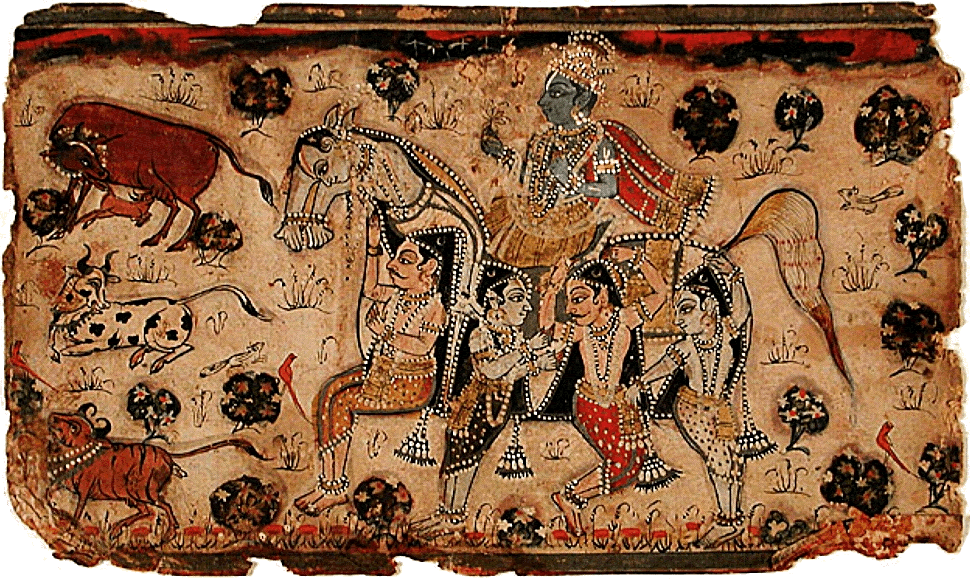
painting of Krishna with the Pândavas as the legs of His horse
is titled: 'Krishna riding a composite horse',
India, Andhra Pradesh, c.1800. Courtesy: LACMA.
Production:
Filognostic
Association of The Order of Time.

Feed-back | Links | Downloads | Music | Pictures | What's New | Search | Donations



 Text 1