

Canto
10
Canto
10
Chapter 43: Krishna Kills the Elephant Kuvalayâpîda
(1) S'rî S'uka said: 'After Krishna and Râma had washed Themselves, oh chastiser of the enemies, They heard the vibrations of kettledrums for the wrestling match and went hither to take a look. (2) When Krishna reached the gate of the arena He saw the elephant Kuvalayâpîda standing there, directed by his keeper. (3) Tightening His clothes and tying together His curly locks, He spoke to the elephant keeper with words as grave as the rumbling clouds: (4) 'Elephant keeper, oh elephant keeper, let Us pass, move aside right now, or else I will send you, together with your elephant, today to the abode of Yama [the lord of death].'
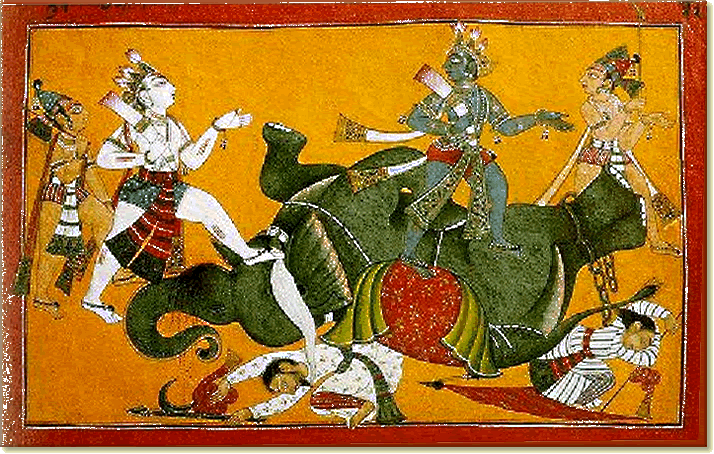
(5) Thus being threatened the elephant keeper got angry and goaded the furious elephant, that was like Yama, time and death, in the direction of Krishna. (6) The master elephant ran toward Krishna and violently seized Him with his trunk, but Krishna, dealing him a blow, escaped from the grip and disappeared between his legs. (7) Angry about not seeing Him anymore, he spotted Him by his sense of smell and grabbed Him with the end of his long nose, but Krishna used force and freed Himself once more. (8) Krishna seized him by the tail and dragged him, that mountain of power, for twenty-five bow-lengths with the ease with which Garuda plays with a snake. (9) Acyuta, moving him to the left and the right, was also moved about by him, just like a calf does with a young boy [at its tail. See also 10.8: 24]. (10) The moment they came to stand face to face, He slapped the elephant with His hand and then quickly moved away again. Thus He hit him at every step and then made him trip. (11) Running away He pretended to fall to the ground, but then He suddenly got up so that the elephant angrily came to strike the earth with his tusks. (12) With his prowess foiled that lord of the elephants was driven into a frenzy, and urged on by his keepers, he furiously attacked Krishna again. (13) The Supreme Lord, the killer of Madhu, confronting him in his attack, with His hand seized him by his trunk and made him fall to the ground. (14) With the ease of a lion jumping on the fallen giant, the Lord yanked out a tusk and killed the elephant as also his keepers with it.
(15) Leaving aside the dead elephant He, being sprinkled with drops of the elephant's blood and sweat, took the tusk on His shoulder and entered [the arena] with His lotus face shining with the fine drops that had appeared by His own perspiring. (16) Oh King, Baladeva and Janârdana, surrounded by several cowherd boys, thus appeared before the audience with the elephant's tusks as their chosen weapons. (17) For the wrestlers He was lightning, for the men He was the best, and for the women He was Cupid incarnate. For the cowherds He was a relative, for the impious rulers He was a chastiser, and for His parents He was a child. For the king of Bhoja He was death, for the unintelligent souls He was merely a material form, for the yogis He was the Supreme Reality, and for the Vrishnis He was the most worshipable deity. In these ways being regarded differently, He entered the arena together with His brother [see * and rasa]. (18) When Kamsa saw that Kuvalayâpîda had been killed and that the two of Them were invincible, his mind was overtaken by a very great anxiety, oh ruler of man. (19) The two mighty-armed Lords, the way They were dressed in each His own garments, with ornaments and garlands, looked in Their excellent costumes like two actors and radiated, being present in the arena, with an effulgence that overwhelmed the minds of all onlookers. (20) The people sitting in the galleries, the citizens and the people from outside, oh King, seeing the two Supreme Personalities, in sheer delight opened their eyes and mouths wide, and drank in the vision of Their faces, never getting enough of Them. (21-22) As if they were drinking Them through their eyes, licking Them up with their tongues, smelling Them through their nostrils and embracing Them with their arms, they spoke with each other commemorating the beauty, qualities, charm and bravery they had seen and heard from Them: (23) 'These two who descended to this world in the home of Vasudeva, are no doubt the direct expansions of Hari, the Supreme Personality. (24) This one here was born from Devakî and brought to Gokula, where He, growing up in the house of Nanda, lived in secret all the time. (25) He put an end to Pûtanâ, the whirlwind-demon and the two Arjuna trees, and also ended the lives of others like S'ankhacûda, Kes'î and Dhenuka. (26-27) He saved the cows and their tenders from the forest fire, He subdued the serpent Kâliya and sobered up Indra by delivering all the residents of Gokula from rain, wind and hail, when He for seven days with one hand held up the best of all mountains. (28) The gopîs seeing His always cheerful, smiling face and glance, that are free from fatigue, could transcend all sorts of distress and live happily. (29) They say that, because of Him, this Yadu dynasty will become very famous and, being protected in every way, will achieve all riches, power and glory. (30) And this brother of His, the lotus-eyed Râma, He is of all opulence and killed Pralamba, [and we think... **] Vatsâsura, Bakâsura and others.'
(31) With the people thus speaking and the musical instruments resounding, Cânûra addressed Krishna and Balarâma, using these words: (32) 'Oh son of Nanda, oh Râma, You two heroes are well respected and skillful at wrestling; the King heard about it, wanted to see that and called for You. (33) When citizens in mind, deeds and words perform to the pleasure of the King, they will acquire good fortune, but not acting so they achieve the opposite. (34) The gopas evidently are always very happy to tend their calves and play and romp, as they wander about deep in the forests. (35) Let us together with the two of You therefore act to the pleasure of the King. Everybody will be pleased with us, for the King embodies the interest of all living beings.'
(36) When Krishna heard this He, welcoming the fight and [thus] considering it desirable, spoke words befitting the time and place [see also 4.8: 54]: (37) 'Even though we wander in the forest, we are also subjects of the Bhoja King. Therefore we must always do whatever pleases him, for that will bring us the supreme benefit. (38) We young boys should, befittingly, contest with those equal in strength. The wrestling match should take place in such a manner that the assembled audience in this arena will not fall from its belief.'
(39) Cânûra said: 'You who sported to kill the elephant that had the strength of a thousand elephants, are not a boy or a youngster, and neither is Balarâma, who is the strongest of the strong! (40) Therefore the two of You should fight with those who are strong. There surely is no injustice in that, it is Your prowess against mine, oh descendent of Vrishni, and let Balarâma take it up with Mushthika.'


Third revised edition, loaded February 8, 2021.
Previous Aadhar edition and Vedabase links:
S'rî S'uka said: 'After Krishna and Râma had washed Themselves, oh chastiser of the enemies, They heard the vibrations of kettledrums for the wrestling match and went hither to take a look.S'rî S'uka said: 'After Krishna and Râma had washed Themselves, o chastiser of the enemies, heard They the vibrations of kettledrums and went they there to take a look. (Vedabase)
When Krishna reached the gate of the arena He saw the elephant Kuvalayâpîda standing there, directed by his keeper.
Reaching the gate of the arena saw Krishna standing there the elephant Kuvalayâpîda, directed by his keeper. (Vedabase)
Tightening His clothes and tying together His curly locks, He spoke to the elephant keeper with words as grave as the rumbling clouds:
Tightening His clothes and tying together His curly locks, spoke He with words grave like the rumbling clouds to the elephant keeper: (Vedabase)
'Elephant keeper, oh elephant keeper, let Us pass, move aside right now, or else I will send you, together with your elephant, today to the abode of Yama [the lord of death].'
'Elephant keeper, o elephant keeper, give way to us, move aside right now or else will I send you with your elephant today to the abode of Yama [the lord of death].' (Vedabase)
Thus being threatened the elephant keeper got angry and goaded the furious elephant, that was like Yama, time and death, in the direction of Krishna.
Thus threatened goaded the angered elephant keeper the fierce elephant that was alike Yama, the time and death, toward Krishna. (Vedabase)
The master elephant ran toward Krishna and violently seized Him with his trunk, but Krishna, dealing him a blow, escaped from the grip and disappeared between his legs.
The master elephant running forward violently seized Him with his trunk, but striking him He escaped from the grip and disappeared between his legs. (Vedabase)
Angry about not seeing Him anymore, he spotted Him by his sense of smell and grabbed Him with the end of his long nose, but Krishna used force and freed Himself once more.
Infuriated not seeing Him spotted he Him by his sense of smell and took he hold of Him with the end of his long nose, but using force He freed himself once more. (Vedabase)
Krishna seized him by the tail and dragged him, that mountain of power, for twenty-five bow-lengths with the ease with which Garuda plays with a snake.
Grabbing him by the tail dragged Krishna him, as easy as Garuda does with a snake, that mountain of power for twenty-five bow-lengths. (Vedabase)
Acyuta, moving him to the left and the right, was also moved about by him, just like a calf does with a young boy [at its tail. See also 10.8: 24].
Acyuta with moving him to the left and to the right was also moved about by him, just like a calf with a young boy [at its tail] would [see also 10.8: 24] (Vedabase)
The moment they came to stand face to face, He slapped the elephant with His hand and then quickly moved away again. Thus He hit him at every step and then made him trip.
Then coming face to face, slapped He the elephant with His hand, ran away and thus hitting him at each step, made He him trip. (Vedabase)
Running away He pretended to fall to the ground, but then He suddenly got up so that the elephant angrily came to strike the earth with his tusks.
He, running, acted as if He fell to the ground, but then He suddenly got up so that hthe elephant angrily came to strike the earth with his tusks. (Vedabase)
With his prowess foiled that lord of the elephants was driven into a frenzy, and urged on by his keepers, he furiously attacked Krishna again.
With his prowess foiled got that lord of the elephants out of frustration into a frenzy, but urged on by his keepers, attacked he furiously Krishna again. (Vedabase)
The Supreme Lord, the killer of Madhu, confronting him in his attack, with His hand seized him by his trunk and made him fall to the ground.
The Supreme Lord, the killer of Madhu, confronting him in attack seized him firmly by his trunk and made him fall to the ground. (Vedabase)
With the ease of a lion jumping on the fallen giant, the Lord yanked out a tusk and killed the elephant as also his keepers with it.
As easy as a lion jumping on the fallen one, yanked the Lord out a tusk and killed He the elephant and his keepers with it. (Vedabase)
Leaving aside the dead elephant He, being sprinkled with drops of the elephant's blood and sweat, took the tusk on His shoulder and entered [the arena] with His lotus face shining with the fine drops that had appeared by His own perspiring.
Leaving aside the dead elephant entered He, sprinkled with drops of the elephant's blood and sweat and holding the tusk on His shoulder, the arena with His lotuslike face shining of the fine drops that had appeared of His own perspiring. (Vedabase)
Oh King, Baladeva and Janârdana, surrounded by several cowherd boys, thus appeared before the audience with the elephant's tusks as their chosen weapons.
Surrounded by several cowherdboys entered Baladeva and Janârdana the arena, o King, with the elephant's tusks as their chosen weapons. (Vedabase)
For the wrestlers He was lightning, for the men He was the best, and for the women He was Cupid incarnate. For the cowherds He was a relative, for the impious rulers He was a chastiser, and for His parents He was a child. For the king of Bhoja He was death, for the unintelligent souls He was merely a material form, for the yogis He was the Supreme Reality, and for the Vrishnis He was the most worshipable deity. In these ways being regarded differently, He entered the arena together with His brother [see * and rasa].
To the wrestlers He was lightning, to the men He was the best, to the women He was Cupid incarnate, to the cowherds He was a relative, to the impious rulers He was a chastiser, to His parents He was a child, to the king of Bhoja He was death, to the unintelligent He was the gross of the universe, to the yogis He was the Supreme Reality and to the Vrishnis He was the most worshipable deity - thus seen differently He entered the arena together with His brother [see * and rasa]. (Vedabase)
When Kamsa saw that Kuvalayâpîda had been killed and that the two of Them were invincible, his mind was overtaken by a very great anxiety, oh ruler of man.
Within Kamsa, who saw Kuvalayâpîda killed and the two of Them invincible, then rose a great anxiety o ruler of man. (Vedabase)
The two mighty-armed Lords, the way They were dressed in each His own garments, with ornaments and garlands, looked in Their excellent costumes like two actors and radiated, being present in the arena, with an effulgence that overwhelmed the minds of all onlookers.
The two mighty armed Lords the way They were dressed with garments, ornaments and garlands like two actors in excellent costumes, shone, present in the arena, with an effulgence that overwhelmed the minds of all onlookers. (Vedabase)
The people sitting in the galleries, the citizens and the people from outside, oh King, seeing the two Supreme Personalities, in sheer delight opened their eyes and mouths wide, and drank in the vision of Their faces, never getting enough of Them.
Seeing the two Supreme Personalities opened the people sitting in the galleries, the citizens and the people from outside, o King, by the force of their joy, their eyes and mouths wide and drank they in Their faces, never getting enough of Them with their vision. (Vedabase)
As if they were drinking Them through their eyes, licking Them up with their tongues, smelling Them through their nostrils and embracing Them with their arms, they spoke with each other commemorating the beauty, qualities, charm and bravery they had seen and heard from Them:
As if drinking with their eyes, licking with their tongues, smelling through their nostrils and embracing with their arms, spoke they among one another commemorating the beauty, qualities, charm and bravery of the things they had seen and heard: (Vedabase).
'These two who descended to this world in the home of Vasudeva, are no doubt the direct expansions of Hari, the Supreme Personality.
'These two surely are direct expansions of Hari, the Supreme Personality, who have descended to this world in the home of Vasudeva. (Vedabase)
This one here was born from Devakî and brought to Gokula, where He, growing up in the house of Nanda, lived in secret all the time.
This one indeed was, born from Devakî, brought to Gokula where He lived hidden all this time growing up in the house of Nanda. (Vedabase)
He put an end to Pûtanâ, the whirlwind-demon and the two Arjuna trees, and also ended the lives of others like S'ankhacûda, Kes'î and Dhenuka.
Pûtanâ as well as the whirlwind-demon were by Him put to death and so He also dealt with many others: the Arjuna trees, S'ankhacûda, Kes'î, Dhenuka... (Vedabase)
He saved the cows and their tenders from the forest fire, He subdued the serpent Kâliya and sobered up Indra by delivering all the residents of Gokula from rain, wind and hail, when He for seven days with one hand held up the best of all mountains.
The cows and their tenders were by Him saved from the forest fire, Kâliya the serpent He subdued, Indra was sobered up by Him, for seven days He held with one hand the best of all mountains delivering all the residents of Gokula from rain, wind and hail... (Vedabase)
The gopîs seeing His always cheerful, smiling face and glance, that are free from fatigue, could transcend all sorts of distress and live happily.
The gopis seeing His always cheerful, smiling face and glance ever free from fatigue could transcend all sorts of distress and live happily... (Vedabase)
They say that, because of Him, this Yadu dynasty will become very famous and, being protected in every way, will achieve all riches, power and glory.
They say that by Him this Yadu dynasty will grow very famous and, protected in every way, will achieve all riches, glory and power... (Vedabase)
And this brother of His, the lotus-eyed Râma, He is of all opulence and killed Pralamba, [and we think... **] Vatsâsura, Bakâsura and others.'
And this brother of His, the lotus-eyed Râma, He's of all opulence and killed Pralamba, [and we think...] Vatsâsura, Bakâsura and others...' (Vedabase)
With the people thus speaking and the musical instruments resounding, Cânûra addressed Krishna and Balarâma, using these words:
As the people were thus speaking and the musical instruments sounded, spoke Cânûra, addressing Krishna and Balarâma, the following words: (Vedabase)
'Oh son of Nanda, oh Râma, You two heroes are well respected and skillful at wrestling; the King heard about it, wanted to see that and called for You.
'O son of Nanda, o Râma, You two heroes are well respected and skillful at wrestling; the king hearing of it wanted to see that and called for You. (Vedabase)
When citizens in mind, deeds and words perform to the pleasure of the King, they will acquire good fortune, but not acting so they achieve the opposite.
Citizens indeed when they in mind, deeds and words perform to the pleasure of the king will acquire good fortune, but opposite to this it is different. (Vedabase)
The gopas evidently are always very happy to tend their calves and play and romp, as they wander about deep in the forests.
The gopas obviously always very happy tend their calves in the forests and play and horse around while grazing the cows. (Vedabase)
Let us together with the two of You therefore act to the pleasure of the King. Everybody will be pleased with us, for the King embodies the interest of all living beings.'
Therefore, let the two of You and us act to the pleasure of the King who embodies all alive, so that all living beings will be satisfied.' (Vedabase)
When Krishna heard this He, welcoming the fight and [thus] considering it desirable, spoke words befitting the time and place [see also 4.8: 54]:
Hearing that spoke Krishna words befitting the time and place [see also 4.8: 54] in welcome of the wrestling that He Himself also considered desirable: (Vedabase)
'Even though we wander in the forest, we are also subjects of the Bhoja King. Therefore we must always do whatever pleases him, for that will bring us the supreme benefit.
'As subjects of the Bhoja king, must We also, even though wandering in the forest, always execute whatever pleases him, for that will confer upon Us the greatest benefit. (Vedabase)
We young boys should, befittingly, contest with those equal in strength. The wrestling match should take place in such a manner that the assembled audience in this arena will not fall from its belief.'
We young boys will as it should contest with those equal in strength; the wrestling match should take place so that the members of the audience in this arena will not fall from their belief.' (Vedabase)
Cânûra said: 'You who sported to kill the elephant that had the strength of a thousand elephants, are not a boy or a youngster, and neither is Balarâma, who is the strongest of the strong!
Cânûra said: 'You and Balarâma are no boys or youngsters, You're the strongest of the strong who sported to kill the elephant that had the strength of a thousand elephants! (Vedabase)
Therefore the two of You should fight with those who are strong. There surely is no injustice in that, it is Your prowess against mine, oh descendent of Vrishni, and let Balarâma take it up with Mushthika.'
Therefore should the two of You fight with those who are strong, there's sure no injustice in that; it's Your prowess against mine, o descendent of Vrishni, and let Balarâma take it up with Mushthika.' (Vedabase)
*: Thus one speaks of ten rasas, attitudes or moods toward Krishna: fury [perceived by the wrestlers], wonder [by the men], conjugal attraction [the women], laughter [the cowherds], chivalry [the kings], mercy [His parents], terror [Kamsa], repulsion [the unintelligent], peaceful neutrality [the yogis] and loving devotion [the Vrishnis].
**: Vatsâsura and Bakâsura were factually killed by Krishna.


The text and audio are offered under the conditions of
the
Creative
Commons Attribution-Noncommercial-Share Alike 3.0 Unported
License.
The picture
of Krishna and Balarâma killing Kuvalayâpîda is painted by Kailash Raj.
© Exoticindiaart.com, used with permission.
Production: Filognostic Association of The Order of Time.

Feed-back | Links | Downloads | Music | Pictures | What's New | Search | Donations



 Text 1