Chapter 11:
Jada Bharata Instructs King
Rahûgana
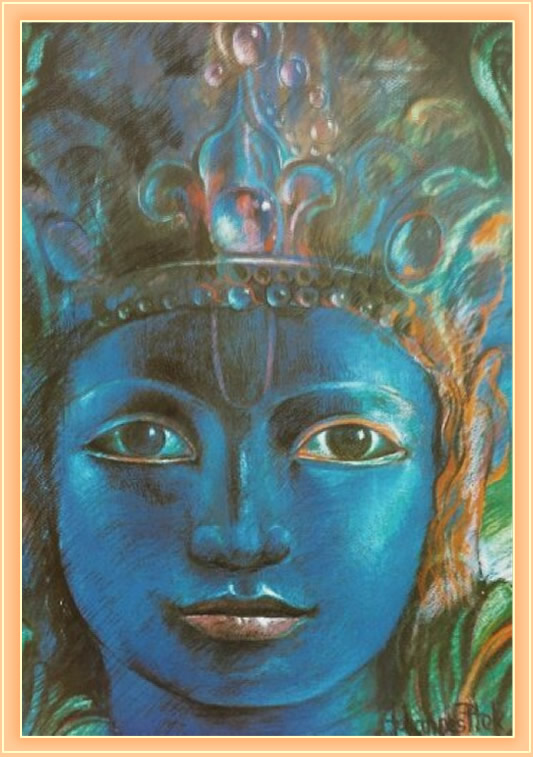
(13-14) The
knower of the field is [originally]
the all-pervading, omnipresent, authentic person, the Oldest One who is
seen and heard of as existing by His own light. He is never born, He is
the transcendental Nârâyana, the Supreme Lord
Vâsudeva. He is the one
who, just like the air present within the body, by His own potency,
exists in the soul as the controller of the moving and unmoving living
entities. He is the Supersoul of expansion who has entered [and
initiated the creation] and thus is of control as the Fortunate One in
the beyond. He is the shelter and knower of everyone in
every field. He is the vital force [the Mover of Time] that appeared in
this material
world [see also B.G.
9:
10 & 15:
15].
Chapter 12:
The Conversation Between Mahârâja
Rahûgana and Jada Bharata
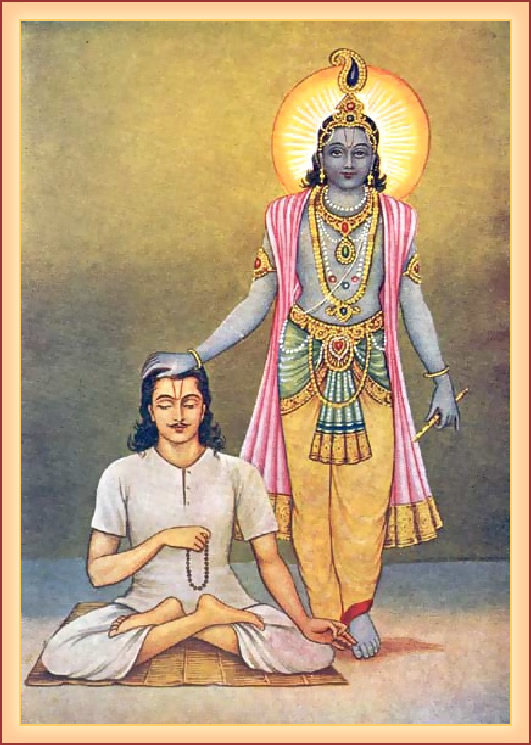
(11) The higher knowing,
the intelligence in its pure existence that constitutes the ultimate
goal, is the Oneness without an inside or an outside, the Absolute
Truth of the Supreme [Brahman], the inner peace [of the meditator] that
in a higher [personal] sense is known as Bhagavân, the Supreme
Lord [of all opulence], who by the scholars is called Vâsudeva
[the Soul of God within, Vishnu, or Lord Krishna as the son of
Vasudeva].
Chapter 13:
Further talks Between Mahârâja
Rahûgana and Jada Bharata
(8) Sometimes, wandering around, his feet are
hurt by thorns and small stones
when he wants to climb the
hills [of social convention], which depresses him at
every step, and sometimes he, as a family man, is dispirited with a
hungry stomach [his ambitions], and gets angry with his own
family members.
Chapter 14: The
Material World as the Great Forest of Enjoyment
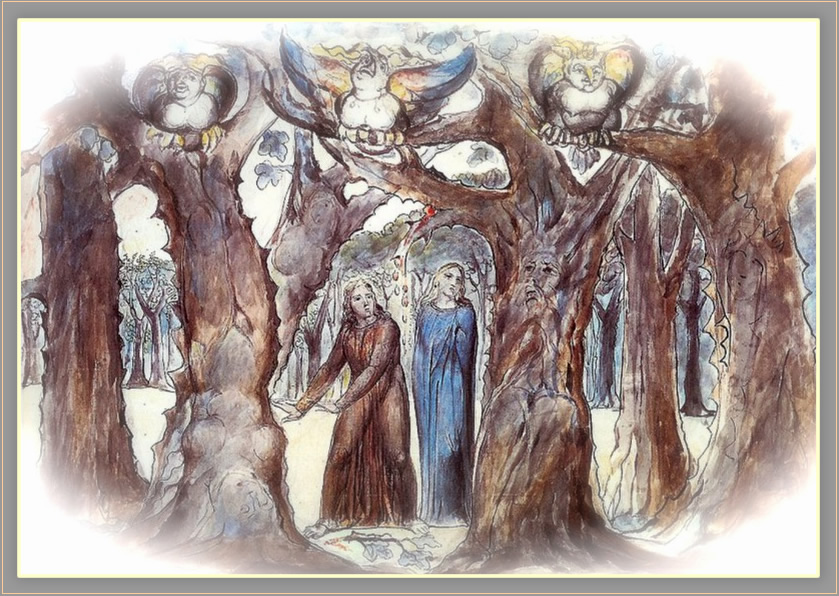
(1) The wise [S'ukadeva] said: 'Those who take the
body for the
real self, being different with the mode of goodness and such, consider
matters from the wrong perspective. Basing themselves on the six
gateways of their senses and their mind, they alternatively operating
favorably, unfavorably or with a mixed approach, have to deal with a
never ending process of transmigration through different series of
physical frames they time and again have to forsake and pick up again.
In relation to Vishnu, the Transcendental Personality who is the Lord,
the bound soul who acting under the control of mâyâ,
the illusory of matter, moves on the difficult path of the hard to
cross forest of material existence, is engaged like a merchant who
wants to make money with things desired by the people. He who engages
his body for the sake of the profit experiences the material world in
which he landed as a cemetery [a dead-end street for his
self-realization] where he encounters a lot of resistance for as long
as he does not succeed to progress in following the example of the
bumblebees, the ones devoted to the lotus feet of the Lord and His
representatives, who put an end to the trouble of reaching His jewel
[His glory].
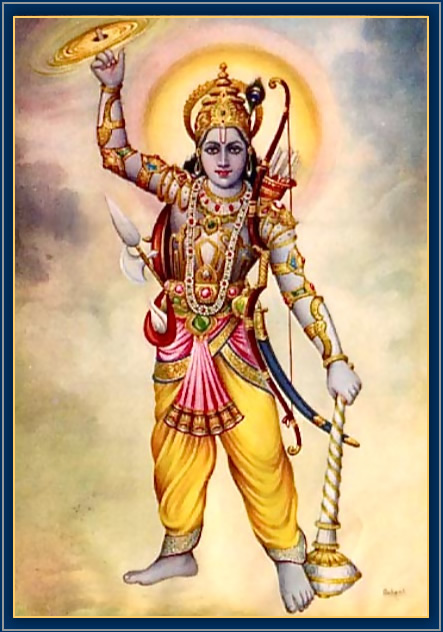
(29) Thus it
may happen that, because of the cakra of the
Controller, the
Supreme Lord Vishnu's disc of Time, the influence of which
stretches from the
first expansion of atoms to the duration of the complete life of
Brahmâ, one has to suffer the symptoms of its rotating.
With that rotation in the course of time, swiftly before one's eyes [in
terms of eternity], in a moment, all lives of
the living entities are
spent, from Brahmâ to the
simplest blade of grass. Directly of Him, the Controller whose personal
weapon is the
disc of Time, one is afraid at heart. As a consequence not caring about
the Supreme
Lord, the Original Person of Sacrifice, one then accepts as worshipable
what lacks foundation, with self-invented gods who,
operating like
buzzards,
vultures,
herons
and
crows, are denied by the
scriptures of one's civilization.
Chapter 15:
The Glories of the Descendants of King Pryavrata
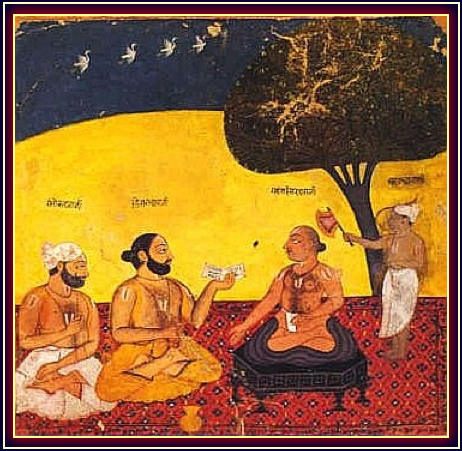
(7) In
the performance of his duties he protected his subjects by maintaining
them [poshana], he made them happy in all respects [prînana],
treated
them
as
his
children
[upalâlana] and sometimes
chastised them as a king [anus'âsana]. He in every respect performed all the prescribed religious ceremonies for the
Supreme Lord, the great Personality and source of all living beings who
is the Supreme Brahman [in person]. By his surrender, the many of his
spiritual qualities and by his service of the lotus feet of the
self-realized souls, he managed to be of devotional service unto the
Supreme Lord, for he, who in the purest consciousness continuously was absorbed
in
the
soul,
had
personally
realized
the
cessation
of
all
identification
with
his
material
self.
Despite
his
awareness
of
his
exalted
spiritual position he, remaining without any false pride
[demonstrations of power],
ruled the entire world strictly according to the Vedic principles.