Canto
8
Chapter 13: Description of Future Manus
(1) S'rî S'uka said: 'Now hear from me about the children of the son of Vivasvân, the present Manu who is known in the world as S'râddhadeva. He is the seventh one [we are now in the twenty-eighth yuga of him who is also known as Vaivasvata Manu]. (2-3) The ten sons of Manu are known as Ikshvâku, Nabhaga, Dhrishtha, S'aryâti, Narishyanta, Nâbhâga [or Nriga] and Dishtha as the seventh one. Then, oh chastiser of the enemy, there are Tarûsha [or Karûshaka], Prishadhra and Manu's tenth son who is known as Vasumân [or Kavi, see also 9.1: 11-12]. (4) Oh King, the Âdityas, the Vasus, the Rudras, the Vis'vedevas, the Maruts, the As'vins and the Ribhus are the demigods [during this period] and Purandara is their Indra. (5) Kas'yâpa, Atri, Vasishthha, Vis'vâmitra, Gautama, Jamadagni and Bharadvâja are known as the seven sages. (6) The appearance of the Supreme Lord Vishnu that took place during this period was the one of Lord Vâmana. He was the youngest Âditya born from mother Aditi and father Kas'yapa Muni.(7) I briefly described the seven periods of the Manus, let me also tell you about the future Manus endowed with the powers of Vishnu [see 8.1 & 8.5].
(8) Samjñâ and Châyâ, the two wives of Vivasvân who were the daughters of Vis'vakarmâ, oh King, I both described to you previously [see 6.6: 40-41]. (9) Some mention a third wife of Vivasvân: Vadavâ. From the three of them there were of Samjñâ three children born - a daughter Yamî and the sons Yama and S'râddhadeva. Now hear about the children of Châyâ. (10) There was Sâvarni [a son], the daughter Tapatî who later became the wife of king Samvarana and S'anais'cara [Saturn] who was the third one. The two As'vins were the sons born from Vadavâ. (11) When the eighth period arrives Sâvarni will become the Manu. The sons of Sâvarni, oh ruler of man, are Nirmoka, Virajaska and others. (12) The Sutapâs, the Virajas and the Amritaprabhas will belong to the demigods and Bali, the son of Virocana, will become the Indra. (13) Having donated the entire universe to Vishnu who begged him for three steps of land, he [Bali] will achieve the post of Indra. Thereafter renouncing he will achieve the perfection of life. (14) He, Bali, bound by the Supreme Lord, was as a token of His appreciation again favored with the kingdom of Sutala where being situated he today still occupies a position more opulent than the one of Indra in heaven. (15-16) Gâlava, Dîptimân, Paras'urâma, As'vatthâmâ, Kripâcârya, Rishyas'ringa and our father Vyâsadeva, the incarnation of the Lord [as a philosopher] will, because of their yoga practice, be the seven sages during the eighth manvantara. They at present are engaged in their respective hermitages, oh King. (17) Sârvabhauma, the Lord and Master [over the world] will, fathered by Devaguhya, be born from Sarasvatî and take away by force the lands of Purandara [Indra] and give them to Bali.
(18) Daksha-sâvarni, the ninth Manu, born as the son of Varuna, will have Bhûtaketu, Dîptaketu and others as his sons, oh King. (19) The Pâras, the Marîcigarbhas and others will be the demigods, the king of heaven will be known as Adbhuta and the seven sages of that period will be headed by Dyutimân. (20) Rishabhadeva, a partial incarnation of the Supreme Lord, will, with Âyushmân as His father, take birth from the womb of Ambudhârâ. Adbhuta will because of Him enjoy all opulence of the three worlds.
(21) The tenth Manu will be Brahma-sâvarni, son of Upas'loka. His sons will be Bhûrishena and others and the twice-born souls will be headed by Havishmân. (22) Havishmân, Sukrita, Satya, Jaya, Mûrti [and others] are the [seven] sages during that period, the Suvâsanas, the Viruddhas and others will be the demigods and S'ambhu will be the controller of the Suras [the Indra]. (23) One of the Supreme Lord's plenary portions, Vishvaksena, will take birth from the womb of Vishûcî in the home of Vis'vasrashthâ and will make friends with S'ambhu.
(24) Dharma-sâvarni will be the eleventh Manu to appear in the future. This self-realized soul will have Satyadharma and others as his ten sons. (25) The Vihangamas, Kâmagamas and Nirvânarucis are the demigods then and Vaidhrita will be their Indra. The seven sages are Aruna and others. (26) A partial incarnation of the Lord known as Dharmasetu will be born from the womb of Vaidhritâ as the son of Âryaka and will rule the three worlds.
(27) Rudra-sâvarni, oh King, will appear as the twelfth Manu and Devavân, Upadeva and Devas'reshthha and others will be his sons. (28) Ritadhâmâ will be the Indra for that period, the demigods will be headed by the Haritas and Tapomûrti, Tapasvî, Âgnîdhraka and others will be the sages. (29) The mighty Svadhâmâ, a partial incarnation of the Lord who Satyasahâ will beget by Sunritâ, will rule that period of Manu.
(30) The self-realized soul Deva-sâvarni will be the thirteenth Manu and Citrasena, Vicitra and others will be his sons. (31) The Sukarmâs and Sutrâmas will become the demigods, Divaspati will be the Indra and Nirmoka and Tattvadars'a and others will be the sages then. (32) Yoges'vara, a partial incarnation of the Lord, will appear from the womb of Brihatî as the son of Devahotra and will endeavor for the sake of Divaspati [the Indra].
(33) Indra-savârni will be the fourteenth Manu and from his semen Uru, Gambhîra, Budha and others will be born. (34) The Pavitras and Câkshushas will be the demigods, S'uci will be the king of heaven and Agni, Bâhu, S'uci, S'uddha, Mâgadha and others will be the ascetics. (35) For that period, oh great king, the Lord will appear in the womb of Vitânâ as Brihadbhânu, the son of Satrâyana, in order to promote all spiritual activities.
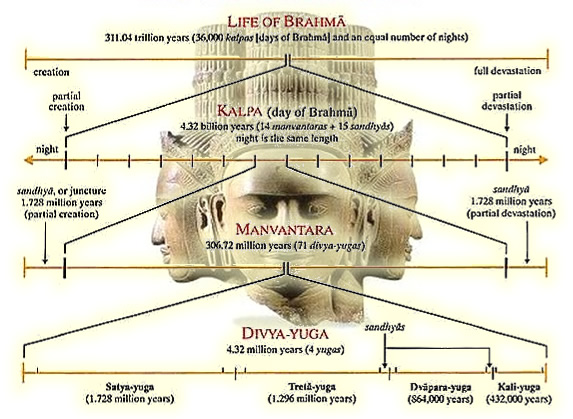
(36) Oh King, the estimated time of the past, the present and the future of these fourteen Manus I have described to you, covers a thousand mahâyugas or one kalpa [one day of Brahmâ, see also picture].'


Third revised edition, loaded July 10, 2019.

Previous Aadhar edition and Vedabase links:
S'rî S'uka said: 'Now hear from me about the children of the son of Vivasvân, the present Manu who is known in the world as S'râddhadeva. He is the seventh one [we are now in the twenty-eighth yuga of him who is also known as Vaivasvata Manu].S'rî S'uka said: 'Now hear from me about the children of the son of Vivasvân known in the world as S'râddhadeva - he who presently is the seventh Manu [we are now in the twenty-eighth yuga of him who is also known as Vaivasvata Manu]. (Vedabase)
The ten sons of Manu are known as Ikshvâku, Nabhaga, Dhrishtha, S'aryâti, Narishyanta, Nâbhâga [or Nriga] and Dishtha as the seventh one. Then, oh chastiser of the enemy, there are Tarûsha [or Karûshaka], Prishadhra and Manu's tenth son who is known as Vasumân [or Kavi, see also 9.1: 11-12].
The ten sons of Manu are known as Ikshvâku and Nabhaga indeed, Dhrishtha and also S'aryâti, Narishyanta and Nâbhâga [or Nriga] with Dishtha as the seventh; further are there Tarûsha [or Karûshaka] and Prishadhra and Manu's tenth who is known as Vasumân [or Kavi] [see also 9.1: 11-12]. (Vedabase)
Oh King, the Âdityas, the Vasus, the Rudras, the Vis'vedevas, the Maruts, the As'vins and the Ribhus are the demigods [during this period] and Purandara is their Indra.
O King, Purandara is there as the Indra of the Âditiyas, the Vasus, the Rudras, the Vis'vedevas, the Maruts, the As'vins and the Ribhus [the demigods]. (Vedabase)
Kas'yâpa, Atri, Vasishthha, Vis'vâmitra, Gautama, Jamadagni and Bharadvâja are known as the seven sages.
Kas'yâpa, Atri, Vasishthha, Vis'vâmitra, Gautama, Jamadagni and Bharadvâja are known as the seven sages mentioned before. (Vedabase)
The appearance of the Supreme Lord Vishnu that took place during this period was the one of Lord Vâmana. He was the youngest Âditya born from mother Aditi and father Kas'yapa Muni.
During this period was the appearance of the Supreme Lord Vishnu in the form of Lord Vâmana as the youngest of Aditi secured by Kas'yapa Muni. (Vedabase)
I briefly described the seven periods of the Manus, let me also tell you about the future Manus endowed with the powers of Vishnu [see 8.1 & 8.5].
In brief I explained the seven changes of Manus, now I'll also tell you about the future Manus empowered by the energy of Vishnu [see 8.1 & 5]. (Vedabase)
Samjñâ and Châyâ, the two wives of Vivasvân who were the daughters of Vis'vakarmâ, oh King, I both described to you previously [see 6.6: 40-41].
The two wives of Vivasvân, the daughters of Vis'vakarmâ Samjñâ and Châyâ, o King, I both described to you before [see 6.6: 40-41]. (Vedabase)
Some mention a third wife of Vivasvân: Vadavâ. From the three of them there were of Samjñâ three children born - a daughter Yamî and the sons Yama and S'râddhadeva. Now hear about the children of Châyâ.
Some mention a third wife of Vivasvân: Vadavâ. Of the three were there of Samjñâ three children born - a daughter Yamî and the sons Yama and S'râddhadeva. Now hear about the children of Châyâ. (Vedabase)
There was Sâvarni [a son], the daughter Tapatî who later became the wife of king Samvarana and S'anais'cara [Saturn] who was the third one. The two As'vins were the sons born from Vadavâ.
They were Sâvarni [a son], the daughter Tapatî who later became the wife of king Samvarana and S'anais'cara [Saturn] who was the third. The As'vins took birth as the sons of Vadavâ. (Vedabase)
When the eighth period arrives Sâvarni will become the Manu. The sons of Sâvarni oh ruler of man, are Nirmoka, Virajaska and others.
When the eight period has arrived will Sâvarni become the Manu. The sons of Sâvarni, o ruler of man, are Nirmoka, Virajaska and others. (Vedabase)
The Sutapâs, the Virajas and the Amritaprabhas will belong to the demigods and Bali, the son of Virocana, will become the Indra.
The demigods will then be the Sutapâs, the Virajas and the Amritaprabhas and Bali, the son of Virocana, will become the Indra. (Vedabase)
Having donated the entire universe to Vishnu who begged him for three steps of land, he [Bali] will achieve the post of Indra. Thereafter renouncing he will achieve the perfection of life.
Having given away the entire universe to Vishnu who begged him for three paces of land, he will achieve the post of Indra and thereafter will he, renouncing, achieve the perfection of life. (Vedabase)
He, Bali, bound by the Supreme Lord, was as a token of His appreciation again favored with the kingdom of Sutala where being situated he today still occupies a position more opulent than the one of Indra in heaven.
He, Bali, bound by the Supreme Lord, was favored with the kingdom of Sutala where, at present having a position equal to Indra, he was to be situated again more opulent than in heaven. (Vedabase)
Gâlava, Dîptimân, Paras'urâma, As'vatthâmâ, Kripâcârya, Rishyas'ringa and our father Vyâsadeva, the incarnation of the Lord [as a philosopher] will, because of their yoga practice, be the seven sages during the eighth manvantara. They at present are engaged in their respective hermitages, oh King.
In the eight manvantara will Gâlava, Dîptimân, Paras'urâma, As'vatthâmâ, Kripâcârya, Rishyas'ringa and our father Vyâsadeva, the incarnation of the Lord [as a philosopher], who at present, o King, are busy with their own hermitages, as a result of their yogapractice be the seven sages. (Vedabase)
Sârvabhauma, the Lord and Master [over the world] will, fathered by Devaguhya, be born from Sarasvatî and take away by force the lands of Purandara [Indra] and give them to Bali.
Sârvabhauma by Devaguhya begotten in Sarasvatî, will as the Master and Controller take away by force the lands of Purandara [Indra] and give them to Bali. (Vedabase)
Daksha-sâvarni, the ninth Manu, born as the son of Varuna, will have Bhûtaketu, Dîptaketu and others as his sons, oh King.
Daksha-sâvarni, the ninth Manu, born as the son of Varuna, will as his sons have Bhûtaketu, Dîptaketu and others, o King. (Vedabase)
The Pâras, the Marîcigarbhas and others will be the demigods, the king of heaven will be known as Adbhuta and the seven sages of that period will be headed by Dyutimân.
The Pâras, the Marîcigarbhas and those will be the demigods, the king of heaven will be known as Adbhuta and the ones headed by Dyutimân will become the seven sages in that period. (Vedabase)
Rishabhadeva, a partial incarnation of the Supreme Lord, will, with Âyushmân as His father, take birth from the womb of Ambudhârâ. Adbhuta will because of Him enjoy all opulence of the three worlds.
From Âyushmân will from the womb of Ambudhârâ Rishabhadeva, a partial incarnation of the Supreme Lord, take birth and of him will Adbhuta enjoy all opulence of the three worlds. (Vedabase)
The tenth Manu will be Brahma-sâvarni, son of Upas'loka. His sons will be Bhûrishena and others and the twice-born souls will be headed by Havishmân.
The tenth Manu will be Brahma-sâvarni, son of Upas'loka; his sons will be Bhûrishena and others and the twice-born will be headed by Havishmân. (Vedabase)
Havishmân, Sukrita, Satya, Jaya, Mûrti [and others] are the [seven] sages during that period, the Suvâsanas, the Viruddhas and others will be the demigods and S'ambhu will be the controller of the Suras [the Indra].
Havishmân, Sukrita, Satya, Jaya and Mûrti [and others] will at the time be the [seven] sages; the Suvâsanas, the Viruddhas and others will be the demigods and S'ambhu will be the controller of the Suras [the Indra]. (Vedabase)
One of the Supreme Lord's plenary portions, Vishvaksena, will take birth from the womb of Vishûcî in the home of Vis'vasrashthâ and will make friends with S'ambhu.
One of the Supreme Lord His plenary portions, Vishvaksena, born from the womb of Vishûcî in the home of Vis'vasrashthâ, will make friends with S'ambhu. (Vedabase)
Dharma-sâvarni will be the eleventh Manu to appear in the future. This self-realized soul will have Satyadharma and others as his ten sons.
The Manu Dharmasâvarni will indeed be the eleventh to appear in the future as a master of the soul and Satyadharma and others will be his ten sons. (Vedabase)
The Vihangamas, Kâmagamas and Nirvânarucis are the demigods then and Vaidhrita will be their Indra. The seven sages are Aruna and others.
The Vihangamas, Kâmagamas and Nirvânarucis are the demigods and Vaidhritâ is their Indra; the seven sages are Aruna and others. (Vedabase)
A partial incarnation of the Lord known as Dharmasetu will be born from the womb of Vaidhritâ as the son of Âryaka and will rule the three worlds.
Born from the womb of Vaidhritâ as the son of Âryaka will a partial incarnation of the Lord known as Dharmasetu then rule the three worlds. (Vedabase)
Rudra-sâvarni, oh King, will appear as the twelfth Manu and Devavân, Upadeva and Devas'reshthha and others will be his sons.
Rudra-sâvarni, o King, will appear as the twelfth Manu and Devavân, Upadeva and Devas'resh and others will be his sons. (Vedabase)
Ritadhâmâ will be the Indra for that period, the demigods will be headed by the Haritas and Tapomûrti, Tapasvî, Âgnîdhraka and others will be the sages.
In that period will Ritadhâmâ be the Indra, will the demigods be headed by the Haritas and will Tapomûrti, Tapasvî, Âgnîdhraka and others be the sages. (Vedabase)
The mighty Svadhâmâ, a partial incarnation of the Lord who Satyasahâ will beget by Sunritâ, will rule that period of Manu.
By Satyasahâ begotten from Sunritâ will the almighty Svadhâmâ, a partial incarnation of the Lord, rule the period of that Manu. (Vedabase)
The self-realized soul Deva-sâvarni will be the thirteenth Manu and Citrasena, Vicitra and others will be his sons.
The thirteenth Manu of advancement to the soul will be Deva-sâvarni and Citrasena, Vicitra and others will be Deva-sâvarni's flesh and blood. (Vedabase)
The Sukarmâs and Sutrâmas will become the demigods, Divaspati will be the Indra and Nirmoka and Tattvadars'a and others will be the sages then.
The Sukarmâs and the Sutrâmas will become the demigods, Divaspati will be the Indra and Nirmoka and Tattvadars'a and others will then be the sages. (Vedabase)
Yoges'vara, a partial incarnation of the Lord, will appear from the womb of Brihatî as the son of Devahotra and will endeavor for the sake of Divaspati [the Indra].
As the son of Devahotra will, as the benefactor of Divaspati [the Indra], from the womb of Brihatî, Yoges'vara appear as a partial incarnation of the Lord. (Vedabase)
Indra-savârni will be the fourteenth Manu and from his semen Uru, Gambhîra, Budha and others will be born.
The Manu known as Indra-savârni will be the fourteenth and of his semen will Uru, Gambhîra, Budha and others be born. (Vedabase)
The Pavitras and Câkshushas will be the demigods, S'uci will be the king of heaven and Agni, Bâhu, S'uci, S'uddha, Mâgadha and others will be the ascetics.
The Pavitras and Câkshushas will be the demigods, S'uci will be the king of heaven and Agni, Bâhu, S'uci, S'uddha, Mâgadha and others will be the ones of penance. (Vedabase)
For that period, oh great king, the Lord will appear in the womb of Vitânâ as Brihadbhânu, the son of Satrâyana, in order to promote all spiritual activities.
For that period, o great king, will the Lord in the womb of Vitânâ appear as Brihadbhânu, the son of Satrâyana, for the performance of all spiritual activities.(Vedabase)
Oh King, the estimated time of the past, the present and the future of these fourteen Manus I have described to you, covers a thousand mahâyugas or one kalpa [one day of Brahmâ, see also picture].'
O King, the estimated time of the past, the present and the future covered by these fourteen that I described to you, consists of a thousand mahâyugas or one kalpa [day of Brahmâ, see also picture].' (Vedabase)


The
text and audio are offered under the conditions of the
Creative
Commons Attribution-Noncommercial-Share Alike
3.0
Unported License.
The painting on
this page represents the different Manus.
Source.
Production: Filognostic
Association
of The
Order of Time

Feed-back | Links | Downloads | Music | Pictures | What's New | Search | Donations


 Text
1
Text
1