Canto
5
Chapter 23: Description of the Stars of S'is'umâra, our Coiling Galaxy
(1) S'rî S'uka then said: '1.3 Million yojanas above them [the stars of the sages] one finds that supreme abode of Lord Vishnu where the great devotee Dhruva, the son of Uttânapâda, resides whose glory of obedient devotion I described already [see 4.9]. It is the source of life of all living entities from now until the end of the kalpa, about which Agni, the fire god, Indra the king of heaven, the founding father who is the Prajâpati, Kas'yapa as also Dharmarâja, in unison full of respect move clockwise. (2) For all the restless luminaries, the planets, the stars and the rest, that place constitutes the incandescent radiating pivot that is established by the Lord. The inconceivable, all-powerful force of Time is considered the cause of their revolving. (3) The luminaries keep their positions, just like three bulls that for threshing rice are yoked to a central pole. Moving in their orbits they have a fixed position relative to the inner and outer rims of the wheel of time, the same way the planets keep their positions around the sun. Holding on to Dhruvaloka till the end of creation, they revolve in the sky as if they are driven by the wind, just like heavy clouds and big birds do, that controlled by the air, move their bodies around according to their respective positions. Thus the luminaries behave consequently, by the combined effort of material nature and the Original Person, the way they always have and never collide with the earth.
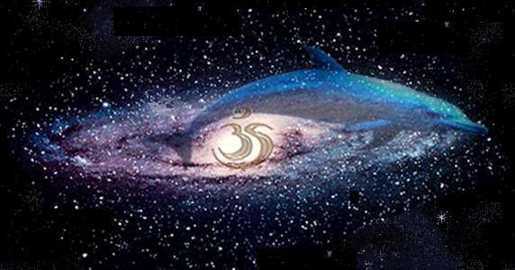
(4) Some imagine this great army of luminaries to be a s'is'umâra [a dolphin] and describe it, concentrated in yoga, as [that what can be seen of] the Supreme Lord Vâsudeva [see also a picture of the celestial sky as factually seen in a telescope]. (5) With its tail pointing at the end of the row of fixed stars in the sky [dhruva] and with its head bent downwards, it has its body coiled. The [planets of] Prajâpati, Agni, Indra and Dharma are found on the tail with [those of the demigods] Dhâtâ and Vidhâtâ at its base. The seven sages are situated on its hip. With its body coiling to the right there are, as its separate body parts, at its northern side the constellations of the fourteen stars [from Abhijit to Punarvasu] that mark the northern course [of the sun] and to the south there are the same number of them [from Pushyâ to Uttarâshâdhâ] marking the southern course. Together the both sides appear like the coiled body of a dolphin. On its back one sees the stars called Ajavîthî [*] and on the belly one sees the 'celestial Ganges' [the series of stars along the full body of the S'is'umâra we know as our Milky Way]. (6) Punarvasu and Pushyâ constitute the loins right and left. Ârdrâ and As'leshâ also to the right and left, are his flippers. Abhijit and Uttarâshâdhâ are the left and right nostril with following next in due order S'ravanâ and Pûrvâshâdhâ for its eyes left and right. Dhanishthhâ and Mûlâ are the right and left ear and the eight stars such as Maghâ marking the southern course, are to be seen as the left ribs while the same number of stars like Mrigas'îrshâ that mark the northern course, are there as the ribs positioned at the other side to the right. S'atabhishâ and Jyeshthhâ should be seen as the position of the right and left shoulder. (7) On its upper chin there is Agasti [Agastya] and on its lower one there is Yamarâja. As its mouth there is Mars, as its genitals there is Saturn, Jupiter is found at the back of the neck and the sun is found at the chest. In its heart Lord Nârâyana is found while the moon serves as its mind. As the navel there is Venus, the two sides of the breast is where the As'vins reside, Mercury is there as the in- and outward going breath, Râhu is the neck and the comets are found all over its body with the numerous stars as its pores [**].
(8) This [form of S'is'umâra] certainly is the form of the Supreme Lord, of Lord Vishnu who consists of all the demigods. With that form before one's eyes one should each morning, noon and evening in all modesty meditate on the following words: 'Our obeisances unto this resting place of all the luminous worlds, unto the master of the demigods, the Supreme Personality in the form of Time upon whom we meditate' [namo jyotih-lokâya kâlâyanâya animishâm pataye mahâ-purushâya abhidhîmahîti, see also 2.2: 24]. (9) Those who in respect of that leader of the demigods consisting of all the planets and stars, that destroyer of sin, practice the mantra as mentioned above by three times a day offering their respects this way or by three times a day meditating as such [in silence], will by that respect [for our sweet Lord in the form of] time very soon find all their sins annihilated.'N.B: See also the pages on galactic time further explaining on this subject.


Third revised edition, loaded July 10, 2018.
Previous Aadhar edition and Vedabase links:
S'rî S'uka then said: '1.3 Million yojanas above them [the stars of the sages] one finds that supreme abode of Lord Vishnu where the great devotee Dhruva, the son of Uttânapâda, resides whose glory of obedient devotion I described already [see 4.9]. It is the source of life of all living entities from now until the end of the kalpa about which Agni, the fire god, Indra the king of heaven, the founding father who is the Prajâpati, Kas'yapa as also Dharmarâja, in unison full of respect move clockwise.
S'rî S'uka said: 'Beyond them [the sages] one finds 1.3 million yojanas further up [astronomy: at 26 thousand lightyears from the earth] that supreme abode, praised in the Rig Veda mantras, which is of Vishnu, the source of life of all entities that live from now up to the end of creation. There indeed remains the great devotee Dhruva, the son of Uttânapâda whose greatness of following devoted I already described; and around it, keeping it to the right do Agni, the fire-god, Indra the king of heaven, the founding father the Prajâpati and Kas'yapa as well as Dharmarâja, in their concern of time always full of respect keep to their image [see 4.9]. (Vedabase)
For all the restless luminaries, the planets, the stars and the rest, that place constitutes the incandescent radiating pivot that is established by the Lord. The inconceivable, all-powerful force of Time is considered the cause of their revolving.
To all the restless luminaries such as the planets and the stars is that place indeed there as the, by the Controller established, incandescent radiating pivot of which the inconceivable, all-powerful force by the factor of time is known as the cause of their revolving. (Vedabase)
The luminaries keep their positions, just like three bulls that for threshing rice are yoked to a central pole. Moving in their orbits they have a fixed position relative to the inner and outer rims of the wheel of time, the same way the planets keep their positions around the sun. Holding on to Dhruvaloka till the end of creation, they revolve in the sky as if they are driven by the wind, just like heavy clouds and big birds do, that controlled by the air, move their bodies around according to their respective positions. Thus the luminaries behave consequently, by the combined effort of material nature and the Original Person, the way they always have and never collide with the earth.
Like three bulls that for threshing rice are yoked to a central pole, do the luminaries keep their proper places moving in their orbits fixed on inner and outer circles of the wheel of time, the same way as the planets around the sun keep their positions. Holding on to Dhruvaloka till the end of creation, they revolve as driven by the wind in the sky, just like heavy clouds and big birds that controlled by the air move their bodies around according their previous positions. So do the luminaries which, by the combined effort of material nature and the Original Person, consequential act to their previous existence, never collide with the earth. (Vedabase)
Some imagine this great army of luminaries to be a s'is'umâra [a dolphin] and describe it, concentrated in yoga, as [that what can be seen of] the Supreme Lord Vâsudeva [see also a picture of the celestial sky as factually seen in a telescope].
Some imagine this great wheel of planets and stars to be a s'is'umâra [a dolphin] and do, concentrated in yoga, describe it as [the visible of] the Supreme Lord Vâsudeva [see also a picture of the celestial sky as factually seen in a telescope]. (Vedabase)
With its tail pointing at the end of the row of fixed stars in the sky [dhruva] and with its head bent downwards, it has its body coiled. The [planets of] Prajâpati, Agni, Indra and Dharma are found on the tail with [those of the demigods] Dhâtâ and Vidhâtâ at its base. The seven sages are situated on its hip. With its body coiling to the right there are, as its separate body parts, at its northern side the constellations of the fourteen stars [from Abhijit to Punarvasu] that mark the northern course [of the sun] and to the south there are the same number of them [from Pushyâ to Uttarâshâdhâ] marking the southern course. Together the both sides appear like the coiled body of a dolphin. On its back one sees the stars called Ajavîthî [of the heavenly course of the sun, the moon and the planets through Mûlâ, Pûrvashâdhâ and Uttarâshâdhâ] and on the belly one sees the 'celestial Ganges' [the series of stars along the full body of the S'is'umâra we know as our Milky Way].
With, situated at the end of its tail, Dhruvaloka and with its head bend downwards, it has its body coiled up. The Prajâpati, Agni, Indra and Dharma are found on the tail with also Dhâtâ and Vidhâtâ at its base; the seven sages are situated on its hip; coiling to the right there are as its separate parts the constellations of the fourteen stars [from Abhijit to Punarvasu] that mark the northern course and to the left in the north there are the same number of them [from Pushyâ to Uttarâshâdhâ], that for sure make it on both sides appear like the coiled body of a dolphin. On its back are of course seen the first three stars [Mûlâ, Pûrvasâdhâ and Uttarâshâdhâ] and on the belly one sees the celestial Ganges [the band of stars of the complete body of the S'is'umâra star cluster we know as our Milky Way]. (Vedabase)
Punarvasu and Pushyâ constitute the loins right and left. Ârdrâ and As'leshâ also to the right and left, are his flippers. Abhijit and Uttarâshâdhâ are the left and right nostril with following next in due order S'ravanâ and Pûrvâshâdhâ for its eyes left and right. Dhanishthhâ and Mûlâ are the right and left ear and the eight stars such as Maghâ marking the southern course, are to be seen as the left ribs while the same number of stars like Mrigas'îrshâ that mark the northern course, are there as the ribs positioned at the other side to the right. S'atabhishâ and Jyeshthhâ should be seen as the position of the right and left shoulder.
Punarvasu and Pushyâ make up for the loins right and left, Ârdrâ and As'leshâ also to the right and left are his flippers, Abhijit and Uttarâshâdhâ are the left and right nostril with next in order of following S'ravanâ and Pûrvâshâdhâ for the eyes left and right; Dhanishthhâ and Mûlâ make up for the right and left ear and the eight stars such as Maghâ marking the southern course are to be seen as the left ribs while the same number of stars like Mrigas'îrshâ that mark the northern course are there as the ribs positioned in reverse order to the right. S'atabhishâ and Jyeshthhâ should be seen in the position of the right and left shoulder. (Vedabase)
On its upper chin there is Agasti [Agastya] and on its lower one there is Yamarâja. As its mouth there is Mars, as its genitals there is Saturn, Jupiter is found at the back of the neck and the sun is found at the chest. In its heart Lord Nârâyana is found while the moon serves as its mind. As the navel there is Venus, the two sides of the breast is where the As'vins reside, Mercury is there as the in- and outward going breath, Râhu is the neck and the comets are found all over its body with the numerous stars as its pores [**].
On the upper chin there is Agasti and on the lower one there is Yamarâja. To the mouth there is Mars, to the genitals there is Saturn, Jupiter is there to the back of the neck, the sun is there for the chest, within the heart is Lord Nârâyana found and in the mind the moon. On the navel there is Venus, on the two sides of the breast reside the As'vins, Mercury is there to the in- and outward breath, Râhu is the neck and the comets are found all over its body with the numerous stars as the pores. (Vedabase)
This [form of S'is'umâra] certainly is the form of the Supreme Lord, of Lord Vishnu who consists of all the demigods. With that form before one's eyes one should each morning, noon and evening in all modesty meditate on the following words: 'Our obeisances unto this resting place of all the luminous worlds, unto the master of the demigods, the Supreme Personality in the form of Time upon whom we meditate' [namo jyotih-lokâya kâlâyanâya animishâm pataye mahâ-purushâya abhidhîmahîti, see also 2.2: 24].
This [form of S'is'umâra] indeed is for sure the form of the Supreme Lord, of Lord Vishnu who consists of all the demigods; observing it each morning, noon and evening one should in worship meditate controlling one's words as follows: 'Our obeisances unto this resting place of all the luminous worlds, unto the master of the demigods, the great Personality in the form of Time, upon whom we meditate' [namo jyotih-lokâya kâlâyanâya animishâm pataye mahâ-purushâya abhidhîmahîti, see also 2.2: 24]. (Vedabase)
Those who in respect of that leader of the demigods consisting of all the planets and stars, that destroyer of sin, practice the mantra as mentioned above by three times a day offering their respects this way or by three times a day meditating as such [in silence], will by that respect [for our sweet Lord in the form of] time very soon find all their sins annihilated.'
Those who, of that leader of the demigods consisting of all the planets and stars, that destroyer of sin, do the mantra above, three times offering their respects and three times meditating, will very quickly find all the sins annihilated they are into at the time. (Vedabase)
*: Ajavîthî refers to the stars of the heavenly course of the sun, the moon and the planets through Mûlâ, Pûrvashâdhâ and Uttarâshâdhâ.
**: The planets of course change their positions to the background of the stars. As such the fixed position in the body of S'is'umâra as mentioned refers to the dynamic nature of the dolphin, the galaxy, itself.

The text and audio are offered under the
conditions of
the
Creative
Commons
Attribution-Noncommercial-Share Alike
3.0
Unported License.
The collage
of
the image on this page is by Anand
Aadhar.
Production: Filognostic
Association
of The
Order of Time

Feed-back | Links | Downloads | Music | Pictures | What's New | Search | Donations



 Text
1
Text
1