
Canto 5
Chapter 16: How the Lord can be Comprehended as a Matter of Fact
(1) The king [Parîkchit] said: 'You spoke [in 5.1: 31-33] about the sphere of the earth [Bhû-mandala] saying that it stretches as far as the heat of the sun reaches and as far as the moon and myriad of stars can be seen. (2) Because of Priyavrata's circumambulating in his chariot [in 5.1: 30-31] by the seven ditches [of the wheels] the oceans were created that separated the seven different dvîpas. This you all clearly described, oh great one. Concerning this subject of study I would like to know everything about the sizes and characteristics in question. (3) With before our eyes the material qualities of the Supreme Lord who - despite the fact that He Himself is free from the modes - assumed the gross form [of the universe], the mind is ready to focus on His more subtle form as the light of the soul [that stands for] the supreme spiritual entity. Oh dear teacher, can you please tell us how He, whom one knows as the Great Lord Vâsudeva, can be comprehended as something demonstrable [tat]?'
(4) The rishi said: 'Oh great King, there are endless transformations of the material qualities [the gunas] of the Supreme Lord. Even though not even a person living as long as Brahmâ is capable of putting it into words or fully understand this, I nevertheless shall try to explain in terms of names, forms and proportions that what from the unmanifest has manifested [as Bhûloka, our terrestrial world]. (5) The width of this area all around the earth [our material 'island'], this space inside the whorl of the lotus flower [of the galaxy unfolding in the night] which is as round as a lotus leaf, measures a terrible number of yojanas [or light years as we say these days*]. (6) Therein nine subdivisions are found [one central area and eight peripheral 'areas separated by mountains'; so-called varshas] of nine times thousand yojanas neatly separated by eight boundaries of rock ['mountain-ranges', 'spiral arms' or giri]. (7) Among these there is one area in the center named Ilâvrita that is entirely golden and is known as the most renown of all mountains, Mount Meru. This area stretches up as far as it is wide and it is of this lotuslike [unfolded] universe the pericarp that, by earthly standards, measures a thirty two thousand yojanas at its base. It stretches sixteen thousand yojanas upwards to its top as also below [according to modern astronomy our galaxy is about seven thousand light years thick].
(8) North and further north of Ilâvrita [projected on the globe of the earth] there are, one after the other stretching out, the three ranges of Nîla, S'veta and S'ringavân, that each by one tenth are flatter in their marking the varshas of Ramyaka, Hiranmaya and Kuru. Stretching out for two thousand yojanas, they reach to the Kshâroda ocean in the east and west [the 'salty one']. (9) The same way there are to the south of Ilâvrita the Nishadha, Hemakûtha and Himalaya ranges that stretch out with a body of thousands of yojanas to the east dividing a same number of varshas that are called Hari, Kimpurusha and Bhârata. (10) And likewise to the west of Ilâvrita as also to the east are situated the two demarcations of the western Mâlyavân and eastern Gandhamâdana ranges that for two thousand yojanas stretch out to the mountains the Nîla and the Nishadha. They constitute the borders of the varshas called Ketumâla and Bhadrâs'va. (11) The mountains named Mandara, Merumandara, Supârs'va and Kumuda at four sides form a belt around Mount Meru that massively spreads out for countless yojanas. (12) On these four mountains standing like flagstaffs one finds, spread over as much as a thousand yojanas, four kinds of the very best trees: the mango, the rose apple, the kadamba and the banyan. With their branches they cover hundreds of yojanas. (13-14) There are four lakes of the purest water, milk, honey and sugarcane juice, drinking from which the demigods [the Apsaras, Gandharvas, Câranas, Kinnaras etc.] have a natural command of the powers of yoga, oh best of the Bharata dynasty. There are also four gardens called Nandana, Caitraratha, Vaibhrâjaka and Sarvatobhadra. (15) The enchanted and enchanting wives of the powerful demigods, whose glories together with those of their partners are sung by the lesser gods, are there engaged in their pastimes. (16) On the slopes of the Mandara, at eleven-hundred yojanas from the top, from the mango tree named Devacûta, the fruits fall down that sweet as nectar are as big as mountain peaks. (17) From the broken mangoes the reddish juice streams in large quantities that is very sweet and fragrant, being mixed with other aromas. It flows down from the top of Mandara mountain in the east of Ilâvrita-varsha in a river called the Arunodâ. (18) The wind in contact with the limbs of Bhavânî [the wife of S'iva], her maid servants and the chaste wives of the Yakshas [S'iva's followers] using this water, fragrant therefrom, can be smelled for ten yojanas around. (19) Similarly the juice of the elephant sized rose apple fruits, which with their tiny seeds are broken to pieces because of falling to the ground at ten-thousand yojanas from the top of Merumandara, flows down in a river named the Jambû-nadî through the entire southern region of Ilâvrita. (20-21) The mud of both the banks that is completely saturated with that juice, delivers, having dried under the influence of the air and the sun, continually [a kind of gold named] Jâmbû-nada. It is used by the denizens of heaven and provides the ever youthful wives of the demigods with all kinds of ornaments in the form of belts, diadems, bangles and so on. (22) But from the big kadamba standing on the slope of the mountain Supârs'va five streams of honey flow from its hollows tens of feet wide [five vyâmas of about five to six feet each] that from the top of that mountain flow down and penetrate the entire western region of Ilâvrita with their fragrance. (23) These flows sweetly perfume, through the breath issuing from the mouths of those who drank from them, the air over a distance of hundred yojanas. (24) So too from the top of Kumuda mountain, on which the banyan tree grows that with its thick stems is called S'atavals'a ['a hundred trunks'], big rivers flow in the northern direction of Ilâvrita. They bring happiness in fulfilling all desires by carrying in their wake an abundance of milk, yogurt, honey, clarified butter, molasses, food grains and so on, as also a certain wealth of clothing, bedding, sitting places, ornaments and more of such goods. (25) The citizens enjoying these benefits, never ever suffer wrinkles, gray hair, fatigue, bad smelling perspiration, old age, disease, premature death, cold or heat, a waning luster or whatever variety of troubles and miseries. For their entire life they enjoy nothing but an unlimited happiness.
(26) Like the filaments of the whorl of a lotus, all around the base of Mount Meru twenty or more mountains are arranged carrying names such as the Kuranga, Kurara, Kusumbha, Vaikanka, Trikûtha, S'is'ira, Patanga, Rucaka, Nishadha, Sinîvâsa, Kapila, S'ankha, Vaidûrya, Jârudhi, Hamsa, Rishabha, Nâga, Kâlañjara and the Nârada. (27) Mount Meru, with its golden brilliance like fire, is surrounded by eight mountains of which the two in the east are called Jathhara and Devakûtha, the two in the west Pavana and Pâriyâtra, the two in the south Kailâsa and Karavîra and the two in the north Tris'ringa and Makara. Each of them stretching out for two thousand yojanas, together cover eighteen thousand square yojanas. (28) On top of Mount Meru one finds in the middle the dwelling place, the city of the most powerful, self-born one [Lord Brahmâ], stretching to all sides for many thousands of yojanas, about which the sages say that it is entirely golden [our galaxy does so for twenty-six-thousand light years to its pericarp and forty to sixty thousand light years in diameter, compare verse 7]. (29) Around that center in each direction the eight cities of the rulers over the planetary systems are found that, being four times as small, are of a likewise form (**).'


Third revised edition, loaded May 18, 2018. 
Previous Aadhar edition and Vedabase links:
The king [Parîkchit] said: 'You spoke [in 5.1: 31-33] about the sphere of the earth [Bhû-mandala] saying that it stretches as far as the heat of the sun reaches and as far as the moon and myriad of stars can be seen.The king [Parîkchit] said: 'You spoke already [in 5.1: 31-33 ] of the sphere of the seven places of refuge [Bhû-mandala]: that it stretches as far as the heat of the sun reaches and as far as the moon and myriad of stars can be seen. (Vedabase)
Because of Priyavrata's circumambulating in his chariot [in 5.1: 30-31] by the seven ditches [of the wheels] the oceans were created that separated the seven different dvîpas. This you all clearly described, oh great one. Concerning this subject of study I would like to know everything about the sizes and characteristics in question.
Because of Priyavrata's circumambulating in his chariot [in 5.1: 30-31 ] were by the seven ditches the oceans created which separated the seven islands; this was all clearly by you described o great one and concerning this subject of study I certainly would like to know everything concerning the measurement and characteristics in question. (Vedabase)
With before our eyes the material qualities of the Supreme Lord who - despite the fact that He Himself is free from the modes - assumed the gross form [of the universe], the mind is ready to focus on His more subtle form as the light of the soul [that stands for] the supreme spiritual entity. Oh dear teacher, can you please tell us how He, whom one knows as the Great Lord Vâsudeva, can be comprehended as something demonstrable [tat]?'
To the material qualities of the Supreme Lord in His assuming the gross form [of the universe] do we, notwithstanding indeed the mind over it, within the heart [as the paramâtmâ] find His smaller form as the light within the soul, as the supreme spiritual entity; o dear teacher, please tell me how He, known as the Great Lord Vâsudeva, thus as a matter of fact can be comprehended. (Vedabase)
The rishi said: 'Oh great King, there are endless transformations of the material qualities [the gunas] of the Supreme Lord. Even though not even a person living as long as Brahmâ is capable of putting it into words or fully understand this, I nevertheless shall try to explain in terms of names, forms and proportions that what from the unmanifest has manifested [as Bhûloka, our terrestrial world].
The rishi said: 'O great King, there is no end to the transformations of the material qualities of the Supreme Lord; though not even a person living as long as Brahmâ is capable to put it into words or either fully understand, shall I nevertheless try to explain what in particular of the original source of the material universe its places of existence in one [Bhûloka] can be said in terms of names, forms and proportions. (Vedabase)
The width of this area all around the earth [our material 'island'], this space inside the whorl of the lotus flower [of the galaxy unfolding in the night] which is as round as a lotus leaf, measures a terrible number of yojanas [or light years as we say these days*].
Whatever [one could say to the size] of this separated area ['island' or dvîpa], this inner whorl of the lotusflower unfolding at night which is as round as a lotus leaf, would be of a terrible number of yojanas [measures of distance, lightyears we say these days in relation to the galaxy]. (Vedabase)
Therein nine subdivisions are found [one central area and eight peripheral 'areas separated by mountains'; so-called varshas] of nine times thousand yojanas neatly separated by eight boundaries of rock ['mountain-ranges', 'spiral arms' or giri].
Therein are nine subdivisions ['years' or 'lands separated by mountains'; varshas] found of nine times thousand yojanas neatly separated by eight boundaries of rock ['mountain-ranges', 'spiral arms' or giri]. (Vedabase)
Among these there is one area in the center named Ilâvrita that is entirely golden and is known as the most renown of all mountains, Mount Meru. This area stretches up as far as it is wide and it is of this lotuslike [unfolded] universe the pericarp that, by earthly standards, measures a thirty two thousand yojanas at its base. It stretches sixteen thousand yojanas upwards to its top as also below [according to modern astronomy our galaxy is about seven thousand light years thick].
Among these there is one division in the middle navel named Ilâvrita that is entirely golden and is known as the most renown of all mountains, Mount Meru, that stretches up as far as it, as an area, is wide and which of this lotuslike unfolded universe is the pericarp that measuring a thirty two thousand yojanas at its base reaches a sixteen thousand yojanas to its top and below [according modern astronomy is our galaxy about seven thousand lightyears thick]. (Vedabase)
North and further north of Ilâvrita [projected on the globe of the earth] there are, one after the other stretching out, the three ranges of Nîla, S'veta and S'ringavân, that each by one tenth are flatter in their marking the varshas of Ramyaka, Hiranmaya and Kuru. Stretching out for two thousand yojanas, they reach to the Kshâroda ocean in the east and west [the 'salty one'].
More and more stretching north of Ilâvrita [projected on the globe of the earth] there are the three ranges found of Nîla, S'veta and S'ringavân, which each by one tenth are flatter in their marking the varshas of Ramyaka, Hiranmaya and Kuru who, each [in proportion] two thousand yojanas wide, have to their east and west extending the Kshâroda ocean [the 'salty one']. (Vedabase)
The same way there are to the south of Ilâvrita the Nishadha, Hemakûtha and Himalaya ranges that stretch out with a body of thousands of yojanas to the east dividing a same number of varshas which are called Hari, Kimpurusha and Bhârata.
The same way are there to the south of Ilâvrita the Nishadha, Hemakûtha and Himâlaya ranges that stretch out with a body of thousands of yojanas to the east dividing a same number of varshas which are called Hari, Kimpurusha and Bhârata. (Vedabase)
And likewise to the west of Ilâvrita as also to the east are situated the two demarcations of the western Mâlyavân and eastern Gandhamâdana ranges that for two thousand yojanas stretch out to the mountains the Nîla and the Nishadha. They constitute the borders of the varshas called Ketumâla and Bhadrâs'va.
Even so are there to the west of Ilâvrita as well as on the eastern side the demarcations of the western Mâlyavân and eastern Gandhamâdana ranges that for a [proportionate] two thousand yojanas stretch out to the north up to the Nîla mountain, and to the south up to the Nishadha mountain, in which they establish the borders of the varshas named Ketumâla and Bhadrâs'va. (Vedabase)
The mountains named Mandara, Merumandara, Supârs'va and Kumuda at four sides form a belt around Mount Meru that massively spreads out for countless yojanas.
The mountains named Mandara, Merumandara, Supârs'va and Kumuda at four sides form a belt around mount Meru massively spreading out for countless yojanas. (Vedabase)
On these four mountains, standing like flagstaffs, one finds, spread over as much as a thousand yojanas, four kinds of the very best trees: the mango, the rose apple, the kadamba and the banyan. With their branches they cover hundreds of yojanas.
On these four mountains standing like flagstaffs one finds, spread over as much as a thousand yojanas, four kinds of the very best of trees: the mango, the rose apple, the kadamba and the banyan, who with their branches cover hundreds of yojanas. (Vedabase)
There are four lakes of the purest water, milk, honey and sugarcane juice, drinking from which the demigods [the Apsaras, Gandharvas, Câranas, Kinnaras etc.] have a natural command of the powers of yoga, oh best of the Bharata dynasty. There are also four gardens called Nandana, Caitraratha, Vaibhrâjaka and Sarvatobhadra.
There are four lakes of the purest water, milk, honey and sugarcane juice as also the four gardens Nandana, Caitraratha, Vaibhrâjaka and Sarvatobhadra - the godlike attending there in enjoying these all, have a natural command of yoga, o best of the Bharata dynasty. (Vedabase)
The enchanted and enchanting wives of the powerful demigods, whose glories together with those of their partners are sung by the lesser gods, are there engaged in their pastimes.
In them do the enchanted and enchanting wives of the best of them, of the husbands indeed who are glorified in songs of praise by the lesser gods, enjoy themselves in their pastimes. (Vedabase)
On the slopes of the Mandara, at eleven-hundred yojanas from the top, from the mango tree named Devacûta, the fruits fall down that sweet as nectar are as big as mountain peaks.
On the slopes of the Mandara do, at eleven-hundred [virtual] yojanas from the top, fall from the mango tree named Devacûta the fruits down sweet as nectar that are as big as mountain peaks. (Vedabase)
From the broken mangoes the reddish juice streams in large quantities that is very sweet and fragrant, being mixed with other aromas. It flows down from the top of Mandara mountain in the east of Ilâvrita-varsha in a river called the Arunodâ.
Of all the mangoes broken open flows in large quantities the reddish juice that is very sweet and fragrant being mixed as it is with other aromas; it flows down east from the top of Mandara mountain in a river named Arunodâ. (Vedabase)
The wind in contact with the limbs of Bhavânî [the wife of S'iva], her maid servants and the chaste wives of the Yakshas [S'iva's followers] using this water, fragrant therefrom, can be smelled for ten yojanas around.
Of Bhavânî [the wife of S'iva], her maid servants and the chaste wives of the Yakshas [S'iva's followers] using this water, does the wind in contact with their limbs become fragrant for ten yojanas around. (Vedabase)
Similarly the juice of the elephant sized rose apple fruits,which with their tiny seeds are broken to pieces because of falling to the ground at ten-thousand yojanas from the top of Merumandara, flows down in a river named the Jambû-nadî through the entire southern region of Ilâvrita.
Similarly do the rose apple fruits that with their tiny seeds are broken to pieces of falling to the ground from a height of a ten-thousand yojanas from the top of Merumandara, flow down with their juice in a river named the Jambû-nadî through the whole southern region of Ilâvrita itself. (Vedabase)
The mud of both the banks that is completely saturated with that juice, delivers, having dried under the influence of the air and the sun, continually [a kind of gold named] Jâmbû-nada. It is used by the denizens of heaven and provides the ever youthful wives of the demigods with all kinds of ornaments in the form of belts, diadems, bangles and so on.
The mud of both the banks entirely soaked with that juice does, dried under the influence of air and sun, continually deliver a kind of gold named Jâmbû-nada, which used by the denizens of heaven indeed provides the demigods, together with their ever youthful wives, the possession of all kinds of ornaments in the form of belts, helmets, bangles and so on. (Vedabase)
But from the big kadamba standing on the slope of the mountain Supârs'va five streams of honey flow from its hollows tens of feet wide [five vyâmas of about five to six feet each] that from the top of that mountain flow down and penetrate the entire western region of Ilâvrita with their fragrance.
But from the mahâkadamba standing on the side of the Supârs'va mountain flow from its hollows five streams of honey tens of feet wide [five vyâmas of about five to six feet each] that from the top of that mountain flow down to saturate the whole of the western side of Ilâvrita with their fragrance. (Vedabase)
These flows sweetly perfume, through the breath issuing from the mouths of those who drank from them, the air over a distance of hundred yojanas.
That stream indeed does, by the breath of the mouths of those who drank therefrom, perfume the air sweet for a hundred yojanas wide. (Vedabase)
So too from the top of Kumuda mountain, on which the banyan tree grows that with its thick stems is called S'atavals'a ['a hundred trunks'], big rivers flow in the northern direction of Ilâvrita. They bring happiness in fulfilling all desires by carrying in their wake an abundance of milk, yogurt, honey, clarified butter, molasses, food grains and so on, as also a certain wealth of clothing, bedding, sitting places, ornaments and more of such goods.
Similarly do from the top of Kumuda mountain, on which the banyan tree grows that with its thick stems is named S'atavals'a ['a hundred trunks'], flow big rivers to the northern side of Ilâvrita, giving happiness in fulfilling all desires carrying in its wake an abundance of milk, yogurt, honey, clarified butter, molasses, food grains and so on, as well as a sure wealth of clothing, bedding, sitting places, ornaments and more of that all. (Vedabase)
The citizens enjoying these benefits, never ever suffer wrinkles, gray hair, fatigue, bad smelling perspiration, old age, disease, premature death, cold or heat, a waning luster or whatever variety of troubles and miseries. For their entire life they enjoy nothing but an unlimited happiness.
Of these benefits do the inhabitants, in the full use of them, for sure never ever get wrinkles, gray hair, fatigue, bad smelling perspiration, old of age, diseased, premature death, cold or heat, a waning luster or whatever variety of troubles and sufferings; for as long as they live they are of an unlimited happiness only. (Vedabase)
Like the filaments of the whorl of a lotus, all around the base of Mount Meru twenty or more mountains are arranged carrying names such as the Kuranga, Kurara, Kusumbha, Vaikanka, Trikûtha, S'is'ira, Patanga, Rucaka, Nishadha, Sinîvâsa, Kapila, S'ankha, Vaidûrya, Jârudhi, Hamsa, Rishabha, Nâga, Kâlañjara and the Nârada.
Like the filaments of the whorl of a lotus are all around the base of mount Meru arranged twenty or more peaks carrying names as the Kuranga, Kurara, Kusumbha, Vaikanka, Trikûtha, S'is'ira, Patanga, Rucaka, Nishadha, Sinîvâsa, Kapila, S'ankha, Vaidûrya, Jârudhi, Hamsa, Rishabha, Nâga, Kâlañjara and the Nârada. (Vedabase)
Mount Meru, with its golden brilliance like fire, is surrounded by eight mountains of which the two in the east are called Jathhara and Devakûtha, the two in the west Pavana and Pâriyâtra, the two in the south Kailâsa and Karavîra and the two in the north Tris'ringa and Makara. Each of them stretching out for two thousand yojanas, together cover eighteen thousand square yojanas.
The Mountain of Meru with its golden brilliance like fire, is surrounded by eight mountains of which the two in the east are called Jathhara and Devakûtha, the two in the west Pavana and Pâriyâtra, the two in the south Kailâsa and Karavîra and the two in the north Tris'ringa and Makara. Each covering an eighteen thousand square yojanas, they stretch out for two thousand yojanas. (Vedabase)
On top of Mount Meru one finds in the middle the dwelling place, the city of the most powerful, self-born one [Lord Brahmâ], stretching to all sides for many thousands of yojanas, about which the sages say that it is entirely golden [our galaxy does so for twenty-six-thousand light years to its pericarp and forty to sixty thousand light years in diameter, compare verse 7].
On top of mount Meru is in the middle the dwellingplace, the city of the most powerful self-born one [Lord Brahmâ] found, stretching to all sides for many thousands of yojanas [our galaxy does so for twenty-six-thousand lightyears to its pericarp and 40 to 60 thousand lights years in diameter, compare verse 7 ] and of which the sages say that it is entirely golden. (Vedabase)
Around that center in each direction the eight cities of the rulers over the planetary systems are found that, being four times as small are of a likewise form (**).'
Around that center are to each direction the eight cities of the rulers over the planetary systems found (*) which four times as small are of a likewise form. (Vedabase)
*: The yojana is a Vedic measure for a great distance which originally stood for the length in kilometers that is covered before one has to unyoke one's horse. Practically that amounts to a distance of 3 to 9 miles or ±5 to 14.5 km. But used in a context of cosmic distances it sometimes amounts to a distance of a light year.
**: The place of Brahmâ is called Manovatî, and those of his assistants such as Indra and Agni are known as Amarâvatî, Tejovatî, Samyamanî, Krishnânganâ, S'raddhâvatî, Gandhavatî, Mahodayâ and Yas'ovatî.

The text and audio are offered under the
conditions of the
Creative
Commons
Attribution-Noncommercial-Share Alike 3.0 Unported License.
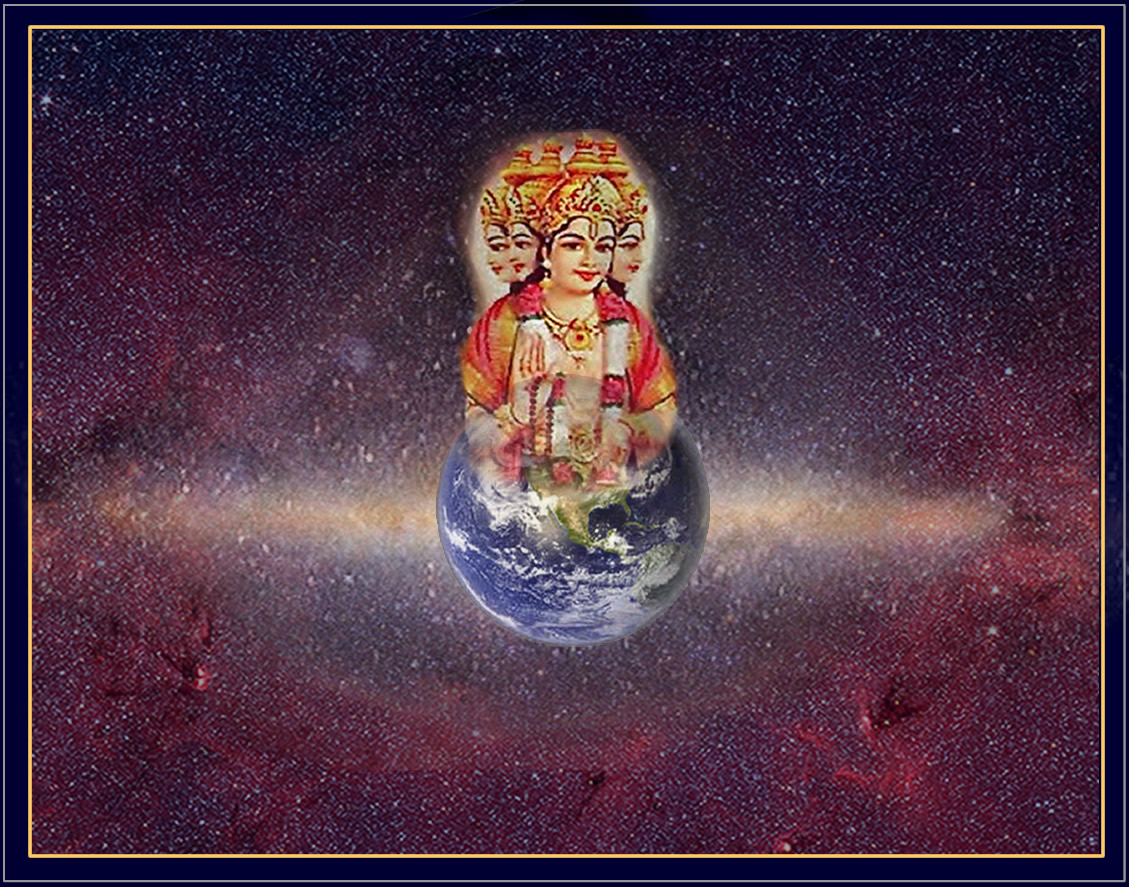
The picture
of Brahmâ as the center of the galactic whorl with mount Meru
is a digital collage of Anand Aadhar.
Production: Filognostic
Association of The Order of Time

Feed-back | Links | Downloads | Music | Pictures | What's New | Search | Donations


 Text 1