Canto 4
Chapter 6: Brahmâ Satisfies Lord S'iva
(1-2) Maitreya said: 'After all the demigods by the soldiers of Rudra were defeated with tridents, spears, swords, bludgeons and hammers, they, wounded all over their bodies, together with all the priests and other members of the assembly in great fear offered Lord Brahmâ their obeisances and reported the events to him in detail. (3) Knowing beforehand of the certainty of these events, the Lord born from the lotus flower [Brahmâ] and Nârâyana, the Supersoul of the entire universe [Vishnu], had not attended Daksha's sacrifice. (4) Hearing what had happened Lord Brahmâ said: 'A great personality has been offended and that is, given the wish to live in peace, generally not conducive for well-being. (5) Despite having committed these offenses in denying Lord S'iva his share of the offerings, you will all quickly find his mercy when you, without any mental reservations, satisfy him by taking shelter of his lotus feet. (6) Do not think you can continue with the sacrifice without forthwith begging for the pardon of the god of all worlds and their controllers you have angered; being deprived of his wife, his heart was most upset by the unkind words [spoken to him]. (7) Neither I, nor Indra, nor all of you and others who have a material body, nor even the sages who know the real extent of his strength and power, have an inkling of what it means to dare a thing like that with him who relies on the soul only.'
(8) After thus having instructed the godly souls Lord Brahmâ went away with in his wake the forefathers and the leaders of the people whom he took from his own place to the abode of Lord S'iva, Kailâsa, the best of all mountains that is so dear to the master. (9) The place, enjoyed by Kinnaras, Gandharvas, and Apsaras [the residents and singers of heaven and their wives] is populated by the perfected ones [or Siddhas] who differ from other people [or are gifted] by birth, by austerity, by their use of herbs or by practicing mantras in yoga. (10) The mountain range, home to a diversity of deer, is replete with all kinds of precious stones and minerals and is grown by trees, creepers and a diversity of other plants. (11) The mountain peaks with their crystal clear waterfalls have various caves pleasing to the wives of the mystics who sport there with their husbands. (12) Resounding with the cries of peacocks and the humming of bees mad about the nectar, there is the continuous song of cuckoos and chirping of other birds. (13) By the elephants moving around the mountain itself seems to be moving, by the sounds of the waterfalls the mountain itself seems to resound and by the trees that yield to all desires the mountain seems to be stretching its arms calling for the birds. (14-15) The mountain is further beautified by mandâra, pârijâta, sarala (pine) and tamâla trees, s'âla and tâla, kovidâra, âsana and arjuna trees, cûtas (mango), kadambas, dhûli-kadambas and nâgas, punnâgas and campakas and one also sees there trees like pâthalas, as'okas, bakulas, kundas and kurabakas. (16) It is also adorned with golden colored lotuses, the cinnamon tree and the mâlatî, kubja, mallikâ and mâdhavî. (17) With kata, jackfruit, julara and banyan trees, plakshas, nyagrodhas and trees producing asafoetida, there are also betelnut trees, pûgas, râjapûgas and jambus [black berries and greenery alike]. (18) Offering a variety of trees like kharjûras, âmrâtakas, âmras and such and others like priyâlas, madhukas and ingudas, it is further enriched with venu-kîcakaih and kîcaka [different sorts of bamboo]. (19-20) Kumuda, utpala, kahlâra and s'atapatra lotuses cover the lakes of the forests that, filled with the sweet whispers of flocks of birds, harbor deer, monkeys, boars, cats, bears, s'alyakas, forest cows and asses, tigers, smaller deer and buffaloes and such. (21) It is enjoyed by different types of deer like the karnântras, ekapadas, as'vâsyas, vrikas and kastûrîs and has groups of banana trees near the sandy banks of the beautiful hillside lakes filled with lotuses. (22) The devoted souls saw the waters of lake Alakanandâ still carrying the flavor of Satî who bathed there and they were struck with wonder about that mountain of the Lord of Ghosts. (23) There at Alakâ ['uncommonly beautiful'] they saw the region with the forest named Saugandhika ['full of fragrance'], that carried that name because of the species of lotus flowers one finds there. (24) The two rivers the Nandâ and Alakanandâ flowing close to the abode of the master, were supremely sanctified because of the dust of the lotus feet. (25) Dear ruler, in these two rivers the celestial damsels descended from their dwellings to play there after making love to their husbands and splatter each other with the water. (26) The two streams having turned yellow because of the kunkum powder [that washed from their breasts] make the elephants and their females who take a bath there drink from the water, despite not being thirsty. (27) The heavenly homes enjoyed by the wives of the virtuous souls were bedecked with countless valuable jewels, pearls and gold, that made them look like clouds in the sky brightened by flashes of lightening.
(28) Passing through the Saugandhika forest that was so attractive with its variety of trees yielding to all desires with its flowers, fruits and leaves, they reached the abode of the Lord of the Yakshas. (29) There they saw the beauty of many birds with red necks whose sounds mixed with the humming of bees as also lakes filled with lotus flowers attractive to groups of swans. (30) The breeze of the sandalwood trees made the wild elephants flock together and continuously stimulated the minds of the wives of the virtuous souls. (31) The staircases leading to the bathing places full of lotuses that were used by the ones faithful to the divine personality [the Kimpurushas], were made of vaidûrya stone. Having seen them they nearby spotted a banyan tree. (32) At a height of thousands of feet it spread out its branches over a quarter of the foot of the mountain, casting a fine cooling shadow. It had no birds nesting in it. (33) Underneath the tree the godly souls saw Lord S'iva, the shelter of many a great sage desiring liberation, who, in having given up his wrath, sat there as grave as eternal time.(34) Saintly liberated souls like the Kumâras headed by Sanandana and Kuvera, the master of the Guhyakas and Râkshasas, sat there worshipful around the solemn and serene Lord. (35) They saw him there as the master of the senses, the knowledge of austerity and the path of yoga; as the friend of the entire world who with his complete love is a blessing to each. (36) One could recognize him as the one desired by the ascetics: with ashes, a staff, matted hair, seated on an antelope skin, the reddish hue of his body and the crescent moon on his head. (37) With a mattress of darbha straw below him he, before an audience of all sages, conversed with Nârada about eternality and the Absolute Truth. (38) He had placed his left foot over his right thigh and, with his right hand resting on his knee, holding his prayer beads, he gesticulated in argument. (39) Thus leaning with his knee fixed and absorbed in the trance of spiritual bliss he, as the first thinker among the sages, received there the respects of the other sages and rulers of the different worlds who had folded their hands. (40) But when Lord S'iva saw that the self born one, Lord Brahmâ, had arrived accompanied by the best of the enlightened and unenlightened, he whose feet were worshiped stood up and bowed his head just like Vishnu did when He as Vâmanadeva welcomed Kas'yapa. (41) And so did the other perfected souls and great rishis who from all sides followed the example of their Lord and offered their obeisances. After that tribute to Lord S'iva, Lord Brahmâ addressed him with a smile.
(42) Brahmâ said: 'I know you as the controller of the entire manifestation of the cosmic creation, as the potency of both the seed [of the father] and the womb [of the mother] and as the one auspicious and supreme who is immaterial and free from change. (43) The way a spider manages its web, oh fortunate one, you create, maintain and destroy this universe with the embodiment of your auspicious energy. (44) In order to protect the benefits of dharma and artha [religion and economy] you empowered Daksha to realize [the system of] sacrifices and settle the respect for that what binds the people [the varnâs'rama system] and to which the brahmins are vowed with the highest regard. (45) Oh auspicious one, the deeds of him who strives to do good lead to the higher worlds, the heavens and the transcendental realm, while someone of inauspicious deeds awaits a ghastly hell. How can it be that for some these results turn out exactly opposite [with the good ones suffering and the bad ones prospering]? (46) Among devotees, who in full surrender at your feet perfectly recognize you as present in all kinds of living beings and who - from the Supreme position - make no difference between living beings, one practically never finds the anger that one does find among animalistic types of people. (47) Those who gave up on the heart, who look for results and make a difference between people, cannot tolerate it when others are faring well and thus are always angry with others and hurtful with harsh words. They do not need to be killed by you because they are killed by providence already. (48) When materialists at some places [allotted to Kalî see 1.17: 36], being bewildered by the insurmountable, illusory energy of the Great Blue One [the Lord as Pushkaranâbha] see matters [of right and wrong] differently, saintly persons out of their compassion will never use their prowess [against them] but be merciful instead, for everything is arranged by fate. (49) Oh Lordship, since the intelligence of you, the seer and knower of all, is never affected by that great potency of the material energy of the Supreme Person [or mâyâ], you in this case should strive to have mercy with those who are bewildered at heart because of that same illusory energy that attracts them to karmic activities. (50) Lord S'iva, you who would partake in the result of Daksha's now unfinished sacrifice, did what you had to do in putting an end to the sacrificial ceremony of his bad priests and destroying everything. Because they did not grant you, who bestow the results, your share of the sacrifice, you have the right to take what is yours. (51) Let the performer Daksha get his life back, let Bhagadeva get his eyes back, let Bhrigu grow his mustache back and let Pûsâ have his row of teeth as before. (52) Let the God-conscious souls whose limbs were broken and the priests who suffered from the weapons and stones, this very moment by your grace, oh angered one, recover from their injuries. (53) Oh Rudra, let the portion of whatever is left of this sacrifice be yours, my dear Lord, so that the sacrificial ceremony today can be completed, oh destroyer of the yajña.'


Third revised edition, loaded April 25, 2024.

Previous Aadhar edition and Vedabase links:
Maitreya said: 'After all the demigods by the soldiers of Rudra were defeated with tridents, spears, swords, bludgeons and hammers, they, wounded all over their bodies, together with all the priests and other members of the assembly in great fear offered Lord Brahmâ their obeisances and reported the events to him in detail.Maitreya said: 'After all the demigods had been defeated with tridents, spears, swords, bludgeons and hammers by the soldiers of Rudra, they together with all the priests and other members of the assembly in great fear reported the events to Lord Brahmâ, offering him obeisances. (Vedabase)
Knowing beforehand of the certainty of these events, the Lord born from the lotus flower [Brahmâ] and Nârâyana, the Supersoul of the entire universe [Vishnu], had not attended Daksha's sacrifice.
Knowing beforehand of the certainty of these events did the Lord born from the lotus flower [Brahmâ] and Nârâyana, the Supersoul of the entire universe [Vishnu], not attend to the sacrifice of Daksha. (Vedabase)
Hearing what had happened Lord Brahmâ said: 'A great personality has been offended and that is, given the wish to live in peace, generally not conducive for well-being.
As he heard what had happened said Lord Brahmâ: 'A great personality has been offended and that is, in desiring to exist so, generally not conducive to your happiness. (Vedabase)
Despite having committed these offenses in denying Lord S'iva his share of the offerings, you will all quickly find his mercy when you, without any mental reservations, satisfy him by taking shelter of his lotus feet.
Even though having committed these offenses in denying Lord S'iva his share of the offerings, should you all, unreserved, satisfy him and quickly find mercy in taking to the shelter of his lotus feet. (Vedabase)
Do not think you can continue with the sacrifice without forthwith begging for the pardon of the god of all worlds and their controllers you have angered; being deprived of his wife, his heart was most upset by the unkind words [spoken to him].
You cannot expect to continue with the sacrifice if you not forthwith beg your pardon with the god of all worlds and their controllers whom you have angered; being deprived of his wife he was in his heart very afflicted by the unkind words. (Vedabase)
Neither I, nor Indra, nor all of you and others who have a material body, nor even the sages who know the real extent of his strength and power, have an inkling of what it means to dare a thing like that with him who relies on the soul only.'
Nor I, nor Indra, nor all of you and others who have a material body, or even the sages who know the truth of the extent of his strength and power, have an inkling of what it means to try a thing like that with him, who relies on the soul only.' (Vedabase)?
After thus having instructed the godly souls Lord Brahmâ went away with in his wake the forefathers and the leaders of the people whom he took from his own place to the abode of Lord S'iva, Kailâsa, the best of all mountains that is so dear to the master.
After thus having instructed the godly ones went Lord Brahmâ away with in his wake the forefathers and the leaders of the people, taking them from his own place to the abode of Lord S'iva, Kailâsa, the best of all mountains so dear to the master. (Vedabase)
The place, enjoyed by Kinnaras, Gandharvas, and Apsaras [the residents and singers of heaven and their wives], is populated by the perfected ones [or Siddhas] who differ from other people [or are gifted] by birth, by austerity, by their use of herbs or by practicing mantras in yoga.
There one lives with the herbs and the austerity of the vedic hymns of yoga, is one together with the perfected ones appreciated by other people and always full of the Kinnaras, Gandharvas, and Apsaras [the residents and singers of heaven and their wives]. (Vedabase)
The mountain range, home to a diversity of deer, is replete with all kinds of precious stones and minerals and is grown by trees, creepers and a diversity of other plants.
The mountain range is filled with all kinds of precious jewels and is, grown by trees, creepers, and a diversity of plants, home to a diversity of deer. (Vedabase)
The mountain peaks with their crystal clear waterfalls have various caves pleasing to the wives of the mystics who sport there with their husbands.
The summits with their crystal clear waterfalls have various caves that accommodate the mystics sporting there with their loving wives. (Vedabase)
Resounding with the cries of peacocks and the humming of bees mad about the nectar, there is the continuous song of cuckoos and chirping of other birds.
Resounding with the cries of peacocks and the humming of bees blind of intoxication, there is the continuous song of cuckoos and chirping of other birds. (Vedabase)By the elephants moving around the mountain itself seems to be moving, by the sounds of the waterfalls the mountain itself seems to resound and by the trees that yield to all desires the mountain seems to be stretching its arms calling for the birds.
With the elephants moving and the sounds of the waterfalls there is it as if the trees, yielding to all desires, themselves moving are stretching their arms calling for the birds. (Vedabase)
The mountain is further beautified by mandâra, pârijâta, sarala (pine) and tamâla trees, s'âla and tâla, kovidâra, âsana and arjuna trees, cûtas (mango), kadambas, dhûli-kadambas and nâgas, punnâgas and campakas and one also sees there trees like pâthalas, as'okas, bakulas, kundas and kurabakas.
The mountain is further decorated with mandâra, pârijâta, sarala (pine) and tamâla trees, s'âla and tâla, kovidâra, âsana and arjuna trees, cûtas (mango), kadambas, dhûli-kadambas and nâgas, punnâgas and campakas and one also sees there trees like pâthalas, as'okas, bakulas, kundas and kurabakas. (Vedabase)
It is also adorned with golden colored lotuses, the cinnamon tree and the mâlatî, kubja, mallikâ and mâdhavî.
It is golden colored with the lotus and the cinnamon tree and beautified by the mâlatî, the kubja, the mallikâ and the mâdhavî flowers. (Vedabase)
Text 17
With kata, jackfruit, julara and banyan trees, plakshas, nyagrodhas and trees producing asafoetida, there are also betelnut trees, pûgas, râjapûgas and jambus [black berries and greenery alike].
With kata, jackfruit, julara and banyan trees, plakshas, nyagrodhas and trees producing asafoetida, there are also betelnut trees, pûgas, râjapûgas and jambus [black berries and greenery alike]. (Vedabase)
Offering a variety of trees like kharjûras, âmrâtakas, âmras and such and others like priyâlas, madhukas and ingudas, it is further enriched with venu-kîcakaih and kîcaka [different sorts of bamboo].
With the variety of trees like kharjûras, âmrâtakas, âmras and such and others like priyâlas, madhukas and ingudas, it is as well rich with venu-kîcakaih and kîcaka [different sorts of bamboo]. (Vedabase)
Kumuda, utpala, kahlâra and s'atapatra lotuses cover the lakes of the forests that, filled with the sweet whispers of flocks of birds, harbor deer, monkeys, boars, cats, bears, s'alyakas, forest cows and asses, tigers, smaller deer and buffaloes and such.
Kumuda, utpala, kahlâra and s'atapatra lotusses cover the lakes of the forests which, filled with the sweet whispers of flocks of birds, harbour deer, monkeys, cats, bears, s'alyakas, forest cows and asses, tigers, smaller deer and buffaloes and such. (Vedabase)
It is enjoyed by different types of deer like the karnântras, ekapadas, as'vâsyas, vrikas and kastûrîs and has groups of banana trees near the sandy banks of the beautiful hillside lakes filled with lotuses.
It is enjoyed by the different types of deer like the karnântras, ekapadas, as'vâsyas, vrikas and kastûrîs and has groups of banana trees at the beautiful lotus ponds with sandy banks. (Vedabase)The devoted souls saw the waters of lake Alakanandâ still carrying the flavor of Satî who bathed there and they were struck with wonder about that mountain of the Lord of Ghosts.
The devoted ones saw the special waters of lake Alakanandâ where Satî had bathed and they were struck with wonder about that mountain of the Lord of Ghosts. (Vedabase)
There at Alakâ ['uncommonly beautiful'] they saw the region with the forest named Saugandhika ['full of fragrance'], that carried that name because of the species of lotus flowers one finds there.
There they saw indeed at Alakâ ['uncommonly beautiful'] the abode of the forest named Saugandhika ['full of fragrance'], which was called that way because of the species of lotus flowers found there. (Vedabase)
The two rivers the Nandâ and Alakanandâ flowing close to the abode of the master, were supremely sanctified because of the dust of the lotus feet.
Even more sanctified by the dust of the lotus feet were the two rivers the Nandâ and Alakanandâ flowing near to the abode of the feet of the master. (Vedabase)
Dear ruler, in these two rivers the celestial damsels descended from their dwellings to play there after making love to their husbands and splatter each other with the water.
Dear ruler, in the both of them did the celestial damsels from their own dwellings after their lovemaking descend to play with their husbands, thereby splattering water at each other. (Vedabase)
The two streams having turned yellow because of the kunkum powder [that washed from their breasts] make the elephants and their females who take a bath there drink from the water, despite not being thirsty.
Both the streams yellow of the kunkum powder made, in offering them a bath, the elephants and their females drink the water, even though they weren't thirsty. (Vedabase)
The heavenly homes enjoyed by the wives of the virtuous souls were bedecked with countless valuable jewels, pearls and gold, that made them look like clouds in the sky brightened by flashes of lightening.
The heavenly homes enjoyed by the wives of the virtuous were bedecked with countless valuable jewels, pearls and gold which made them look like clouds brightened by the flashes of lightening. (Vedabase)
Passing through the Saugandhika forest that was so attractive with its variety of trees yielding to all desires with its flowers, fruits and leaves, they reached the abode of the Lord of the Yakshas.
Passing through the Saugandhika forest attractive with its variety of trees yielding with flowers, fruits and leaves to all desires, they reached the abode of the Lord of the Yakshas. (Vedabase)
There they saw the beauty of many birds with red necks whose sounds mixed with the humming of bees as also lakes filled with lotus flowers attractive to groups of swans.
There they saw the beauty of many birds with red necks whose sounds mixed with the humming of the bees and also lakes with groups of swans and the most precious lotus flowers. (Vedabase)
The breeze of the sandalwood trees made the wild elephants flock together and continuously stimulated the minds of the wives of the virtuous souls.
The breeze of the sandalwood trees made the wild elephants flock together and stimulated the minds of the wives of the virtuous over and over. (Vedabase)
The staircases leading to the bathing places full of lotuses that were used by the ones faithful to the divine personality [the Kimpurushas], were made of vaidûrya stone. Having seen them they nearby spotted a banyan tree.
The staircases to the bathing places full of lotuses, used by the loyal of the divine personality [the kimpurushas], were made of vaidûrya and having seen those spotted they not far away from there a banyan tree. (Vedabase)
At a height of thousands of feet it spread out its branches over a quarter of the foot of the mountain, casting a fine cooling shadow. It had no birds nesting in it.
At a height of thousands of feet it spread out its branches over a quarter of the foot of the mountain, casting a fine cooling shadow having no birds nesting in it. (Vedabase)
Underneath the tree the godly souls saw Lord S'iva, the shelter of many a great sage desiring liberation, who, in having given up his wrath, sat there as grave as eternal time.
Underneath it saw the godly ones Lord S'iva, the shelter of many a great sage desiring liberation, sitting there as grave as eternal time in having given up his wrath. (Vedabase)
Saintly liberated souls like the Kumâras headed by Sanandana and Kuvera, the master of the Guhyakas and Râkshasas, sat there worshipful around the solemn and serene Lord.
Saintly liberated souls like the Kumâras headed by Sanandana and Kuvera, the master of the Guhyakas and Râkshasas sat their in praise around the solemn and serene Lord. (Vedabase)
They saw him there as the master of the senses, the knowledge of austerity and the path of yoga; as the friend of the entire world who with his complete love is a blessing to each.
There they saw him as the master of the senses, the knowledge of austerity and the path of yoga; the friend of the whole world, who out of his full affection is the blessing for all. (Vedabase)
One could recognize him as the one desired by the ascetics: with ashes, a staff, matted hair, seated on an antelope skin, the reddish hue of his body and the crescent moon on his head.
He could be recognized as he is desired by the ascetics: with ashes, a staff, matted hair, seated on an antelope skin, the reddish hue of his body and the crescent moon on his head. (Vedabase)
With a mattress of darbha straw below him he, before an audience of all sages, conversed with Nârada about eternality and the Absolute Truth.
Sitting on a mattress of straw was he, for all the sages to hear, conversing with Nârada about the eternal and the Absolute Truth. (Vedabase)
He had placed his left foot over his right thigh and, with his right hand resting on his knee, holding his prayer beads, he gesticulated in argument.
With his left foot placed over his right thigh and with his right hand resting on his knee holding his prayer-beads, was he making a gesture of argument. (Vedabase)
Thus leaning with his knee fixed and absorbed in the trance of spiritual bliss he, as the first thinker among the sages, received there the respects of the other sages and rulers of the different worlds who had folded their hands.
He, leaning with his knee thus fixed and absorbed in the trance of spiritual bliss as the prime thinker of the wise, received there the respects from all the other sages present with their hands folded. (Vedabase)But when Lord S'iva saw that the self born one, Lord Brahmâ, had arrived accompanied by the best of the enlightened and unenlightened, he whose feet were worshiped stood up and bowed his head just like Vishnu did when He as Vâmanadeva welcomed Kas'yapa.
But when Lord S'iva, saw that the selfborn one, Lord Brahmâ, whose feet are worshiped, had arrived accompanied by the best of the enlightened and unenlightened, rose he to his feet and bowed he his head just like Vishnu did when He as Vâmanadeva welcomed Kas'yapa. (Vedabase)
And so did the other perfected souls and great rishis who from all sides followed the example of their Lord and offered their obeisances. After that tribute to Lord S'iva, Lord Brahmâ addressed him with a smile.
And so did the other perfected ones and great rishis, who verily from all sides followed their Lord in offering obeisances. After that demonstration of respect Lord Brahmâ smilingly began to address Lord S'iva. (Vedabase)
Brahmâ said: 'I know you as the controller of the entire manifestation of the cosmic creation, as the potency of both the seed [of the father] and the womb [of the mother] and as the one auspicious and supreme who is immaterial and free from change.
Brahmâ said: 'You I know as the controller, as the potency of both the father and the mother of the entire cosmic manifestation and as the one auspicious and supreme who is unchanging and immaterial. (Vedabase)
The way a spider manages its web, oh fortunate one, you create, maintain and destroy this universe with the embodiment of your auspicious energy.
You certainly from the favorable of your energy, by your personal expansion, o fortunate one, create, maintain and annihilate this universe that works like a spider's web. (Vedabase)
In order to protect the benefits of dharma and artha [religion and economy] you empowered Daksha to realize [the system of] sacrifices and settle the respect for that what binds the people [the varnâs'rama system] and to which the brahmins are vowed with the highest regard.
Truly of you do the loyal and vowed brahmins derive the benefits of religion and economy instituted by Daksha, in preparing the sacrifices for you in this world and regulating the necessary societal respect. (Vedabase)
Oh auspicious one, the deeds of him who strives to do good lead to the higher worlds, the heavens and the transcendental realm, while someone of inauspicious deeds awaits a ghastly hell. How can it be that for some these results turn out exactly opposite [with the good ones suffering and the bad ones prospering]?
O most auspicious of the auspicious, to your lordship do the prescribed duties of the performer lead to higher worlds, the heavens and the transcendental and does one wonder why there for someone is also the opposite and the unfortunate of a ghastly hell. (Vedabase)
Among devotees, who in full surrender at your feet perfectly recognize you as present in all kinds of living beings and who - from the Supreme position - make no difference between living beings, one practically never finds the anger that one does find among animalistic types of people.
But with the devotees who in full surrender at your feet perfectly see you present in all sorts of living beings and from within the Supreme make no difference between living beings, there is practically never the anger found, one finds with animalistic men. (Vedabase)
Those who gave up on the heart, who look for results and make a difference between people, cannot tolerate it when others are faring well and thus are always angry with others and hurtful with harsh words. They do not need to be killed by you because they are killed by providence already.
Those who think everything is different, look for results and can't stand it when others are doing well; they who have given up on the heart inflict in constant anger with others pain with harsh words. They do not need to be killed by you as they are killed by providence already. (Vedabase)
When materialists at some places [allotted to Kalî see 1.17: 36], being bewildered by the insurmountable, illusory energy of the Great Blue One [the Lord as Pushkaranâbha] see matters [of right and wrong] differently, saintly persons out of their compassion will never use their prowess [against them] but be merciful instead, for everything is arranged by fate.
When at some places persons bewildered by the insurmountable illusory energy of the Great Blue One [the Lord as Pushkaranâbha], have a different idea, will saintly persons out of compassion never use their prowess but have mercy instead, for everything is settled by providence. (Vedabase)
Oh Lordship, since the intelligence of you, the seer and knower of all, is never affected by that great potency of the material energy of the Supreme Person [or mâyâ], you in this case should strive to have mercy with those who are bewildered at heart because of that same illusory energy that attracts them to karmic activities.
O your Lordship, but of the great potency of the Supreme Person His material energy is the intelligence, that sees and knows everything, by the same illusory energy unaffected, so in this case, o Lord, you have to be of mercy with those who, out of their being enslaved, are bewildered at heart. (Vedabase)
Lord S'iva, you who would partake in the result of Daksha's now unfinished sacrifice, did what you had to do in putting an end to the sacrificial ceremony of his bad priests and destroying everything. Because they did not grant you, who bestow the results, your share of the sacrifice, you have the right to take what is yours.
O Lord S'iva, you did what you had to do, putting an end to the complete of the sacrifice of the bad priests of Daksha who would get the result of the now unfinished sacrifice he held; from that sacrifice, not being granted your share, you have the right to take what's yours. (Vedabase)
Let the performer Daksha get his life back, let Bhagadeva get his eyes back, let Bhrigu grow his mustache back and let Pûsâ have his row of teeth as before.
Let the performer Daksha get his life back, Bhagadeva get his eyes back, Bhrigu grow his mustache back and let Pûsâ as before have his row of teeth. (Vedabase)Let the God-conscious souls whose limbs were broken and the priests who suffered from the weapons and stones, this very moment by your grace, oh angered one, recover from their injuries.
Let the god conscious whose limbs were broken and the priests who suffered from the weapons and stones, directly now, by your favor, o angered one, recover from their injuries. (Vedabase)
Oh Rudra, let the portion of whatever is left of this sacrifice be yours, my dear Lord, so that the sacrificial ceremony today can be completed, oh destroyer of the yajña.'
O Rudra, let the portion of whatever is left of this sacrifice be yours my dear Lord, so that that offering today may find its completion, o destroyer of the yajña. (Vedabase)

The text and audio are offered under the
conditions of the
Creative Commons
Attribution-Noncommercial-Share Alike 3.0 Unported License.
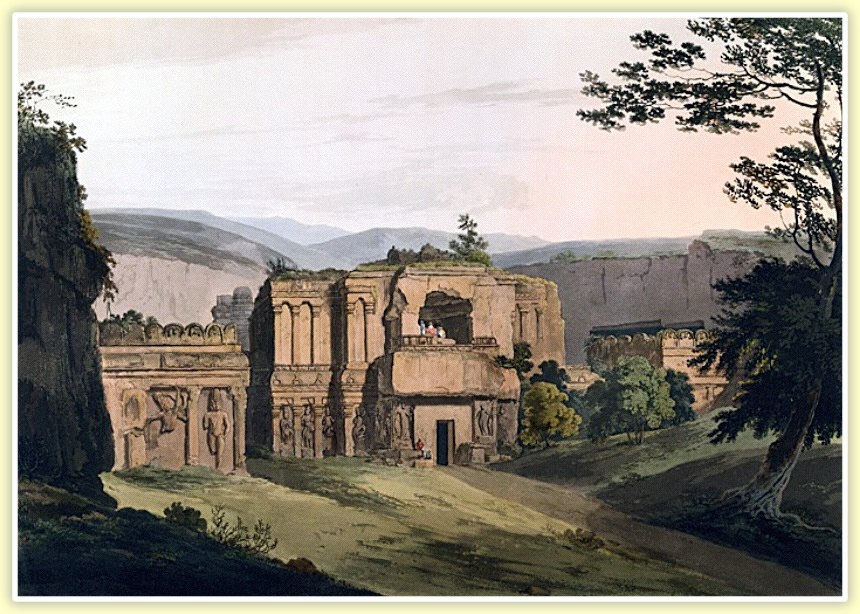
The first picture is a coloured aquatint titled: 'The Entrance
to Kailasa'
Engraver: Daniell, Thomas (1749-1840) Date: 1803.
Courtesy: Bristish
Library OnlineGallery.
The second painting is titled: 'Kailashpati on Kailash
(Meditating Shiva) with Shivalinga of Ice'
It is © of Exoticindiaart.com. Used with permission.
Production: Filognostic
Association of The Order of Time

Feed-back | Links | Downloads | Music | Pictures | What's New | Search | Donations