Canto
4
Chapter 2: Daksha Curses Lord S'iva
(1) Vidura said: 'Why exhibited Daksha enmity towards Lord S'iva, the best among all gentle souls, while he neglected his daughter Satî whom he cared so much about? (2) How could he hate him who is the spiritual master of the entire world and who, being satisfied within with a peaceful personality and free from enmity, is the greatest demigod of the universe? (3) Satî gave up the life that is so difficult to give up. So please tell me the reason why, oh brahmin, the father-in-law and son-in-law quarreled?'
(4) Maitreya said: 'Once in the past at a sacrifice held by the ruler of creation [the Prajâpati], all the immortal souls, the great sages along with the philosophers, the demigods and the gods of the sacrificial fire together with all their followers had assembled. (5) When he [Daksha] arrived at that great assembly, the sages could see him as someone who, free from the darkness of ignorance, shone like the sun. (6) The members of the assembly along with those taking care of the fire, impressed by his luster, all stood up from their seats, with the exception of Lord Brahmâ and Lord S'iva. (7) Daksha, the great lord, who was properly welcomed by the leaders of the assembly, made his obeisances towards the one unborn [Brahmâ], the master of the world, and sat down upon his order. (8) Before he took his seat though, he felt insulted by Lord S'iva who showed no sign of respect. He lost his temper and with an angry look in his eyes said the following. (9) 'Listen to me, oh wise among the brahmins, oh godly souls and fire gods, as I speak to you about the manners of the gentle-minded, and this I do not out of ignorance or jealousy. (10) He [S'iva] lacking in manners, has shamelessly spoilt the fame of the rulers of the universe and polluted the path of proper conduct. (11) Acting like an honest man, he [as a son of mine] has accepted to be of a lower position by taking the hand of my daughter in the presence of fire and brahmins. (12) Accepting the hand of her who has eyes like that of a deer cub and himself having the eyes of a monkey, he has not, as it should, honored me with a word of welcome and by standing up from his seat. (13) Contrary to what I want I gave my daughter to someone with no respect for the rules and regulations, to someone who impure and proud has broken with the code of conduct, as if I gave the message of the Vedas to a s'ûdra! (14-15) In the company of ghosts and demons he wanders around at the burial places where corpses are burned and laughs and cries there like a madman, with scattered hair smearing himself with the ashes of the funeral pyre. He has a garland of skulls and is ornamented with dead man's bones; he is only in name S'iva or auspicious. He is in fact inauspicious, crazy and dear to the crazy, he is their leader and Lord engrossed in the mode of ignorance! (16) To him, the Lord of the Ghosts void of all cleanliness with a heart full of awkward matters, I alas, upon the request of the supreme teacher [Brahmâ], have given away Satî.'
(17) Maitreya said: 'Thus having abused S'iva who remained without hostility, Daksha next rinsed his hands and mouth with water and began to curse him angrily: (18) 'The portion of the sacrifice to God that the demigods along with Indra, Upendra [the younger brother of Indra] and others are entitled to, is there not for the lowest of the demigods.' (19) Even though the members of the assembly urged him not to, Daksha, having cursed S'iva, left the place and went home, oh Vidura, for he had gotten very angry. (20) Understanding that Lord S'iva had been cursed, one of his principal associates Nandîs'vara, turned red. Blind with anger he harshly condemned Daksha and the brahmins who had allowed the cursing to take place.
(21) 'May he who in the physical presence of him, the non-envious Lord S'iva, bears envy and thus is stupefied by a dual vision, lose all his grip on reality. (22) He who is attracted to a householder's life of pretentious religiosity and in a desire for material happiness performs fruitive activities, will see his intelligence concerning the Vedic word fail. (23) He who, with the intelligence of taking the body for one's self, has forgotten the knowledge of Vishnu and as an animal is attached to his sex life, let that excessive Daksha, soon get the head of a goat! (24) May those who follow Daksha in his insults and dulled in the ignorance of their fruitive activities have lost their intelligence and knowledge, time and again end up here in the ocean of material suffering. (25) May those who are so envious with Lord S'iva and whose minds became slow because of the enchanting flowery words of the Vedas that are so pervaded with the scent of honey, for ever be stupefied. (26) Let those brahmins who have taken to education, austerity and vows for the purpose of acquiring money and satisfying their physical senses, as beggars wander from door to door, eating whatever!'
(27) When Bhrigu heard the words of this curse against the class of the twice-born, he in response pronounced an insurmountable curse following the brahminical way of chastising: (28) 'May anyone who takes a vow to please Lord S'iva and follows such principles, become an atheist straying away from the scriptural injunctions. (29) May those who took initiation to worship S'iva and abandoning cleanliness, foolishly have their hairs long, wear bones and are covered by ashes, find their destiny in intoxication. (30) Because you [Nandîs'vara], blaspheme the Vedas and the brahmins who support the established rules of society, you have sought your refuge in atheism. (31) In the Vedas, which in the past have always been rigidly followed for being the auspicious, eternal path for all people, one finds the evidence of Janârdana [the Lord as the well-wisher of all]. (32) Blaspheming that supreme and pure spirit constituting the eternal path of the truthful souls, you are doomed to end up in atheism wherein the Lord of matter and death [S'iva as Bhûtapati] is your deity!'
(33) Maitreya said: 'After one thus had spoken about S'iva with the curse of Bhrigu, the Supreme One, somewhat downcast, left the place together with his followers. (34) And so did the fathers of mankind for a thousand years settle for the sacrifice, oh great master, in which the chief of all gods is Hari, the Supreme Personality. (35) After purifying their hearts by taking a ceremonial, concluding bath at the place where the Ganges meets the Yamunâ, they all left from there to return to their own places.'


Third revised edition, loaded March 27, 2024.
Previous Aadhar edition and Vedabase links:
Vidura said: 'Why exhibited Daksha enmity towards Lord S'iva, the best among all gentle souls, while he neglected his daughter Satî whom he cared so much about?Vidura said: 'Why did Daksha exhibit enmity towards Lord S'iva, the best among the gentle, neglecting his own daughter Satî while he cared so much about her? (Vedabase)
How could he hate him who is the spiritual master of the entire world and who, being satisfied within with a peaceful personality and free from enmity, is the greatest demigod of the universe?
How could he hate him who is the spiritual master of the whole world and who, with a peaceful personality and satisfied without enmity within, is the greatest demigod of the universe? (Vedabase)
Satî gave up the life that is so difficult to give up. So please tell me the reason why, oh brahmin, the father-in-law and son-in-law quarreled?'
Tell me therefore, o brahmin, the reason because of which the father- and son-in-law quarreled and because of which Satî gave up the life that is impossible to give up.' (Vedabase)
Maitreya said: 'Once in the past at a sacrifice held by the ruler of creation [the Prajâpati], all the immortal souls, the great sages along with the philosophers, the demigods and the gods of the sacrificial fire together with all their followers had assembled.
Maitreya said: 'Formerly, were the leaders, great sages and immortal ones of the creation along with their followers and the philosophers assembled at a sacrifice. (Vedabase)
When he [Daksha] arrived at that great assembly, the sages could see him as someone who, free from the darkness of ignorance, shone like the sun.
Entering that great assembly there made the sages see him [Daksha], free from darkness as he was, as shining with a luster like that of the sun. (Vedabase)
The members of the assembly along with those taking care of the fire, impressed by his luster, all stood up from their seats, with the exception of Lord Brahmâ and Lord S'iva.
They, the members of the assembly along with the ones of the fire, who were impressed by his luster all, except for Lord Brahmâ and Lord S'iva, stood up from their seats. (Vedabase)
Daksha, the great lord, who was properly welcomed by the leaders of the assembly, made his obeisances towards the unborn one [Brahmâ], the master of the world, and sat down upon his order.
Daksha, the one of all opulence, who was properly welcomed by the leaders of the assembly, made his obeisances towards the unborn one, the master of the world, and sat down upon his order. (Vedabase)
Before he took his seat though, he felt insulted by Lord S'iva who showed no sign of respect. He lost his temper and with an angry look in his eyes said the following.
Before the seated Lord S'iva, who showed no respect for him, he felt offended though and losing his temper he spoke to him with an angry look in his eyes. (Vedabase)
'Listen to me, oh wise among the brahmins, oh godly souls and fire gods, as I speak to you about the manners of the gentle-minded, and this I do not out of ignorance or jealousy.
'Listen to me, o wise among the brahmins, o godly ones, o fire-gods, how I speak to you about the manners of the gentle ones, and this I do not out of ignorance or jealousy. (Vedabase)
He [S'iva] lacking in manners, has shamelessly spoilt the fame of the rulers of the universe and polluted the path of proper conduct.
He, who belongs to the rulers of the universe, has, lacking in manners, shamefully polluted and spoilt the fame of the ones following the path of the gentle ones. (Vedabase)
Acting like an honest man, he [as a son of mine] has accepted to be of a lower position by taking the hand of my daughter in the presence of fire and brahmins.
He has accepted to be of a lower position, acting like an honest man in taking the hand of my daughter, in the presence of fire and brahmins. (Vedabase)
Accepting the hand of her who has eyes like that of a deer cub and himself having the eyes of a monkey, he has not, as it should, honored me with a word of welcome and by standing up from his seat.
Taking the hand of her who has eyes like that of a deer cub, he has himself the eyes of a monkey, not welcoming me, who is worthy of such a reception, with the honor of standing up from his seat. (Vedabase)
Contrary to what I want I gave my daughter to someone with no respect for the rules and regulations, to someone who impure and proud has broken with the code of conduct, as if I gave the message of the Vedas to a s'ûdra!
With no respect for the rules and regulations, he, impure and proud, has broken with the code of civility; although I didn't want to, have I handed over my daughter as if the message of the Vedas would be given to a s'ûdra. (Vedabase)
In the company of ghosts and demons he wanders around at the burial places where corpses are burned and laughs and cries there like a madman, with scattered hair smearing himself with the ashes of the funeral pyre. He has a garland of skulls and is ornamented with dead man's bones; he is only in name S'iva or auspicious. He is in fact inauspicious, crazy and dear to the crazy, he is their leader and Lord engrossed in the mode of ignorance!
Accompanied by ghosts and demons he wanders around at the burial places where corpses are burnt, laughing and crying like a madman, with scattered hair smearing himself with the ashes of the funeral pyre. He has a garland of skulls and is ornamented with dead man's bones; only in name he is S'iva or auspicious. He is in fact inauspicious, crazy and dear to the crazy, their leader and Lord, engrossed in the mode of ignorance. (Vedabase)
To him, the Lord of the Ghosts void of all cleanliness with a heart full of awkward matters, I alas, upon the request of the supreme teacher [Brahmâ], have given away Satî.'
To him, the Lord of Ghosts, void of all cleanliness, with his heart so far off, I alas, as the supreme teacher did request, have given Satî.' (Vedabase)
Maitreya said: 'Thus having abused S'iva who remained without hostility, Daksha next rinsed his hands and mouth with water and began to curse him angrily:
Maitreya said: 'Thus abusing S'iva who remained without hostility, Daksha angry, next washed his hands and mouth with water and began to curse: (Vedabase)
Text 18
'The portion of the sacrifice to God that the demigods along with Indra, Upendra [the younger brother of Indra] and others are entitled to, is there not for the lowest of the demigods.'
'The portion of the sacrifice to the gods that the demigods have along with Indra, Upendra [the younger brother of Indra] and others, is not for the lowest of the demigods to get.' (Vedabase)
Even though the members of the assembly urged him not to, Daksha, having cursed S'iva, left the place and went home, oh Vidura, for he had gotten very angry.
Though asked by the members of the assembly not to, did he, Daksha, having cursed S'iva, leave from there going home, o Vidura, as he had grown very angry. (Vedabase)
Understanding that Lord S'iva had been cursed, one of his principal associates Nandîs'vara, turned red. Blind with anger he harshly condemned Daksha and the brahmins who had allowed the cursing to take place.
Understanding that Lord S'iva had been cursed, one of his principal associates Nandis'vara, turned red and blind with anger and he harshly cursed Daksha and the brahmins who had allowed the cursing to happen. (Vedabase)
'May he who in the physical presence of him, the non-envious Lord S'iva, bears envy and thus is stupefied by a dual vision, lose all his grip on reality.
'May he who in reference to the physique of this one, the non-envious Lord S'iva, bears envy and thus is stupefied by a dual vision, lose all his grip on reality. (Vedabase)He who is attracted to a householder's life of pretentious religiosity and in a desire for material happiness performs fruitive activities, will see his intelligence concerning the Vedic word fail.
He who is attracted to the householders life of pretentious religiosity and performs by the explanations of the Vedas in a desire for material happiness and fruitive action, will see his intelligence lost. (Vedabase)
He who, with the intelligence of taking the body for one's self, has forgotten the knowledge of Vishnu and as an animal is attached to his sex life, let that excessive Daksha, soon get the head of a goat!
Let him who with the intelligence of accepting the body as the self has forgotten the knowledge of Vishnu and as an animal is attached to sex-life, that excessive Daksha, soon have the head of a goat. (Vedabase)
May those who follow Daksha in his insults and dulled in the ignorance of their fruitive activities have lost their intelligence and knowledge, time and again end up here in the ocean of material suffering.
May those who follow Daksha in his insults and who in the nescience of their fruitive actions grew dull in their materialistic education and intelligence, time and again end up here in the ocean of material suffering. (Vedabase)
May those who are so envious with Lord S'iva and whose minds became slow because of the enchanting flowery words of the Vedas that are so pervaded with the scent of honey, for ever be stupefied.
Let those who are so envious with Lord S'iva and whose minds have grown slow of the enchanting flowery words of the Vedas so profuse with the scent of honey, remain attached. (Vedabase)
Let those brahmins who have taken to education, austerity and vows for the purpose of acquiring money and satisfying their physical senses, as beggars wander from door to door, eating whatever!'
Let those brahmins, who have taken to education, austerity and vows in order to have money and to satisfy their physical senses, wander here as beggars from door to door, eating whatever!' (Vedabase)
When Bhrigu heard the words of this curse against the class of the twice-born, he in response pronounced an insurmountable curse following the brahminical way of chastising:
Hearing the words of his curse thus against the class of the twiceborn, pronounced in response Bhrigu an insurmountable curse in line with the brahminical way of chastising: (Vedabase)
'May anyone who takes a vow to please Lord S'iva and follows such principles, become an atheist straying away from the scriptural injunctions.
'May anyone who takes a vow to please Lord S'iva and follows such principles, become an atheist straying away from the scriptural injunctions. (Vedabase)
May those who took initiation to worship S'iva and abandoning cleanliness, foolishly have their hairs long, wear bones and are covered by ashes, find their destiny in intoxication.
Let them, who have abandoned cleanliness, foolishly having their hairs long, wearing bones and covered in ashes, embark on the lead of S'iva from which one has the spiritual of finding relief in intoxication. (Vedabase)
Because you [Nandîs'vara], blaspheme the Vedas and the brahmins who support the established rules of society, you have sought your refuge in atheism.
Since you in truth blaspheme the brahmins and the allegiance to the Vedas, you have therefore taken shelter of the weakness of atheism. (Vedabase)
In the Vedas, which in the past have always been rigidly followed for being the auspicious, eternal path for all people, one finds the evidence of Janârdana [the Lord as the well-wisher of all].
In the Vedas, that are for sure the auspicious eternal path of all people and which in the past have always been rigidly followed, one finds the evidence of Janârdana [the Lord as the well-wisher of all]. (Vedabase)
Blaspheming that supreme and pure spirit constituting the eternal path of the truthful souls, you are doomed to end up in atheism wherein the Lord of matter and death [S'iva as Bhûtapati] is your deity!'
Blaspheming that supreme and pure spirit, which is the eternal path of the truthful, you are to end up in atheism where you have your deity, the Lord of matter and the dead [S'iva as Bhûtapati]!' (Vedabase)
Maitreya said: 'After one thus had spoken about S'iva with the curse of Bhrigu, the Supreme One, somewhat downcast, left the place together with his followers.
Maitreya said: 'Thus being spoken of in the curse of Bhrigu, did S'iva, the Supreme One, somewhat downcast, leave from there with his followers. (Vedabase)
And so did the fathers of mankind for a thousand years settle for the sacrifice, oh great master, in which the chief of all gods is Hari, the Supreme Personality.
Of that, are even the fathers of mankind for thousands of years in worship, o great master, as that is how the Supreme Personality, the leader of all the wise, should be respected. (Vedabase)
After purifying their hearts by taking a ceremonial, concluding bath at the place where the Ganges meets the Yamunâ, they all left from there to return to their own places.'
Purifying their hearts, taking their ceremonial concluding bath where the Ganges meets with the Yamunâ, they all left from there heading for their own places. (Vedabase)

The text and audio are offered under the
conditions of
the
Creative Commons Attribution-Noncommercial-Share Alike
3.0
Unported License.
The hindu
vintage
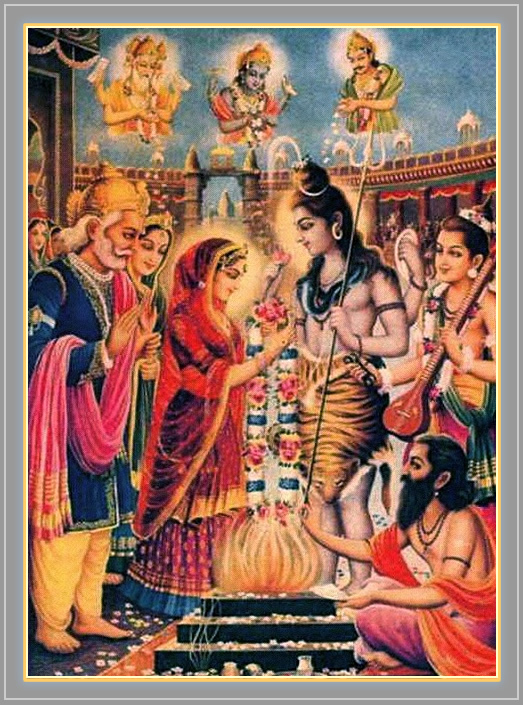
image shows S'iva as the one loved by all during his marriage.
Production: Filognostic
Association
of The
Order of Time

Feed-back | Links | Downloads | Music | Pictures | What's New | Search | Donations