Canto 4
Chapter 13: Description of the Descendants of Dhruva Mahârâja
(1) Sûta said [to the rishis at Naimishâranya]: "Hearing Maitreya's description of Dhruva's ascent to the abode of Vaikunthha, Vidura's love for the Supreme Lord in the beyond grew and again he began to question Maitreya Muni.
(2) Vidura asked: 'Who were they, you called the Pracetâs? Which family were they known by, whose sons were they, oh best among the sworn, and where performed they their sacrifice? (3) I think that Nârada is the greatest of all the devotees; he saw God before his eyes and described the procedure of rendering devotional service to the Lord [in kriyâ-yoga or the pâñcarâtrika-method]. (4) When these men were performing their sacrificial duties in worship of the Supreme Lord, the Enjoyer of All Sacrifices was by Nârada described with devotion. (5) Oh brahmin, be so kind to tell me, so very eager to hear, in full all the stories about the Lord that were narrated there by the devarishi.'
(6) Maitreya said: 'Utkala, the son of Dhruva, after his father departed for the forest, did not desire the throne of the emperor, his father, with all the lands and opulence belonging to it. (7) From the day he was born he was a most satisfied, unattached soul, who equipoised saw the Supersoul as spread everywhere in the world and all the world as resting in the Supersoul. (8-9) Because of his single-minded resolve about the spirit of the Absolute, his being separated from heaven had ended in the oneness of the Self. A consequent yoga practice had increased his bliss that as fire burned away the karmic impurities of his mind. Thus realizing his constitutional position all his thoughts were devoted to the Soul of all Souls. (10) Out on the road he to the less intelligent appeared to be like a fool, blind, deaf, dumb and mad, but actually his intelligence was more like a fire with its flames tempered. (11) Thinking that Utkala had no intelligence and was mad, the elders of the family and the ministers of state appointed Vatsara, the younger son of Bhrami, ruler of the world. (12) Svarvîthi, King Vatsara's dearest wife, gave birth to six sons: Pushpârna, Tigmaketu, Isha, Ûrja, Vasu and Jaya. (13) Pushpârna had two wives, Doshâ and Prabhâ. Of Prabhâ there were the sons Prâtar, Madhyandinam and Sâyam. (14) Pradosha, Nis'itha and Vyushtha were the three sons of Doshâ. Vyushtha begot in his wife Pushkarinî a son named Sarvatejâ [the all powerful one]. (15-16) His wife, called Âkûti, gave birth to a son named Câkshusha who was the [sixth] Manu. His queen Nadvalâ bore him [twelve] pure sons: Puru, Kutsa, Trita, Dyumna, Satyavân, Rita, Vrata, Agnishthoma, Atîrâtra, Pradyumna, S'ibi and Ulmuka. (17) Ulmuka begot six very good sons in Pushkarinî [who had the same name as her predecessor]: Anga, Sumanâ, Khyâti, Kratu, Angirâ and Gaya. (18) The wife of Anga, Sunîthâ, gave birth to Vena who was very crooked. Disappointed about his bad character the wise king Anga left the city [to live in the forest]. (19-20) He [Vena] was cursed by the sages whose angry words struck him like thunder. After that had happened he died. Being without a king all the inhabitants of the world were pestered by thieves and rogues. They then churned his right arm [his 'hand'], upon which a partial incarnation [ams'a-avatâra] of Nârâyana descended called Prithu, who became the original Lord of the Earth.
(21) Vidura said: 'With King Anga being such a reservoir of good qualities and a saintly person, a lover of brahminical culture and a great soul, how could his son be so bad that he became indifferent and left? (22) Why did the sages conversant with the religious principles who saw Vena's faults, desire to pronounce the brahmin's curse against him, while it was the king who carried the rod of punishment? (23) The king is never to be insulted by the citizens, however sinful he may be, because he by his personal influence maintains the power of all the local officials. (24) Please describe to me, your faithful devotee, oh brahmin, all there is to say about the activities of the son of Sunîthâ, for you are well conversant with [the things of] heaven and earth.'
(25) Maitreya replied: 'King Anga once executed a great as'vamedha sacrifice, but to that great offering all the godly souls never attended, despite the fact that they were invited by the officiating brahmins. (26) Puzzled about it they then told the instigator of the sacrifice: 'The godly souls do not accept the oblations in the fire of the priests. (27) Oh King, there is nothing impure about the offerings that you with great care collected, nor is there anything wrong with the proper execution of the mantras by the qualified brahmins. (28) In this we cannot find the least insult or neglect in respect of the godly souls, because of which the God-conscious who were to witness the sacrifice, would not accept their share.'
(29) Maitreya said: 'King Anga, the performer of the sacrifice, was very depressed after hearing what the twice-born souls said. He then, with their permission, addressed the priests to be informed by them: (30) 'Being invited the ones of God are not going to [attend the sacrificial ceremony and] accept their share of the offerings. My dear priests, please tell me what offense I have committed.'
(31) The leading priests said: ‘Oh god of man, in this life you have not committed even the slightest sin, but in your previous life there was an impurity because of which you in this life are without a son. (32) We, who wish you all good fortune, therefore say to you: execute the sacrifice to get good offspring, oh King, when you worship the Lord, the enjoyer of the sacrifice, with the desire to get a son, He will grant you one. (33) All the men of God will thereupon accept their share of the sacrifice, because then, for the purpose of [getting] a son, evidently the Supreme Personality has been invited. (34) The Lord being worshiped will award the person whatever he desires; people will reap the fruits of their actions according to the way they were of respect for Him.'
(35) For the king to get a son the scholars, thus having decided, offered rice cake in the fire of the Lord of the Flames [Vishnu]. (36) As a result a person appeared in white garments with a golden garland and a golden pot wherein he carried rice boiled in milk. (37) The king, firmly rooted in the noble mind, took with the permission of the scholars the in milk boiled rice in his joined palms and, after smelling with great delight, offered it to his wife. (38) The childless queen ate from the food that would give her a child and indeed was impregnated by the husband. In due time she then gave birth to a son. (39) That boy appeared partly following in the footsteps of his death-oriented, maternal, irreligious grandfather. He therefore became an offender of the holy duty. (40) He used to take up his bow as a hunter and go into the forest to kill innocent deer. Thus all the people cried: 'There he is, the cruel Vena!' (41) While playing in the playground with boys of his age he very cruelly violently killed them mercilessly as if he slaughtered animals. (42) Seeing how cruel his son was, the king, by different means of punishment, could not get a grip on him and thus became most aggrieved. He thought: (43) 'They who are without a son living at home must have worshiped the Lord [in a previous life]. They do not have to suffer the unbearable sorrow because of such a bad son. (44) Because of his sinful reputation and unrighteousness there will be great discord among the people and endless anxiety. (45) Who would want such a so-called son? He inevitably binds the soul to illusion; what intelligent person would value a son who brings misery to one's family life? (46) I think it is better to have a bad son than a good one. Because of a hellish household a mortal can detach himself from his home as a source of misery.'
(47) Thus grown indifferent the king, unable to sleep, got up in the middle of the night to forsake his home that was so opulent because of the blessings of the great souls. Not noticed by anyone he left Vena's mother who was fast asleep. (48) As soon as was understood that the king, no longer taking care, had left, all the citizens, priests and ministers, friends and the rest of the people searched the earth in great bereavement, like they were inexperienced yogis looking [outside] for the original person hidden [within the heart]. (49) Not finding a trace of the father of the nation, oh Kaurava, the citizens returned disappointed to their city and informed, after offering their respects, with tears in their eyes the assembled sages about the absence of the king.'


Third revised edition, loaded September 10, 2017.
Previous Aadhar edition and Vedabase links:
Sûta said [to the rishis at Naimishâranya]: "Hearing Maitreya's description of Dhruva's ascent to the abode of Vaikunthha, Vidura's love for the Supreme Lord in the beyond grew and again he began to question Maitreya Muni.
Sûta said [to the rishis at Naimishâranya]: "The hearing of the description of Maitreya of Dhruva's ascent to the abode of Vaikunthha, made Vidura's love for the Supreme Lord, who cannot be seen by one's normal eyes, grow and again he made an effort to question Maitreya Muni. (Vedabase)
Vidura asked: 'Who were they, you called the Pracetâs? Which family were they known by, whose sons were they, oh best among the sworn, and where performed they their sacrifice?
Vidura asked: 'Who where they, you called the Pracetâs? What was the renown of their family and who were their sons, o best among the sworn, and what sacrifice did they perform? (Vedabase)
I think that Nârada is the greatest of all the devotees; he saw God before his eyes and described the procedure of rendering devotional service to the Lord [in kriyâ-yoga or the pâñcarâtrika-method].
I think that Nârada is the greatest of all the devotees; he saw God in the eye and he spoke about the procedure of rendering service in devotion unto the Lord [kriyâ-yoga or the pâñcarâtrika-method]. (Vedabase)
When these men were performing their sacrificial duties in worship of the Supreme Lord, the Enjoyer of All Sacrifices was by Nârada described with devotion.
When these men were doing their duties of sacrifice in worship of the Supreme Lord, was He by Nârada full of devotion described. (Vedabase)
Oh brahmin, be so kind to tell me, so very eager to hear, in full all the stories about the Lord that were narrated there by the devarishi.'
O brahmin, be so kind to tell me in full, what stories about the Lord were all narrated there by the devarishi.' (Vedabase)
Maitreya said: 'Utkala, the son of Dhruva, after his father departed for the forest, did not desire the throne of the emperor, his father, with all the lands and opulence belonging to it.
Maitreya said: 'Utkala, the son of Dhruva, did, after his father departed for the forest, not desire the royal seat of his father with all its lands and opulence. (Vedabase)
From the day he was born he was a most satisfied, unattached soul, who equipoised saw the Supersoul as spread everywhere in the world and all the world as resting in the Supersoul.
From his very birth, he was a satisfied, unattached soul, who equipoised, saw the Supersoul spread everywhere in the world and all the world as resting in the Supersoul. (Vedabase)
Because of his single-minded resolve about the spirit of the Absolute, his being separated from heaven had ended in the oneness of the self. A consequent yoga practice had increased his bliss that as fire burned away the karmic impurities of his mind. Thus realizing his constitutional position all his thoughts were devoted to the Soul of all Souls.
Relating to the holy spirit had, for his spiritual soul, ended the separation from heaven [nirvâna] and by a continuing yoga-practice he had increased his bliss, that as fire burnt all the impurities of karma out of his mind; thus realizing his constitutional position he then saw nothing but the Supreme Soul. (Vedabase)
Out on the road he to the less intelligent appeared to be like a fool, blind, deaf, dumb and mad, but actually his intelligence was more like a fire with its flames tempered.
Out on the road appeared he, to the less intelligent, to be like a fool, blind, deaf, dumb and mad, but actually was his intelligence more like a fire of which the flames are tempered. (Vedabase)
Thinking that Utkala had no intelligence and was mad, the elders of the family and the ministers of state appointed Vatsara, the younger son of Bhrami, ruler of the world.
Thinking Utkala to be void of intelligence and mad, appointed the elders of the family and the ministers of state Vatsara, the younger son of Bhrami, the ruler of the world. (Vedabase)
Svarvîthi, King Vatsara's dearest wife, gave birth to six sons: Pushpârna, Tigmaketu, Isha, Ûrja, Vasu and Jaya.
Svarvîthi, King Vatsara's dearest wife, gave birth to six sons: Pushpârna, Tigmaketu, Isha, Ûrja, Vasu en Jaya. (Vedabase)
Pushpârna had two wives, Doshâ and Prabhâ. Of Prabhâ there were the sons Prâtar, Madhyandinam and Sâyam.
Pushpârna had two wives Doshâ and Prabhâ and of Prabhâ there was the happiness of seeing the sons Prâtar, Madhyandinam and Sâyam. (Vedabase)
Pradosha, Nis'itha and Vyushtha were the three sons of Doshâ. Vyushtha begot in his wife Pushkarinî a son named Sarvatejâ [the all powerful one].
Pradosha, Nis'itha and Vyushtha were likewise the three sons of Doshâ. Vyushtha begot in his wife Pushkarinî a son named Sarvatejâ [the all powerful one]. (Vedabase)
His wife, called Âkûti, gave birth to a son named Câkshusha who was the [sixth] Manu. His queen Nadvalâ bore him [twelve] pure sons: Puru, Kutsa, Trita, Dyumna, Satyavân, Rita, Vrata, Agnishthoma, Atîrâtra, Pradyumna, S'ibi and Ulmuka.
His wife, called Âkûti, gave birth to Câkshusha Manu who indeed was the [sixth] Manu. Free from passion he from his queen Nadvalâ gave the world the sons Puru, Kutsa, Trita, Dyumna, Satyavân, Rita, Vrata, Agnishthoma, Atîrâtra, Pradyumna, S'ibi en Ulmuka. (Vedabase)
Ulmuka begot six very good sons in Pushkarinî [who had the same name as her predecessor]: Anga, Sumanâ, Khyâti, Kratu, Angirâ and Gaya.
In Pushkarinî begot Ulmuka six very good sons: Anga, Sumanâ, Khyâti, Kratu, Angirâ and Gaya. (Vedabase)
The wife of Anga, Sunîthâ, gave birth to Vena who was very crooked. Disappointed about his bad character the wise king Anga left the city [to live in the forest].
The wife of Anga, Sunîthâ gave birth to Vena who was very crooked and because of his bad character left the saintly king Anga disappointed the city. (Vedabase)
Text 19-20
He [Vena] was cursed by the sages whose angry words struck him like thunder. After that had happened he died. Being without a king all the inhabitants of the world were pestered by thieves and rogues. They then churned his right arm [his 'hand'], upon which a partial incarnation [ams'a-avatâra] of Nârâyana descended called Prithu, who became the original Lord of the Earth.
He [Vena] was cursed by the great sages, whose angry words struck him like thunder; after that he then died, and being without a king, all the inhabitants of the world then suffered from thieves and rogues. They churned his right hand, upon which a partial incarnation [ams'a-avatâra] of Nârâyana called Prithu descended, who became the original Lord of the Earth.' (Vedabase)
Vidura said: 'With King Anga being such a reservoir of good qualities and a saintly person, a lover of brahminical culture and a great soul, how could his son be so bad that he became indifferent and left?
Vidura said: 'When King Anga was such a reservoir of good character and a saintly person, a lover of brahminical culture and a great soul, how could his son be so bad that he became indifferent and left? (Vedabase)
Why did the sages conversant with the religious principles who saw Vena's faults, desire to pronounce the brahmin's curse against him, while it was the king who carried the rod of punishment?
Why did the sages conversant with the religious principles, finding fault, desire to award Vena the brahmin's curse while it was he himself who carried the rod of punishment? (Vedabase)
The king is never to be insulted by the citizens, however sinful he may be, because he by his personal influence maintains the power of all the local officials.
The king is never to be insulted by the citizens however sinful he may be, because he maintains of all the local officials the power by his personal influence. (Vedabase)
Please describe to me, your faithful devotee, oh brahmin, all there is to say about the activities of the son of Sunîthâ, for you are well conversant with [the things of] heaven and earth.'
Please describe all this about the activities of the son of Sunîthâ to me, your faithful devotee, o brahmin, as you are well conversant with the things above and below. (Vedabase)
Maitreya replied: 'King Anga once executed a great as'vamedha sacrifice, but to that great offering all the godly souls never attended, despite the fact that they were invited by the officiating brahmins.
Maitreya answered: 'King Anga once executed a great as'vamedha sacrifice, but to that great offering all the godly ones, although invited by the officiating brahmins, never attended. (Vedabase)
Puzzled about it they then told the instigator of the sacrifice: 'The godly souls do not accept the oblations in the fire of the priests.
Puzzled about it they then told the institutor of the sacrifice: 'The godly ones do not accept the priests their oblations in the fire. (Vedabase)
Oh King, there is nothing impure about the offerings that you with great care collected, nor is there anything wrong with the proper execution of the mantras by the qualified brahmins.
O King, there is nothing impure with the offerings that you with great care collected, nor is there anything wrong with the proper execution of the mantras by the qualified brahmins. (Vedabase)
In this we cannot find the least insult or neglect in respect of the godly souls, because of which the God-conscious who were to witness the sacrifice, would not accept their share.'
In this connection we cannot find the least insult or neglect in respect of the godly ones because of which the ones of divinity, that are to witness the sacrifice, wouldn't accept their own share.' (Vedabase)
Maitreya said: 'King Anga, the performer of the sacrifice, was very depressed after hearing what the twice-born souls said. He then, with their permission, addressed the priests to be informed by them:
Maitreya said: 'King Anga, the performer of the sacrifice, was, after hearing what the twice-born said, very depressed about it and then with their permission he addressed the priests to be further informed: (Vedabase)
'Being invited the ones of God are not going to [attend the sacrificial ceremony and] accept their share of the offerings. My dear priests, please tell me what offense I have committed.'
'Being invited the ones of God are not coming to accept their shares of the sacrifice; my dear priests, please tell me what the nature of the offense is that I committed?' (Vedabase)
The leading priests said: ‘Oh god of man, in this life you have not committed even the slightest sin, but in your previous life there was an impurity because of which you in this life are without a son.
The leading priests said: 'O god of man, in this life you not even committed the slightest sin, but in your previous life there is a sin from which in this life you are accordingly without any son. (Vedabase)
We, who wish you all good fortune, therefore say to you: execute the sacrifice to get good offspring, oh King, when you worship the Lord, the enjoyer of the sacrifice, with the desire to get a son, He will grant you one.
Therefore - all good fortune to you - execute the sacrifice to get a good son, o King; the Lord, the enjoyer of the sacrifice, worshiped by you desiring a son, will deliver you one. (Vedabase)
All the men of God will thereupon accept their share of the sacrifice, because then, for the purpose of [getting] a son, evidently the Supreme Personality has been invited.
Thereupon will all the men of God accept their share in the sacrifice, because for the purpose of a son then directly the Supreme Personality has been invited. (Vedabase)
The Lord being worshiped will award the person whatever he desires; people will reap the fruits of their actions according to the way they were of respect for Him.'
The Lord being worshiped will award the person whatever the objects desired, when it is sure that accordingly He for the people is the desired outcome.' (Vedabase)
For the king to get a son the scholars, thus having decided, offered rice cake in the fire of the Lord of the Flames [Vishnu].
Having decided thus engaged the learned ones their means of sacrifice in offering to Vishnu, the Lord of the Flames, for the purpose of the king to get a son. (Vedabase)
As a result a person appeared in white garments with a golden garland and a golden pot wherein he carried rice boiled in milk.
From the sacrificial fire a person in white garments appeared with a golden garland and a golden pot in which he carried rice boiled in milk. (Vedabase)
The king, firmly rooted in the noble mind, took with the permission of the scholars the in milk boiled rice in his joined palms and, after smelling with great delight, offered it to his wife.
He, the king, fixed in the noble mind, with the permission of the learned took the in milk boiled rice in his joined palms which he, after smelling it with great delight, offered to his wife. (Vedabase)
The childless queen ate from the food that would give her a child and indeed was impregnated by the husband. In due time she then gave birth to a son.
She, the queen, eating from the food that would give her a child, indeed, conceiving from the husband, became pregnant and thus she in due time gave birth to the son that she, missing one, needed to appear. (Vedabase)
That boy appeared partly following in the footsteps of his death-oriented, maternal, irreligious grandfather. He therefore became an offender of the holy duty.
That child, a boy indeed, appeared partly following his maternal grandfather's irreligion of death; and of that he became an offender of the holy duty. (Vedabase)
He used to take up his bow as a hunter and go into the forest to kill innocent deer. Thus all the people cried: 'There he is, the cruel Vena!'
He used to take up his bow as a hunter, going into the forest to kill innocent deer and thus all the people would cry 'There he is, the cruel Vena!' (Vedabase)
While playing in the playground with boys of his age he very cruelly violently killed them mercilessly as if he slaughtered animals.
While playing in the playground with boys of his age he very cruelly by force merciless killed them as if he was slaughtering animals. (Vedabase)
Seeing how cruel his son was, the king, by different means of punishment, could not get a grip on him and thus became most aggrieved. He thought:
Seeing how cruel his son was, was the king by different kinds of punishments not able to get a grip on him and thus he became greatly aggrieved thinking: (Vedabase)
'They who are without a son living at home must have worshiped the Lord [in a previous life]. They do not have to suffer the unbearable sorrow because of such a bad son.
'Those who are without a son must have honored God; they do not have to suffer this unbearable sorrow to live at home with such a bad son. (Vedabase)
Because of his sinful reputation and unrighteousness there will be great discord among the people and endless anxiety.
From a bad son's sinful reputation and unrighteousness will there be a great discord among men and an endless anxiety among all people. (Vedabase)
Who would want such a so-called son? He inevitably binds the soul to illusion; what intelligent person would value a son who brings misery to one's family life?
Who would want such a so-called son? No doubt means he for the soul a bondage to illusion; which intelligent man would value one who brings miserey to one's home? (Vedabase)
I think it is better to have a bad son than a good one. Because of a hellish household a mortal can detach himself from his home as a source of misery.'
I think it is better to have a bad son than a good one because one, from the grief, becomes detached from one's home, that as the source of all grief, turns the life of a mortal man into a heap of trouble.' (Vedabase)
Thus grown indifferent the king, unable to sleep, got up in the middle of the night to forsake his home that was so opulent because of the blessings of the great souls. Not noticed by anyone he left Vena's mother who was fast asleep.
Thus grown indifferent got he, the king, unable to sleep, up in the middle of the night to give up his home so opulent from the blessings of the great souls and left he, not seen by anyone, Vena's mother deep asleep. (Vedabase)
As soon as was understood that the king, no longer taking care, had left, all the citizens, priests and ministers, friends and the rest of the people searched the earth in great bereavement, like they were inexperienced yogis looking [outside] for the original person hidden [within the heart].
As soon as was understood that the king, no longer caring, had left, searched all the citizens, priests and ministers, friends and the rest of the people the earth in great bereavement, just as inexperienced yogis are looking outside for what's hidden in the person. (Vedabase)
Not finding a trace of the father of the nation, oh Kaurava, the citizens returned disappointed to their city and informed, after offering their respects, with tears in their eyes the assembled sages about the absence of the king.'
Not finding a trace of their father of state, o Kaurava, returned the citizens disappointed to their city and informed they with tears in their eyes, after offering their respects, the sages assembled about the absence of the king. (Vedabase)


The text and audio are offered under the
conditions of the
Creative
Commons
Attribution-Noncommercial-Share Alike 3.0 Unported License.
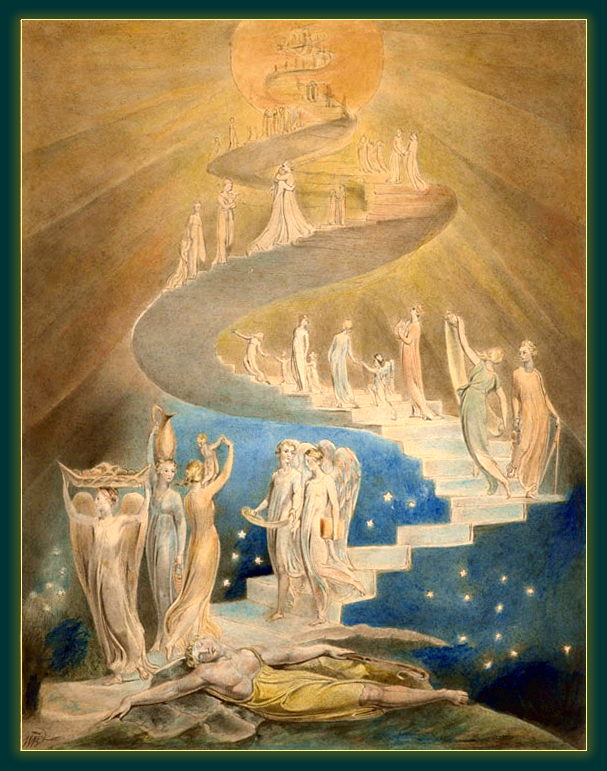
The picture
is a painting titled: 'Jacob's Ladder'
and is painted by William Blake. Source; British Museum.
Production: Filognostic
Association of The Order of Time.

Feed-back | Links | Downloads | Music | Pictures | What's New | Search | Donations