Chapter 10: Dhruva Mahârâja's Fight with the Yakshas
(1) Maitreya said: 'Dhruva ['the immovable one'] married Bhrami [meaning 'turning around'] the daughter of Prajâpati S'is'umâra ['the dolphin', 'the galaxy'] and named her sons Kalpa ['epoch'] and Vatsara ['tropical year']. (2) With another wife called Ilâ ['the comfort'], a daughter of Vâyu [the demigod of the air], the powerful ruler begot a son called Utkala ['the one who carries the load'] and a jewel of a girl. (3) Uttama ['the one of excel'] however, Dhruva's brother who did not marry, was during a hunt in the Himalaya range killed by a very powerful Yaksha [an evil spirit]. He was [soon] followed by his mother [Suruci]. (4) When Dhruva heard about the death of his brother, he filled with lamentation angrily swore revenge and got on his victorious chariot to leave for the city of the Yakshas.
(5) Heading in the northern direction the king saw in a valley of the Himalayas that was inhabited by followers of Lord S'iva, a city full of ghostly people. (6) Oh ruler, the mighty-armed one blew his conch shell that resounded fearfully in all directions in the sky so that the wives of the Yakshas became most afraid. (7) Out of resentment against the sound of the conch shell, thereupon the very powerful soldiers of Kuvera appeared and attacked him with all kinds of weapons. (8) He, the hero and powerful bowman with all of them attacking, could fight many adversaries simultaneously and killed them one after another, shooting three arrows at a time. (9) Being convinced that they, because of these arrows aimed at their heads, all without fail surely would be defeated, they lauded his action. (10) But incapable of accepting to be trampled under his feet like serpents, they tried to retaliate by shooting twice as much arrows at the same time. (11-12) Eager to counter both his actions and his charioteer, they, 130.000 men strong, most angrily showered thereupon all kinds of feathered arrows, bludgeons, swords, tridents, pointed lances, spears and fire weapons. (13) The master of war vanished completely from sight behind that constant shower of weapons, just like a mountain covered by a downpour.
(14) In the sky a tumult of disappointment resounded from the Siddhas who, witnessing the fight, assumed that this grandson of Manu had been killed because he, like the sun, had set in the ocean of Yakshas. (15) The Yakshas exclaimed that the victory was theirs, but then his chariot reappeared from the fighting lot like the sun emerges from the mist. (16) His twanging divine bow created lamentation among his enemies as he scattered the different weapons with his arrows, just like the wind scatters an array of clouds. (17) The sharp arrows released from his bow pierced the shields and entered the bodies of the demons, just like thunderbolts hitting the mountains. (18-19) The battlefield that bewilders the minds of heroes, began to glimmer from the by the arrows severed heads complete with garlands and turbans beautiful with earrings and helmets, and the cut off thighs and arms that with beautiful bracelets and armlets shone like golden palm trees. (20) The remaining soldiers, the most of whom had wounded limbs because of the arrows of the greatest of all warriors, fled in all directions like elephants defeated by a lion.
(21) When he saw that none of the enemy soldiers were left standing, the best of all men wanted to see their city, but he did not enter it for one cannot be sure of the plans of a mystical enemy. (22) While he who had the finest chariot, apprehensive about a counterattack of his enemies, was talking to his charioteer, a loud sound like that of the ocean was heard that could be recognized as the wind of a dust storm rising from all directions. (23) In a moment the sky was covered by a mass of dense clouds that everywhere glittered with lightening accompanied by thunder that threatened on all sides. (24) Oh faultless one, there was an inundation of blood, mucus, pus, stool, urine, marrow and trunks of bodies falling from the sky in front of him. (25) Then from the sky a downpour from everywhere could be observed of a mountain of clubs, bludgeons, swords and maces, together with a hail of big stones. (26) Serpents breathing like thunder vomited fire with angry eyes and groups of mad elephants, lions and tigers were encroaching. (27) As if the last of days had arrived the sea flooded the earth in all directions with fierce rolling waves, producing a tremendous sound.
(28) These kinds of phenomena are created by heinous demons who with demonic illusions try to frighten the less intelligent soul. (29) The great sages cognizant of the highly dangerous mystic power that by the demons was directed against Dhruva, then assembled to support him and help him out. (30) They said: 'Oh son of Uttânapâda, may the Supreme Lord carrying the bow called S'ârnga, be the Godhead that kills all the enemies of the surrendered souls in order to remove their distress. For it is the chanting and hearing of His holy name that forthwith helps men fully to overcome insurmountable death, oh Dhruva.'



Previous Aadhar edition and Vedabase links:
Maitreya said: 'Dhruva ['the immovable one'] married Bhrami [meaning 'turning around'] the daughter of Prajâpati S'is'umâra ['the dolphin', 'the galaxy'] and named her sons Kalpa ['epoch'] and Vatsara ['tropical year'].Maitreya said: 'Dhruva ['the immovable one'] married Bhrami [meaning: turning around], daughter of the Prajâpatî S'is'umâra ['the dolphin', 'the galaxy'] and named her sons Kalpa ['epoch'] and Vatsara ['tropical year']. (Vedabase)
With another wife called Ilâ ['the comfort'], a daughter of Vâyu [the demigod of the air], the powerful ruler begot a son called Utkala ['the one who carries the load'] and a jewel of a girl.
With another wife called Ilâ ['the comfort'], a daughter of Vâyu [the demigod of the air], did the powerful one beget a son called Utkala ['the one who carries the load'] and a jewel of a girl. (Vedabase)
Uttama ['the one of excel'] however, Dhruva's brother who did not marry, was during a hunt in the Himalaya range killed by a very powerful Yaksha [an evil spirit]. He was [soon] followed by his mother [Suruci].
But Uttama ['the one of excel'], Dhruva's brother who did not marry, was during a hunt in the Himalaya range killed by a very powerful Yaksha [an evil spirit]; his mother [Suruci] followed thereafter. (Vedabase)
When Dhruva heard about the death of his brother, he filled with lamentation angrily swore revenge and got on his victorious chariot to leave for the city of the Yakshas.
Dhruva hearing about the death of his brother swore, filled with lamentation, angered revenge and got on his chariot of victory to leave for the city of the Yakshas. (Vedabase)
Heading in the northern direction the king saw in a valley of the Himalayas that was inhabited by followers of Lord S'iva, a city full of ghostly people.
Heading in the northern direction the king saw in a valley of the Himalayas inhabited by followers of Lord S'iva, a city full of ghostly people. (Vedabase)
Oh ruler, the mighty-armed one blew his conch shell that resounded fearfully in all directions in the sky so that the wives of the Yakshas became most afraid.
There the mighty-armed one blew his conchshell resounding, o ruler, fearfully in the sky in all directions so that the wives of the Yakshas became most afraid. (Vedabase)
Out of resentment against the sound of the conch shell, thereupon the very powerful soldiers of Kuvera appeared and attacked him with all kinds of weapons.
Thereupon appeared the very powerful soldiers of Kuvera, who couldn't tolerate the sound of the conchshell, and attacked him with all kinds of weapons. (Vedabase)
He, the hero and powerful bowman with all of them attacking, could fight many adversaries simultaneously and killed them one after another, shooting three arrows at a time.
He, the hero and powerful bowman, with all of them falling over him, could fight many adversaries simultaneously and killed them one after another, shooting his arrows three at a time. (Vedabase)
Being convinced that they, because of these arrows aimed at their heads, all without fail surely would be defeated, they lauded his action.
By those arrows aimed at their heads, lauded they that action of him, being convinced of the fact that they without fail for sure all would be defeated. (Vedabase)
But incapable of accepting to be trampled under his feet like serpents, they tried to retaliate by shooting twice as much arrows at the same time.
Unable to tolerate that they would be trampled like serpents under his feet, tried they to retaliate, striking back with twice as much arrows at the same time. (Vedabase)
Eager to counter both his actions and his charioteer, they, 130.000 men strong, most angrily showered thereupon all kinds of feathered arrows, bludgeons, swords, tridents, pointed lances, spears and fire weapons.
Eager to counter the actions of him and his charioteer, they, a 130.000 men strong, very angry showered thereupon all kinds of feathered arrows, bludgeons, swords, tridents, pointed lances, spears and fire weapons. (Vedabase)
The master of war vanished completely from sight behind that constant shower of weapons, just like a mountain covered by a downpour.
Behind that constant shower of weapons disappeared the master of war, like a mountain covered by an outpour of rain, completely out of sight. (Vedabase)
In the sky a tumult of disappointment resounded from the Siddhas who, witnessing the fight, assumed that this grandson of Manu had been killed because he, like the sun, had set in the ocean of Yakshas.
In the sky resounded a tumult of disappointment from the perfected ones witnessing the fight who assumed that this grandson of Manu, setting like the sun in the ocean of Yakshas, had been killed. (Vedabase)
The Yakshas exclaimed that the victory was theirs, but then his chariot reappeared from the fighting lot like the sun emerges from the mist.
The Yakshas exclaimed that the victory was theirs, but then from the fighting appeared his chariot like the sun does from the mist. (Vedabase)
His twanging divine bow created lamentation among his enemies as he scattered the different weapons with his arrows, just like the wind scatters an array of clouds.
His twanging divine bow created the lamentation of his enemies, scattering the different weapons with his arrows just like the wind scatters an array of clouds. (Vedabase)
The sharp arrows released from his bow pierced the shields and entered the bodies of the demons, just like thunderbolts hitting the mountains.
The sharp arrows released from his bow had pierced the shields and entered the bodies of the demons, just like thunderbolts do over mountains. (Vedabase)
The battlefield that bewilders the minds of heroes, began to glimmer from the by the arrows severed heads complete with garlands and turbans beautiful with earrings and helmets, and the cut off thighs and arms that with beautiful bracelets and armlets shone like golden palm trees.
The battlefield, as it bewilders the mind of heroes, began to glimmer from the by the arrows severed heads with garlands and turbans, beautiful with earrings and helmets, and the cut off thighs and arms that with beautiful bracelets and armlets were like golden palm trees. (Vedabase)
Text 20
The remaining soldiers, the most of whom had wounded limbs because of the arrows of the greatest of all warriors, fled in all directions like elephants defeated by a lion.
The remaining soldiers of whom most of them had their limbs wounded by the arrows from the greatest of warriors, fled in all directions, like elephants defeated by a lion. (Vedabase)
When he saw that none of the enemy soldiers were left standing, the best of all men wanted to see their city, but he did not enter it for one cannot be sure of the plans of a mystical enemy.
At that time seeing that none of the enemy soldiers were left standing, desired the best of all men to see their city, but he didn't enter it for one can't be sure of the plans of a mystical enemy. (Vedabase)
While he who had the finest chariot, apprehensive about a counterattack of his enemies, was talking to his charioteer, a loud sound like that of the ocean was heard that could be recognized as the wind of a dust storm rising from all directions.
When the one with the finest chariot, apprehensive about a counterattack from his enemies, was talking to his charioteer, was a loud sound as from the ocean heard that could be recognized as made by the wind of a duststorm coming from all directions. (Vedabase)
In a moment the sky was covered by a mass of dense clouds that everywhere glittered with lightening accompanied by thunder that threatened on all sides.
In a moment the sky was covered by a mass of dense clouds that everywhere glittered with lightening accompanied by a threatening thunder from all sides. (Vedabase)
Oh faultless one, there was an inundation of blood, mucus, pus, stool, urine, marrow and trunks of bodies falling from the sky in front of him.
O faultless one, there was an inundation of blood, mucus, pus, stool, urine and marrow and trunks of bodies falling from the sky in front of him. (Vedabase)
Then from the sky a downpour from everywhere could be observed of a mountain of clubs, bludgeons, swords and maces, together with a hail of big stones.
Then in the sky could be seen a downpour from all directions of a mountain of clubs, bludgeons, swords, maces and a hail of big stones. (Vedabase)
Serpents breathing like thunder vomited fire with angry eyes and groups of mad elephants, lions and tigers were encroaching.
Serpents breathing like thunder vomited fire with angry eyes and groups of mad elephants, lions and tigers were encroaching. (Vedabase)
As if the last of days had arrived the sea flooded the earth in all directions with fierce rolling waves, producing a tremendous sound.
As if the last of days had arrived flooded the sea in all directions the earth with fierce waves coming forward, producing a tremendous sound. (Vedabase)
These kinds of phenomena are created by heinous demons who with demonic illusions try to frighten the less intelligent ones.
These kinds of phenomena are created by the demons, who heinous in their demoniac nature, try to frighten the less intelligent. (Vedabase)
The great sages cognizant of the highly dangerous mystic power that by the demons was directed against Dhruva, then assembled to support him and help him out.
The great sages cognizant of the highly dangerous mystic power by the demons directed against Dhruva then united to support him and help him out. (Vedabase)
They said: 'Oh son of Uttânapâda, may the Supreme Lord carrying the bow called S'ârnga, be the Godhead that kills all the enemies of the surrendered souls in order to remove their distress. For it is the chanting and hearing of His holy name that forthwith helps men fully to overcome insurmountable death, oh Dhruva.'
They said: 'O son of Uttânapâda, may the Supreme Lord carrying the bow called S'ârnga, be the Godhead that kills all the enemies of the surrendered souls in order to remove their distress; it is also the hearing and chanting of His holy name that immediately helps men fully over the insurmountable of death, o Dhruva.' (Vedabase)


The text and audio are offered under the conditions of
the
Creative
Commons Attribution-Noncommercial-Share Alike
3.0
Unported License.
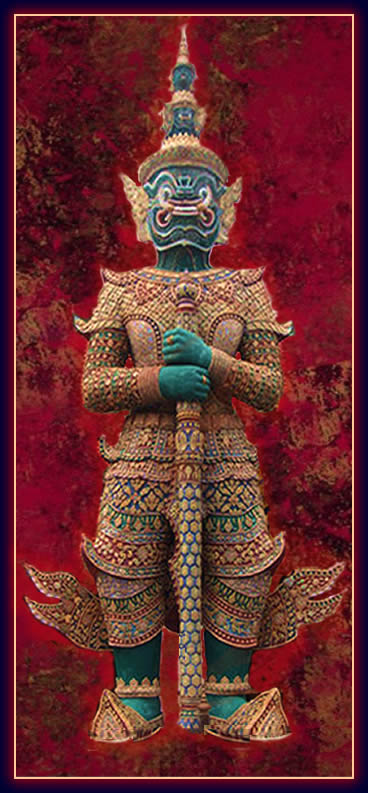
The picture of a
guarding Yaksha is a statue
near the entrance of the Grand Palais in Bangkok. Thailand.
Source: Tourist
photo.
Production: Filognostic
Association
of The
Order of Time

Feed-back | Links | Downloads | Music | Pictures | What's New | Search | Donations