
Canto 2
Chapter 8: Questions by King Parîkchit
(1) The king asked: 'How did Nārada, the seer of the divine being instructed by Lord Brahmā, oh brahmin, explain the modes and their transcendence and to whom did he explain it? (2) This I wish to understand, oh best one: what is the reality of those who know the truth of the Lord who is so full of wonderful potencies and whose narrations are so beneficial for all the worlds? (3) Please continue speaking, oh you of great fortune, so that I, with my mind focussed on the Soul of the Complete, S'rî Krishna, freed from material attachment may relinquish my conditioned body. (4) Those who with faith regularly listen to this spiritual matter and also seriously persist in the endeavor, will, after not too long a time, see the Supreme Lord appear in their hearts. (5) When one thus through one's ears receives the sounds [of the Bhâgavatam], the lotus flower of one's loving relationship with Krishna will wash away all impurities, the same way the autumnal rain cleanses the water of the pools. (6) A person whose heart was cleansed, being liberated from all miseries in life, will never give up the shelter of Krishna's feet, just like a traveler never will give up his home [see also B.G. 5: 17; 8: 16; 8: 21-28; 9: 3; 15: 3-4; 15: 6].
(7) Can you from your self-knowledge, tell me whether the living being itself not being material, oh brahmin, takes up a material body accidentally or whether it does so because of some reason? (8) How can the Original Person whose position in this world is defined by this lotus flower [this gigantic universe] that grew from His abdomen, likewise be known in the situation of the [much smaller] measurement of His different embodiments? (9) He from the lotus flower, [Brahmâ] who was not born from matter but from His navel, he who gave life to all the ones born with a material body, how could he see His Form by His mercy? (10) How can the Original Person, He who maintains, creates and annihilates the material worlds, remain untouched by His own external energy while He as the Lord of all energies rests in the heart of everyone? (11) Formerly I heard you discuss [in chapter 2.5] the different [planets or] worlds with their governors as the different parts of the body of the Original Person. So what [can you tell us] about those governors who by their different places are the different parts of Him?
(12) And what about a day of Brahmâ [a kalpa] and the periods between them [vikalpas]? What can you say about the time we refer to with the words past, future and present? And how about the lifespan allotted to embodied beings? (13) Oh purest of the twice-born souls, when did time begin and what can you say about the indication of time as being short or long as like passing with a certain activity? (14) And what is the effect of the karma that the living beings as a consequence of their desires accumulate because of [identifying with] the basic qualities of nature? (15) Please describe to us how the earth, the lower regions, the four quarters of heaven, the sky, the planets and the stars, the hills, the rivers, the seas and the islands and their inhabitants have appeared. (16) What is the extent and measure of [the] outer space [universe] and the inner space, and what are their divisions? And what is the character and action of the great souls and, please, describe the vocations and age groups of society. (17) What are the different ages, how long do they take and what is their nature? And which incarnation of the Lord performs what kind of wonderful activities in each and every age?
(18) What is the dharma of human society at large and what are the specific duties of the different trades and the saintly ruling class? And what are the obligations towards people in distress? (19) How many elements are there in creation, what are their characteristics and how do they react? What are the rules and regulations for the devotional service to the Original Person and for relating to the inner self in the culture of yoga? (20) What are the special abilities the yoga master acquires and where do they lead to? How do the yogis detach from the astral body and what is the nature of the spiritual knowledge found in the Vedas, their subsidiary literatures [the Upaveda], the law books and the Vedic stories and historical accounts? (21) How do the living beings find their existence, how do they find stability and how do they find their end? What are the procedures for performing rituals, pious works and deeds of self-interest and what are the regulations for the three goals of life [the economic, religious and sensual interests]? (22) How can all souls as a consequence of their actions be created again [after they died], how do heretics come about, what does it mean for souls to be bound or liberated and what does it mean to realize one's original position of service [svarûpa]? (23) How does the Supreme Lord as an independent soul enjoy His pastimes by His own potency and how can He forsake these actions when He as the Almighty One remains a witness to His external energy?
(24) About all of this and more that I did not ask you, oh fortunate one, I have been wondering from the beginning. Please explain in accordance with the truth, oh great sage, that what you want to tell me, having fallen at your feet. (25) Where others only follow the custom of a previously formulated philosophy, you are an authority in this matter like the self-born Brahmâ. (26) I never tire, oh brahmin, of drinking, in the hunger of my fasting, from the flow of the nectar ocean of your words about the infallible Lord.' "
(27) Sûta Gosvâmî said: "He [S'ukadeva] thus in that assembly with questions like these being asked by the king about topics concerning the highest truth, was, as the instrument of the Creator, very pleased with this servant of Vishnu. (28) He told him that this purâna called the Bhâgavatam was transmitted by the Supreme Lord to Lord Brahmâ at the beginning of the first day [or kalpa] of creation. (29) He promised to try to give a full description, from the beginning to the end, of everything that the king, the best of the Pându dynasty, had asked and would ask more."
Read the inspiration to this chapter by Anand Aadhar.


Third revised edition, loaded June 28, 2023.
Previous Aadhar edition and Vedabase links:
The king asked: 'How did Nārada, the seer of the divine being instructed by Lord Brahmā oh brahmin, explain the modes and their transcendence and to whom did he explain it?The king asked: 'How did Nârada, being instructed by Lord Brahmâ, o brahmin, explain the modes and their transcendence, and whom did he explain it to?' (Vedabase)
This I wish to understand, oh best one: what is the reality of those who know the truth of the Lord who is so full of wonderful potencies and whose narrations are so beneficial for all the worlds?
This I wish to understand o best one: what is the reality of those who are in the Absolute of the truth of the Lord who is so full of wonderful potencies and whose narrations are so beneficial to all the worlds? (Vedabase)
Please continue speaking, oh you of great fortune, so that I, with my mind focussed on the Soul of the Complete, S'rî Krishna, freed from material attachment may relinquish my conditioned body.
Please continue speaking, o you of great fortune, so that I, about to leave my body, freed from material association, may put my thoughts to the Supreme of the soul, Lord S'rî Krishna. (Vedabase)
Those who with faith regularly listen to this spiritual matter and also seriously persist in the endeavor, will, after not too long a time, see the Supreme Lord appear in their hearts.
Those who with faith, regularly take to the matter and as well seriously endure in the endeavor, will after not too long a time see the Supreme Lord appear in their hearts. (Vedabase)
When one thus through one's ears receives the sounds [of the Bhâgavatam], the lotus flower of one's loving relationship with Krishna will wash away all impurities, the same way the autumnal rain cleanses the water of the pools.
Thus receiving it through their ears from the love of their own liberation, this lotus [the Bhâgavatam] of Krishna washes away the impurities like the waters of autumn do. (Vedabase)
A person whose heart was cleansed, being liberated from all miseries in life, will never give up the shelter of Krishna's feet, just like a traveler never will give up his home [see also B.G. 5: 17; 8: 16; 8: 21-28; 9: 3; 15: 3-4; 15: 6].
Once being cleansed will the person, who took to the shelter of Krishna's feet, never give up that liberation, just like a traveler, who going through the miseries of life, will never give up his home [see also B.G. 5: 17; 8: 16; 8: 21-28; 9: 3; 15: 3-4; 15: 6]. (Vedabase)
Can you from your self-knowledge, tell me whether the living being itself not being material, oh brahmin, takes up a material body accidentally or whether it does so because of some reason?
As it is not a question of being material, o brahmin, can you, as you may know from your good self, tell me whether the living being in the undertaking comes to the body accidentally or of some cause? (Vedabase)
How can the Original Person whose position in this world is defined by this lotus flower [this gigantic universe] that grew from His abdomen, likewise be known in the situation of the [much smaller] measurement of His different embodiments?
If He is in possession of the lotusflower of this world, that as it were sprouted from His abdomen, then what is the difference between the Original Person to the measure of this extent [of the Virâth Rûpa] and the situation that one speaks of with the many different embodiments? (Vedabase)
He from the lotus flower, [Brahmâ] who was not born from matter but from His navel, he who gave life to all the ones born with a material body, how could he see His Form by His mercy?
How could he who was not born from matter himself and who gave life to all the ones born with a material body, through His mercy see His Form while being born from the lotusflower of the navel? (Vedabase)
How can the Original Person, He who maintains, creates and annihilates the material worlds, remain untouched by His own external energy while He as the Lord of all energies rests in the heart of everyone?
And also [how can it be that] He as the Original Person maintaining, creating and annihilating the material worlds remains untouched by His own external energy while resting as the Lord of all energies in the heart of everyone? (Vedabase)
Formerly I heard you discuss [in chapter 2.5] the different [planets or] worlds with their governors as the different parts of the body of the Original Person. So what [can you tell us] about those governors who by their different places are the different parts of Him?
Before I heard You discuss the different worlds with their governors as the different parts of the body of the Original Person, so what [can you tell] about those governors that by the different systems are the different parts of Him? (Vedabase)
And what about a day of Brahmâ [a kalpa] and the periods between them [vikalpas]? What can you say about the time we refer to with the words past, future and present? And how about the lifespan allotted to embodied beings?
And what about the day of brahmâ [a kalpa] and the periods between them [vikalpas], as also what to say about the time measuring what one calls the past, future and present - and how about the lifespan allotted to embodied beings? (Vedabase)
Oh purest of the twice-born souls, when did time begin and what can you say about the indication of time as being short or long as like passing with a certain activity?
O purest of the twice born, what may be the beginning of time and what about the way it, in terms of one's karma, is experienced as being short or long? (Vedabase)
And what is the effect of the karma that the living beings as a consequence of their desires accumulate because of [identifying with] the basic qualities of nature?
Then again to what extent is one taken over by accruing [karma] to the different modes of nature in the different life forms which are also certainly the result of one's desire. (Vedabase)
Please describe to us how the earth, the lower regions, the four quarters of heaven, the sky, the planets and the stars, the hills, the rivers, the seas and the islands and their inhabitants have appeared.
Please describe to us how life underneath the earth, in the four quarters of heaven, in the sky, on the planets and about the stars, on the hills, in the rivers, the seas and on the islands comes about and what are their inhabitants? (Vedabase)
What is the extent and measure of [the] outer space [universe] and the inner space, and what are their divisions? And what is the character and action of the great souls and, please, describe the vocations and age groups of society.
What is the extent and measure of the outer space universe and the innerspace, and what are their divisions? And what is the character and action of the great souls and the vocations and age-groups of society? (Vedabase)
What are the different ages, how long do they take and what is their nature? And which incarnation of the Lord performs what kind of wonderful activities in each and every age?
What are the different ages, how long do they take and what is their nature and which incarnation of the Lord performs what kind of wonderful activities in each and every age? (Vedabase)
What is the dharma of human society at large and what are the specific duties of the different trades and the saintly ruling class? And what are the obligations towards people in distress?
What are the specific religious affiliations of human society in general and what are the duties of the three classes [labor, trade and intellect] and their administration [the fourth class], as also, what would the obligations be to people in distress? (Vedabase)
How many elements are there in creation, what are their characteristics and how do they react? What are the rules and regulations for the devotional service to the Original Person and for relating to the inner self in the culture of yoga?
And what is the number of elements of creation and what are their characteristics and interaction? What are the rules and regulations of the devotional practice to the Original Person in the cultivation of yoga and what are the different spiritual methods leading thereto? (Vedabase)
What are the special abilities the yoga master acquires and where do they lead to? How do the yogis detach from the astral body and what is the nature of the spiritual knowledge found in the Vedas, their subsidiary literatures [the Upaveda], the law books and the Vedic stories and historical accounts?
What are the opulences of the yogamaster, where do they lead to, how do the yogis detach from the astral body and what is the transcendental knowledge found in the religiosity about the historical accounts and the vedic stories? (Vedabase)
How do the living beings find their existence, how do they find stability and how do they find their end? What are the procedures for performing rituals, pious works and deeds of self-interest and what are the regulations for the three goals of life [the economic, religious and sensual interests]?
What is the specific order of all those transient living beings and how does it end? What are the good deeds, rituals and also the regulative principles concerning the religion, the means of existence and the pleasing of the senses? (Vedabase)
How can all souls as a consequence of their actions be created again [after they died], how do heretics come about, what does it mean for souls to be bound or liberated and what does it mean to realize one's original position of service [svarûpa]?
How do all those who either live in union with the Lord or go against Him come about and what is the conditioning of the ones liberated as also that of the ones that live undetermined? (Vedabase)
How does the Supreme Lord as an independent soul enjoy His pastimes by His own potency and how can He forsake these actions when He as the Almighty One remains a witness to His external energy?
As surely as the independent Supreme Lord enjoys His pastimes from His own inner potency, He, correctly, gives them up just the same, to the external of His capacity remaining a witness as the Almighty. (Vedabase)
About all of this and more that I did not ask you, oh fortunate one, I have been wondering from the beginning. Please explain in accordance with the truth, oh great sage, that what you want to tell me, having fallen at your feet.
About all this and more that I didn't ask you, o Supreme Person, I've been wondering from the beginning. Please explain in accordance with the truth, o great sage, what you want to tell me with us all having fallen at your feet. (Vedabase)
Where others only follow the custom of a previously formulated philosophy, you are an authority in this matter like the self-born Brahmâ.
Surely in these matters of factual knowing are you as good as Brahmâ originating directly from the Lord, while others are only following to custom after what of borrowed knowledge could be said. (Vedabase)
I never tire, oh brahmin, of drinking, in the hunger of my fasting, from the flow of the nectar ocean of your words about the infallible Lord.' "
I never get tired, o brahmin, of drinking, in hunger of my fasting, of the nectar of the Infallible flowing from the ocean of your speech'." (Vedabase)
Sûta Gosvâmî said: "He [S'ukadeva] thus in that assembly with questions like these being asked by the king about topics concerning the highest truth, was, as the instrument of the Creator, very pleased with this servant of Vishnu.
Suta Gosvâmî said: "He [S'ukadeva] thus being questioned by the king on topics of the highest truth like these, was, as the instrument of the Creator, very pleased in meeting this servant of Vishnu. (Vedabase)
He told him that this purâna called the Bhâgavatam was transmitted by the Supreme Lord to Lord Brahmâ at the beginning of the first day [or kalpa] of creation.
He said: 'This science of the Personality of God called the Bhâgavatam consisting of the story in pursuance of the Vedas, was given to the spirit by the Supreme Lord at the beginning of the age wherein the Creator found his existence.' (Vedabase)
He promised to try to give a full description, from the beginning to the end, of everything that the king, the best of the Pându dynasty, had asked and would ask more."
He then prepared himself to describe in full whatever the king, the best of the dynasty of Pându, all asked in his, from the beginning to the end, continuing inquiries." (Vedabase)

The text and audio are offered under the
conditions of the
Creative Commons Attribution-Noncommercial-Share Alike 3.0
Unported License.
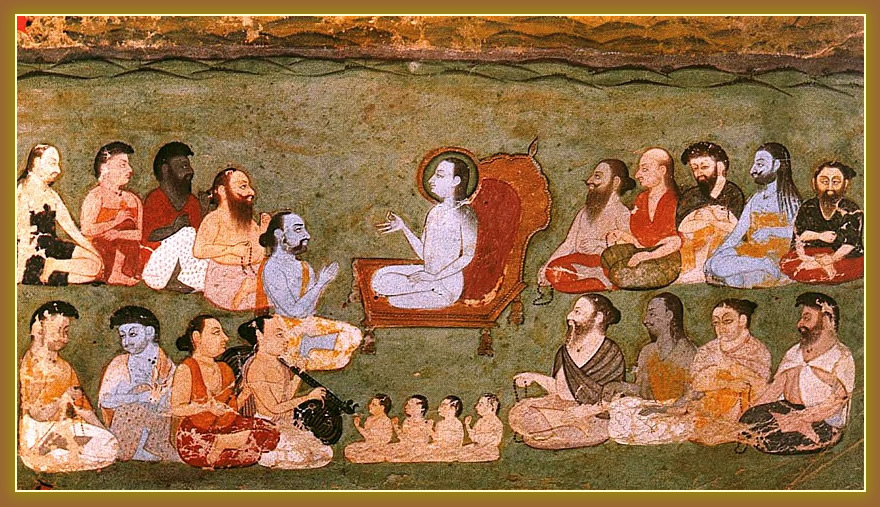
The image of Parîkchit and the sages before S'ukadeva is
a Kishangarh painting of the Rajasthani school. India, 17th
century. Source.
Production: Filognostic Association of The Order of Time

Feed-back | Links | Downloads | Music | Pictures | What's New | Search | Donations



 Text 1