Canto
12
Canto
12
Chapter 6: Mahârâja Parîkchit Liberated and the Veda Handed Down in Four
(1) S'rî Sûta said: "After Mahârâja Parîkchit, the one protected by Vishnu, had heard what was said by the sage, the equal minded seer of the Supreme Soul, the son of Vyâsa, he approached his lotus feet, bowed his head down and said with his hands folded the following to him. (2) The king said: 'With the great mercy shown by your goodness full of compassion, I have attained perfection because you described directly to me the Lord Without a Beginning or End. (3) It is no surprise at all for great souls absorbed in the Infallible One to be of mercy with the ignorant conditioned souls who are tormented by distress.(4) We [thus] heard from you this collection of classical stories in which the Supreme Lord Uttamas'loka is being described [*]. (5) My lord, I do not fear Takshaka or any other living being, nor do I fear repeated deaths; I have entered the Spirit of the Absolute revealed by you as [nirvâna, as] standing apart from everything material, and [am now] free from fear. (6) Please allow me, oh brahmin, to resign my speech [and other sensory functions] to Adhokshaja, so that I, with an absorbed mind having forsaken all sensual desires, can give up my life. (7) With the help of you who showed the all-auspicious, supreme shelter of the Lord Almighty, I have become fixed in non-material knowledge and wisdom, and has my ignorance been eradicated.' "
(8) Sûta said: "Thus having been addressed the powerful saint, the son of Vyâsa, gave him the permission. After the king, that god among the people, along with the renounced sages thereupon had paid his respects, the sage left. (9-10) Parîkchit, the saintly king, by the power of reason thereupon fixed his mind on his soul, meditated on the Supreme Truth and arrested his breath. On the bank of the Ganges sitting on darbha grass laid to the east, the great yogi, facing the north, free from all attachment in perfect realization of the Absolute Spirit broke with all doubts and became as motionless as a tree. (11) Dear scholars, when Takshaka, being triggered by the angered son of the brahmin sage [Samika], was on his way to kill the king, he encountered Kas'yapa Muni [see 1.18]. (12) He was an expert in countering poison, but Takshaka satisfied him with valuables and persuaded him to return home. Thereupon he, able to assume any form desired, disguised himself as a brahmin and bit the king. (13) Before the eyes of all embodied souls the body of the fully self-realized saint among the kings was consumed by the fire of the snake's poison and turned immediately to ashes. (14) From every direction of the earth and the sky a great cry of lamentation was heard from all amazed demigods, demons, human beings and other creatures. (15) The kettledrums of the demigods resounded, the Gandharvas and Apsaras sang, and the self-realized souls spoke words of praise and rained down a shower of flowers. (16) When Janamejaya heard that his father had been bitten by Takshaka, he most enraged accordingly together with the brahmins offered all the snakes [of the world] as oblations in a sacrificial ceremony. (17) Takshaka, seeing the great serpents being burned in the blazing fire of the snake sacrifice, agitated by fear went to Indra for shelter. (18) King Janamejaya, not seeing Takshaka among them, said to the brahmins: 'Why has Takshaka, the lowest of all serpents, not been burned?'
(19) [They answered:] 'Oh best of the kings, he is hiding, having approached Indra for shelter. The snake is protected by him and therefore did not end up in the fire.'
(20) After the highly intelligent son of Parîkchit heard these words, he said to the priests: 'Dear scholars, why not make Takshaka fall into the fire along with Indra?'
(21) Hearing that, the priests performed the ritual for offering Takshaka along with Indra. [They prayed:] 'Oh Takshaka, may you quickly fall into this fire here together with Indra and his host of demigods.' (22) Indra who together with Takshaka and his vimâna was thrown from his position by the derogatory words of the brahmins, became most disturbed. (23) Brihaspati, the son of Angirâ, who saw him in his vimâna together with Takshaka fall from the sky, addressed the king: (24) 'This snake-bird does not deserve to be killed by you, oh ruler of men. He, this king of the snakes, drank from the nectar [of the gods] and is therefore beyond any doubt free from aging and immortal! (25) The life and death of a living being and his destination [in a next life], oh King, are solely the result of his karma, his own actions; no other agent is accountable for his happiness and distress. (26) A living being dying because of snakes, thieves, fire and lightening, hunger, thirst, disease or other agents, oh King, undergoes that because of his accumulated karma. (27) For that reason, oh King, this sacrifice should be stopped that is performed with the intent to harm others. People burning innocent snakes will have to suffer that fate themselves [see also the Mahâbhârata 1.43].' "
(28) Sûta said: "Thus being addressed he said: 'So be it!', and with respect for the words of the great sage he ceased with the snake sacrifice and worshiped that master of speech [Brihaspati]. (29) It is this hard to discern great material illusion [mahâmâyâ] belonging to Vishnu that causes misfortune because of the interaction of the material qualities [the gunas]. The souls who are part and parcel of Him get bewildered by it always causing trouble, and are consequently caught in material bodies. (30-31) The directly visible illusory energy, wherein abiding one lacking in peace thinks in terms of deceit [by blaming others], will not [prevail] when one constantly investigates what goes on in the soul. This is so because one therein, [in that state] the transcendentalists speak about, is not of the materialistic arguments that assume so many forms, nor because of it is of a mind full of decisions and doubts. In that [transcendental consciousness] the living entity is not of worldly concerns or of their causes and the benefits achieved by them, nor is he therein of the I-awareness [that is so strong] in its being bound to the basic qualities. That is all excluded then. A wise soul should take pleasure in warding off the waves of worldly conditioning as also anyone thus being entangled [see also e.g. 6.4: 31-32]. (32) The supreme refuge of Lord Vishnu is, by those who wish to give up everything inessential, designated as that what is 'neither this, nor that' [see also neti neti]. Rejecting the immorality [of materialism] and with their emotions directed at nothing else, they embrace in their hearts the 'not-that' [of the Soul, of Him] to which they hold on, deeply absorbed in meditation [in samâdhi]. (33) [Thus] not being corrupted by the 'I' and 'mine' that is based upon having a body and a home, they attain this supreme refuge of Lord Vishnu. (34) Insulting words one should tolerate and one should never disrespect anyone, nor should one identify with this material body or hold a grudge against whomever. (35) I offer my obeisances to Him, the Supreme Personality of Godhead S'rî Krishna, whose knowledge is always new and upon whose lotus feet meditating I have assimilated this collection of wisdom [samhitâ]'."
(36) S'rî S'aunaka said: "Please tell us this, oh gentle soul [Sûta]: in what way have Paila and the other highly intelligent disciples of Vyâsa who constitute the Vedic authority, spoken about the Vedas, and how have they divided them?"
(37) Sûta said: "Oh brahmin, Lord Brahmâ, the most elevated being, had his mind perfectly under control and heard in his heart the subtle transcendental sound [of ta-pa, 2.9: 6] that arose from the ether. One can hear that sound when one closes one's ears [for sounds from the outside. See also s'abda]. (38) By the worship of that sound, oh brahmin, yogis cleanse the contamination away from the heart that is known as the substance, the activity and the doer [**], and find liberation from rebirth. (39) From that [sound] the threefold omkâra [A-U-M] came into being that, manifesting itself unseen, constitutes the representation of the Supreme Lord [Bhagavân], the Absolute Truth [Brahman] and the Supersoul [Paramâtmâ, see also 1.2: 11, B.G. 7: 8]. (40-41) One perceives this [eternal, itself imperceptibly manifesting] sound, outside the physical sense of hearing and power of vision. The complete of the Vedic sound one employs, is an elaboration of this omkâra that from the soul manifests itself in the ether. It constitutes the direct expression of the self-generating Absolute Truth and Supersoul, it constitutes the eternal seed of the Vedas and constitutes the secret of all mantras [see also 7.15: 31, 9.14: 48, 11.14: 34-35, 11.21: 36-40].(42) Oh eminence of Bhrigu, the three sounds of the alphabet beginning with A that came into being [the sounds A, U and M], are fundamental to [all] the threefold forms of material existence: the modes [the gunas], the names [of the three Vedas], the destinations [the three types of lokas] and the states of consciousness [avasthâtraya]. (43) The mighty unborn Lord [Brahmâ] created from it [that threefold sound] the different sounds of the total collection of vowels, sibilants, semivowels and consonants, as they are known by their short and long forms. (44) For the purpose of giving instruction on the four sacrifices [see ritvik], the almighty one created with all these sounds from his four faces the four Vedas, along with his omkâra and vyâhriti invocations [of the names of the seven lokas]. (45) He taught them [as a complete set] to his sons who were the great rishis among the brahmins most expert in the art of Vedic recitation, and they in their turn imparted them as instructors of dharma [âcâryas] to their sons. (46) Throughout the four yugas generation after generation, one after the other disciple fixed in his vows received them [these Vedas] by disciplic succession [paramparâ]. They were divided among the prominent sages at the end of Dvâpara-yuga. (47) The brahmin sages, inspired by the Infallible Lord situated in their hearts, came to that dividing among each other of the Vedas when they saw that under the influence of time the intelligence [of the people] diminished, the life span shortened and the strength weakened [see also 1.4: 16-18]. (48-49) Oh brahmin, in this period [of Manu], Brahmâ and S'iva and other rulers over the worlds requested the Supreme Lord, the Maintainer of the Universe, to protect the principles of religion. Oh most fortunate soul, the Lord [in the form of Krishna Dvaipâyana Vyâsa], by Parâs'ara begotten in the womb of Satyavatî, then descended as a partial expansion of His plenary portion [Sankarshana] and divided the Veda in four. (50) Like someone sorting out gems, he separated the group of mantras in four categories of collections [samhitâs]: the Rig, Atharva, Yajur and Sâma Veda [see Vedas]. (51) The highly intelligent and mighty sage, asked four of his disciples to approach him one by one, oh brahmin, to give each of them one of the [four] collections. (52-53) He taught Paila the first collection [the Rig Veda] named Bahvrica ['many verses'], to Vais'ampâyana he spoke the collection of Yajur mantras called Nigada ['the recited'], the Sâma mantras titled Chandoga ['singer in metre'] he told Jaimini, and the [Atharva] mantras from [the sages] Atharva and Angirâ he entrusted to his dear disciple Sumantu [see also 4.21: 22]. (54-56) Paila told his Samhitâ [that he divided in two] to Indrapramiti and Bâshkala. The latter one, oh son of Bhrigu [S'aunaka], divided his collection in four parts he handed down to his disciples Bodhya, Yâjñavalkya, Parâs'ara and Agnimitra. The self-controlled sage Indrapramiti taught his collection to the learned seer [his son] Mândûkeya, and his disciple Devamitra taught it to Saubhari and others. (57) S'âkalya, his son, divided his collection in five parts he gave to Vâtsya, Mudgala, S'âlîya, Gokhalya and S'is'ira. (58) Sage Jâtûkarnya, also a disciple of his, added to the collection he received a glossary when he passed it down to Balâka, Paila, Jâbâla and Viraja. (59) Bâshkali [the son of Bâshkala] assembled from the different branches [of the Rig Veda] the collection called the Vâlakhilya-samhitâ that was received by [the daitya sons] Vâlâyani, Bhajya and Kâs'âra. (60) This is how those many collections of the Rig Veda verses were maintained by these brahmin seers [in disciplic succession]. Anyone who hears about the distribution of these sacred verses is freed from all sins.
(61) [Some] disciples of Vais'ampâyana were known as the Carakas ['the ones vowed'] because they for their guru executed a vow to atone for the sin of having killed a brahmin. They became authorities on the Atharva Veda. (62) Yâjñavalkya, another disciple, said: 'Oh master, what value have the endeavors of these weak fellows? I will perform a most difficult penance!'
(63) Thus being addressed his spiritual master got angry and said: 'Go away, enough of you, a disciple insulting scholars; give immediately everything up that I taught you!'
(64-65) The son of Devaratâ then regurgitated the collected Yajur mantras. After he had left, the sages greedily looked at these Yajur mantras and turned into partridges picking them up. These branches of the Yajur Veda thus became known as the most beautiful Taittirîya-samhitâ ['the partridge collection']. (66) Oh brahmin, Yâjñavalkya, looking for extra mantras unknown to his spiritual master, thereupon carefully worshiped the Lord of the sun.
(67) S'rî Yâjñavalkya said: 'My obeisances unto the Supreme Personality of Godhead, who, appearing as the sun and just like the ether, in the form of the Supersoul inside and in the form of Time outside, is present in the hearts of the four kinds of living entities beginning from Brahmâ down to the blades of grass [as born from wombs, eggs, moist and seed, see also 2.10: 37-40]. You who cannot be covered by material terms, all by Yourself, with the flow of years made up of the tiny fragments of kshanas, lavas and nimeshas [see 3.11: 7], carry out the maintenance of this universe by taking away and returning its water [in the form of rain]. (68) Oh Lord of the Sun, oh Glowing One, oh Best among the Gods, by the rules of the sacred tradition I daily meditate, at the [three] junctures of the day, with full attention on Your glowing sphere, on You, the mighty controller, who burn all the sins, the consequent suffering as also what led to them, of all souls offering prayers [see also 11.14: 35 and the Gâyatrî]. (69) You, who in this world are the Lord dwelling in the hearts of all the moving and nonmoving living beings depending on Your shelter, awaken [and inspire] their unconscious material mind, senses and different vital airs [the vâyus]. (70) This world was seized and swallowed by the horrible mouth of the python known as darkness, and became unconscious like being dead. You alone, most magnanimous mercifully casting Your glance, awaken [the sleeping souls] with the gift of insight. At the beginning, half way and at the end of the day You thus, day after day engage [the pious] in the ultimate benefit known as one's own nature of delivering service in a spiritual existence [svadharma]. (71) Like an earthly king You [in the form of the sun] travel around everywhere creating fear among the sinners, while the deities of the directions holding lotus flowers, with folded palms offer their respects. (72) Hoping for Yajur mantras not known to anyone else, I therefore with prayer approach Your two lotus feet, oh Lord, that are honored by the spiritual masters of the three worlds [lokas, and see 5.23: 8].' "
(73) Sûta said: "He, the Supreme Lord of the Sun thus glorified being satisfied, assumed the form of a horse and presented to the sage the Yajur mantras that were never learned by any other mortal being [see also 5.18: 6]. (74) The mighty sage divided the hundreds of Yajur mantras in fifteen branches that were accepted by the disciples Kânva, Mâdhyandina and others under the name Vâjasaneyi: 'stemming from the manes of the horse.' (75) Of Jaimini Rishi, the manager of the Sâma Veda, there was a son Sumantu as also a grandson Sutvân. Each of them he told one half of the collection. (76-77) Sukarmâ, another disciple [of Jaimini] and great thinker, divided the tree of the Sâma Veda into a thousand collections of Sâma mantras, after which, oh brahmin, the disciples Hiranyanâbha - the son of Kus'ala - Paushyañji, as also another one named Âvantya who was most advanced in spiritual realization, took charge of them. (78) From Paushyañji and Âvantya there were five hundred disciples who are called the Sâma Veda singers of the north, or also [in later times, some of them] the singers of the south. (79) Laugâkshi, Mângali, Kulya, Kus'îda and Kukshi, [five] other disciples of Paushyañji, each took care of a hundred collections of mantras. (80) Krita, a disciple of Hiranyanâbha, communicated twenty four samhitâs to his disciples, and the remaining ones were handed down by the self-realized sage Âvantya."


Third revised edition, loaded October 18, 2022.
Previous Aadhar edition and Vedabase links:
S'rî Sûta said: "After Mahârâja Parîkchit, the one protected by Vishnu, had heard what was said by the sage, the equal minded seer of the Supreme Soul, the son of Vyâsa, he approached his lotus feet, bowed his head down and said with his hands folded the following to him.S'rî Sûta said: "Mahârâja Parîkchit, the one protected by Vishnu, hearing what by the sage, the equalminded seer of the Supreme Soul, the son of Vyâsa, was said, approached his lotus feet, bowed his head down and said with his hands folded to him the following. (Vedabase)
The king said: 'With the great mercy shown by your goodness full of compassion, I have attained perfection because you described directly to me the Lord Without a Beginning or End.
The king said: 'With the great mercy shown by your goodness I have attained perfection, because a compassionate soul like you has described directly to me the Lord Without a Beginning or and End. (Vedabase)
It is no surprise at all for great souls absorbed in the Infallible One to be of mercy with the ignorant conditioned souls who are tormented by distress.
I do not consider it surprising for great souls absorbed in the Infallible One to be of mercy with the ignorant conditioned souls tormented by distress. (Vedabase)
We [thus] heard from you this collection of classical stories in which the Supreme Lord Uttamas'loka is being described [*].
We [thus] heard from you this collection of classical stories in which the Supreme Lord Uttamas'loka is fittingly described [*]. (Vedabase)
My lord, I do not fear Takshaka or any other living being, nor do I fear repeated deaths; I have entered the Spirit of the Absolute revealed by you as [nirvâna, as] standing apart from everything material, and [am now] free from fear.
My lord, I do not fear Takshaka or any other living being, nor do I fear repeated deaths; I have entered the Spirit of the Absolute you have revealed as standing apart from everything material and free from fear. (Vedabase)
Please allow me, oh brahmin, to resign my speech [and other sensory functions] to Adhokshaja, so that I, with an absorbed mind having forsaken all sensual desires, can give up my life.
Please allow me, o brahmin, to dedicate my speech [and other sensory functions] to Adhokshaja so that I, with an absorbed mind having given up all sensual desires, may give up my life air. (Vedabase)
With the help of you who showed the all-auspicious, supreme shelter of the Lord Almighty, I have become fixed in non-material knowledge and wisdom, and has my ignorance been eradicated.' "
With the help of you showing the all-auspicious, supreme shelter of the Lord Almighty, I have become fixed in non-material knowledge and wisdom and my ignorance has been eradicated'." (Vedabase)
Sûta said: "Thus having been addressed the powerful saint, the son of Vyâsa, gave him the permission. After the king, that god among the people, along with the renounced sages thereupon had paid his respects, the sage left.
Sûta said: "Thus addressed the powerful saint, the son of Vyâsa, gave him the permission. Then, after being worshiped by that god among the people and the renounced sages, he went away. (Vedabase)
Parîkchit, the saintly king, by the power of reason thereupon fixed his mind on his soul, meditated on the Supreme Truth and arrested his breath. On the bank of the Ganges sitting on darbha grass laid to the east, the great yogi, facing the north, free from all attachment in perfect realization of the Absolute Spirit broke with all doubts and became as motionless as a tree.
Parîkchit, the saintly king, putting his mind to his soul by the power of reason, meditated upon the Supreme and arrested his breath so that he became as motionless as a tree. Sitting upon darbha grass laid to the east on the bank of the Ganges the great yogi, facing the north, broke in perfect realization of God with all doubts. (Vedabase)
Dear scholars, when Takshaka, being triggered by the angered son of the brahmin sage [Samika], was on his way to kill the king, he encountered Kas'yapa Muni [see 1.18].
O learned ones, when Takshaka, triggered by the angered son of the twice-born one [Samika], went on his way to kill the king, he met Kas'yapa Muni [see 1.18]. (Vedabase)
He was an expert in countering poison, but Takshaka satisfied him with valuables and persuaded him to return home. Thereupon he, able to assume any form desired, disguised himself as a brahmin and bit the king.
Satisfying him, an expert in countering poison, with valuables, Takshaka persuaded him to return home. Thereupon he, who could assume any form he wished, disguised himself as a brahmin and bit the king. (Vedabase)
Before the eyes of all embodied souls the body of the fully self-realized saint among the kings was consumed by the fire of the snake's poison and turned immediately to ashes.
While all embodied beings were looking on the body of the fully selfrealized saint among the kings that was consumed by the fire of the snake's poison turned immediately to ashes. (Vedabase)
From every direction of the earth and the sky a great cry of lamentation was heard from all amazed demigods, demons, human beings and other creatures.
There was a great cry of lamentation from all directions of the earth and the sky expressing how verily all the demigods, demons, human beings and other creatures were stunned. (Vedabase)
The kettledrums of the demigods resounded, the Gandharvas and Apsaras sang, and the self-realized souls spoke words of praise and rained down a shower of flowers.
The godly resounded kettledrums, the Gandharvas and Apsaras sang and rained down a shower of flowers and the wise spoke words of praise. (Vedabase)
When Janamejaya heard that his father had been bitten by Takshaka, he most enraged accordingly together with the brahmins offered all the snakes [of the world] as oblations in a sacrificial ceremony.
Janamejaya hearing that his father was bitten by Takshaka, most enraged accordingly offered together with the twice-born the snakes [of all the world] as oblations in a great sacrifice. (Vedabase)
Takshaka, seeing the great serpents being burned in the blazing fire of the snake sacrifice, agitated by fear went to Indra for shelter.
Takshaka seeing the great serpents being burned in the blazing fire of the snake sacrifice, very disturbed with fear went to Indra for shelter. (Vedabase)
King Janamejaya, not seeing Takshaka among them, said to the brahmins: 'Why has Takshaka, the lowest of all serpents, not been burned?'
King Janamejaya not seeing Takshaka among them said to the brahmins: 'Why has Takshaka, the lowest of all serpents not been burned?' (Vedabase)
[They answered:] 'Oh best of the kings, he is hiding, having approached Indra for shelter. The snake is protected by him and therefore did not end up in the fire.'
[They answered:] 'O best of the kings, he has approached Indra for shelter and under his protection the snake therefore didn't end up in the fire.' (Vedabase)
After the highly intelligent son of Parîkchit heard these words, he said to the priests: 'Dear scholars, why not make Takshaka fall into the fire along with Indra?'
The mighty intelligent son of Parîkchit hearing these words replied to the priests: 'O learned ones then why not throw Takshaka along with Indra into the fire?' (Vedabase)
Hearing that, the priests performed the ritual for offering Takshaka along with Indra. [They prayed:] 'Oh Takshaka, may you quickly fall into this fire here together with Indra and his host of demigods.'
Hearing that the learned ones performed the ritual for offering Takshaka along with Indra: 'O Takshaka, may you quickly fall here into this fire together with Indra and his host of demigods'. (Vedabase)
Indra who together with Takshaka and his vimâna was thrown from his position by the derogatory words of the brahmins, became most disturbed.
Indra who along with Takshaka and his vimâna saw his position undermined by the derogatory words of the brahmins was greatly disturbed about what he heard. (Vedabase)
Brihaspati, the son of Angirâ, who saw him in his vimâna together with Takshaka fall from the sky, addressed the king:
When Brihaspati spotted him with Takshaka in his vimâna falling from the sky, the son of Angirâ addressed the king: (Vedabase)
'This snake-bird does not deserve to be killed by you, oh ruler of men. He, this king of the snakes, drank from the nectar [of the gods] and is therefore beyond any doubt free from aging and immortal!
'This snake-bird doesn't deserve to be killed by you, o great ruler of men; by him, the king of the snakes, has the nectar of the gods been drunk and therefore he is unquestinably free from old age and practically immortal! (Vedabase)
The life and death of a living being and his destination [in a next life], oh King, are solely the result of his karma, his own actions; no other agent is accountable for his happiness and distress.
The life and death of a living being and his destination in his next life o King, are only the result of his karma; for him there is apart from that no other agent giving happiness and distress. (Vedabase)
A living being dying because of snakes, thieves, fire and lightening, hunger, thirst, disease or other agents, oh King, undergoes that because of his accumulated karma.
Someone born may die because of snakes, thieves, fire and lightening, hunger, thirst, disease and other agents o King, but in any of these cases he undergoes the reactions to what he did in the past. (Vedabase)
For that reason, oh King, this sacrifice should be stopped that is performed with the intent to harm others. People burning innocent snakes will have to suffer that fate themselves [see also the Mahâbhârata 1.43].' "
For that reason o King, this sacrifice that is performed with the intent to harm the serpents should be stopped. When we burn the innocent for certain persons will have to suffer for that bid [see also the Mahâbhârata 1.43]." (Vedabase)
Sûta said: "Thus being addressed he said: 'So be it!', and with respect for the words of the great sage he ceased with the snake sacrifice and worshiped that master of speech [Brihaspati].
Sûta said: "Thus being addressed he with respect for the words of the great sage said: 'So be it!', and ceasing with the snake sacrifice he worshiped the master of eloquence [Brihaspati]. (Vedabase)
It is this hard to discern great material illusion [mahâmâyâ] belonging to Vishnu that causes misfortune because of the interaction of the material qualities [the gunas]. The souls who are part and parcel of Him get bewildered by it always causing trouble, and are consequently caught in material bodies.
This very mahâmâyâ of Vishnu cannot be discerned or checked by those who, as part-and-parcel spiritual souls belonging to Him, get bewildered because of Him as a consequence of their normal bodily functioning according to the modes of nature. (Vedabase)
The directly visible illusory energy, wherein abiding one lacking in peace thinks in terms of deceit [by blaming others], will not [prevail] when one constantly investigates what goes on in the soul. This is so because one therein, [in that state] the transcendentalists speak about, is not of the materialistic arguments that assume so many forms, nor because of it is of a mind full of decisions and doubts. In that [transcendental consciousness] the living entity is not of worldly concerns or of their causes and the benefits achieved by them, nor is he therein of the I-awareness [that is so strong] in its being bound to the basic qualities. That is all excluded then. A wise soul should take pleasure in warding off the waves of worldly conditioning as also anyone thus being entangled [see also e.g. 6.4: 31-32].
The visible illusory energy in which one missing the peace thinks 'that's a fraud' is not [prevailing] when one constantly watches what is going on in the soul. This because one in that about which the transcendentalists speak is not of the materialistic arguments that assume so many forms nor of the mind with its functions of decisions and doubts that is a consequence of that. In that [transcendental consciousness] the living entity is not of worldly concerns or of their causes and the benefits achieved by them, nor is he then of the I-awareness that is so strong when one is associating with the modes. That is all excluded then. Someone wise should take pleasure in warding off the waves of worldly conditioning as well as those who are entangled thus [see also e.g. 6.4: 31-32]. (Vedabase)
The supreme refuge of Lord Vishnu is, by those who wish to give up everything inessential, designated as that what is 'neither this, nor that' [see also neti neti]. Rejecting the immorality [of materialism] and with their emotions directed at nothing else, they embrace in their hearts the 'not-that' [of the Soul, of Him] to which they hold on, deeply absorbed in meditation [in samâdhi].
The supreme refuge of Lord Vishnu is by those who are desirous to forsake [the world] designated as that which is 'nor this, nor that' [see also neti neti]. And thus they, who direct their emotions nowhere else, reject the petty materialism and embrace thereto in their hearts the 'not-that' [of the Soul, of Him] that the ones who are of absorption hold on to. (Vedabase)
[Thus] not being corrupted by the 'I' and 'mine' that is based upon having a body and a home, they attain this supreme refuge of Lord Vishnu.
They for whom there is not the corruption of the 'I' and 'mine' that is based upon having a home and a body, that way find out what the supreme refuge of Vishnu is. (Vedabase)
Insulting words one should tolerate and one should never disrespect anyone, nor should one identify with this material body or hold a grudge against whomever.
Insulting words one should tolerate, one should never disrespect anyone, nor identify with this material body or hold a grudge against whomever. (Vedabase)
I offer my obeisances to Him, the Supreme Personality of Godhead S'rî Krishna, whose knowledge is always new and upon whose lotus feet meditating I have assimilated this collection of wisdom [samhitâ]'."
I offer my obeisances to Him, the Supreme Personality of Godhead S'rî Krishna whose power is never impeded and upon whose lotus feet I meditating have assimilated this collection of wisdom [Samhitâ]'." (Vedabase)
S'rî S'aunaka said: "Please tell us this, oh gentle soul [Sûta]: in what way have Paila and the other highly intelligent disciples of Vyâsa who constitute the Vedic authority, spoken about the Vedas, and how have they divided them?"
S'rî S'aunaka said: "Please tell us this: in what way spoke Paila and the other greatly intelligent disciples of Vyâsa who constitute the vedic authority, about the Vedas and how divided they them?" (Vedabase)
Sûta said: "Oh brahmin, Lord Brahmâ, the most elevated being, had his mind perfectly under control and heard in his heart the subtle transcendental sound [of ta-pa, 2.9: 6] that arose from the ether. One can hear that sound when one closes one's ears [for sounds from the outside. See also s'abda].
Sûta said: "O brahmin, Lord Brahmâ, the most elevated being, had his mind perfectly under control and heard in his heart the subtle transcendental sound [of ta-pa, 2.9: 6] which arose from the ether. One can hear that sound when one closes one's ears for sounds from the outside [see also s'abda]. (Vedabase)
By the worship of that sound, oh brahmin, yogis cleanse the contamination away from the heart that is known as the substance, the activity and the doer [**], and find liberation from rebirth.
By the worship of that sound, o brahmin, yogis cleanse away from the heart the contamination known as the substance, the activity and the doer [**], and thus achieve freedom from rebirth. (Vedabase)
From that [sound] the threefold omkâra [A-U-M] came into being that, manifesting itself unseen, constitutes the representation of the Supreme Lord [Bhagavân], the Absolute Truth [Brahman] and the Supersoul [Paramâtmâ, see also 1.2: 11, B.G. 7: 8].
From that activity the threefold omkâra came into being which, manifesting itself without that its power is seen, is the representation of the Supreme Lord [Bhagavân], the Absolute Truth [Brahman] and the Supersoul [Paramâtmâ, see also 1.2: 11, B.G. 7: 8]. (Vedabase)
One perceives this [eternal, itself imperceptibly manifesting] sound, outside the physical sense of hearing and power of vision. The complete of the Vedic sound one employs, is an elaboration of this omkâra that from the soul manifests itself in the ether. It constitutes the direct expression of the self-generating Absolute Truth and Supersoul, it constitutes the eternal seed of the Vedas and constitutes the secret of all mantras [see also 7.15: 31, 9.14: 48, 11.14: 34-35, 11.21: 36-40].
He [the Supreme Self] perceives this unmanifest, subtle sound outside of the physical sense of hearing and power of vision. The complete of the vedic sound one employs is an elaboration thereof: an elaboration of the omkâra which appears from the soul in the ether. Of the self-originating Brahman and Paramâtmâ it is the direct expression. It is the eternal seed of the Vedas that is the secret of all mantras [see also 7.15: 31, 9.14: 48, 11.14: 34-35, 11.21: 36-40]. (Vedabase)
Oh eminence of Bhrigu, the three sounds of the alphabet beginning with A that came into being [the sounds A, U and M], are fundamental to [all] the threefold forms of material existence: the modes [the gunas], the names [of the three Vedas], the destinations [the three types of lokas] and the states of consciousness [avasthâtraya].
O eminence of Bhrigu, the three sounds [A, U and M] of the alphabet beginning with A originated therefrom [from that sound]. They are fundamental to the threefold aspect of material existence, viz. the gunas, the names [of the three Vedas] the destinations [the three types of lokas] and states of consciousness [avasthâtraya]. (Vedabase)
The mighty unborn Lord [Brahmâ] created from it [that threefold sound] the different sounds of the total collection of vowels, sibilants, semivowels and consonants, as they are known by their short and long forms.
The mighty unborn Lord [Brahmâ] created from it the different sounds of the total collection of vowels, sibilants, semivowels, and consonants as they are known by their short and long measures. (Vedabase)
For the purpose of giving instruction on the four sacrifices [see ritvik], the almighty one created with all these sounds from his four faces the four Vedas, along with his omkâra and vyâhriti invocations [of the names of the seven lokas].
The almighty one created with them from his four faces the four Vedas, along with with his omkâra and his vyâhriti invocations [of the names of the seven lokas]. He did this because he desired to give instruction on the four sacrifices [see ritvik]. (Vedabase)
He taught them [as a complete set] to his sons who were the great rishis among the brahmins most expert in the art of Vedic recitation, and they in their turn imparted them as instructors of dharma [âcâryas] to their sons.
He taught them to his sons who were the great rishis among the brahmins most expert in the art of vedic recitation, and they on their turn imparted them to their own sons as their teachers of the dharma [âcâryas]. (Vedabase)
Throughout the four yugas generation after generation, one after the other disciple fixed in his vows received them [these Vedas] by disciplic succession [paramparâ]. They were divided among the prominent sages at the end of Dvâpara-yuga.
This way throughout the four yugas one after the other, generation after generation the disciples who were firm in their belief received them [these Vedas, through the paramparâ]. Then, at the end of Dvâpara-yuga they were divided by the prominent sages. (Vedabase)
The brahmin sages, inspired by the Infallible Lord situated in their hearts, came to that dividing among each other of the Vedas when they saw that under the influence of time the intelligence [of the people] diminished, the life span shortened and the strength weakened [see also 1.4: 16-18].
Observing that under the influence of kâla [the people became] lesser intelligent and short-lived and that their strength was diminished, divided the chief sages, inspired by the Infallible Lord situated in their hearts, the Vedas [see also 1.4: 16-18]. (Vedabase)
Oh brahmin, in this period [of Manu], Brahmâ and S'iva and other rulers over the worlds requested the Supreme Lord, the Maintainer of the Universe, to protect the principles of religion. Oh most fortunate soul, the Lord [in the form of Krishna Dvaipâyana Vyâsa], by Parâs'ara begotten in the womb of Satyavatî, then descended as a partial expansion of His plenary portion [Sankarshana] and divided the Veda in four.
O brahmin, in this period [of Manu], the rulers over the worlds - Brahmâ and S'iva and others - requested the Supreme Lord, the Protector of the Universe, to protect the principles of religion. The Lord [in the form of Krishna Dvaipâyana Vyâsa], begotten by Parâs'ara in the womb of Satyavatî, then decended as a partial expansion of His plenary portion [as a partial expansion of Sankarshana thus], with the purpose of dividing the Veda in four. (Vedabase)
Like someone sorting out gems, he separated the group of mantras in four categories of collections [samhitâs]: the Rig, Atharva, Yajur and Sâma Veda [see Vedas].
Just like sorting out gems, he separated the collection of mantras, providing four specific categories of collections [Samhitâs]: the Rig, Atharva, Yajur and Sâma Veda [see Vedas]. (Vedabase)
The highly intelligent and mighty sage, asked four of his disciples to approach him one by one, oh brahmin, to give each of them one of the [four] collections.
The greatly intelligent and powerful sage, one by one asked four of his disciples to approach him in order to give each of them one of the [four] collections, o brahmin. (Vedabase)
He taught Paila the first collection [the Rig Veda] named Bahvrica ['many verses'], to Vais'ampâyana he spoke the collection of Yajur mantras called Nigada ['the recited'], the Sâma mantras titled Chandoga ['singer in metre'] he told Jaimini, and the [Atharva] mantras from [the sages] Atharva and Angirâ he entrusted to his dear disciple Sumantu [see also 4.21: 22].
He taught Paila the first collection [the Rig Veda] naming it Bahvrica ['many verses'], to Vais'ampâyana he spoke the collection of Yajur mantras naming them Nigada ['the recited'], the Sâma mantras named Chandoga ['singer in metre'] he taught Jaimini and the mantras named Atharva and Angirâ he entrusted his dear disciple Sumantu [see also 4.21: 22]. (Vedabase)
Paila told his Samhitâ [that he divided in two] to Indrapramiti and Bâshkala. The latter one, oh son of Bhrigu [S'aunaka], divided his collection in four parts he handed down to his disciples Bodhya, Yâjñavalkya, Parâs'ara and Agnimitra. The self-controlled sage Indrapramiti taught his collection to the learned seer [his son] Mândûkeya, and his disciple Devamitra taught it to Saubhari and others.
Paila spoke his Samhitâ [divided in two] to Indrapramiti and Bâshkala. The latter one, dividing his collection in four o son of Bhrigu [S'aunaka], handed it down to his disciples Bodhya, Yâjñavalkya, Parâs'ara and Agnimitra. Indrapramiti, self-controlled, taught his collection to the learned seer [his son] Mândûkeya, and his disciple Devamitra taught it to Saubhari and others. (Vedabase)
S'âkalya, his son, divided his collection in five parts he gave to Vâtsya, Mudgala, S'âlîya, Gokhalya and S'is'ira.
S'âkalya, his son, divided his collection in five parts he one by one gave to Vâtsya, Mudgala, S'âlîya, Gokhalya and S'is'ira. (Vedabase)
Sage Jâtûkarnya, also a disciple of his, added to the collection he received a glossary when he passed it down to Balâka, Paila, Jâbâla and Viraja.
Sage Jâtûkarnya, also a disciple of his added to the collection he received a glossary when he passed it down to Balâka, Paila, Jâbâla and Viraja. (Vedabase)
Bâshkali [the son of Bâshkala] assembled from the different branches [of the Rig Veda] the collection called the Vâlakhilya-samhitâ that was received by [the daitya sons] Vâlâyani, Bhajya and Kâs'âra.
Bâshkali [the son of Bâshkala] assembled from all the different branches [of the Rig Veda] the collection called the Vâlakhilya-Samhitâ which next was received by [the daitya sons] Vâlâyani, Bhajya and Kâs'âra. (Vedabase)
This is how those many collections of the Rig Veda verses were maintained by these brahmin seers [in disciplic succession]. Anyone who hears about the distribution of these sacred verses is freed from all sins.
Thus were the collections of these many verses by these brahmin rishis maintained in [disciplic] resolve. The one who hears about the distribution of these sacred verses is freed from all sins. (Vedabase)
[Some] disciples of Vais'ampâyana were known as the Carakas ['the ones vowed'] because they for their guru executed a vow to atone for the sin of having killed a brahmin. They became authorities on the Atharva Veda.
The disciples of Vais'ampâyana, became authorities of the Atharva Veda and are known as the Carakas ['the ones vowed'] because they executed strict vows to atone for the sin of their guru who had killed a brahmin. (Vedabase)
Yâjñavalkya, another disciple, said: 'Oh master, what value have the endeavors of these weak fellows? I will perform a most difficult penance!'
Yâjñavalkya, one of his disciples, in this respect had said: 'O master, what would be the value of the endeavors of these weak fellows? I'll perform a most difficult penance!' (Vedabase)
Thus being addressed his spiritual master got angry and said: 'Go away, enough of you, a disciple insulting scholars; give immediately everything up that I taught you!'
Thus addressed his spiritual master got angry and said: 'Go away, enough of you insulting the learned; right now give everything up you learned from me!' (Vedabase)
The son of Devaratâ then regurgitated the collected Yajur mantras. After he had left, the sages greedily looked at these Yajur mantras and turned into partridges picking them up. These branches of the Yajur Veda thus became known as the most beautiful Taittirîya-samhitâ ['the partridge collection'].
The son of Devaratâ then regurgitated the collected Yajur mantras and left thereafter. The sages greedily looking at these Yajur mantras turned into partridges and picked them up. Thus these branches of the Yajur Veda became known as the most beautiful Taittirîya-Samhitâ ['the partridge collection']. (Vedabase)
Oh brahmin, Yâjñavalkya, looking for extra mantras unknown to his spiritual master, thereupon carefully worshiped the Lord of the sun.
O brahmin, Yâjñavalkya, who next sought for additional mantras his spiritual master not even knew, carefully offered prayers to the mighty controller that is the sun. (Vedabase)
S'rî Yâjñavalkya said: 'My obeisances unto the Supreme Personality of Godhead, who, appearing as the sun and just like the ether, in the form of the Supersoul inside and in the form of Time outside, is present in the hearts of the four kinds of living entities beginning from Brahmâ down to the blades of grass [as born from wombs, eggs, moist and seed, see also 2.10: 37-40]. You who cannot be covered by material terms, all by Yourself, with the flow of years made up of the tiny fragments of kshanas, lavas and nimeshas [see 3.11: 7], carry out the maintenance of this universe by taking away and returning its water [in the form of rain].
S'rî Yâjñavalkya said: 'My obeisances unto the Supreme Personality of Godhead who, appearing as the sun, as the Supersoul in the form of Time is present [as the Controller] in the hearts of the four kinds of living entities beginning from Brahmâ down to the blades of grass [as born from wombs, eggs, moist and seed, see also 2.10:37-40]. You who, the same way as the sky [by its clouds], cannot be covered by material designations, all by Yourself, with the flow of years made up of the tiny fragments of kshanas, lavas and nimeshas [see 3.11: 7], carry out the maintenance of this universe by taking away and returning the water [as rain]. (Vedabase)
Oh Lord of the Sun, oh Glowing One, oh Best among the Gods, by the rules of the sacred tradition I daily meditate, at the [three] junctures of the day, with full attention on Your glowing sphere, on You, the mighty controller, who burn all the sins, the consequent suffering as also what led to them, of all souls offering prayers [see also 11.14: 35 and the Gâyatrî].
O Lord of the Sun, o glowing one, o Best Among the Ones Awakened, by the rules of the sacred tradition I daily meditate at the [three] junctures of the day with full attention upon the glowing sphere of You, the mighty controller, who of all those who offer prayers burn all the sins, as also the resultant suffering and that what lead to it [see also 11.14: 35 and the Gâyatrî]. (Vedabase)
You, who in this world are the Lord dwelling in the hearts of all the moving and nonmoving living beings depending on Your shelter, awaken [and inspire] their unconscious material mind, senses and different vital airs [the vâyus].
You, who in this world indeed are the Lord dwelling in the hearts of all the moving and nonmoving living beings who depend on Your shelter, animate the nonliving matter of the mind, the senses and the different vital airs [the vâyus]. (Vedabase)
This world was seized and swallowed by the horrible mouth of the python known as darkness, and became unconscious like being dead. You alone, most magnanimous mercifully casting Your glance, awaken [the sleeping souls] with the gift of insight. At the beginning, half way and at the end of the day You thus, day after day engage [the pious] in the ultimate benefit known as one's own nature of delivering service in a spiritual existence [svadharma].
You alone, most magnanimous mercifully glancing over [the creation] awaken, with the gift of sight, the sleeping people of this world who, seized and swallowed by the horrible mouth of the python that is known as darkness, fell into unconsciousness like they were dead. At the beginning, half way and at the end of the day You so, day after day, for the sake of finding the soul engage the pious in the ultimate benefit that is known as their personal duty and nature of service [svadharma]. (Vedabase)
Like an earthly king You [in the form of the sun] travel around everywhere creating fear among the sinners, while the deities of the directions holding lotus flowers, with folded palms offer their respects.
Like an earthly king You travel around everywhere creating fear among the sinners while the controlling deities of the directions holding lotusflowers from different sides with folded palms offer their respects. (Vedabase)
Hoping for Yajur mantras not known to anyone else, I therefore with prayer approach Your two lotus feet, oh Lord, that are honored by the spiritual masters of the three worlds [lokas, and see 5.23: 8].' "
Thus my Lord I, desirous for Yajur mantras that are not known to others, with prayer approach Your two lotus feet that are honored by the spiritual masters of the three worlds [lokas, and see 5.23: 8]'." (Vedabase)
Sûta said: "He, the Supreme Lord of the Sun thus glorified being satisfied, assumed the form of a horse and presented to the sage the Yajur mantras that were never learned by any other mortal being [see also 5.18: 6].
Sûta said: "He, the Supreme Lord of the Sun being satisfied assumed the form of a horse and presented to the sage the Yajur mantras that were never learned by any other mortal being [see also 5.18: 6]. (Vedabase)
The mighty sage divided the hundreds of Yajur mantras in fifteen branches that were accepted by the disciples Kânva, Mâdhyandina and others under the name Vâjasaneyi: 'stemming from the manes of the horse.'
With the hundreds of Yajur mantras the mighty sage contrived fifteen branches and accepted by the disciples Kânva and Mâdhyandina under the name Vâjaseneyi: 'produced from the manes of the horse'. (Vedabase)
Of Jaimini Rishi, the manager of the Sâma Veda, there was a son Sumantu as also a grandson Sutvân. Each of them he told one half of the collection.
Of Jaimini Rishi, the reciter of the Sâma Veda, there was a son Sumantu as well as his grandson Sutvân; to each of them he spoke one of the two parts of the collection. (Vedabase)
Sukarmâ, another disciple [of Jaimini] and great thinker, divided the tree of the Sâma Veda into a thousand collections of Sâma mantras, after which, oh brahmin, the disciples Hiranyanâbha - the son of Kus'ala - Paushyañji, as also another one named Âvantya who was most advanced in spiritual realization, took charge of them.
Sukarmâ, another disciple [of Jaimini] and great thinker, divided the tree of the Sâma Veda into a thousand collections of Sâma mantras after which, o brahmin, the two disciples Hiranyanâbha - the son of Kus'ala - and Paushyañji, plus another one, Âvantya who was most advanced in spiritual realization, took charge of them. (Vedabase)
From Paushyañji and Âvantya there were five hundred disciples who are called the Sâma Veda singers of the north, or also [in later times, some of them] the singers of the south.
There was a total of five hundred disciples of Paushyañji and Âvantya who are called the Sâma Veda singers of the north, but they are on the contrary [in later times, some of them] also known as the eastern singers. (Vedabase)
Laugâkshi, Mângali, Kulya, Kus'îda and Kukshi, [five] other disciples of Paushyañji, each took care of a hundred collections of mantras.
Other disciples of Paushyañji, namely Laugâkshi, Mângali, Kulya, Kus'îda and Kukshi, each took care of a hundred collections of mantras. (Vedabase)
Krita, a disciple of Hiranyanâbha, communicated twenty four Samhitâs to his disciples, and the remaining ones were handed down by the self-realized sage Âvantya."
Krita, the disciple of Hiranyanâbha, communicated twenty four Samhitâs to his disciples; the remaining ones were handed down by the self-realized sage Âvantya." (Vedabase)
*: The S'rîmad Bhâgavatam is also known by the name of 'Paramahamsa-samhitâ': the collection of stories about the Supreme Swanlike Lord.
**: The substance, the activity and the doer as impurities are understood as manifestations of the ego-inspiring modes of the ignorance of inert matter, the passion of movement and the goodness of knowledge, also known as the adhibhautika hindrance of the body, the adhyâtmika hindrance of the organs of action and the adhidaivika hindrance of the senses of perception [see kles'a].

The
text and audio are offered under the conditions of
the
Creative Commons
Attribution-Noncommercial-Share Alike 3.0
Unported License.
The image of
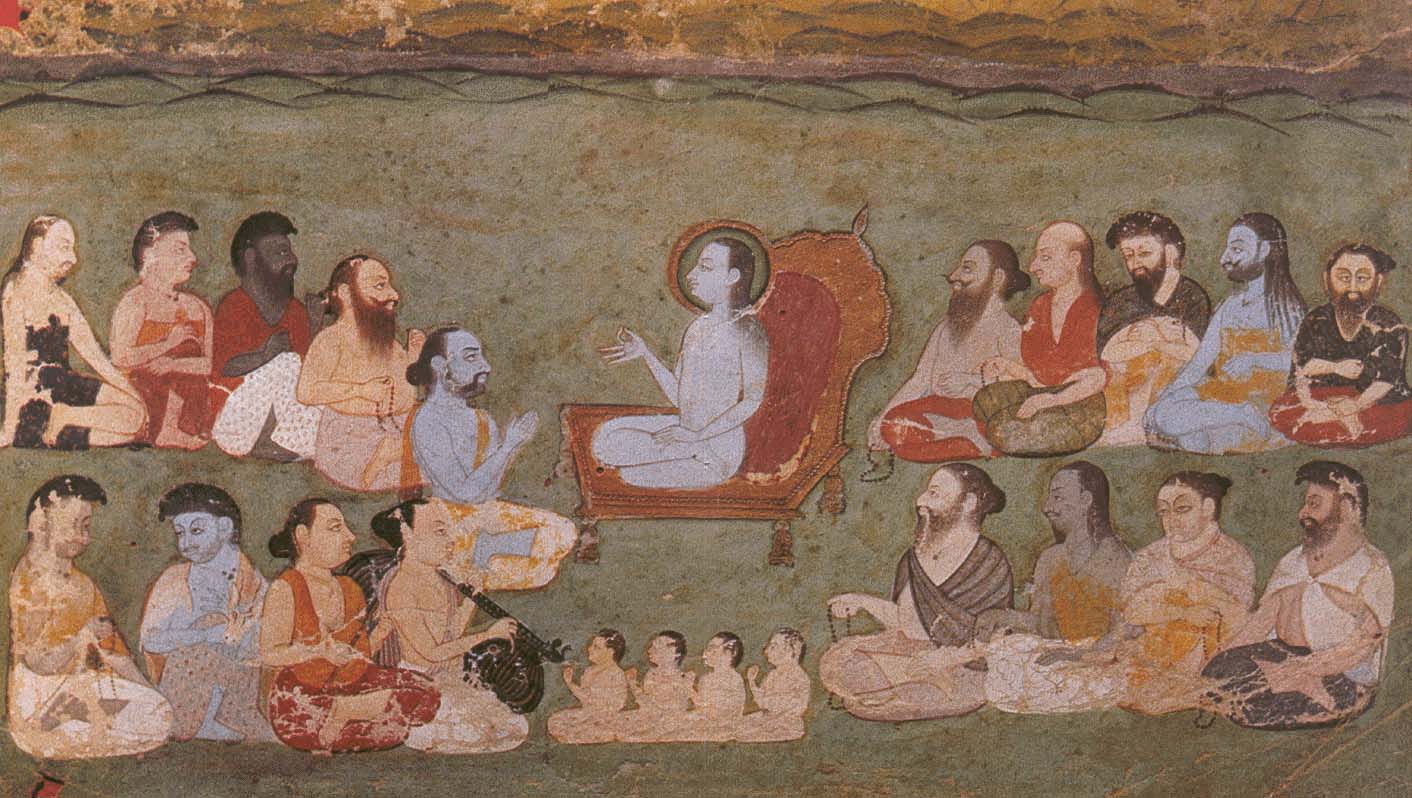
Parîkchit before S'ukadeva is a detail of the image used at 2.8.
It is a Kishangarh painting of the Rajasthani school. India,
17th century. Source.
The second image is a collage by Anand Aadhar against the
background of a painting called:
"Yantra of Lord Vishnu with twenty-four Avatâras" by Vidya Devi
and Dhirendra Jha . Source: Exoticindiaart.com, used with permission.
Production: Filognostic Association of The Order of Time.

Feed-back | Links | Downloads | Music | Pictures | What's New | Search | Donations