
Canto
10
Canto
10
Chapter 52: The Lords Leap from a Mountain and Rukminî's Message to Lord Krishna
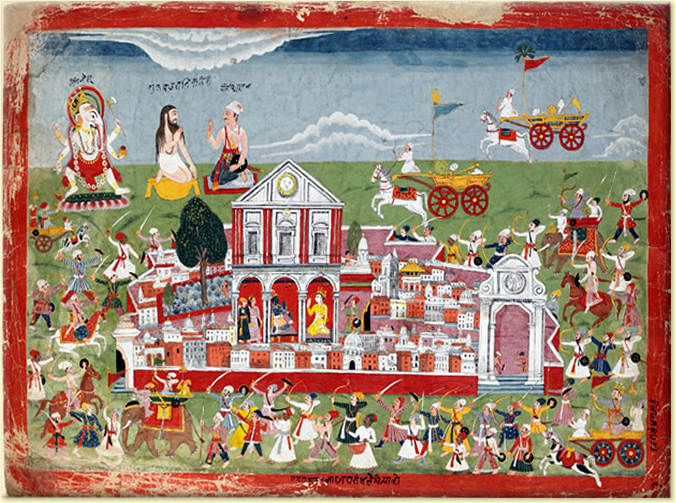
(1) S'rî S'uka said: 'Thus being blessed by Krishna, the descendant of Ikshvâku [Mucukunda] circumambulating Him bowed down and left through the mouth of the cave. (2) Noticing that the human beings, the animals, plants and trees were all in a poor condition [were small], he concluded that the Age [the yuga] of Kali had arrived and went in the northern direction [compare 1.15: 44]. (3) He had faith in the process of penance, was of self-control and free from attachments and doubts. With his mind thus absorbed in Krishna he entered the realm of the mountain Gandhamâdana ['the nice smell']. (4) Reaching Badarikâs'rama [see e.g. 3.4: 4, 4.12: 16, 5.4: 5, 7.11: 6], the residence of Nara-Nârâyana, he who conquering all duality had found peace in his austerity, worshiped the Lord.
(5) The Supreme Lord returned to His city Mathurâ that was surrounded by the Yavanas, killed the barbarian army and brought their riches to Dvârakâ. (6) As Acyuta was engaged in taking the wealth with oxen and men, Jarâsandha arrived on the scene leading twenty-three armies. (7) Seeing the mighty waves of soldiers of the enemy armies, the two Mâdhavas adopting a human course, quickly ran away, oh King. (8) Abandoning the load of riches, appearing afraid but factually being free from fear, They on Their lotus petal feet covered many yojanas. (9) Seeing the Two escape, the mighty ruler of Magadha loudly laughed and pursued the Lords with charioteers and soldiers, not being quite aware of Their special nature. (10) Exhausted from full speed having run a long distance, They climbed a very high mountain known as Pravarshana ['the rainy one'] where the mighty Lord [Indra] is always showering rains. (11) Knowing that They were hiding on the mountain, but not exactly where, oh King, he [Jarâsandha], with firewood set ablaze the mountain on all sides. (12) Quickly leaping down from the eleven yojanas high, everywhere burning mountain, They fell to the ground. (13) Not being seen by Their opponent or his helpers, the two finest Yadus returned to Their city that had the ocean as its moat, oh King. (14) The king of the Magadhas mistakenly thought that Balarâma and Kes'ava had burned in the fire, pulled back his huge force and returned to Magadha. (15) As previously stated, the opulent sovereign of Ânarta, named Raivata, on the order of Brahmâ gave Balarâma his daughter Raivatî in marriage [9.3: 33-36]. (16-17) The Supreme Lord Govinda, oh hero among the Kurus, married Vaidarbhî [Rukminî], the daughter of Bhîshmaka, on her own request. She was a plenary portion of the Goddess of Fortune. With force overruling S'âlva and the other kings in support of S'is'upâla, He accomplished this [by stealing her away] before the eyes of all the people, just like the son of Târksya [Garuda, stole] the nectar from heaven.'
(18) The honorable king said: 'In the manner of a Râkshasa [by kidnapping thus], so I heard, the Supreme Lord thus married Rukminî, the daughter of Bhîshmaka with the charming face. (19) Oh lord, I would like to hear how Krishna, He with His immeasurable potency, stole away His bride and [therewith] defeated such kings as Jarâsandha and S'âlva. (20) What intelligent person, oh brahmin, can ever get enough of listening to the righteous, enchanting and always new stories [see 10.45: 48] we hear about Krishna, which remove the worldly contamination?'
(21) The son of Vyâsa said: 'There was a king named Bhîshmaka, the great ruler of Vidarbha, who had five sons and one daughter with an exceptionally pretty face. (22) Rukmî was the first born son, followed by Rukmaratha, Rukmabâhu, Rukmakes'a and Rukmamâlî. Rukminî was their chaste sister [rukma means: 'what is bright or radiant']. (23) Hearing Mukunda's beauty, prowess, character and opulences being sung by those who came to her family home, she deemed Him a suitable husband. (24) Krishna knowing her to be a repository of intelligence, auspicious marks, magnanimity, beauty, good behavior and other qualities, likewise considered her a suitable wife, and decided to marry her. (25) But Rukmî, who hated Krishna, prevented this, even though his family wanted to give his sister to Krishna, oh King. He thought of S'is'upâla. (26) The princess of Vidarbha with her dark eyes, was unhappy with that knowledge. She pained her mind and quickly sent a certain dependable brahmin to Krishna. (27) After arriving in Dvârakâ he was ushered in by the gatekeepers and saw the Original Personality sitting on a golden throne. (28) The moment the Lord who is good to the brahmins, saw him, He came down from His throne, seated him and performed worship the same way the residents of heaven worship Him. (29) With him having eaten and rested, He who is the goal of the devotees approached him to personally massage his feet. Patiently He asked him: (30) 'Oh My best one, are the religious activities supported by your first-class, twice-born seniors, proceeding without too much difficulty, and are you always happy within? (31) When a brahmin remains satisfied with whatever [comes his way] and does not fail in his religious duty, that will bring him all he desires. (32) Dissatisfied he, even as a master of enlightened souls, will keep moving from world to world, while satisfied he, even when he possesses nothing, will sleep well with all his limbs [and mind] free from distress. (33) I bow My head again and again to those brahmins who are satisfied with what they get, for they, peaceful and free from false ego, are the best well-wishers of all living beings [see also B.G. 2: 71, 12: 13-14]. (34) Are you faring well as a subject to your king? He in whose kingdom the people being protected lead a happy life, is very dear to Me. (35) Where have you come from, crossing the [ocean of] troubles, and for what purpose have you come here? Please tell Us everything, if it is not a secret. What is it that We may do for you?'
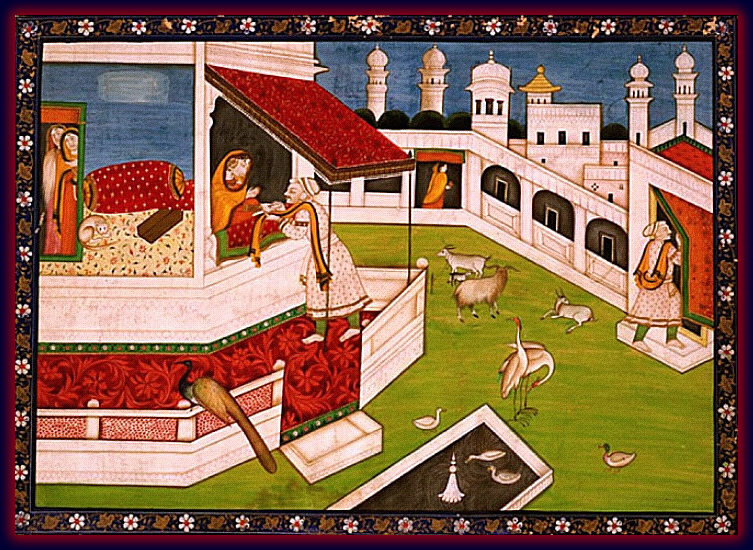
(36) After the Supreme One, who for the sake of His pastimes assumes His bodies, thus had asked these questions, the brahmin related everything to Him. (37) 'S'rî Rukminî told me: 'Oh Most Beautiful One of all the Worlds, I heard about Your qualities. For all who listen and whom You have entered through the openings of their ears, You thus remove the distress of their bodies. To those who have eyes, the sight of Your beauty constitutes the complete fulfillment of their life's purpose. Therefore I have without any shame devoted my mind to You Acyuta! (38) Who, oh Mukunda, compares to Your greatness, Your lineage, character, beauty, knowledge, youth, property and influence? Which sober and marriageable girl of a noble birth would, coming of age, not choose You for her husband, oh lion among men, oh You who fills the mind of every member of society with joy? (39) I thus have chosen Your good Self, oh dear Lord, for my husband. I offer myself hereby to You as Your wife, oh Omnipotent One. Please accept me! May the king of Cedi [S'is'upâla], who like a jackal wants to steal away the portion belonging to the king of the animals, never touch what is allotted to the [real] hero. (40) When I sufficiently have worshiped the Supreme Personality of Godhead, the Lord, by the performance of pious works, with sacrifices, charity, observances and vows, by honoring the gods, the gurus and the brahmins, and with other activities, may [Krishna] the elder brother of Gada [9.24: 46] then [please] come and take my hand, and not the son of Damaghosha or others like him? (41) Come tomorrow when the marriage takes place, unseen to Vidarbha, oh Invincible One. Fight surrounded by Your officers then to crush the armed resistance of the kings of Caidya and Magadha, and next, as the reward for Your valor, marry me in the râkshasa style [by taking me with You]. (42) You may wonder how, with me moving within my quarters, You can carry me away without killing my relatives. Let me tell You how: the day before there is a large ceremonial procession outside [the palace] for the presiding deity of the family. In that ceremony the new bride approaches the goddess Girijâ [Ambikâ in her temple]. (43) Great souls like [S'iva] the husband of Ûma, in order to overcome their own ignorance, long to bathe in the dust of Your lotus feet. When I, oh Lotus-eyed One, cannot obtain Your mercy, I should, being weakened by vows, give up my life to attain You [only] after hundreds of births.' (44) The brahmin ended with: 'This is the confidential message I bring you, oh Lord of the Yadus, please consider what needs to be done right now in this matter.'


Third revised edition, loaded April 16, 2021.
Previous Aadhar edition and Vedabase links:
S'rî S'uka said: 'Thus being blessed by Krishna, the descendant of Ikshvâku [Mucukunda] circumambulating Him bowed down and left through the mouth of the cave.S'rî S'uka said: 'In this manner, my dear, being graced by Krishna circumambulated the descendant of Ikshvâku Him bowing down and left he through the mouth of the cave. (Vedabase)
Noticing that the human beings, the animals, plants and trees were all in a poor condition [were small], he concluded that the Age [the yuga] of Kali had arrived and went in the northern direction [compare 1.15: 44].
Noticing that the human beings, the animals, plants and trees were all in a poor condition concluded he that Kali-yuga had arrived and went he in the northern direction [compare 1.15: 44]. (Vedabase)
He had faith in the process of penance, was of self-control and free from attachments and doubts. With his mind thus absorbed in Krishna he entered the realm of the mountain Gandhamâdana ['the nice smell'].
With faith in the process of penance was he, seriously detached from a materially motivated association with people, freed from doubts and thus having fixed his mind upon Krishna he reached the mountain Gandhamâdana ['the nice smell']. (Vedabase)
Reaching Badarikâs'rama [see e.g. 3.4: 4, 4.12: 16, 5.4: 5, 7.11: 6], the residence of Nara-Nârâyana, he who conquering all duality had found peace in his austerity, worshiped the Lord.
Reaching Badarikâs'rama [see e.g. 3.4: 4; 4.12: 16; 5.4: 5; 7.11: 6], the residence of Nara-Nârâyana, worshiped he, with respecting all duality, the Lord from the peace he had found with his austerity. (Vedabase)
The Supreme Lord returned to His city Mathurâ that was surrounded by the Yavanas, killed the barbarian army and brought their riches to Dvârakâ.
The Supreme Lord turned back to His city Mathurâ that was surrounded by the Yavanas and brought, after killing the barbarian army, their riches to Dvârakâ. (Vedabase)
As Acyuta was engaged in taking the wealth with oxen and men, Jarâsandha arrived on the scene leading twenty-three armies.
As Acyuta by oxen and men was engaged in taking the wealth, arrived there Jarâsandha leading twenty-three armies. (Vedabase)
Seeing the mighty waves of soldiers of the enemy armies, the two Mâdhavas adopting a human course, quickly ran away, oh King.
Seeing the powerful waves of soldiers of the enemy armies ran the two Mâdhavas, adopting a human course, o King, quickly away. (Vedabase)
Abandoning the load of riches, appearing afraid but factually being free from fear, They on Their lotus petal feet covered many yojanas.
Abandoning the load of goods acting like cowards who are afraid, covered They, actually not afraid at all, with Their lotuspetal feet many yojanas. (Vedabase)
Seeing the Two escape, the mighty ruler of Magadha loudly laughed and pursued the Lords with charioteers and soldiers, not being quite aware of Their special nature.
Seeing the Two fleeing laughed the mighty ruler of Mâghada loudly and pursued he with charioteers and soldiers the Lords, not being quite aware of Their special nature. (Vedabase)
Exhausted from full speed having run a long distance, They climbed a very high mountain known as Pravarshana ['the rainy one'] where the mighty Lord [Indra] is always showering rains.
Having put Their powers to a test full speed having run a long distance, climbed They a very high mountain known as Pravarshana ['the rainy one'] where the mighty one [Indra] is always showering rains. (Vedabase)
Knowing that They were hiding on the mountain, but not exactly where, oh King, he [Jarâsandha], with firewood set ablaze the mountain on all sides.
Knowing that They were hiding on the mountain, but not exactly where o King, set he, with firewood igniting fires on all sides, the mountain ablaze. (Vedabase)
Quickly leaping down from the eleven yojanas high, everywhere burning mountain, They fell to the ground.
Quickly leaping down from it being eleven yojanas high and burning on all sides, fell They to the ground. (Vedabase)
Not being seen by Their opponent or his helpers, the two finest Yadus returned to Their city that had the ocean as its moat, oh King.
Not being seen by Their opponent or his helpers returned the two finest Yadus to Their city which had the ocean as its moat, o King. (Vedabase)
The king of the Magadhas mistakenly thought that Balarâma and Kes'ava had burned in the fire, pulled back his huge force and returned to Magadha.
The king of the Magadhas on his part mistakenly thought that Balarâma and Kes'ava had burned in the fire and went to Magadha pulling back his huge force. (Vedabase)
As previously stated, the opulent sovereign of Ânarta, named Raivata, on the order of Brahmâ gave Balarâma his daughter Raivatî in marriage [9.3: 33-36].
As previously stated gave the opulent sovereign of Ânarta, named Raivata, on the order of Brahmâ Balarâma his daughter Raivatî in marriage [9.3: 33-36]. (Vedabase)
The Supreme Lord Govinda oh hero among the Kurus, married Vaidarbhî [Rukminî] the daughter of Bhîshmaka, on her own request. She was a plenary portion of the Goddess of Fortune. With force overruling S'âlva and the other kings in support of S'is'upâla, He accomplished this [by stealing her away] before the eyes of all the people, just like the son of Târksya [Garuda, stole] the nectar from heaven.'
Govinda the Supreme Lord Himself, married, o hero among the Kurus, Vaidarbhî [Rukminî] the daughter of Bhîshmaka, to her own choice. She was a plenary portion of the goddess of fortune. By force overruling S'âlva and other kings in support of S'is'upâla, accomplished He this [by stealing her away] before the eyes of all the people, just like the son of Târkshya [Garuda, stole] the nectar of heaven.' (Vedabase)
The honorable king said: 'In the manner of a Râkshasa [by kidnapping thus], so I heard, the Supreme Lord thus married Rukminî, the daughter of Bhîshmaka with the charming face.
The honorable king said: 'In the manner of a Râkshasa [by kidnapping thus], so I heard, married the Supreme Lord thus Rukminî, the daughter of Bhîshmaka with the charming face. (Vedabase)
Oh lord, I would like to hear how Krishna, He with His immeasurable potency, stole away His bride and [therewith] defeated such kings as Jarâsandha and S'âlva.
O lord, I'd like to hear about how Krishna stole away the bride, with His immeasurable potency defeating such kings as Jarasândha and S'âlva. (Vedabase)
What intelligent person, oh brahmin, can ever get enough of listening to the righteous, enchanting and always new stories [see 10.45: 48] we hear about Krishna, which remove the worldly contamination?'
O brahmin! Who can ever all understand what is said and get enough of hearing about the always new [see 10.45: 48] propitious, delightful topics of Krishna which remove the contamination of the world?'? (Vedabase)
The son of Vyâsa said: 'There was a king named Bhîshmaka, the great ruler of Vidarbha, who had five sons and one daughter with an exceptionally pretty face.
The son of Vyâsa said: 'There was a king named Bhîshmaka, the great ruler of Vidarbha, of whom there were five sons and one daughter with an exceptionally pretty face. (Vedabase)
Rukmî was the first born son, followed by Rukmaratha, Rukmabâhu, Rukmakes'a and Rukmamâlî. Rukminî was their chaste sister [rukma means: 'what is bright or radiant'].
Rukmî was the first born son, followed by Rukmaratha, Rukmabâhu, Rukmakes'a and Rukmamâlî; Rukminî their sister was of a saintly character [rukma means: 'what is bright or radiant']. (Vedabase)
Hearing Mukunda's beauty, prowess, character and opulences being sung by those who came to her family home, she deemed Him a suitable husband.
She, from hearing Mukunda's beauty, prowess, character and opulences being sung by those who came to her family home, deemed Him a suitable husband. (Vedabase)
Krishna knowing her to be a repository of intelligence, auspicious marks, magnanimity, beauty, good behavior and other qualities, likewise considered her a suitable wife, and decided to marry her.
Krishna, finding her as a repository of intelligence, auspicious marks, magnanimity, beauty, good behavior and other qualities a suitable wife, then took the decision to marry her. (Vedabase)
But Rukmî, who hated Krishna, prevented this, even though his family wanted to give his sister to Krishna, oh King. He thought of S'is'upâla.
Even though the family wanted to give the sister to Krishna o King, was this by Rukmî, who hated Krishna, prevented; he thought more of S'is'upâla. (Vedabase)
The princess of Vidarbha with her dark eyes, was unhappy with that knowledge. She pained her mind and quickly sent a certain dependable brahmin to Krishna.
The princess of Vidarbha with her dark eyes unhappy with that knowledge, pained her mind and quickly sent a certain dependable brahmin to Krishna. (Vedabase)
After arriving in Dvârakâ he was ushered in by the gatekeepers and saw the Original Personality sitting on a golden throne.
He, arriving at Dvârakâ, brought inside by the gatekeepers saw the Original Person seated on a golden throne. (Vedabase)
The moment the Lord who is good to the brahmins, saw him, He came down from His throne, seated him and performed worship the same way the residents of heaven worship Him.
The Lord Good to the Brahmins seeing him got down from His throne, seated him and performed worship the way the residents of heaven worship Him. (Vedabase)
With him having eaten and rested, He who is the goal of the devotees approached him to personally massage his feet. Patiently He asked him:
With him having eaten and rested approached the Goal of the Saintly Devotees him in order to personally give him a massage for his feet and asked He him patiently: (Vedabase)
'Oh My best one, are the religious activities supported by your first-class, twice-born seniors, proceeding without too much difficulty, and are you always happy within?
'My best, are the religious practices sanctioned by your first-class, twice-born seniors, proceeding without too much difficulty and are you always happy within? (Vedabase)
When a brahmin remains satisfied with whatever [comes his way] and does not fail in his religious duty, that will bring him all he desires.
When a brahmin satisfied carries on with whatever [comes his way], not falling short in his religious duty, will those [practices] for him every way be the cow of plenty. (Vedabase)
Dissatisfied he, even as a master of enlightened souls, will keep moving from world to world, while satisfied he, even when he possesses nothing, will sleep well with all his limbs [and mind] free from distress.
Dissatisfied will he, even though he is the master of the godly, again and again end up in various worlds; but satisfied will he, even though destitute, rest with all his limbs free from pain and fever. (Vedabase)
I bow My head again and again to those brahmins who are satisfied with what they get, for they, peaceful and free from false ego, are the best well-wishers of all living beings [see also B.G. 2: 71, 12: 13-14].
To the learned who are satisfied with their progress [in self-realization] I bow My head again and again because they, void of false ego, are of the saintly and of all living beings, peaceful as they are the best well-wishers [see also B.G. 2: 71, 12: 13-14]. (Vedabase)
Are you faring well as a subject to your king? He in whose kingdom the people being protected lead a happy life, is very dear to Me.
Are you faring well with what the king all does, o brahmin? For the king whose subjects are happy to live protected in his state is very dear to Me. (Vedabase)
Where have you come from, crossing the [ocean of] troubles, and for what purpose have you come here? Please tell Us everything, if it is not a secret. What is it that We may do for you?'
From where, crossing the [ocean of] troubles, did you arrive here and for what purpose; please tell Us everything, if its not a secret; what is it We may do for you?' (Vedabase)
After the Supreme One, who for the sake of His pastimes assumes His bodies, thus had asked these questions, the brahmin related everything to Him.
With the Supreme Being, who for the sake of His pastimes assumes His bodies, thus asking these questions, related the brahmin everything to Him: (Vedabase)
'S'rî Rukminî told me: 'Oh Most Beautiful One of all the Worlds, I heard about Your qualities. For all who listen and whom You have entered through the openings of their ears, You thus remove the distress of their bodies. To those who have eyes, the sight of Your beauty constitutes the complete fulfillment of their life's purpose. Therefore I have without any shame devoted my mind to You, Acyuta!
'S'rî Rukminî has said: 'O Most Beautiful One of all the Worlds, hearing that for all those who hear about Your qualities You, entering through the openings of their ears, remove the distress of their bodies and that they who have eyes to see the beauty of You, obtain the complete fulfillment of all desires, have I without shame installed You in my mind! (Vedabase)
Who, oh Mukunda, compares to Your greatness, Your lineage, character, beauty, knowledge, youth, property and influence? Which sober and marriageable girl of a noble birth would, coming of age, not choose You for her husband oh lion among men, oh You who fills the mind of every member of society with joy?
Who, o Mukunda, is Your equal in aristocratic background, character, beauty, knowledge, youth, property and influence? What sober and marriageable girl of a good family would, coming of age, not choose for her husband You, o lion among men, who are so delightful to the minds of all mankind? (Vedabase)
I thus have chosen Your good Self, oh dear Lord, for my husband. I offer myself hereby to You as Your wife, oh Omnipotent One. Please accept me! May the king of Cedi [S'is'upâla], who like a jackal wants to steal away the portion belonging to the king of the animals, never touch what is allotted to the [real] hero.
Therefore have I chosen Your good Self, dear Lord, for my husband and offer I myself as a wife to You, o Omnipotent One, please accept me; may the king of Cedi [S'is'upâla] never, like a jackal away with what belongs to the king of the animals, touch what is allotted to the hero. (Vedabase)
When I sufficiently have worshiped the Supreme Personality of Godhead, the Lord, by the performance of pious works, with sacrifices, charity, observances and vows, by honoring the gods, the gurus and the brahmins, and with other activities, may [Krishna] the elder brother of Gada [9.24: 46] then [please] come and take my hand, and not the son of Damaghosha or others like him?
Let with the Supreme Lord, the Highest Controller sufficiently worshiped by means of pious works, sacrifices, charity, observances, vows, honoring the gods, the gurus and the learned and other activities, the elder brother of Gada [9.24: 46] come and take my hand and not the son of Damaghosha or others like him. (Vedabase)
Come tomorrow when the marriage takes place, unseen to Vidarbha, oh Invincible One. Fight surrounded by Your officers then to crush the armed resistance of the kings of Caidya and Magadha, and next, as the reward for Your valor, marry me in the râkshasa style [by taking me with You].
The day before the marriage takes place You must come to Vidarbha, o Invincible One, in secret surrounded by Your officers to crush fighting the armed resistance of the kings of Caidya and Magadha and take me in marriage in the râkshasa style as the reward for Your valor. (Vedabase)
You may wonder how, with me moving within my quarters, You can carry me away without killing my relatives. Let me tell You how: the day before there is a large ceremonial procession outside [the palace] for the presiding deity of the family. In that ceremony the new bride approaches the goddess Girijâ [Ambikâ in her temple].
How to carry me, moving within my quarters, away without killing my relatives, You might say; let me tell You how to: on the day before is there for the presiding deity of the family a large ceremonial procession outside in which the new bride approaches the goddess Girijâ [Ambikâ in her temple]. (Vedabase)
Great souls like [S'iva] the husband of Ûma, in order to overcome their own ignorance, long to bathe in the dust of Your lotus feet. When I, oh Lotus-eyed One, cannot obtain Your mercy, I should, being weakened by vows, give up my life to attain You [only] after hundreds of births.'
Great souls, like the husband of Ûma [S'iva], in order to overcome their own ignorance hanker to bathe in the dust of Your lotus feet; when I, o Lotus-eyed One, cannot obtain Your mercy I ought to give up my life in being weakened by vows, so that I [finally] obtain You after a hundred births more.' (Vedabase)
The brahmin ended with: 'This is the confidential message I bring you, oh Lord of the Yadus, please consider what needs to be done right now in this matter.'
[The brahmin ended with:] This is the confidential message brought by me, o Lord of the Yadus, so please consider what immediately following up on this matter needs to be done.' (Vedabase)

The text and audio are offered under the
conditions of the
Creative
Commons Attribution-Noncommercial-Share Alike 3.0 Unported
License.
The first image is titled: "Jarasandha's army besieges Mathura'
folio from a Bhagavata Purana. India, mca. 1775-1800'.
Source: Smithsonian
Museum, Freer Sackler gallery.
The second image is titled 'Princess Rukmini Receives Krishna's
Message'.
Folio of a Rukmini-Harana (Abduction of Rukmini) India, Himachal
Pradesh, Guler, South Asia, circa 1800.
Courtesy of LACMA.
Production: Filognostic Association of The Order of Time.

Feed-back | Links | Downloads | Music | Pictures | What's New | Search | Donations



 Text 1