
Canto
10
Canto
10
Chapter 5: Krishna's Birth Ceremony and the Meeting of Nanda Mahârâja and Vasudeva
(1-2) S'rî S'uka said: 'Nanda was a man of great devotion. Overjoyed that a son had been born, he invited the scholars conversant with the Veda, cleansed himself with a bath and dressed himself up. In order to celebrate the birth [with a jâtakarma ceremony*] as was prescribed, he took care that the mantras were chanted, and also arranged for the worship of the forefathers and demigods. (3) To the brahmins he donated countless fully decorated milk cows and seven mountains of sesame seed, masses of jewels and gold-embroidered cloth. (4) Material things are purified by time, by washing and bathing them, by rituals, by penance, by worship, by charity and by contentment, but the soul is purified by self-realization. (5) The scholars, the storytellers, the reciters and the singers uttered words that purified everyone and everything, while the bherîs and dundubhis [drums] sounded constantly. (6) All of Vraja was swept, the doorsteps, the courtyards and the interiors were sprinkled with water, and a variety of festoons and flags decorated gates that were made with garlands, pieces of cloth and mango leaves. (7) The cows, bulls and calves were smeared with turmeric oil and decorated with a variety of mineral colors, peacock feathers, cloth, golden ornaments and flowers. (8) Oh King, the cowherds [the gopas] gathering there, carried all kinds of gifts and were dressed in the most precious garments, with costly ornaments, coats and turbans. (9) The cowherd wives [the gopîs] were also glad to hear that mother Yas'odâ had given birth to a boy, and personally gave their best by appearing in festive dresses with eye make-up and wearing jewelry and such.(10) With their lotuslike faces most beautifully decorated with saffron and fresh kunkuma, they with offerings in their hands hurried hither with swaying bosoms and hips. (11) The gopîs wore brilliantly polished jeweled earrings, strings of golden coins around their necks and colorfully embroidered clothes. It was a feast to the eye to see them, with their swinging bangles, earrings, breasts and garlands, thus being dressed going to Nanda's house, while a shower of flowers fell from their hair. (12) They all for a long time pronounced blessings for the newborn child, like 'pâhi' ['be protected'], and sprinkled the Unborn Lord with turmeric oil while saying prayers. (13) With Krishna, the Unlimited Controller of the Entire Universe, arriving in Nanda's cow community, many different musical instruments vibrated in a great festival. (14) The gopas rejoicing, threw curds, milk and buttermilk at each other and smeared with butter. (15-16) In order to offer his child the best prospects and to satisfy Lord Vishnu, Nanda, that noble soul, warm-heartedly honored the gopas, the storytellers, the reciters, the singers, and all those who found their livelihood by their education, with whatever they could wish for and could use as for clothes, ornaments and cows [see also 7.14: 17]. (17) The greatly fortunate Rohinî [the mother of Baladeva, see 10.2: 7] was congratulated by Nanda and Yas'odâ, and she also, beautifully dressed and adorned with a garland and a necklace, moved around busily [being engaged in receiving guests]. (18) Oh King, from that time on the cow lands of Nanda became opulent with all riches, for they, now being the residence of the Lord, were by His transcendental qualities transformed into a place for the pastimes of Ramâ [the Goddess of Fortune, see 8.8: 8].
(19) Nanda thereafter entrusted the protection of Gokula [the cow village] to his cowherd men and went to Mathurâ to pay Kamsa the yearly taxes over his profit, oh best of the Kuru dynasty. (20) Vasudeva, who heard that his [younger step-]brother Nanda [**] had arrived [in the city] - as it turned out to pay his tribute to the king, thereupon went to his camp. (21) When Nanda all of a sudden saw him before his eyes, he very pleased rose to his feet as if his body had found a new life. Overwhelmed by love and affection he embraced his dear friend. (22) Welcoming him respectfully with all regards, he assigned him a seat and informed about his health. Vasudeva, attached as he was, then asked about his two sons, saying the following, oh ruler over the world. (23) 'Dear brother Nanda, advanced in age and having no son, you were desperately longing for one. What a great fortune now to have gotten a son! (24) What a great fortune also to see you here today, it is like a rebirth. Despite being around in this world of birth and death, it is so very hard to meet again your loved ones! (25) Like things that afloat in a river are carried away by the force of the waves, we, intimately living together, do not stay [together] in one place, because our karmic ways are diverging. (26) Is everything alright with your cow business? Is there enough water, grass, plants and such, in the great forest where you are living now with your friends? (27) Oh brother, does my son who with His mother [Rohinî] lives in your house, consider you His father and is He a sweet boy under your loving care? (28) A person's three goals of life as described in the Vedic literatures [the regulation of one's lusts, income and rituals], find their consequence and belief when one is together. But that is not so when that togetherness has become difficult, then they lose their meaning.'
(29) S'rî Nanda said: 'Kamsa killed, alas, the many sons you had with Devakî, and also the one remaining child, the youngest, a daughter, went to heaven. (30) Fate determines the end of all things, providence is elevated above every living being, and the unseen is the ultimate truth of all souls. He who knows this will never get bewildered.'
(31) S'rî Vasudeva said: 'Now that you have paid the king his yearly taxes and we have met, the both of us should not spend more days together in this place. Something might have happened in Gokula!'(32) S'rî S'uka said: 'After that advise of Vasudeva, Nanda and the gopas excused themselves, yoked their oxen to their bullock carts, and then left for Gokula.'

Third revised edition, loaded May 2, 2020.
Previous Aadhar edition and Vedabase links:
S'rî S'uka said: 'Nanda was a man of great devotion. Overjoyed that a son had been born, he invited the scholars conversant with the Veda, cleansed himself with a bath and dressed himself up. In order to celebrate the birth [with a jâtakarma ceremony*] as was prescribed, he took care that the mantras were chanted, and also arranged for the worship of the forefathers and demigods.S'rî S'uka said: 'Nanda overjoyed that a son had been born, broad of mind invited the learned conversant with the Veda, cleansed himself with a bath and dressed himself up. To celebrate the birth [in jâtakarma*] had he the mantras chanted and arranged he as well for the worship of the forefathers and demigods as prescribed. (Vedabase)
To the brahmins he donated countless fully decorated milk cows and seven mountains of sesame seed, masses of jewels and gold-embroidered cloth.
To the brahmins he donated countless fully decorated milk-cows and seven mountains of sesame seed, covered with jewels and gold-embroidered cloth. (Vedabase)
Material things are purified by time, by washing and bathing them, by rituals, by penance, by worship, by charity and by contentment, but the soul is purified by self-realization.
By time, by bathing, by purification ceremonies, by austerity and by worship becomes in charity and contentment all that one has purified, but the soul is purified by selfrealization. (Vedabase)
The scholars, the storytellers, the reciters and the singers uttered words that purified everyone and everything, while the bherîs and dundubhis [drums] sounded constantly.
Under the constant vibrations of bherîs and dundubhis [drums] uttered the learned, the storytellers, the reciters and the singers words that purified all and everything. (Vedabase)
All of Vraja was swept, the doorsteps, the courtyards and the interiors were sprinkled with water, and a variety of festoons and flags decorated gates that were made with garlands, pieces of cloth and mango leaves.
All of Vraja was cleaned; all doorsteps, the courtyards and the interiors were washed and a variety of festoons and flags decorated arches with garlands, pieces of cloth and mango-leaves. (Vedabase)
The cows, bulls and calves were smeared with turmeric oil and decorated with a variety of mineral colors, peacock feathers, cloth, golden ornaments and flowers.
The cows, bulls and calves were smeared with turmeric-oil and decorated with a variety of mineral colors, peacock feathers, cloth, golden ornaments and flowers. (Vedabase)
Oh King, the cowherds [the gopas] gathering there, carried all kinds of gifts, and were dressed in the most precious garments, with costly ornaments, coats and turbans.
O King, the cowherds [the gopas] gathering were dressed with the most precious ornaments and garments like coats and turbans and took all kinds of gifts with them. (Vedabase)
The cowherd wives [the gopîs] were also glad to hear that mother Yas'odâ had given birth to a boy, and personally gave their best by appearing in festive dresses with eye make-up and wearing jewelry and such.
The cowherd wives [the gopîs] were also glad to hear of mother Yas'odâ giving birth to a boy and gave personally their best appearing in festive dresses with their eyes made up and wearing jewelry and such. (Vedabase)
With their lotuslike faces most beautifully decorated with saffron and fresh kunkuma, they with offerings in their hands hurried hither with swaying bosoms and hips.
With their most beautiful lotuslike faces and decorations, saffron and fresh kunkum, hurried they with swaying bosoms and hips hither with offerings in their hands. (Vedabase)
The gopîs wore brilliantly polished jeweled earrings, strings of golden coins around their necks and colorfully embroidered clothes. It was a feast to the eye to see them, with their swinging bangles, earrings, breasts and garlands, thus being dressed going to Nanda's house, while a shower of flowers fell from their hair.
The gopîs wore dazzling jeweled earrings, strings of gold coins around their necks and had their vestments colorful embroidered while on their way towards Nanda's house a shower of flowers fell from their garlands; with the raiment and their swinging bangles, earrings, breasts and garlands were they a feast to the eye. (Vedabase)
They all for a long time pronounced blessings for the newborn child, like 'pâhi' ['be protected'], and sprinkled the Unborn Lord with turmeric oil while saying prayers.
All for long offered blessings to the newborn one like 'pâhi' ['be protected'] and sprinkled with prayers the Unborn Lord with turmeric-oil. (Vedabase)
With Krishna, the Unlimited Controller of the Entire Universe, arriving in Nanda's cow community, many different musical instruments vibrated in a great festival.
With the arrival in Nanda's cow-community of Krishna, the Unlimited Controller of the Entire Universe, vibrated a diversity of musical instruments in a great festival. (Vedabase)
The gopas rejoicing, threw curds, milk and buttermilk at each other and smeared with butter.
Rejoicing threw the gopas with curds, milk and buttermilk and smeared they one another with the butter. (Vedabase)
In order to offer his child the best prospects and to satisfy Lord Vishnu, Nanda, that noble soul, warm-heartedly honored the gopas, the storytellers, the reciters, the singers, and all those who found their livelihood by their education, with whatever they could wish for and could use as for clothes, ornaments and cows [see also 7.14: 17].
To offer his child the best prospects was that noble soul, Nanda, being of the greatest mind towards them as well as towards the storytellers, the reciters, the singers and others who found their livelihood by their education, for the purpose of satisfying Lord Vishnu of worship with whatever they could wish for and use as for clothes, ornaments and cows [see also 7.14: 17]. (Vedabase)
The greatly fortunate Rohinî [the mother of Baladeva, see 10.2: 7] was congratulated by Nanda and Yas'odâ, and she also, beautifully dressed and adorned with a garland and a necklace, moved around busily [being engaged in receiving guests].
The greatly fortunate Rohinî [the mother of Baladeva hiding out there, see 10.2: 7] was also made happy by the guardian that was Nanda and was busily going around beautiful with her dress, garland and the decoration of a necklace. (Vedabase)
Oh King, from that time on the cow lands of Nanda became opulent with all riches, for they, now being the residence of the Lord, were by His transcendental qualities transformed into a place for the pastimes of Ramâ [the Goddess of Fortune, see 8.8: 8].
O King, from that time on became the cow-lands of Nanda opulent with all riches as they, as the residence of the Lord, by His transcendental qualities had become the place for the pastimes of Ramâ [the Goddess of Fortune, see 8.8: 8]. (Vedabase)
Nanda thereafter entrusted the protection of Gokula [the cow village] to his cowherd men and went to Mathurâ to pay Kamsa the yearly taxes over his profit, oh best of the Kuru dynasty.
Nanda, after entrusting the cowherd men the protection of Gokula [the cow-village], went to Mathurâ to pay of his profit his yearly taxes to Kamsa, o best of the Kuru-dynasty. (Vedabase)
Vasudeva, who heard that his [younger step-]brother Nanda [**] had arrived [in the city] - as it turned out to pay his tribute to the king, thereupon went to his camp.
Vasudeva, when he heard that his [younger step-]brother Nanda [**] had left - as he found out in order to pay his tribute to the king - went to where he stayed. (Vedabase)
When Nanda all of a sudden saw him before his eyes, he very pleased rose to his feet as if his body had found a new life. Overwhelmed by love and affection he embraced his dear friend.
Seeing him [Vasudeva] so suddenly, he pleased got up as if his body had found new life and overwhelmed by love and affection embraced he his dear friend. (Vedabase)
Welcoming him respectfully with all regards, he assigned him a seat and informed about his health. Vasudeva, attached as he was, then asked about his two sons, saying the following, oh ruler over the world.
With all honors welcomed, asked about his health and assigned a place to sit asked he [Vasudeva], attached as he was, about his own two sons saying the following, o ruler over the world. (Vedabase)
'Dear brother Nanda, advanced in age and having no son, you were desperately longing for one. What a great fortune now to have gotten a son!
'Dear brother Nanda, what a great fortune has befallen you now perchance to have gotten the son for which you, so advanced in age and having none, were so desperately longing. (Vedabase)
What a great fortune also to see you here today; it is like a rebirth. Despite being around in this world of birth and death, it is so very hard to meet again your loved ones!
What a great fortune also to have you today here, it is like a rebirth; it is so very hard, despite of being around in this world of birth and death, to meet one's beloved once again! (Vedabase)
Like things that afloat in a river are carried away by the force of the waves, we, intimately living together, do not stay [together] in one place, because our karmic ways are diverging.
Like things afloat in a river carried away by the force of the waves do we, intimately living together, not remain in one place diverging in our karmic ways. (Vedabase)
Is everything alright with your cow business? Is there enough water, grass, plants and such in the great forest, where you are living now with your friends?
Is everything okay with your cow-business, is there enough water, grass, plants and all of that in the great forest where you are living now with your friends? (Vedabase)
Oh brother, does my son who with His mother [Rohinî] lives in your house, consider you His father and is He a sweet boy under your loving care?
O brother, does my son, living with His mother in your house, consider you His father and is He sweet under the care of you both? (Vedabase)
A person's three goals of life as described in the Vedic literatures [the regulation of one's lusts, income and rituals], find their consequence and belief when one is together. But that is not so when that togetherness has become difficult, then they lose their meaning.'
The three enjoined aims of life of a person [of regulated lusts, income and rituals] find their meaning and effect in one's being together, but that is not so if that togetherness has become difficult, then they run futile.' (Vedabase)
S'rî Nanda said: 'Kamsa killed, alas, the many sons you had with Devakî, and also the one remaining child, the youngest, a daughter, went to heaven.
S'rî Nanda said: 'How regrettable it is that the many sons you had with Devakî were killed by Kamsa and that also the one remaining child, the youngest, a daughter has gone to heaven. (Vedabase)
Fate determines the end of all things, providence is elevated above every living being, and the unseen is the ultimate truth of all souls. He who knows this will never get bewildered.'
From the One Unseen find all things their fulfillment, the Unseen One is the ultimate for each alive; that destiny is one's ultimate truth and he who knows that will not get bewildered.' (Vedabase)
S'rî Vasudeva said: 'Now that you have paid the king his yearly taxes and we have met, the both of us should not spend more days together in this place. Something might have happened in Gokula!'
S'rî Vasudeva said: 'Now you've paid the king his yearly taxes and we have met, should the both of us not stay here in this place for long, something might have happened in Gokula!' (Vedabase)
S'rî S'uka said: 'After that advise of Vasudeva, Nanda and the gopas excused themselves, yoked their oxen to their bullock carts, and then left for Gokula.'
S'rî S'uka said: 'With that advise excusing himself yoked Nanda and his companions their oxen to their bullock-carts and left they for Gokula.' (Vedabase)
*: The jâtakarma birth ceremony, which can take place when the umbilical cord, connecting the child and the placenta, is cut, entails the touching of the tongue of the new-born thrice with ghee preceded by introductory prayers. The birth ceremony for Krishna is also called Nandotsava. The day of yearly celebrating His birth is called Janmâshthamî [the eight day of the month of Bhâdra or S'râvana (August-September)].
**: The paramparâ elucidates: 'Vasudeva and Nanda Mahârâja were so intimately connected that they lived like brothers. Furthermore, it is learned from the notes of S'rîpâda Madhvâcârya that Vasudeva and Nanda Mahârâja were stepbrothers. Vasudeva's father, S'ûrasena, married a vais'ya girl, and from her Nanda Mahârâja was born. Later, Nanda Mahârâja himself married a vais'ya girl, Yas'odâ. Therefore his family is celebrated as a vais'ya family, and Krishna, identifying Himself as their son, took charge of vais'ya activities like the care for cows (krishi-go-rakshya-vânijyam, B.G. 18: 44)'.

The
text and audio are offered under the conditions of the
Creative
Commons Attribution-Noncommercial-Share Alike
3.0
Unported License.
The first
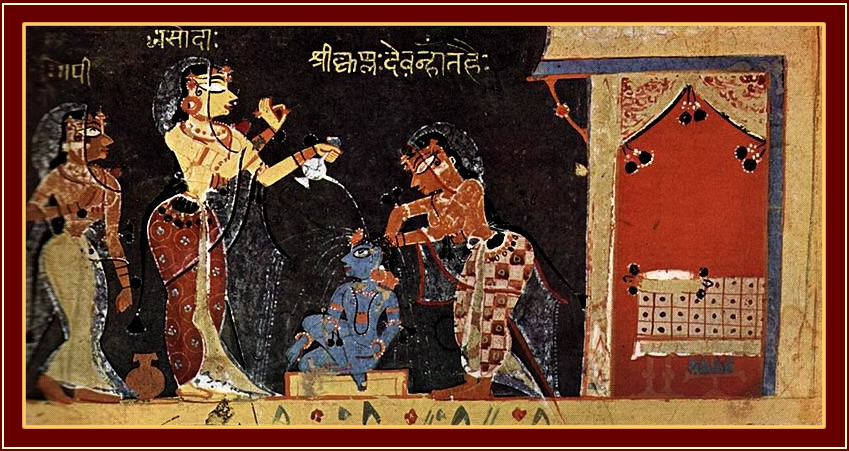
painting is titled:'Yashoda bathing the child Krishna',
Bhagavata Purana Manuscript,
The Yorck Project: 10.000 Meisterwerke der Malerei. Source.
The second painting is titled: "Rao Ram Singh I of Kota Plays
Nanda".
Possibly a page from a dispersed series of the Bhagavata Purana
(Story of the Lord Vishnu)
Made in Kota c. 1700., Rajasthan, India. Source: Philadelphia
Museum
of
Art.
Production: Filognostic
Association
of The
Order of Time.

Feed-back | Links | Downloads | Music | Pictures | What's New | Search | Donations




 Text 1-2