

Canto 10
Canto 10
Chapter 37: Kes'î and Vyoma Killed and Nârada Eulogizes Krishna's Future
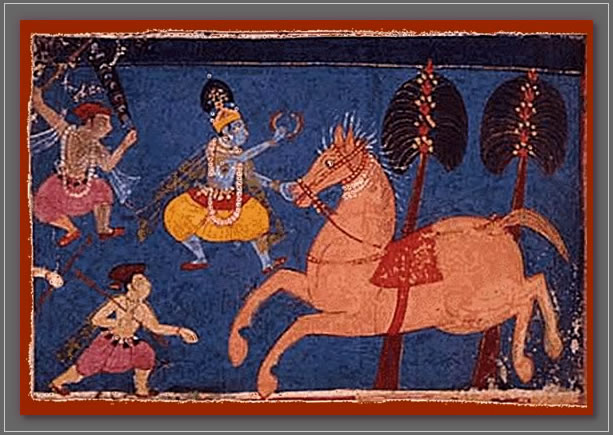
(1-2) S'rî S'uka said: 'Then there was Kes'î being sent by Kamsa [in 10.36: 20]. He as a huge horse with his hooves with the speed of mind ripped open the earth and scattered the clouds as also the celestial carriers of the gods. With his manes and neighing he frightened everyone. The Supreme Lord in response to the stir of the clouds created by his tail and his whinnying that terrified His cowherd village, thereupon stepped forward to fight. He called for Kes'î who roaring like a lion was searching Him. (3) The moment he, who was hard to conquer and approach and most aggressively with a wide open mouth was swallowing the sky, saw Him before him, he rushed furiously forward to attack the lotus-eyed Lord with his legs. (4) The Lord of the Beyond alert to that dodged that attack and seized him with His arms by the legs. He whirled him around indifferently and threw him at a distance of a hundred bow lengths, standing there just like the son of Târkshya [Garuda] throwing a snake. (5) Regaining his consciousness he stood up in bitter rage and ran, [with his mouth] wide open, full speed at the Lord. With a smile He then put His left arm in Kes'î's mouth, like it was a snake in a hole. (6) As Kes'î's teeth came in touch with the Lord's arm, they fell out as if they had come in contact with a red-hot iron. Thereupon the arm of the Supreme Soul swelled within his body, so that his belly expanded like a diseased belly does after being neglected. (7) Because Krishna's arm thus expanded, his breathing was arrested. Kicking with his legs, perspiring all over, rolling with his eyes and excreting feces, he thereupon fell lifeless to the ground. (8) After the Mighty-armed One had retracted His arm from the dead body, which looked like a cucumber [karkathikâ], He, unassuming as He was in His effortlessly having killed His enemy, was honored from above by the gods with a rain of flowers.
(9) The devarishi [Nârada], the most exalted devotee of the Lord, oh King, approached Krishna in private and said the following to Him who is so effortless in His actions: (10-11) 'Krishna, oh Krishna, oh Vâsudeva, immeasurable Soul, oh Lord of Yoga, oh Controller of the Universe, oh shelter of each, oh You master and very best of the Yadus! You alone are the Soul of all living beings who, like fire hidden in firewood, resides within the heart as the Witness, the Lord, the Supreme Personality. (12) You, as the refuge of the spiritual soul, first of all, through Your energy, produced the basic qualities of nature. Unfailing in Your purpose You through these modes create, destroy and maintain this universe. (13) You, this one [creator] Himself, have descended for the protection of the virtuous souls and for the destruction of the demons [Daityas], the savages [Râkshasas] and tormentors [Pramathas], who have the world of the living beings in their grip. (14) To our great fortune You in person have sportively killed this demon who assumed the form of a horse and because of whose neighing being terrified the vigilant gods abandoned heaven. (15-20) The day after tomorrow, I will see that Cânûra, Mushthika and other wrestlers, as also the elephant [Kuvalayâpîda] and Kamsa, are killed by You, oh Almighty One. Thereafter [the demons] S'ankha, [Kâla-]yavana, Mura and Naraka will follow, You will steal the pârijâta flower and defeat Indra. I will see You marry the daughters of the heroes [the kings] as a reward for Your valor. In Dvârakâ You will deliver King Nriga from his curse, oh Master of the Universe, and capture the jewel named Syamantaka together with a wife. You will retrieve the deceased son of a brahmin [Sândîpani Muni] from Your abode [of death] and then You will kill Paundraka, burn down the city of Kâs'î [Benares] and see to the demise of Dantavakra. Thereafter You will kill the king of Cedi [S'is'upâla] at the great sacrifice [see also 3.2: 19, 7.1: 14-15]. The poets on this earth will be singing about these and other great feats, that I will see You perform during Your stay in Dvârakâ. (21) Then I will see You, as the charioteer of Arjuna, assume the form of Time in bringing about the destruction of the armed forces of this world. (22) Let us approach [You who are] this Supreme Lord, full of the purest wisdom, who is completely fulfilled in His original identity, whose will in none of His exploits can be thwarted, and who, by the power of His potency, always desists from [identifying with] the flow of things occurring with the [interaction of the] basic qualities of the illusory, material energy. (23) For You I am bowed down, You the Greatest of the Yadus, Vrishnis and Sâtvatas, the self-contained Controller who, by Your creative potency, has arranged for an endless number of specific situations in which You immediately could act and in which You have taken upon Yourself [the burden of] humanity being divided [in warfare].'
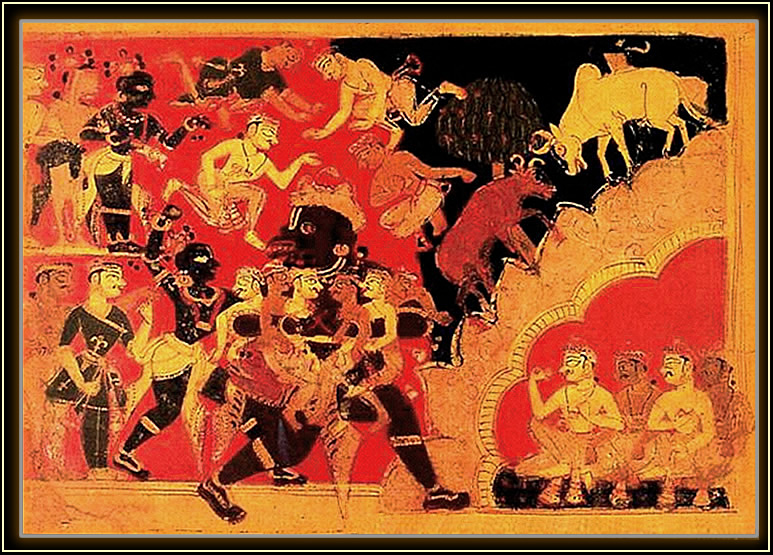
(24) S'rî S'uka said: 'The most eminent sage among the devotees, thus respectfully having honored Krishna, the leading Yadu, received permission to leave and went away, most delighted about having seen Him. (25) Govinda, the Supreme Lord who in a fight had killed Kes'î, still tended the animals together with the cowherd boys, who were most pleased with the happiness He brought to Vraja. (26) One day, when the gopas were grazing the animals on the slopes of the hill, they engaged in the game 'stealing and hiding', playing the roles of thieves and herders. (27) Some of them were therein the thieves, some were the shepherds, while a couple of them, oh King, played for the unsuspecting sheep. (28) A son of the demon Maya named Vyoma ['the sky'], a powerful magician, disguised himself as a gopa and then, engaging as one of the many thieves, led away almost all the boys who acted as the sheep. (29) The great demon threw them one by one in a mountain cave the entrance of which he blocked with a boulder, so that only four or five of them remained. (30) Krishna, He who offers shelter to all pious souls, finding out what he was doing, seized the gopa carrier as forcefully as a lion would seize a wolf. (31) The demon resumed his original form that was as big as a mountain. By all means he tried to free himself, but held tightly in His grip he, being debilitated, failed. (32) Controlling him with His arms, Acyuta forced him to the ground and, while the gods in heaven were watching, He killed him like it concerned a sacrificial animal. (33) He broke through the blocked entrance of the cave and led the gopas out of their awkward position, whereupon He, praised by the gopas and the gods, returned to His cowherd village.'


Third revised edition, loaded December 24, 2020.
Previous Aadhar edition and Vedabase links:
S'rî S'uka said: 'Then there was Kes'î being sent by Kamsa [in 10.36: 20]. He as a huge horse with his hooves with the speed of mind ripped open the earth and scattered the clouds as also the celestial carriers of the gods. With his manes and neighing he frightened everyone. The Supreme Lord in response to the stir of the clouds created by his tail and his whinnying that terrified His cowherd village, thereupon stepped forward to fight. He called for Kes'î who roaring like a lion was searching Him.S'rî S'uka said: 'Then as sent by Kamsa [in 10.36: 20] was there Kes'î, a huge horse that, with his hooves ripping open the earth and with the speed of mind scattering the clouds as well the celestial carriers of the gods, with his manes and neighing frightened everyone. The Supreme Lord stepped, in response to the stir of the clouds created by his tail and his whinnying which terrified His cowherd village, thereupon forward to fight and called for Kes'î who searching for Him was roaring like a lion. (Vedabase)
The moment he, who was hard to conquer and approach and most aggressively with a wide open mouth was swallowing the sky, saw Him before him, he rushed furiously forward to attack the lotus-eyed Lord with his legs.
When he, hard to conquer and approach and agressive with a mouth wide open swallowing the sky, saw Him before him, rushed he furiously forward to attack the lotus eyed Lord with his legs. (Vedabase)
The Lord of the Beyond alert to that dodged that attack and seized him with His arms by the legs. He whirled him around indifferently and threw him at a distance of a hundred bow lengths, standing there just like the son of Târkshya [Garuda] throwing a snake.
Dodging that seized the Lord of the Beyond, alert to it, him with His arms by the legs to whirl him around indifferently and throw him at a distance of a hundred bow lengths, standing there just like the son of Târkshya [Garuda] throwing a snake. (Vedabase)
Regaining his consciousness he stood up in bitter rage and ran, [with his mouth] wide open, full speed at the Lord. With a smile He then put His left arm in Kes'î's mouth, like it was a snake in a hole.
He regaining his consciousness rose in bitter rage and ran, opening wide [his mouth], fast for the Lord who on His turn with a smile put His left arm in his mouth like a snake in a hole. (Vedabase)
As Kes'î's teeth came in touch with the Lord's arm, they fell out as if they had come in contact with a red-hot iron. Thereupon the arm of the Supreme Soul swelled within his body, so that his belly expanded like a diseased belly does after being neglected.
As Kes'î's teeth came in touch with the Lord His arm fell they out as if they had come in contact with a redhot iron and swelled the arm of the Supreme Soul having entered his body up like a sick belly [of dropsy] in neglect. (Vedabase)
Because Krishna's arm thus expanded, his breathing was arrested. Kicking with his legs, perspiring all over, rolling with his eyes and excreting feces, he thereupon fell lifeless to the ground.
With Krishna's arm thus expanding was his breath arrested and fell he, kicking his legs, perspiring all over, rolling with his eyes and excreting feces, lifeless down to the ground. (Vedabase)
After the Mighty-armed One had retracted His arm from the dead body, which looked like a cucumber [karkathikâ], He, unassuming as He was in His effortlessly having killed His enemy, was honored from above by the gods with a rain of flowers.
The Mighty-armed One retracting His arm from the dead body that looked like a cucumber [karkathikâ], was, as unassuming as He was in His effortlessly having killed His enemy, from above worshiped by the gods with a rain of flowers. (Vedabase)
The devarishi [Nârada], the most exalted devotee of the Lord oh King, approached Krishna in private and said the following to Him who is so effortless in His actions:
The devarishi [Nârada], the most exalted devotee of the Lord, o King, said in private to Krishna who is so effortless in His actions this: (Vedabase)
'Krishna, oh Krishna, oh Vâsudeva, immeasurable Soul, oh Lord of Yoga, oh Controller of the Universe, oh shelter of each, oh You master and very best of the Yadus! You alone are the Soul of all living beings who, like fire hidden in firewood, resides within the heart as the Witness, the Lord, the Supreme Personality.
'Krishna, o Krishna, o Vâsudeva, immeasurable Soul, o Lord of Yoga, o Controller of the Universe, o shelter of each, o You master and very best of the Yadus; You alone are the Soul of all living beings who like fire hidden in firewood resides within the heart as the Witness, the Controller, the Supreme Personality. (Vedabase)
You, as the refuge of the spiritual soul, first of all, through Your energy, produced the basic qualities of nature. Unfailing in Your purpose You through these modes create, destroy and maintain this universe.
As the Refuge of the Intelligence of the Spirit Soul You first produced, by Your energy, the modes of nature and through these [then] this thruth [of the Universe], to the drive of which You create, destroy and maintain as the Controller. (Vedabase)You, this one [creator] Himself, have descended for the protection of the virtuous souls and for the destruction of the demons [Daityas], the savages [Râkshasas] and tormentors [Pramathas], who have the world of the living beings in their grip.
You, this one [creator] Himself, have in order to protect the saintly descended for the destruction of the demons [Daityas], wildmen [Râkshasas] and tormentors [Pramathas] who impose as leaders. (Vedabase)
To our great fortune You in person have sportively killed this demon who assumed the form of a horse and because of whose neighing being terrified the vigilant gods abandoned heaven.
To our fortune have You sportfully killed this demon that assumed the form of a horse of whose neighing the vigilant gods terrified abandoned heaven. (Vedabase)
The day after tomorrow, I will see that Cânûra, Mushthika and other wrestlers, as also the elephant [Kuvalayâpîda] and Kamsa, are killed by You, oh Almighty One. Thereafter [the demons] S'ankha, [Kâla-]yavana, Mura and Naraka will follow, You will steal the pârijâta flower and defeat Indra. I will see You marry the daughters of the heroes [the kings] as a reward for Your valor. In Dvârakâ You will deliver King Nriga from his curse, oh Master of the Universe, and capture the jewel named Syamantaka together with a wife. You will retrieve the deceased son of a brahmin [Sândîpani Muni] from Your abode [of death] and then You will kill Paundraka, burn down the city of Kâs'î [Benares] and see to the demise of Dantavakra. Thereafter You will kill the king of Cedi [S'is'upâla] at the great sacrifice [see also 3.2: 19, 7.1: 14-15]. The poets on this earth will be singing about these and other great feats, that I will see You perform during Your stay in Dvârakâ.
The day after tomorrow, will I see Cânûra, Mushthika and other wrestlers as also the elephant [Kuvalayâpîda] and Kamsa been killed by You, o Almighty One. Thereafter will follow [the demons] S'ankha, [Kâla-]yavana and Mura as well as Naraka and will You steal the pârijâta flower and defeat Indra. In Dvârakâ will You, o Master of the Universe, be known for marrying the daughters of the heroic [kings] with the gift of Your valor, the deliverance of King Nriga from his curse, capturing the jewel named Syamantaka together with a wife and presenting the dead son of a brahmin [Sândîpani Muni] from Your abode [of death]. Next will You kill Paundraka, burn down the city of Kâs'î [Benares] and see to the demise of Dantavakra and the king of Cedi [S'is'upâla] during the great sacrifice [see also: 3.2: 19, 7.1: 14-15]. About these and other great feats that I will see performed by You as You stay in Dvârakâ will the poets on this earth be singing. (Vedabase)
Then I will see You, as the charioteer of Arjuna, assume the form of Time in bringing about the destruction of the armed forces of this world.
Then will I see You as the charioteer of Arjuna with whom You assume the form of Time with the purpose of effectively bringing about the destruction of the complete of the armed forces of this world. (Vedabase)
Let us approach [You who are] this Supreme Lord, full of the purest wisdom, who is completely fulfilled in His original identity, whose will in none of His exploits can be thwarted, and who, by the power of His potency, always desists from [identifying with] the flow of things occurring with the [interaction of the] basic qualities of the illusory, material energy.
Let me approach [You who are] this Supreme Lord, full of the purest spiritual awareness, who in His original identity is completely fulfilled, whose will in none of His exploits can be thwarted and who by the power of His potency is always elevated above the flow of the things happening with the modes of the illusory, material energy. (Vedabase)
For You I am bowed down, You the Greatest of the Yadus, Vrishnis and Sâtvatas, the self-contained Controller who, by Your creative potency, has arranged for an endless number of specific situations in which You immediately could act and in which You have taken upon Yourself [the burden of] humanity being divided [in warfare].'
For You, the Controller self-contained, who by the creative potency of Your own Self has arranged for an unlimited number of specific situations so that You could enact and now have taken upon Yourself [the burden of] humanity divided [in warfare], I do bow myself down, You the Greatest of the Yadus, Vrishnis and Sâtvatas.' (Vedabase)
S'rî S'uka said: 'The most eminent sage among the devotees, thus respectfully having honored Krishna, the leading Yadu, received permission to leave and went away, most delighted about having seen Him.
S'rî S'uka said: 'The most eminent sage among the devotees thus respectfully of reverence for Krishna, the leading Yadu, received permission to leave and went away being elated of having seen Him. (Vedabase)
Govinda, the Supreme Lord who in a fight had killed Kes'î, still tended the animals together with the cowherd boys, who were most pleased with the happiness He brought to Vraja.
And Govinda, the Supreme Lord who in a fight had killed Kes'î, tended the animals together with the cowherd boys who were so pleased about Him bringing happiness to Vraja. (Vedabase)
One day, when the gopas were grazing the animals on the slopes of the hill, they engaged in the game 'stealing and hiding', playing the roles of thieves and herders.
One day, when the gopas were grazing the animals, enacted they at the hillside games of hide and seek playing cops and robbers. (Vedabase)
Some of them were therein the thieves, some were the shepherds, while a couple of them, oh King, played for the unsuspecting sheep.
In that game were some the thieves, some were the herds while others of them, o King, to that acted as the unsuspecting sheep. (Vedabase)
A son of the demon Maya named Vyoma ['the sky'], a powerful magician, disguised himself as a gopa and then, engaging as one of the many thieves, led away almost all the boys who acted as the sheep.
A son of the demon Maya named Vyoma ['the sky'], a powerful magician, assumed the disguise of a gopa and engaged in the game as one of the many thieves. Thus he led away almost all the ones who acted as the sheep. (Vedabase)
The great demon threw them one by one in a mountain cave the entrance of which he blocked with a boulder, so that only four or five of them remained.
One by one threw the great demon them in a mountaincave of which he blocked the entrance with a boulder so that only four or five remained. (Vedabase)
Krishna, He who offers shelter to all pious souls, finding out what he was doing, seized the gopa carrier as forcefully as a lion would seize a wolf.
Finding out what he was doing seized Krishna, the leader of the gopas and shelterer of the saintly, him without mercy just like a lion would seize a wolf. (Vedabase)
The demon resumed his original form that was as big as a mountain. By all means he tried to free himself, but held tightly in His grip he, being debilitated, failed.
The demon resuming his original form that was as big as a mountain by all means wanted to free himself, but held tightly in His grip was he debilitated not capable of doing so. (Vedabase)
Controlling him with His arms, Acyuta forced him to the ground and, while the gods in heaven were watching, He killed him like it concerned a sacrificial animal.
Holding him fast with His arms forced Acyuta him to the ground and while the gods in heaven were watching killed He him like he was a sacrificial animal [strangled him thus]. (Vedabase)
He broke through the blocked entrance of the cave and led the gopas out of their awkward position, whereupon He, praised by the gopas and the gods, returned to His cowherd village.'
Breaking through the blocked entrance of the cave freed He the gopas out of their awkward position and returned He, under the praises of the gopas and the gods, to His cowherd village.' (Vedabase)


The text and audio are offered under the conditions of
the
Creative
Commons Attribution-Noncommercial-Share Alike 3.0 Unported
License.
The first
picture shows Krishna killing the Kes'i demon. Source.
The second picture is called: 'Krishna killing the demon
Vyomasura'.
Bhagavata Purana. Ms., Pre-Mughal, c. 1550 .
Production: Filognostic
Association of The Order of Time.

Feed-back | Links | Downloads | Music | Pictures | What's New | Search | Donations



 Text 1-2